Bisacodyl
Ukraine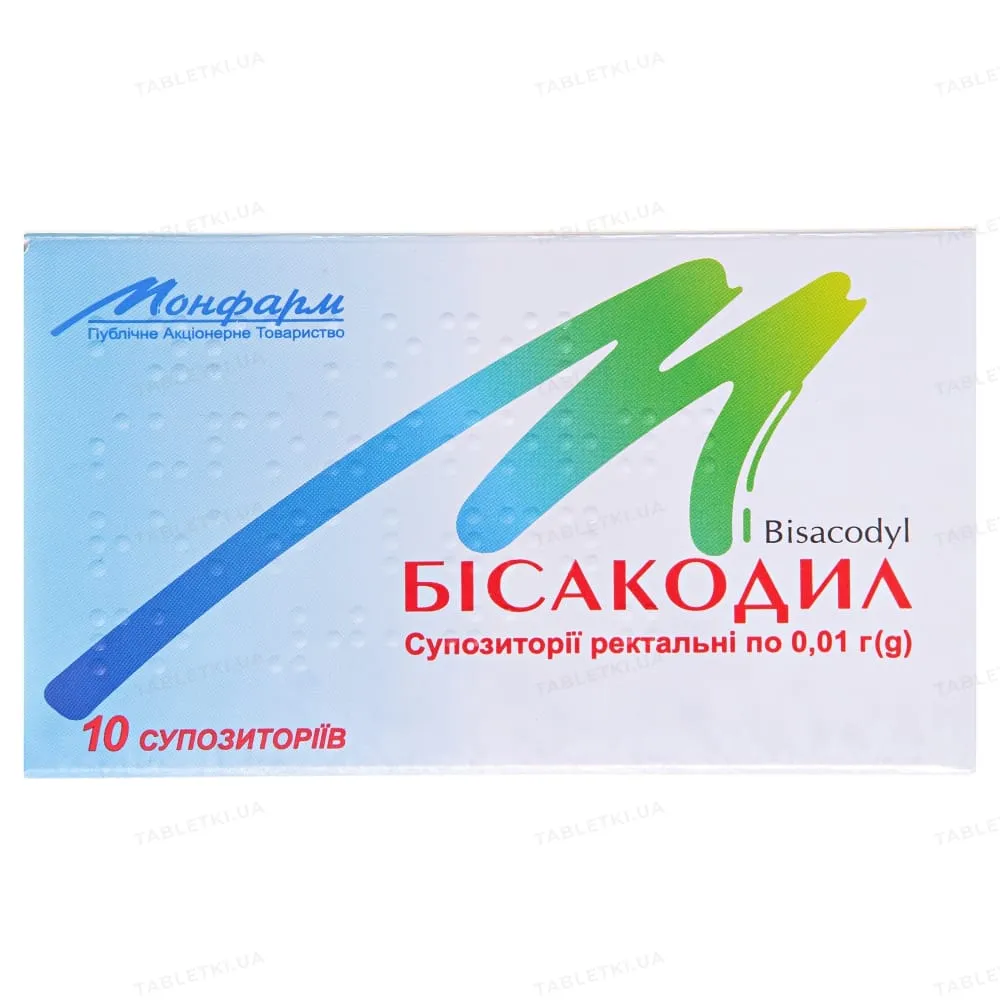
Table of Contents
INSTRUCTIONS FOR MEDICAL USE OF THE MEDICINAL PRODUCT BISACODYL (BISACODYL)
Composition:
Active ingredient: bisacodyl;
1 suppository contains bisacodyl 0.01 g (10 mg);
Excipients: colloidal anhydrous silicon dioxide, hard fat.
Pharmaceutical form. Rectal suppositories.
Main physicochemical properties: white or cream-colored, bullet-shaped suppositories.
Pharmacotherapeutic group. Contact laxatives. ATC code A06AB02.
Pharmacological properties.
Pharmacodynamics.
Bisacodyl is a laxative that stimulates colonic peristalsis through irritant action on the mucosa or direct stimulation of nerve endings in the submucosal and mucosal nerve plexuses.
Pharmacokinetics.
Bisacodyl is poorly absorbed from the gastrointestinal tract and itself affects electrolyte absorption. As a result, increased osmotic pressure within the intestinal lumen retains a larger amount of water, leading to softening of stools and easier passage through the colon. In addition, stool volume increases, which stimulates peristalsis and facilitates defecation.
Bacterial enzymes in the colon metabolize bisacodyl into its active compound—diphenol—which undergoes conjugation during first-pass metabolism in the liver with glucuronic or sulfuric acid, and is returned to the intestine via enterohepatic circulation. This process prolongs the drug's effect.
Absorption of bisacodyl after intrarectal administration is minimal. Absorbed bisacodyl undergoes deacetylation in the liver to form a phenolic derivative, which is subsequently excreted in urine. The portion remaining in the colon is excreted in feces.
Clinical characteristics.
Indications.
Short-term symptomatic treatment of constipation, including habitual constipation and chronic constipation in bedridden patients and elderly patients; prior to diagnostic procedures, surgical and obstetric interventions, as well as in pre- and postoperative periods.
Contraindications.
Hypersensitivity to bisacodyl and to other components of the medicinal product.
Intestinal obstruction.
Acute abdominal conditions, including appendicitis and acute inflammatory bowel diseases.
Severe abdominal pain associated with nausea and vomiting, which may indicate the aforementioned serious conditions.
Severe dehydration.
Anal fissures or ulcerative proctitis with mucosal damage.
Interaction with other medicinal products and other forms of interaction.
Bisacodyl enhances the effect of cardiac glycosides due to decreased serum potassium levels. It also enhances the potassium-excreting effect of diuretics and glucocorticoids.
Concomitant use of bisacodyl with other laxatives may intensify adverse gastrointestinal reactions.
Special precautions for use.
Duration of treatment. Like other laxatives, Bisacodyl should not be used continuously for more than 5 days without identifying the cause of constipation. Prolonged and excessive use of the drug may lead to fluid and electrolyte imbalance, as well as hypokalemia. Loss of intestinal fluid. Fluid loss during defecation may result in dehydration, which may be manifested by symptoms such as thirst and oliguria. Dehydration may be harmful to the body (e.g., in renal insufficiency, in elderly patients); therefore, if the above symptoms occur, the drug should be discontinued and may be resumed only under medical supervision. Long-term use may lead to dependence, whereby defecation becomes possible only after administration of a laxative.
Elderly patients. Frequent use of Bisacodyl in elderly patients may exacerbate asthenia, cause orthostatic hypotension and coordination disorders related to electrolyte loss. The drug may reduce serum potassium levels.
Dizziness, syncope. Dizziness and syncope may occur during defecation; defecation syncope and vascular reactions may develop during abdominal pain, which may be associated with constipation necessitating the use of a laxative.
Gastrointestinal disturbances. Isolated cases of abdominal pain and diarrhea with blood have been reported with Bisacodyl use, possibly related to intestinal mucosal ischemia. Some patients may experience blood in stools, which is generally mild and does not require treatment (see section "Adverse reactions").
Suppositories are not recommended for patients with anal fissures, proctitis, or ulcerative hemorrhoids, as they may cause pain and local irritation. The product should not be used in patients with obstructive intestinal disorders or acute abdominal conditions such as appendicitis, or in patients with inflammatory bowel diseases.
Local reactions. When using suppositories, painful sensations and local irritation may occur, especially in the presence of anal fissures or ulcerative proctitis.
The solid fat base may reduce the effectiveness of latex products (e.g., condoms).
Stimulant laxatives, including Bisacodyl, do not promote weight loss.
Use during pregnancy or breastfeeding.
Bisacodyl is not recommended during pregnancy, especially during the first trimester, except when the expected benefit to the mother outweighs the potential risk to the fetus, and only under medical supervision. Adequate controlled clinical studies in pregnant women have not been conducted.
Bisacodyl is not recommended during breastfeeding, except when the expected benefit to the mother outweighs the potential risk to the infant, and only under medical supervision. It is unknown whether bisacodyl is excreted in breast milk.
Ability to affect reaction speed when driving or operating machinery.
No studies have been conducted on the effect of Bisacodyl on the ability to drive or operate machinery. However, patients should be advised that due to the possibility of experiencing dizziness and/or syncope, they should refrain from driving or operating machinery.
Method of Administration and Dosage
Before using the suppository, it is necessary to:
- Detach one suppository in the primary packaging along the perforated line of the blister pack;
- then pull the edges of the film in opposite directions, tearing it apart, and remove the suppository from the primary packaging.
The medication is intended for rectal administration.
Bisacodyl should be used only for the treatment of adult patients: 1 suppository once daily, usually in the morning. Treatment should not last longer than 7 days.
Children.
The medication must not be administered to children.
Overdose.
Administration of Bisacodyl in high doses may lead to diarrhea, abdominal spasms, and clinically significant loss of potassium and electrolytes. Intestinal atony and stasis colitis may occasionally occur.
Prolonged use of laxatives may cause chronic diarrhea, abdominal pain, hypokalemia, secondary hyperaldosteronism, and nephrolithiasis. As a consequence of hypokalemia, cases of renal tubular damage, metabolic alkalosis, and muscle weakness have been reported.
Treatment: fluid replacement therapy and correction of electrolyte imbalance (especially hypokalemia). This is particularly important for elderly and young patients. Administration of spasmolytics may be considered.
Adverse reactions.
The frequency of adverse reactions is classified as follows: very common (≥ 1/10), common (≥ 1/100 to < 1/10), uncommon (≥ 1/1000 to < 1/100), rare (≥ 1/10,000 to < 1/1000), very rare (< 1/10,000), frequency not known (cannot be estimated from the available data).
Immune system disorders: rare – hypersensitivity and allergic reactions, including angioedema and anaphylactic reactions.
Metabolism and nutrition disorders: rare – dehydration.
Nervous system disorders: uncommon – dizziness, loss of consciousness. These adverse effects occurring after drug administration are related to vasovagal reaction (i.e., due to intestinal spasm, straining during defecation); rare – syncope.
Gastrointestinal disorders: common – discomfort, abdominal pain, cramps, nausea, and diarrhea; uncommon – blood in stools, vomiting, abdominal discomfort, anorectal discomfort; rare – colitis, including ischemic colitis.
Local reactions (reactions at the site of administration, including pain and irritation): frequency not known – the use of suppositories may be associated with pain and local irritation, especially in the presence of anal fissures and ulcerative colitis.
Shelf life. 3 years.
Storage conditions. Store in the original packaging, out of reach of children, at a temperature not exceeding 25 °C.
Packaging. 5 suppositories per blister, 2 blisters per carton.
Availability. Over-the-counter.
Manufacturer. Private Joint-Stock Company "Lekhim-Kharkiv".
Manufacturer's address and location of its business activity.
36 Severina Pototskoho Street, Kharkiv, Kharkiv Oblast, 61115, Ukraine.