Biolectra magnesii fortissimum
Ukraine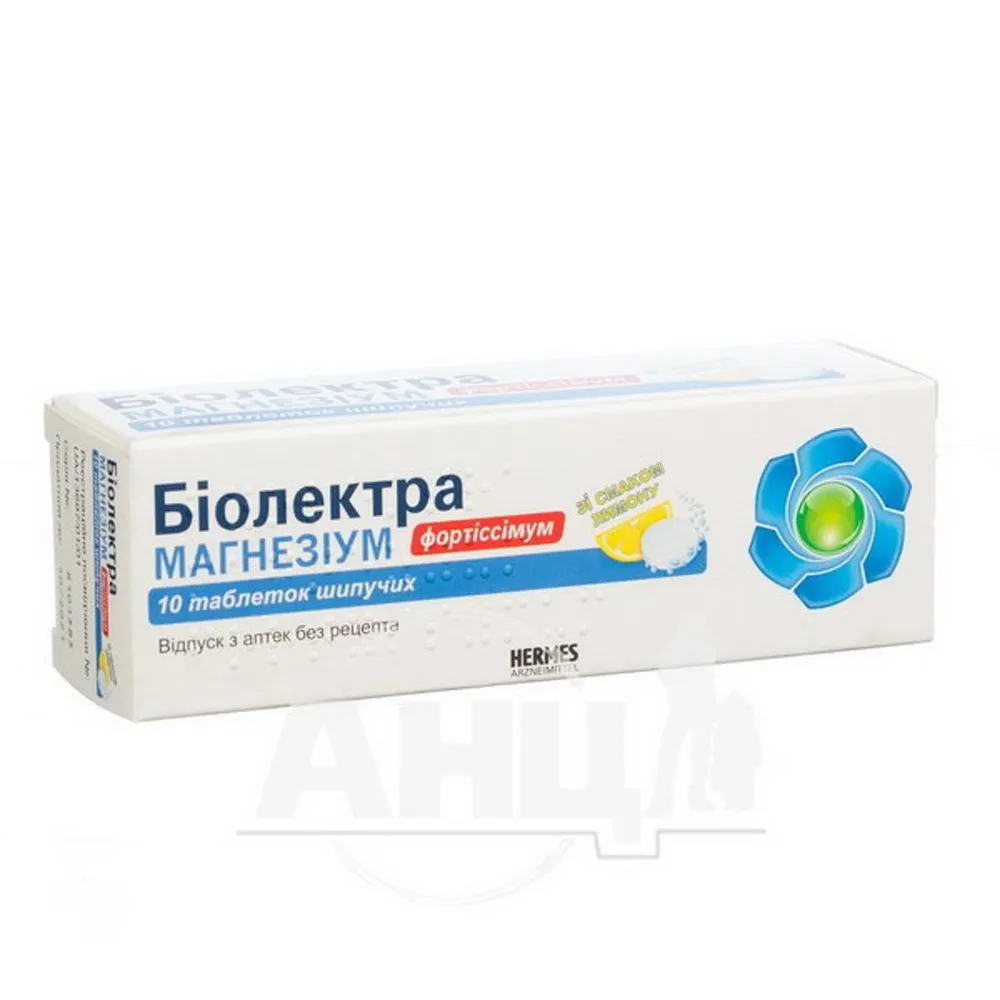
Table of Contents
INSTRUCTIONS FOR MEDICAL USE OF THE MEDICINAL PRODUCT BİOLEKTRA MAGNESIUM FORTISSIMUM (BIOLECTRA® MAGNESIUM FORTISSIMUM)
Composition:
Active substances: light magnesium oxide and light magnesium carbonate;
One effervescent tablet contains 342 mg of light magnesium oxide and 670 mg of light magnesium carbonate, corresponding to 365 mg (15 mmol) of magnesium ions;
Excipients: citric acid anhydrous, sodium hydrogencarbonate, sodium carbonate anhydrous, potassium hydrogencarbonate, sodium saccharin, sodium cyclamate, sodium chloride, lemon flavor "MN" (containing mannitol (E 421), sorbitol (E 420)), lime flavor "MGK" (containing mannitol (E 421), sorbitol (E 420)).
Pharmaceutical form. Effervescent tablets.
Main physicochemical properties: round, white tablets with smooth surface and imprint "Biolectra" on one side.
Pharmacotherapeutic group.
Mineral supplements. Other mineral supplements. Magnesium preparations. Combinations of different magnesium salts. ATC code A12CC30.
Pharmacological Properties.
Pharmacodynamics.
Magnesium is an essential element for the body due to its central role in metabolism. Magnesium is necessary for numerous energy-related processes in the body and participates in the metabolism of proteins, fats, carbohydrates, nucleic acids, and in neuromuscular excitation.
Numerous functions involving energy generation (e.g., oxidative phosphorylation) or energy consumption (e.g., ion transport, muscle contraction) depend on magnesium and may be partially or completely impaired in case of its deficiency.
Magnesium activates glycolytic enzymes, cellular oxidation enzymes, and enzymes involved in nucleic acid synthesis. It also plays an important role in myocardial contraction processes and acts as a stabilizer of fibrinogen and platelets. Magnesium deficiency is known to be one of the causes of arterial hypertension, vascular spasm, neoplastic diseases, and urolithiasis. In stress conditions, increased amounts of free ionized magnesium are excreted; therefore, additional magnesium intake helps enhance stress resistance. Magnesium plays a key role in neuromuscular excitation, acting as an antagonist of calcium ions.
The total amount of magnesium in the body of an adult human is approximately 20–30 g. Of this amount, about 50% is found in bones, 45% in cells, and only 5% can be detected in blood serum.
Intracellular magnesium concentration ranges from 10 to 60 mmol/L, while the normal plasma magnesium concentration ranges from 0.7 to 1.1 mmol/L. In blood plasma, approximately two-thirds of magnesium ions are in dissolved form, and about one-third are bound to proteins.
Pharmacokinetics.
When administered orally, magnesium absorption depends on the body's initial magnesium content. More magnesium is absorbed when the body is deficient, and less is absorbed when the body is saturated with magnesium. The absorption ratio follows homeostatically regulated resorption kinetics, typical for physiologically active substances.
Under conditions of balanced magnesium equilibrium and normal kidney function, even high doses of magnesium do not lead to accumulation beyond normal levels.
After intestinal absorption, magnesium is primarily excreted by the kidneys. Unabsorbed magnesium is eliminated in feces.
Clinical characteristics.
Indications.
Treatment of magnesium deficiency in the body when it is the cause of disturbances in muscular activity (neuromuscular disorders, cramps).
Contraindications.
Hypersensitivity to the active substances or to any other component of the medicinal product.
Renal function disorders and disturbances in cardiac excitation conduction (high-grade AV block), which may lead to bradycardia. Disorders of mineral and electrolyte metabolism (hypermagnesemia, hyperkalemia).
The medicinal product is contraindicated in severe myasthenia gravis, dehydration (exsiccosis), metabolic alkalosis, chronic urinary tract infections caused by urea-splitting bacteria (risk of struvite stone formation), and calcium-magnesium-ammonium-phosphate diathesis.
Interaction with other medicinal products and other forms of interaction.
Since magnesium and other medicinal products may mutually affect absorption in the body, an interval of 2–3 hours should generally be maintained between the administration of different medicinal products. This particularly applies to fluorides and tetracyclines, for which a strict interval of 2–3 hours must be observed.
Concomitant use with medicinal products containing aluminium (e.g. antacids) may increase aluminium absorption.
Aminoglycoside antibiotics, cisplatin, and cyclosporin A accelerate magnesium excretion.
Diuretics (such as thiazides and furosemide), epidermal growth factor receptor (EGFR) antagonists (such as cetuximab and erlotinib), proton pump inhibitors (such as omeprazole and pantoprazole), and viral DNA polymerase inhibitors (foscarnet, pentamidine, rapamycin, and amphotericin B) may cause magnesium deficiency. Due to increased magnesium excretion in patients taking the above-mentioned drugs, magnesium dosage adjustment may be required.
Special precautions for use.
The medicinal product contains 107 mg of sodium (the main component of table salt) in each effervescent tablet. This is equivalent to 5.4% of the recommended maximum daily intake of sodium for an adult.
The medicinal product contains 2.51 mmol (98 mg) of potassium. Caution is advised when administering to patients with impaired renal function or those on a potassium-controlled diet.
The medicinal product contains 0.72 mg of sorbitol in each effervescent tablet.
Use during pregnancy or breastfeeding.
There are no risks associated with the use of the medicinal product during pregnancy and breastfeeding. However, use of the medicinal product during breastfeeding is recommended only after consultation with a physician and under medical prescription.
Ability to influence reaction rate while driving or operating machinery.
Does not affect.
Dosage and Administration.
For adults and children aged 15 years and older, the recommended dose is 1 effervescent tablet 1–2 times daily.
The tablet should be dissolved in a glass of water; the resulting solution should be consumed.
The duration of treatment depends on the underlying causes of magnesium deficiency and is determined individually by a physician.
Children.
The medicinal product is not recommended for children under 15 years of age.
Overdose.
With oral administration of magnesium salts, hypermagnesemia occurs only in cases of renal insufficiency. Patients with renal impairment should not take magnesium salts.
Symptoms of intoxication
High magnesium concentrations cause skeletal muscle relaxation (magnesium plasma levels above 5.5 mmol/L). Higher magnesium ion concentrations (10–20 mmol/L) prolong cardiac conduction time, and even higher concentrations may lead to cardiac arrest in diastole.
Treatment of intoxication
Intravenous administration of calcium provides immediate antagonism of the described symptoms due to the known antagonistic effect between calcium and magnesium ions.
Side effects.
At higher doses, softening of stools may occur, which is not considered dangerous and disappears after dose reduction. With prolonged use of high doses of the medicinal product, a feeling of fatigue may develop. In such a case, the physician should decide on the appropriateness of continuing magnesium administration based on clinical picture and laboratory findings.
Shelf life.
3 years.
Storage conditions.
No special storage conditions required.
Packaging.
10 effervescent tablets in a tube; 1 or 2 tubes in a cardboard box.
Prescription status.
Over-the-counter.
Manufacturer.
Hermes Pharma GmbH.
Manufacturer's address and place of business.
Hans-Urmiller-Ring 52, 82515 Wolfratshausen, Germany.