Bimatoprost-pharmaten
Ukraine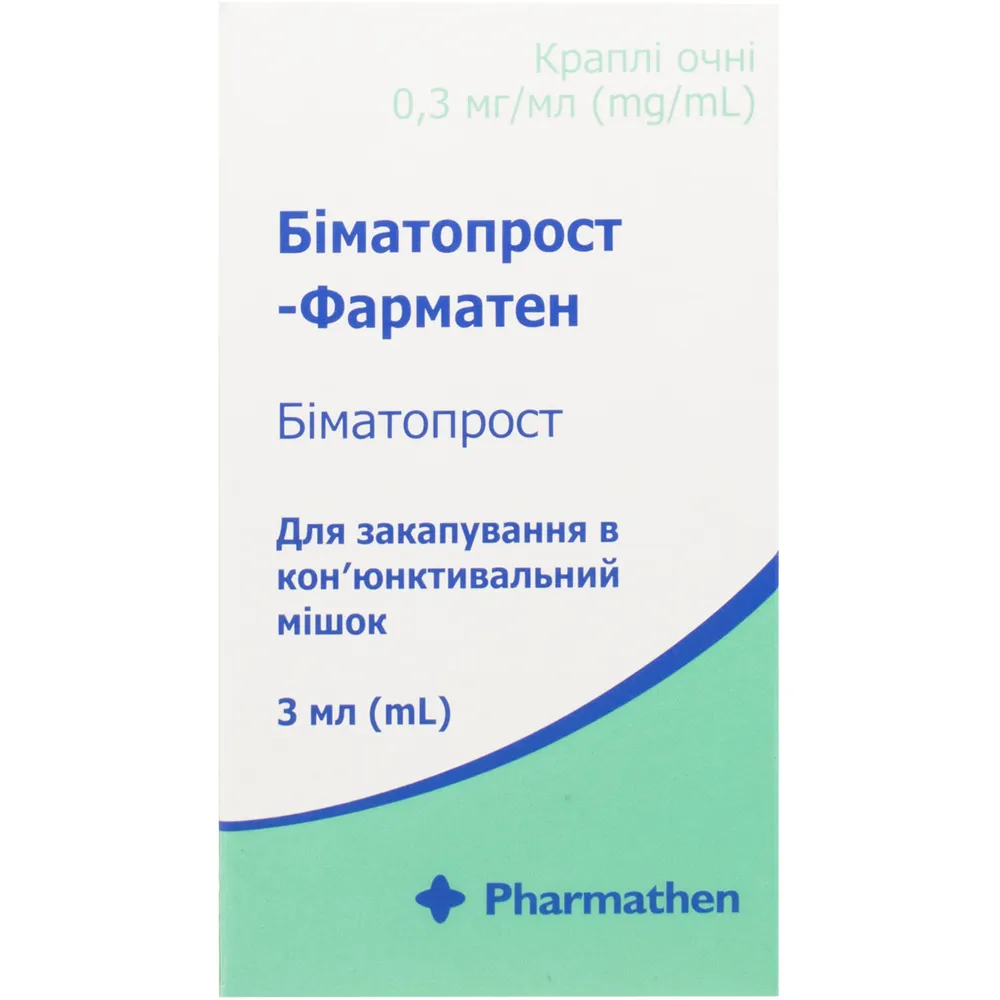
Table of Contents
INSTRUCTION FOR MEDICAL USE OF THE MEDICINAL PRODUCT BIMATOPROST-PHARMATHEN (BIMATOPROST-PHARMATHEN)
Composition:
Active substance: bimatoprost;
1 ml of solution contains 0.3 mg of bimatoprost;
Excipients: benzalkonium chloride, sodium chloride, sodium hydrogen phosphate heptahydrate, citric acid monohydrate, sodium hydroxide or hydrochloric acid concentrated, water for injections.
Medicinal form: Eye drops.
Main physicochemical properties: clear, colorless solution, free from visible particles.
Pharmacotherapeutic group: Medicinal products used in ophthalmology. Anti-glaucoma agents and miotics. Prostaglandin analogues.
ATC code: S01EE03.
Pharmacological Properties
Pharmacodynamics
The mechanism by which bimatoprost reduces intraocular pressure (IOP) in humans involves increasing the outflow of aqueous humor through the trabecular meshwork and enhancing uveoscleral outflow. Reduction in IOP begins approximately 4 hours after the first administration, with maximum effect achieved within approximately 8–12 hours. The duration of effect lasts for at least 24 hours.
Bimatoprost is a potent agent for reducing IOP. It belongs to the synthetic prostamides and is structurally related to prostaglandin F2α (PGF2α), but does not act on any of the known prostaglandin receptor types. Bimatoprost selectively mimics the action of recently discovered biosynthetic substances known as prostamides. However, the structure of the prostamide receptor has not yet been established.
During a 12-month monotherapy in adult patients using bimatoprost eye drops at a concentration of 0.3 mg/mL compared to timolol, the mean change in IOP from baseline, measured in the morning at 8 a.m., ranged from -7.9 to -8.8 mmHg. At each patient visit, mean diurnal IOP values measured over the 12-month period varied by no more than 1.3 mmHg throughout the day and never exceeded 18.0 mmHg.
Pharmacokinetics
Bimatoprost penetrates well through the human cornea and sclera under in vitro conditions. After ophthalmic administration in adults, systemic exposure to bimatoprost is very low, and no accumulation over time has been observed. Following daily instillation of 1 drop of 0.3 mg/mL bimatoprost solution once daily in both eyes for 2 weeks, the maximum plasma concentration (Cmax) was reached 10 minutes after administration and declined below the limit of detection (0.025 ng/mL) within 1.5 hours after instillation. Mean values of Cmax and AUC0–24h were similar on day 7 and day 14, approximately 0.08 ng/mL and 0.09 ng•h/mL, respectively, indicating that steady-state concentrations of bimatoprost were achieved within the first week of topical administration.
Bimatoprost is moderately distributed into tissues, with a steady-state volume of distribution of 0.67 L/kg. In human circulation, bimatoprost is primarily located in plasma. Plasma protein binding of bimatoprost is approximately 88%.
Bimatoprost is the principal circulating compound in blood after entering the systemic circulation following ocular instillation. Bimatoprost is then subject to oxidation, N-deethylation, and glucuronidation, forming various metabolites.
Bimatoprost is primarily eliminated via the kidneys: 67% of the dose administered intravenously to healthy volunteers was excreted in urine and 25% in feces. The elimination half-life, determined after intravenous administration, was approximately 45 minutes, and total plasma clearance was 1.5 L/h/kg.
Pharmacokinetics in Elderly Patients
After instillation of bimatoprost eye drops at a concentration of 0.3 mg/mL twice daily, mean AUC0–24h values of bimatoprost were significantly higher in elderly patients (aged 65 years and older) at 0.0634 ng•h/mL compared to young healthy volunteers (0.0218 ng•h/mL). However, these findings are not considered clinically significant, as systemic exposure following ophthalmic administration remains very low in both elderly and young individuals. No accumulation of bimatoprost in blood over time was observed, and the safety profile was similar in elderly and younger patients.
Clinical characteristics.
Indications.
Reduction of elevated intraocular pressure (IOP) in adults with chronic open-angle glaucoma and ocular hypertension (as monotherapy or adjunctive therapy to beta-adrenergic blockers).
Contraindications.
Hypersensitivity to the active substance or to any of the excipients included in the medicinal product, including benzalkonium chloride.
Interaction with other medicinal products and other forms of interaction.
Studies on drug interactions have not been conducted.
In humans, development of interactions is not expected, since after instillation of 0.3 mg/mL solution of bimatoprost ophthalmic drops, systemic concentrations of bimatoprost are extremely low (less than 0.2 ng/mL). Bimatoprost undergoes biotransformation by multiple enzymes and pathways; in preclinical studies, no effect on liver enzymes metabolizing drugs was observed.
In clinical trials, bimatoprost was used concomitantly with several different ophthalmic beta-adrenergic blockers without any evidence of drug interactions.
Concomitant use of bimatoprost and other antiglaucoma agents, except topical beta-adrenergic blocker preparations, during combination therapy for glaucoma has not been studied.
Prostaglandin analogs (e.g., Bimatoprost-Farmaten) have the potential to reduce the intraocular pressure-lowering effect when used by patients with glaucoma or ocular hypertension in combination with other prostaglandin analogs.
Special precautions for use.
Prior to initiating treatment, patients should be informed about prostaglandin-associated periorbitopathies, including possible eyelash growth, darkening of the eyelid skin, and increased pigmentation of the iris, as such effects have been observed during treatment with bimatoprost. Some of these changes may be permanent and may result in a difference between the eyes if only one eye has been treated. Increased iris pigmentation is likely to be irreversible. Pigmentation changes occur due to an increase in melanin content within melanocytes, not an increase in the number of melanocytes. The long-term effect of increased iris pigmentation is unknown. Color changes in the iris associated with ophthalmic use of bimatoprost may be subtle and may take several months or years to become noticeable. Typically, brown pigmentation around the pupil spreads concentrically toward the periphery of the iris, resulting in the iris or parts of it becoming more brown in color. Treatment appears not to affect iris nevi or iris freckles. After 12 months of treatment with bimatoprost at a dose of 0.3 mg/mL, the incidence of iris pigmentation was 1.5% and did not increase over the subsequent 3 years of treatment. Reversible changes in pigmentation of the periorbital tissues have been reported in some patients.
Since cystoid macular edema has been infrequently reported after treatment with bimatoprost ophthalmic solution 0.3 mg/mL, the drug should be used with caution in patients with known risk factors for macular edema (e.g., aphakia and pseudophakia with posterior capsule rupture).
There have been isolated spontaneous reports of reactivation of previous corneal infiltrates or ocular infections during treatment with bimatoprost ophthalmic solution 0.3 mg/mL. The drug should be used with caution in patients with a history of significant ocular viral infections (e.g., herpes simplex) or uveitis/iritis.
The use of bimatoprost has not been studied in patients with inflammatory eye diseases, neovascular, inflammatory, or angle-closure glaucoma, congenital glaucoma, or narrow-angle glauopenia.
In areas where the bimatoprost solution is in constant contact with the skin surface, hair growth may occur. Therefore, it is important to use the drug according to the instructions and to avoid contact with the cheek or other skin areas.
The use of bimatoprost ophthalmic drops has not been studied in patients with respiratory disorders. Although limited information exists regarding treatment of patients with asthma or chronic obstructive pulmonary disease (COPD) in their medical history, post-marketing reports include exacerbations of asthma, dyspnea, and COPD, as well as new-onset asthma. The frequency of these symptoms is not established. The drug should be used with caution in patients with COPD, asthma, or respiratory disorders due to other causes.
The use of bimatoprost has not been studied in patients with heart block more severe than first-degree or in patients with uncontrolled congestive heart failure. There are limited spontaneous reports of bradycardia or arterial hypotension associated with the use of bimatoprost ophthalmic solution 0.3 mg/mL. Therefore, the drug should be used with caution in patients predisposed to low heart rate or low blood pressure.
In clinical studies of patients with glaucoma or ocular hypertension treated with bimatoprost ophthalmic solution 0.3 mg/mL, it was shown that administration of more than one dose of bimatoprost per day may reduce the intraocular pressure (IOP)-lowering effect. Patients using bimatoprost in combination with other prostaglandin analogs should be monitored for changes in IOP.
Bimatoprost-Farmaten contains the preservative benzalkonium chloride, which may be absorbed by soft contact lenses. Due to the presence of benzalkonium chloride, ocular irritation and discoloration of soft contact lenses may also occur. Contact lenses should be removed before instillation and may be reinserted no sooner than 15 minutes after administration of the drug.
Benzalkonium chloride has been reported to cause punctate keratopathy and/or toxic ulcerative keratopathy. Since Bimatoprost-Farmaten contains benzalkonium chloride, patients with dry eye or corneal epithelial damage should be monitored during frequent or prolonged use of the drug.
There have been reports of bacterial keratitis associated with the use of multidose containers of topical ophthalmic products. Such containers were inadvertently contaminated by patients, most of whom had concomitant ocular diseases. Patients with damaged ocular epithelial surface have an increased risk of developing bacterial keratitis.
The dropper tip of the bottle must not come into contact with the eye, surrounding surfaces, fingers, or other surfaces to avoid microbial contamination of the solution.
Use during pregnancy or breastfeeding.
There are insufficient data on the use of bimatoprost in pregnant women. Reproductive toxicity has been demonstrated in animal studies at high doses that were toxic to the mother.
Bimatoprost-Farmaten should not be used during pregnancy unless clearly needed.
It is unknown whether bimatoprost is excreted in human breast milk. Animal studies have shown that bimatoprost is excreted in breast milk. A decision should be made whether to discontinue breastfeeding or to discontinue bimatoprost therapy, taking into account the benefits of breastfeeding for the child and the benefits of therapy for the woman.
Data on the effect of bimatoprost on human fertility are lacking.
Effect on the ability to drive or operate machinery.
Bimatoprost-Farmaten has a minor influence on the ability to drive or operate machinery. As with other ophthalmic drops, if blurred vision occurs after instillation, patients should wait until vision clears before driving or operating machinery.
Method of administration and dosage.
It is recommended to instill 1 drop into the affected eye(s) once daily in the evening. The dose should not exceed one administration per day, as more frequent use of the drug may reduce the intraocular pressure-lowering effect.
When using multiple topical ophthalmic medications, they should be administered with a 5-minute interval between each.
Special patient groups
Patients with hepatic or renal impairment
The use of bimatoprost in patients with renal impairment or moderate to severe hepatic impairment has not been studied; therefore, the drug should be used with caution in such patients. In patients with a history of mild liver disease or with baseline elevations of alanine aminotransferase (ALT), aspartate aminotransferase (AST), and/or bilirubin, treatment with bimatoprost ophthalmic solution 0.3 mg/mL for up to 24 months did not cause adverse effects on liver function.
Children
Safety and efficacy of the drug in children under 18 years of age have not been established; therefore, its use is not recommended in this patient population.
Overdose.
Cases of overdose have not been reported. Overdose is unlikely with topical ophthalmic administration.
In the event of overdose, symptomatic and supportive treatment should be administered.
Adverse Reactions
During clinical studies and in the post-marketing period, the following adverse reactions have been reported, most of which were ocular, mild to moderate in severity, and non-serious.
Nervous system disorders: headache, dizziness.
Eye disorders: conjunctival hyperemia, eye pruritus, eyelash growth, prostaglandin-associated periorbitopathy, punctate epithelial keratitis, corneal erosion, eye burning, eye irritation, allergic conjunctivitis, blepharitis, visual disturbance, asthenopia, conjunctival edema, foreign body sensation in the eye, dry eye, eye pain, photophobia, lacrimation, eye discharge, visual disorders/blurred vision, iris hyperpigmentation, eyelash darkening, eyelid erythema, eyelid pruritus, retinal hemorrhage, uveitis, cystoid macular edema, iritis, blepharospasm, eyelid retraction, periorbital erythema, eyelid edema, changes in periorbital area and eyelids, including deepening of eyelid sulcus, eye discomfort.
Vascular disorders: arterial hypertension.
Respiratory system disorders: asthma, asthma exacerbation, COPD exacerbation, dyspnea.
Gastrointestinal disorders: nausea.
Skin and subcutaneous tissue disorders: periorbital skin hyperpigmentation, hirsutism, skin hypopigmentation (periorbital).
General disorders and administration site conditions: asthenia.
Investigations: abnormalities in liver function tests.
Immune system disorders: hypersensitivity reactions, including signs and symptoms of ocular allergy and allergic dermatitis.
Adverse reactions reported with phosphate-containing ophthalmic drops
In rare cases, corneal calcification has been reported in some patients with significant corneal damage following the use of phosphate-containing ophthalmic drops.
Shelf life
30 months.
Do not use after the expiry date stated on the packaging. Use within 4 weeks after first opening the bottle.
Storage conditions
No special storage conditions required.
Keep out of the reach of children.
Packaging
3 ml of ophthalmic solution in dropper bottles closed with caps with tamper-evident closure. One dropper bottle in a cardboard box.
Prescription category
Prescription only.
Manufacturers
Pharmathen S.A.;
Balkanpharma-Razgrad AD.
Addresses of manufacturers and their places of business
Dervenakion 6, Pallini Attiki 15351, Greece;
68 Aprilsko vastanie Blvd., Razgrad 7200, Bulgaria.