Bifon® skin
Ukraine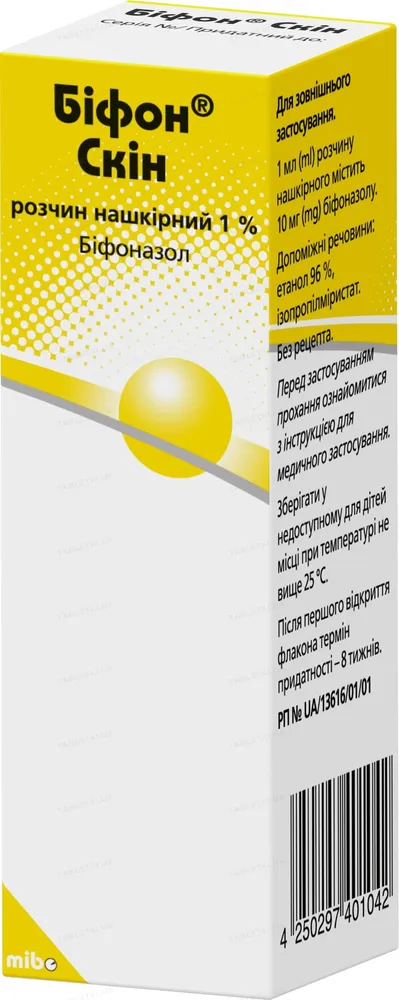
Table of Contents
INSTRUCTIONS FOR MEDICAL USE OF THE MEDICINAL PRODUCT BIFON® SKIN (BIFON®SKIN)
Composition:
Active substance: bifonazole;
1 ml of topical solution contains 10 mg of bifonazole;
Excipients: ethanol 96%, isopropyl myristate.
Pharmaceutical form. Topical solution.
Main physicochemical properties: clear solution.
Pharmacotherapeutic group. Antifungal agents for topical use. Imidazole and triazole derivatives. Bifonazole.
ATC code D01AC10.
Pharmacological Properties
Pharmacodynamics
Mechanism of Action
Bifonazole is a broad-spectrum antifungal agent from the imidazole derivative group, active against dermatophytes, yeasts, molds, and other fungi such as Malassezia furfur; in addition, it is effective against Corynebacterium minutissimum.
Bifonazole inhibits ergosterol biosynthesis at two distinct steps in the synthesis pathway. This dual mechanism of action differentiates bifonazole from other azole derivatives and other antifungal agents. Inhibition of ergosterol biosynthesis leads to disturbances in the structure and function of the cytoplasmic membrane. Ergosterol is a crucial component of fungal cell membranes.
Pharmacodynamic Effects
Bifonazole demonstrates pronounced fungicidal activity against dermatophytes at concentrations as low as 5 mcg/mL and after 6 hours of exposure. Fungicidal activity against yeasts, such as fungi of the genus Candida, is observed at concentrations of 20 mcg/mL.
Moreover, this active substance exhibits inhibitory effects at concentrations 2 to 10 times lower than the MIC (minimum inhibitory concentration). At a substrate concentration of only 3 mcg/mL, activity of rapidly proliferating Trichophyton mentagrophytes mycelium is inhibited.
Clinical Efficacy and Safety
Bifonazole demonstrates a favorable profile regarding the development of resistance. Initially resistant variants of normally susceptible fungi are rare. To date, no evidence of secondary resistance development in initially susceptible fungal strains has been observed in studies.
Pharmacokinetics
Absorption
Bifonazole penetrates well into the affected layers of the skin. Six hours after application, concentrations are detected that are equal to or greatly exceed the MIC for the main causative agents of dermatomycoses: from 1000 mcg/cm³ in the upper epidermal layer to 5 mcg/cm³ in the papillary layer.
The duration of retention of bifonazole solution on the skin, defined as the protective effect against infection in guinea pigs, is 36–48 hours.
The prolonged presence of bifonazole in the skin at effective antifungal concentrations, combined with its fungicidal mode of action, forms the basis for once-daily application in topical therapy.
In studies investigating drug absorption following topical application to intact human skin, the concentration of the active substance in blood plasma was always below the limit of detection (< 1 ng/mL). Only minimal absorption was observed when applied to inflamed skin areas. Due to such extremely low concentrations of the active substance (generally less than 5 ng/mL), systemic effects are not expected.
Clinical characteristics.
Indications.
Treatment of skin mycoses caused by dermatophytes, yeasts, and molds, as well as other pathogens such as Malassezia furfur or Corynebacterium minutissimum, for example:
- cutaneous and intertriginous mycoses (Tinea corporis and Tinea inguinalis);
- interdigital mycoses (Tinea pedis, Tinea manuum);
- pityriasis versicolor (tinea versicolor);
- superficial cutaneous candidiasis;
- erythrasma.
Contraindications.
Do not use Bifon® Skin in patients with hypersensitivity to any component of the product.
Bifon® Skin is not intended for treatment of ear canal lesions.
Special precautions.
Avoid exposing Bifon® Skin to fire or hot objects. Keep away from sources of ignition – no smoking. Due to the presence of ethyl alcohol, the solution is highly flammable.
Interaction with other medicinal products and other forms of interaction.
Limited data suggest a potential for interaction between topically administered bifonazole and warfarin, leading to an increased international normalized ratio (INR). Therefore, patients should be appropriately monitored when bifonazole and warfarin are used concomitantly.
Special precautions for use.
Patients with a history of hypersensitivity reactions to other antifungal agents of the imidazole group (e.g., econazole, clotrimazole, miconazole) should use medicinal products containing bifonazole only with caution.
Avoid contact of BIFON® SKIN with the eyes.
Antifungal treatment of the nail bed with BIFON® SKIN can be performed only after prior keratolytic removal of the nail tissue infected with fungi.
Children
The use of the medicinal product BIFON® SKIN in children is possible only under medical supervision.
Use during pregnancy or breastfeeding.
Pregnancy
There are insufficient data on the use of bifonazole in pregnant women. Animal studies have demonstrated reproductive toxicity following oral administration. The potential risk for humans is unknown. Since bifonazole is an active substance used exclusively topically, a risk is not expected. However, for safety reasons, bifonazole should be used during pregnancy only after careful assessment of the benefit-risk ratio. The use of bifonazole during the first trimester of pregnancy should be avoided.
Breastfeeding
It is unknown whether bifonazole passes into human breast milk. Available pharmacodynamic/toxicological data from animal studies indicate that bifonazole/metabolite passes into milk. For safety reasons, breastfeeding should be discontinued during treatment with bifonazole.
Fertility
Bifonazole has not been shown to impair male or female fertility.
Ability to affect reaction speed when driving vehicles or operating machinery.
BIFON® SKIN has no effect or has a negligible effect on the ability to drive vehicles or operate machinery.
Method of Administration and Dosage
Dosage
In the absence of other instructions from the physician, the medication should be applied to the skin once daily.
Children
The use of Bifon® Skin in children is possible only under medical supervision.
Method and Duration of Administration
Bifon® Skin should be applied as a thin layer or sprayed onto affected skin areas once daily, rubbed in thoroughly, preferably in the evening before bedtime.
In most cases, a few drops of the solution (approximately 3 drops) are sufficient to cover and rub into an area of skin the size of a palm.
When using the spray with a dosing pump, one or two actuations onto the affected area are sufficient.
To achieve a sustained effect, Bifon® Skin should be used continuously for the treatment periods indicated below, even after symptoms have disappeared.
Typically, the treatment duration for the following conditions is:
- Athlete's foot, interdigital tinea (Tinea pedis, Tinea pedis interdigitalis) – 3 weeks;
- Tinea infections on other body areas, hands, and skin folds (Tinea corporis, Tinea manuum, Tinea inguinalis) – 2–3 weeks;
- Pityriasis versicolor (tinea versicolor), erythrasma – 2 weeks;
- Superficial cutaneous candidiasis – 2–4 weeks.
Treatment should be thorough and continued until negative fungal culture results are obtained after symptom resolution, but for at least an additional 14 days. A treatment-free interval of 3–4 days should be observed between the last application of the drug and fungal culture sampling to avoid potential interference from residual active ingredient on culture results.
Children
The use of Bifon® Skin in infants and younger children is possible only under medical supervision.
Overdose
There is no risk of acute intoxication, as toxicity following a single excessive topical application (application over a large skin area under conditions favoring absorption) or accidental oral ingestion is unlikely.
Adverse reactions.
According to available data, adverse reactions are classified as follows:
Very common (>1/10); common (from >1/100 to <1/10); uncommon (from >1/1000 to <1/100); rare (from >1/10000 to <1/1000); very rare (<1/10000); not known (cannot be estimated from available data).
| System organ |
Frequency |
Adverse reactions |
| Skin and subcutaneous tissue disorders |
Unknown |
Skin dryness, skin irritation, maceration, skin peeling, redness, burning, itching, rash, eczema, vesicle formation, urticaria, contact dermatitis, allergic dermatitis. |
| General disorders and administration site conditions |
Unknown |
Pain at application site, peripheral edema (at application site). |
These adverse effects are reversible after discontinuation of treatment.
Reporting of suspected adverse reactions
Reporting of adverse reactions following authorization of the medicinal product is important. It allows ongoing monitoring of the benefit-risk balance of this medicinal product. Healthcare professionals and patients, as well as their legal representatives, should report all suspected adverse reactions and lack of efficacy via the Automated Pharmacovigilance Information System at the following link: https://aisf.dec.gov.ua.
Shelf life.
3 years.
After first opening of the dropper bottle or spray bottle with dispenser – 8 weeks.
Storage conditions.
Keep out of reach and sight of children. Store at temperatures not exceeding 25 °C.
Packaging.
15 ml or 35 ml of solution in a dropper bottle, 25 ml in a spray bottle with dispenser. One bottle per cardboard pack.
Supply classification.
Over-the-counter.
Manufacturer.
mibe GmbH & Co. KG.
Manufacturer's address and location of its operations.
Muenchener Strasse 15, 06796 Bitterfeld-Wolfen, Saxony-Anhalt, Germany.