Besalol
Ukraine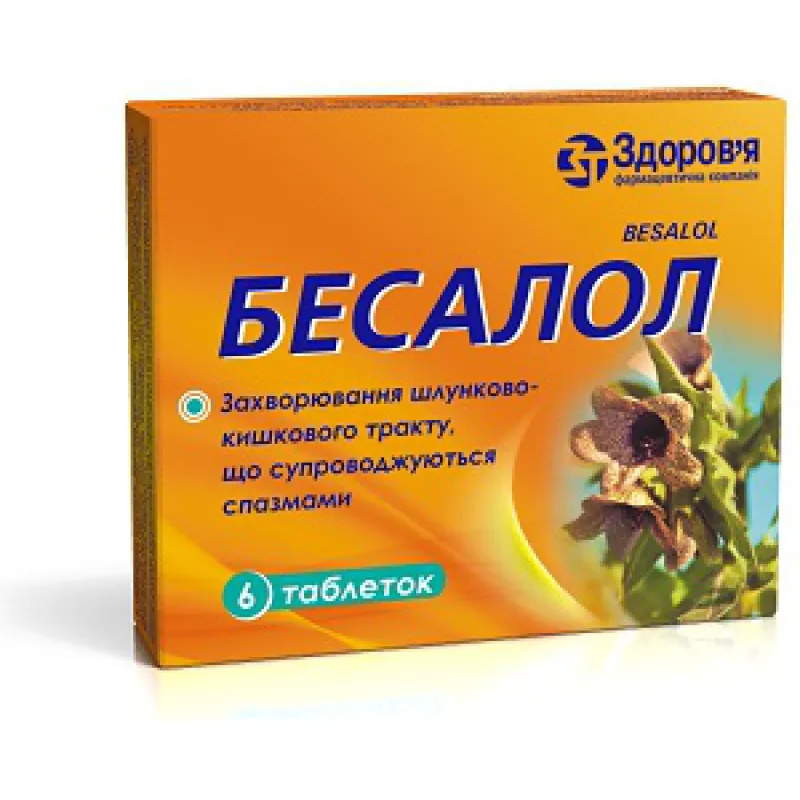
Table of Contents
INSTRUCTIONS FOR MEDICAL USE OF THE MEDICINAL PRODUCT BESALOL (BESALOL)
Composition:
Active substances: 1 tablet contains belladonna (belladonna) dry extract (6:1) (extractant – ethanol 20%) 10 mg, phenylsalicylate 300 mg;
Excipients: lactose monohydrate; microcrystalline cellulose; sodium croscarmellose; stearic acid.
Pharmaceutical form. Tablets.
Main physicochemical properties: tablets from light yellow with a brownish tinge to light brown in color, with speckles, with a weak specific odor, biconvex in shape.
Pharmacotherapeutic group. Spasmolytics and anticholinergics in combination with other drugs. ATC code A03ED.
Pharmacological Properties.
Pharmacodynamics. A combined medicinal product, whose pharmacological effects are due to the action of its components – belladonna extract and phenylsalicylate.
Alkaloids of belladonna extract (atropine, hyoscyamine, scopolamine, etc.) have an M-cholinolytic effect. In the gastrointestinal tract, they produce a spasmolytic effect (reducing tone, amplitude, and frequency of peristalsis of smooth muscle) and a moderate analgesic effect. They also exhibit spasmolytic action on the smooth musculature of the bronchi, pancreas, gallbladder, bile ducts, urinary bladder, and ureters; reduce secretion of salivary, lacrimal, sweat, gastric, and bronchial glands.
Phenylsalicylate is cleaved in the alkaline environment of the intestine, releasing phenol (which suppresses pathogenic flora) and salicylic acid (which exerts anti-inflammatory action). Overall, phenylsalicylate provides the antiseptic effect of the drug. A distinctive feature of phenylsalicylate is that it does not cause intestinal dysbiosis even with prolonged use.
Pharmacokinetics. The drug is well absorbed in the gastrointestinal tract. Alkaloids of belladonna penetrate through the blood-brain and placental barriers and into breast milk.
Excreted by the kidneys.
|buds|
Clinical characteristics.
Indications. Gastrointestinal disorders accompanied by spasms (colitis, enterocolitis).
Contraindications. Hypersensitivity to the components of the drug, salicylates, and other anti-inflammatory and antirheumatic agents; closed-angle glaucoma, prostatic adenoma with impaired urine flow; atrial fibrillation, tachycardia, chronic heart failure, ischemic heart disease, mitral stenosis, severe arterial hypertension; acute bleeding, gastrointestinal hemorrhage; thyrotoxicosis; hyperthermic syndrome; gastrointestinal disorders accompanied by obstruction (esophageal achalasia, pyloric stenosis, intestinal atony); hepatic and renal insufficiency; myasthenia gravis.
The drug should not be used in patients with a tendency to allergies, bronchial asthma, or spasmodic bronchitis.
Interaction with other medicinal products and other forms of interaction. The pharmacological action of belladonna alkaloids may be enhanced when used concomitantly with other medicinal products having antimuscarinic effects (M-cholinoblockers, antiparkinsonian agents (amantadine), spasmolytics, certain antihistamines, butyrophenones, phenothiazines, disopyramides, quinidine, and tricyclic antidepressants, non-selective inhibitors of neuronal monoamine reuptake).
When used with monoamine oxidase inhibitors, cardiac arrhythmia may occur; with quinidine and procainamide – summation of the cholinolytic effect is observed. May reduce the duration and depth of action of narcotic agents, and weaken the analgesic effect of opioids.
Concomitant use with diphenhydramine or diprazine enhances the drug's effect; with nitrates, haloperidol, and systemic corticosteroids – increases the risk of elevated intraocular pressure; with sertraline – the depressive effect of both drugs is enhanced; with spironolactone and minoxidil – the effect of spironolactone and minoxidil is reduced; with penicillins – the effect of both drugs is enhanced; with nizatidine – the action of nizatidine is enhanced; with ketoconazole – absorption of ketoconazole is reduced; with ascorbic acid and attapulgite – the action of atropine is reduced; with pilocarpine – the effect of pilocarpine in glaucoma treatment is reduced; with oxprenolol – the antihypertensive effect of the drug is reduced. Under the influence of octadine, a reduction in the hyposecretory effect of atropine is possible, which weakens the action of M-cholinomimetics and anticholinesterase agents. Concomitant use with sulfonamide drugs increases the risk of kidney damage; with potassium-containing preparations, intestinal ulceration may occur; with nonsteroidal anti-inflammatory drugs – the risk of gastric ulceration and hemorrhage increases.
An increased effect of anticoagulants (e.g., coumarin, heparin) and drugs that lower blood glucose levels is possible, as well as a reduced effect of drugs promoting uric acid excretion. The risk of gastrointestinal bleeding is increased during concomitant treatment with corticosteroids (e.g., prednisolone) or concurrent alcohol consumption.
Inhibition of intestinal peristalsis by atropine may lead to altered absorption of other medicinal products.
Concomitant use of antidiarrheal agents and antacids may result in reduced absorption of the drug.
Special precautions for use.
Patients must inform their physician about any previous reaction to medications of this group!
Prior to first use of the medicinal product, consult a physician! Do not use the medication beyond the recommended duration without medical consultation!
Individuals whose activities require high visual acuity should avoid using this medication.
Use under physician supervision may be considered in patients with cardiovascular disorders accompanied by bradycardia.
Use with caution in patients with prostatic hyperplasia without urinary tract obstruction, Down syndrome, cerebral palsy, reflux esophagitis, hiatal hernia associated with reflux esophagitis, inflammatory bowel diseases including ulcerative colitis and Crohn's disease, megacolon, patients with xerostomia, elderly patients or debilitated patients, chronic lung diseases without reversible obstruction, chronic lung diseases associated with low sputum production that is difficult to expectorate, especially in debilitated patients with autonomic (vegetative) neuropathy, and in patients with brain damage.
Patients with glucose-6-phosphate dehydrogenase deficiency (an inherited enzymatic disorder) should not use this medication without a physician's prescription due to the risk of hemolytic anemia (destruction of red blood cells).
The effect on platelet aggregation in patients with a tendency to increased bleeding due to platelet dysfunction has not been studied. Therefore, such patients should take the medication only under physician supervision.
Patients with impaired kidney or liver function require special monitoring during treatment. During prolonged therapy, regular monitoring of blood parameters and serum uric acid levels is recommended.
Belladonna alkaloids may affect the results of the following laboratory tests:
- Gastric acidity tests (they may antagonize the activity of pentagastrin and histamine; discontinue the medication 24 hours before the test);
- Radioisotope gastric emptying studies (they may delay gastric emptying);
- Phenolsulfonphthalein urinary secretion test (they may delay the excretion of phenolsulfonphthalein in urine).
The medication contains lactose. If a patient has known sugar intolerance, medical advice should be sought before taking this medicinal product.
Use during pregnancy or breastfeeding. Use during pregnancy or breastfeeding is not recommended.
Ability to influence reaction speed when driving or operating machinery. During treatment, patients should avoid activities requiring high concentration, rapid psychomotor reactions, and sharp vision (e.g., driving vehicles or operating complex machinery).
Method of Administration and Dosage
For adults: take 1 tablet 2–3 times daily.
Maximum daily dose for adults: 6 tablets.
Dosage and duration of treatment are individually determined and depend on the course and severity of the disease, clinical efficacy of the drug, and the nature of therapy (administration of the drug alone or in combination with other medicinal products).
Children. There is no experience with use in children; therefore, the medicinal product should not be used in pediatric practice.
Overdose.
Symptoms: In mild overdose – accommodation disorders, difficult urination, intestinal atony, headache, dysphagia, thirst, skin rashes. In severe overdose – dryness of the skin and mucous membranes, mydriasis, paralysis of accommodation, increased intraocular pressure, tachycardia, dizziness, urinary retention, psychomotor agitation, delirium, seizures. Possible intensification of adverse reactions, vomiting, decreased arterial pressure, tremor, drowsiness, hallucinations, irritability, hyperthermia; central nervous system depression, depression of respiratory and vasomotor centers.
Treatment: Discontinue the drug. Symptomatic therapy. Antidote: proserin (neostigmine) or physostigmine.
Adverse reactions.
Gastrointestinal disorders: thirst, taste disturbances, dysphagia, decreased intestinal motility up to atony, reduced tone of bile ducts and gallbladder, constipation, diarrhea.
Cardiac disorders: palpitations; tachycardia; arrhythmia, including extrasystoles; myocardial ischemia.
Vascular disorders: facial flushing, sensation of hot flushes.
Neurological disorders: dry mouth, headache, dizziness, nervousness, insomnia, psychomotor agitation, seizures.
Eye disorders: increased intraocular pressure, mydriasis, photophobia, paresis/paralysis of accommodation, transient visual disturbances.
Urinary system disorders: urinary retention, difficulty in urination.
Respiratory system and mediastinal organs: decreased secretory activity and tone of bronchi, leading to formation of viscous sputum that is difficult to cough up.
Skin and subcutaneous tissue disorders: allergic reactions, skin rashes, urticaria, exfoliative dermatitis, hyperemia.
Immune system disorders: possible hypersensitivity reactions, including anaphylactic reactions, anaphylactic shock, asthma.
Other: decreased sweating, dry skin, dysarthria.
If any unusual reactions occur, it is necessary to consult a physician regarding further use of the medicinal product.
Shelf life: 4 years.
Storage conditions. Store in original packaging at a temperature from 2 °C to 8 °C.
Keep out of reach of children.
Packaging. Tablets, 6 pieces, 10 pieces in a blister; 6 pieces, 10 pieces in a blister in a carton.
Supply category. Over-the-counter.
Manufacturer. LIMITED LIABILITY COMPANY "CORPORATION "ZDOROVYA".
Manufacturer's address. Ukraine, 61013, Kharkiv region, city of Kharkiv, Shevchenka Street, 22.