Bengey
Ukraine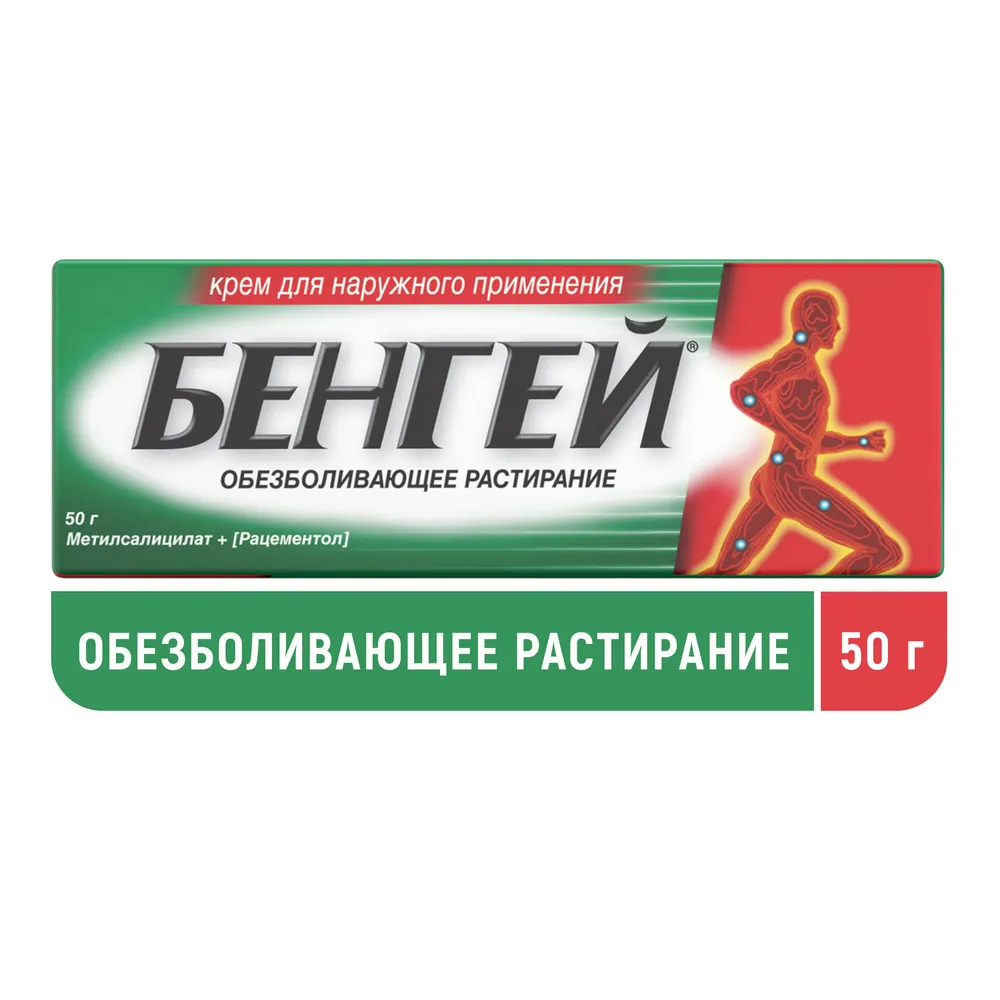
Table of Contents
INSTRUCTIONS FOR MEDICAL USE OF THE MEDICINAL PRODUCT BENGAY® (BENGAy®)
Composition:
Active substances: 1 g of cream contains methyl salicylate 150 mg, racemic menthol 100 mg;
Excipients: stearic acid, glycerol monostearate, lanolin, sorbitan trioleate, sorbitan tristearate, triethanolamine, purified water.
Medicinal form: Cream.
Main physicochemical properties: smooth, white, homogeneous cream with a characteristic odor.
Pharmacotherapeutic group:
Topically applied agents for joint and muscular pain.
ATC code: M02AX10.
Pharmacological Properties
Pharmacodynamics
Menthol. Local application of menthol is accompanied by a rapid onset and persistence of a warming sensation.
Methyl salicylate is a counterirritant used for temporary relief of deep muscular pain.
Local application of cream containing methyl salicylate to painful joints affected by arthritis leads to a significant reduction in muscle tension.
Following topical application, methyl salicylate penetrates through intact skin and exerts a systemic effect; the amount absorbed is sufficient to produce a pronounced analgesic effect.
The reduction of muscle spasm and pain caused by this spasm, observed with the use of Ben-Gay®, is associated with the warming effect. This warming effect serves several functions: improvement of blood flow due to capillary dilation and facilitation of the removal of irritant substances (such as lactic acid).
Pharmacokinetics
After topical application, methyl salicylate is absorbed through healthy skin. Absorption of methyl salicylate into the subcutaneous tissue leads to systemic action.
Following topical application, methyl salicylate penetrates through undamaged skin. Data indicate that the drug absorbed through the skin acts systemically, and the amount absorbed is sufficient to ensure a significant analgesic effect.
Clinical characteristics.
Indications.
Symptomatic therapy of joint and muscle pain, arthralgia associated with joint stiffness, and pain in the lumbar-sacral region of the spine caused by strain.
Contraindications.
Open wounds, skin irritation, hypersensitivity to the components of the drug and to salicylic acid preparations, patients with bronchial asthma.
Children under 18 years of age.
Interaction with other medicinal products and other forms of interaction.
Concomitant use with acetylsalicylic acid may lead to salicylate toxicity.
Methylsalicylate absorbed through the skin may enhance the effect of oral anticoagulants (warfarin, acenocoumarol); as this preparation contains salicylate, there is a risk of bleeding. In patients who concurrently used warfarin and a topical analgesic cream containing methylsalicylate, a significant increase in INR has been reported.
Particular caution is recommended when using concomitantly topical or systemic nonsteroidal anti-inflammatory drugs, as well as oral hypoglycemic agents of the sulfonylurea derivatives, sulfonamides, methotrexate, digoxin, valproate, barbiturates, and lithium, due to increased plasma concentrations of these active substances.
Concomitant use with other topical preparations on the same skin area is prohibited.
Special precautions for use.
For external use only.
The use of salicylates has been associated with Reye's syndrome.
Do not use under tight or warming bandages, or together with electric heating pads or hot water bottles.
If skin irritation or a rash occurs, discontinue use of the product.
Avoid contact with eyes, mucous membranes, or damaged or inflamed skin areas.
Do not use in combination with anticoagulants (warfarin, acenocoumarol) due to an increased risk of bleeding.
The product contains lanolin (wool fat), which may cause local skin reactions (e.g., contact dermatitis).
Do not use the product for more than 10 days or over large areas of skin.
Absorption of the product may significantly increase with heating or physical activity (e.g., during sports). Avoid sun exposure due to an increased risk of phototoxicity.
Use during pregnancy or breastfeeding
Pregnancy
There is insufficient data on the safety of using Bengay® cream in pregnant or breastfeeding women; therefore, the use of this product during these periods is not recommended.
If used during pregnancy, it should be under medical supervision.
Breastfeeding
Methyl salicylate is absorbed through the skin and may pass into breast milk; therefore, the product should be used with caution during pregnancy or breastfeeding.
Breastfeeding women should not apply the cream to the area of the mammary glands.
If used during breastfeeding, it should be under medical supervision.
Effect on the ability to drive or operate machinery
The product does not affect the ability to drive a vehicle or operate machinery.
Method of Administration and Dosage
For adults, apply a small amount of the cream and rub it into the painful areas of the skin. If necessary, repeat the procedure every few hours (3–4 times daily). The duration of treatment is determined individually by a physician.
Children. The product must not be used in children under 18 years of age.
Overdose
Excessive use may lead to salicylate toxicity.
In case of ingestion, seek medical advice immediately.
Methyl salicylate
Ingestion of methyl salicylate may result in severe, acute salicylate poisoning. Symptoms may develop within 2 hours and are similar to those of salicylate poisoning, although methyl salicylate is generally more toxic.
Cases of death have been reported following ingestion of small amounts—specifically, 4 mL in children or 6 mL in adults—despite the calculated lethal dose being approximately 30 mL.
Symptoms of mild to moderate overdose may include: fever, rapid breathing (tachypnea), tinnitus, respiratory alkalosis, metabolic acidosis, depression, mild dehydration, nausea, and vomiting. In cases of severe poisoning, encephalopathy, coma, arterial hypotension, pulmonary edema, seizures, acidemia, coagulation disorders, cerebral edema, and cardiac arrhythmias may occur.
However, symptoms of methyl salicylate poisoning may differ somewhat from those of acetylsalicylic acid poisoning. Typical features include central nervous system stimulation, intense hyperpnea (increased respiration), and hyperthermia. The odor of the medicinal product may be detected in exhaled air and urine. Improper or excessive topical use, especially when combined with occlusive dressings or other salicylate-containing medicinal products, may lead to toxicity, which may also be fatal.
In case of overdose, general supportive measures should be implemented and symptomatic treatment initiated. Administration of activated charcoal may be considered.
Activated charcoal may be justified when plasma salicylate concentration exceeds 250 mg/kg. Plasma salicylate levels should be monitored, although this alone is insufficient to determine the severity of poisoning, as clinical and biochemical parameters must also be monitored.
Elimination may be accelerated by urinary alkalinization, which can be achieved using a 1.26% sodium bicarbonate solution. Urinary pH should be monitored. Metabolic acidosis may be corrected by intravenous administration of 8.4% sodium bicarbonate solution (serum potassium concentration must be checked first). Forced diuresis is not recommended, as it does not enhance salicylate excretion and may lead to pulmonary edema.
Hemodialysis may be considered in cases of severe poisoning with plasma salicylate concentrations > 700 mg/L (5.1 mmol/L), or at lower plasma concentrations if severe clinical or metabolic disturbances are present.
Patients under 10 years of age or over 70 years of age may be at increased risk of salicylate poisoning; therefore, hemodialysis may be required at an earlier stage.
Menthol
Ingestion of large amounts of products containing menthol may cause the following symptoms: nausea, abdominal pain, vomiting, and central nervous system effects such as dizziness, ataxia, flushing, somnolence, slow respiration (bradypnea), and coma.
Side effects.
From the skin and subcutaneous tissue
Hypersensitivity reactions
Urticaria and other skin lesions – upon ingestion, due to the effect of menthol.
From the immune system
Angioedema.
From the respiratory system, thorax and mediastinum
Dyspnea.
General disorders and administration site reactions
Reactions at the site of application (including blisters, burning, redness, irritation, pain, paresthesia, itching and rash).
Injury, poisoning and procedural complications
Local skin burns at the site of application.
From the gastrointestinal tract – upon ingestion, due to the effect of menthol
Nausea, abdominal pain, vomiting.
From the nervous system – upon ingestion in large quantities, due to the effect of menthol
Dizziness, ataxia, facial flushing, drowsiness, respiratory depression and coma.
Shelf life
2 years. Do not use after the expiry date stated on the packaging.
Storage conditions.
Store at a temperature not exceeding 25 °C, in a place inaccessible to children.
Packaging.
50 g in a tube; 1 tube in a cardboard box.
Supply category. Over-the-counter.
Manufacturer. Janssen-Cilag, France.
Manufacturer's name and address.
Domaine de Maigremont, 27100 Val de Reuil, France.
Marketing authorization holder.
McNeil Products Limited, United Kingdom.
Address of the marketing authorization holder.
Foundation Park, Roxborough Way, Maidenhead, Berkshire, SL6 3UG, United Kingdom.
Representative of the marketing authorization holder. LLC "Johnson & Johnson Ukraine", Ukraine.
Address of the representative.
Ukraine
02152, Kyiv, Pavla Tychyny Ave., 1V.
+38 (044) 498 0888
+38 (044) 498 7392.