Beloderm
Ukraine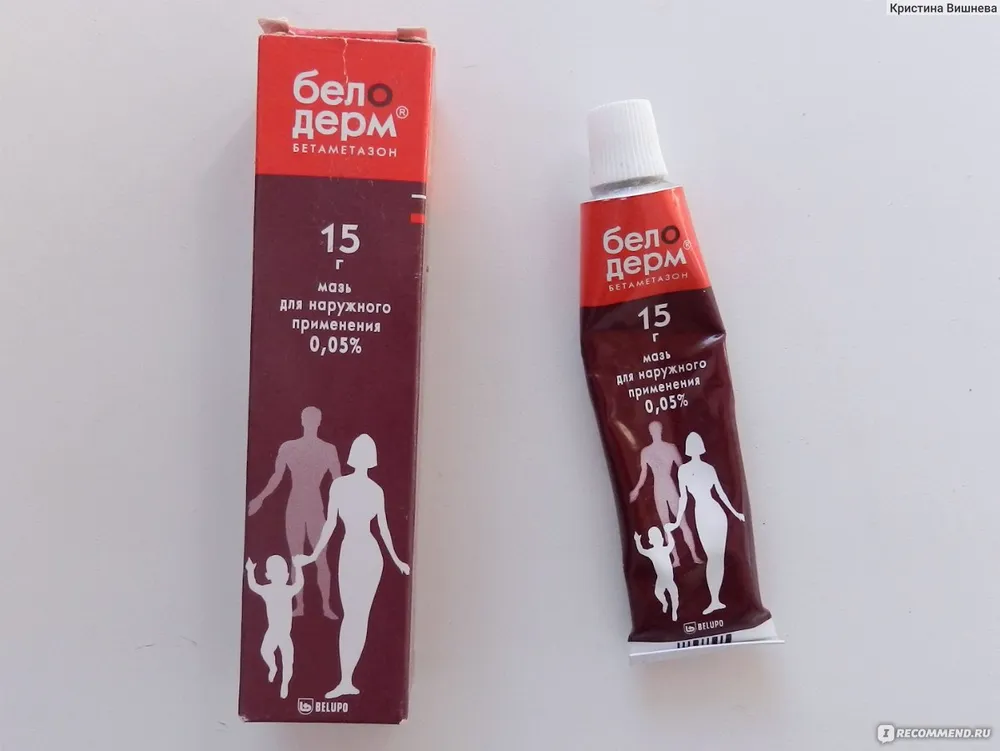
Table of Contents
INSTRUCTIONS FOR MEDICAL USE OF THE MEDICINAL PRODUCT BЕLODERM (BELODERM®)
Composition:
Active substance: betamethasone;
1 g of ointment contains betamethasone dipropionate 0.640 mg, equivalent to 0.500 mg of betamethasone;
Excipients: mineral oil, white soft paraffin.
Pharmaceutical form. Topical ointment.
Main physical and chemical properties: white, semi-transparent, homogeneous ointment.
Pharmacotherapeutic group.
Corticosteroids for dermatological use. Potent corticosteroids (Group III).
ATC code: D07AC01.
Pharmacological properties.
Pharmacodynamics.
Betamethasone, a synthetic glucocorticoid for topical use, exhibits high glucocorticoid activity and produces only minimal mineralocorticoid effect. It exerts potent anti-inflammatory, antipruritic, and vasoconstrictive actions. Therefore, it is used in the treatment of dermatoses responsive to corticosteroids.
Pharmacokinetics.
When applied topically, betamethasone may be minimally absorbed through normal, intact skin. Systemic absorption of corticosteroids is expected only under unfavorable conditions (prolonged treatment, occlusive dressing). After penetration into the skin, the pharmacokinetic profile of topical corticosteroids is similar to that of systemic corticosteroids.
Corticosteroids bind to plasma proteins to varying degrees, are mainly metabolized in the liver, and are excreted in the urine.
Some topical corticosteroids and their metabolites are excreted in bile.
Clinical characteristics.
Indications.
Treatment of dermatoses sensitive to potent glucocorticosteroid therapy, such as psoriasis; initial treatment of severe atopic eczema.
Contraindications.
Hypersensitivity to betamethasone or to other corticosteroids, or to any of the excipients of the product. Viral infections, including post-vaccination reactions and varicella; viral skin infections (e.g., herpes simplex, herpes zoster, varicella); acne; rosacea-like (perioral) dermatitis; bacterial dermatoses, including tuberculosis and syphilis of the skin; fungal infections; ophthalmological diseases (Beloderm is not intended for ophthalmic use). Do not use under occlusive dressings (casts). Particular caution should be exercised when applying Beloderm to facial skin. Avoid contact of the product with eyes or mucous membranes. Do not use during the first trimester of pregnancy (see section "Use during pregnancy or breastfeeding"). Prolonged treatment and/or application over large skin areas should be avoided, as systemic absorption of the active substance may occur.
Interaction with other medicinal products and other forms of interaction.
Due to the presence of white soft paraffin and mineral oil as excipients, treatment with this product in the anogenital area may damage the structure of latex condoms and reduce their safety during use while undergoing treatment.
Special precautions for use.
Beloderm is generally well tolerated; however, treatment should be discontinued if irritation or hypersensitivity occurs. If a hypersensitivity reaction or skin irritation develops, the drug should be discontinued immediately and appropriate therapy should be initiated. In the presence of infection or fungal skin lesions, appropriate antifungal or antibacterial agents should be prescribed. If the desired effect is not rapidly achieved, corticosteroid therapy should be discontinued until signs of infection have resolved.
Beloderm is not intended for ophthalmic use. Avoid contact of the drug with mucous membranes. Beloderm should not be applied to the eyes or periorbital area due to the risk of developing cataract, glaucoma, fungal eye infections, or herpes simplex exacerbation.
Systemic absorption of topical corticosteroids generally increases with higher corticosteroid potency, longer duration of treatment, and larger treated body surface area. Therefore, potent corticosteroids applied over large skin areas should be used under careful and periodic monitoring, as they may suppress the hypothalamic-pituitary-adrenal (HPA) axis. If suppression occurs, the drug should be discontinued, the frequency of application reduced, or the patient switched to a less potent corticosteroid. HPA axis function usually recovers after discontinuation of the drug.
In some cases, withdrawal symptoms may occur, requiring the addition of systemic corticosteroid therapy.
Local and systemic toxicity may occur, especially after prolonged use of betamethasone on large skin areas, damaged skin, skin folds, or under occlusive dressings. Certain body areas, such as the groin, axillae, and perianal region, where natural occlusion exists, are more susceptible to developing striae during betamethasone therapy. Use on these areas should be strictly limited.
Prolonged use of the ointment on the face is not recommended due to the possible development of rosacea-like dermatitis, perioral dermatitis, and acne.
Do not use in the treatment of varicose leg ulcers (trophic dermatomycoses).
Topical corticosteroids may be hazardous in psoriasis for several reasons, including the risk of relapse due to tolerance development, the risk of generalized pustular psoriasis, and local or systemic toxicity resulting from impaired skin barrier function.
Use of systemic and topical corticosteroids may lead to visual disturbances.
If symptoms such as blurred vision or other visual disturbances occur, patients should consult an ophthalmologist to evaluate possible causes, which may include cataract, glau游戏副本
Method of Administration and Dosage
Apply Beloderm as a thin layer to the affected skin area 1–2 times daily, depending on the severity of the condition.
Method of Administration
Apply a sufficient amount of the ointment as a thin layer to completely cover the affected skin areas and gently rub it into the skin. When symptoms improve, the frequency of application may be reduced.
Prolonged use of Beloderm or application over large areas (more than 20% of body surface) should be avoided. This also applies to treatment covering more than 10% of body surface for longer than one week. After improvement of clinical symptoms, it is often recommended to switch to a weaker glucocorticosteroid.
A so-called tandem therapy approach may be recommended, consisting of applying Beloderm once daily, followed 12 hours later by a suitable topical preparation not containing an active ingredient.
Intermittent therapy may also be beneficial, involving alternating use of Beloderm and a topical preparation without an active ingredient throughout the week.
Careful monitoring for signs and symptoms of systemic drug effects is necessary.
The method of administration should be adapted according to skin type and stage of the disease.
Beloderm is the preferred dosage form for dry, scaly, and rough skin in chronic and subacute stages of disease.
In dermatoses associated with bacterial infection, targeted antibacterial therapy should be administered. Patients with fungal dermatoses require specific treatment.
Do not use under occlusive dressings, as this may enhance the drug's adverse effects.
Children
There are no clinical data on the use of Beloderm in children; therefore, its use is not recommended in this age group. Due to the larger surface area to body weight ratio in children compared to adults, and increased drug absorption, children are more susceptible to hypothalamic-pituitary-adrenal (HPA) axis suppression and development of exogenous corticosteroid effects.
Overdose
Excessive or prolonged use of topical corticosteroids may lead to suppression of pituitary-adrenal function, resulting in secondary adrenal insufficiency and symptoms of hypercorticism, including Cushing's syndrome. Acute symptoms of hypercorticism are usually reversible.
In case of overdose, appropriate symptomatic treatment is indicated. Electrolyte balance should be corrected if necessary. In cases of chronic toxic effects, gradual withdrawal of the corticosteroid is recommended.
Side effects.
Frequency of adverse reactions: very common (≥1/10); common (≥1/100 to <1/10); uncommon (≥1/1000 to <1/100); rare (≥1/10000 to <1/1000); very rare (≥1/10000); frequency not known (frequency cannot be estimated based on available data).
| Adverse reactions related to treatment |
|
| Skin and subcutaneous tissue disorders Common: Uncommon: |
Burning, itching, irritation, dryness of the skin, folliculitis, hypertrichosis, acneiform eruptions, hypopigmentation, steroid-induced acne, rosacea-like (perioral) dermatitis Skin maceration, skin atrophy, striae, miliaria, particularly under occlusive dressing |
| Infections and infestations Uncommon: |
Secondary infection, particularly under occlusive dressing |
Skin tingling, skin induration, skin cracking, sensation of warmth, lamellar desquamation, focal desquamation, follicular eruptions, erythema, telangiectasia, ecchymoses, allergic contact dermatitis, skin hyperpigmentation, depigmentation of hair.
When applying the medicinal product over large areas or under occlusive dressing, particularly for prolonged periods, the possibility of systemic effects should be considered.
Hypersensitivity reactions may occur in individuals with known hypersensitivity to any component of the product.
Any adverse reactions observed during systemic administration of glucocorticoids, including suppression of the adrenal cortex, may also occur with topical application of glucocorticoids.
Cases of visual clouding have been reported with systemic use of glucocorticosteroids (frequency unknown).
Shelf life.
4 years.
Storage conditions.
Store at temperatures not exceeding 25 °C. Do not freeze.
Keep out of reach and sight of children.
Packaging.
15 or 30 g in a tube; 1 tube per cardboard box.
Prescription status.
Prescription only.
Manufacturer.
Belupo, lijekovi i kozmetika, d.d.
Manufacturer's address and place of business.
Danica 5, 48000 Koprivnica, Croatia.