Beclometasone-zdorovya
Ukraine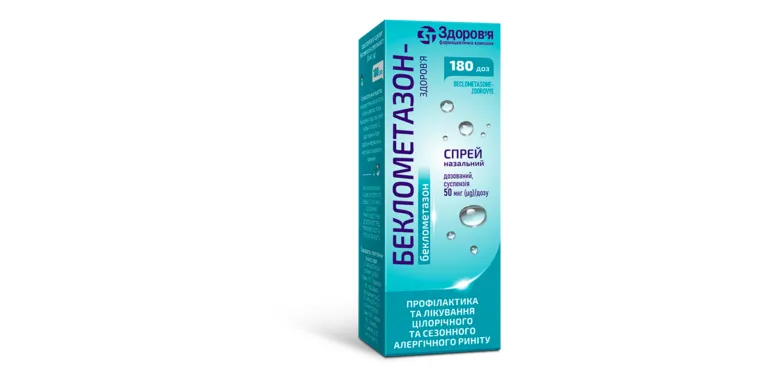
Table of Contents
INSTRUCTIONS FOR MEDICAL USE OF THE MEDICINAL PRODUCT BЕCLOMETASONE-ZDOROVYE (BECLOMETASONE-ZDOROVYE)
Composition:
Active substance: beclometasone;
1 dose of the preparation contains beclomethasone dipropionate – 50 mcg;
Excipients: microcrystalline cellulose and sodium carmellose, glucose, benzalkonium chloride, phenylethyl alcohol, polysorbate 80, purified water.
Pharmaceutical form. Metered nasal spray, suspension.
Main physicochemical characteristics: white, opaque suspension without any visible particles.
Pharmacotherapeutic group. Drugs used in nasal disorders. Anti-inflammatory and other locally acting drugs for nasal disorders. Corticosteroids. ATC code R01AD01.
Pharmacological properties.
Pharmacodynamics.
After topical application, beclometasone-17,21-dipropionate exerts a potent anti-inflammatory and vasoconstrictive effect. Beclometasone dipropionate is a prodrug with low affinity for glucocorticoid receptors. It is hydrolyzed by esterases to form the active metabolite beclometasone-17-monopropionate, which has high local anti-inflammatory activity.
Beclometasone dipropionate provides preventive baseline treatment of hay fever when used prior to allergen exposure. With regular use, beclometasone dipropionate prevents recurrent allergic symptoms.
Pharmacokinetics.
After intranasal administration of beclometasone dipropionate, systemic absorption was assessed by measuring plasma concentrations of its active metabolite, beclometasone-17-monopropionate (B-17-MP). The absolute bioavailability of B-17-MP after intranasal administration is 44%. Beclometasone dipropionate is rapidly cleared from the bloodstream, and after intranasal administration, its plasma concentration is undetectable (< 50 pg/mL). Metabolism occurs in all tissues via esterases. The main metabolite is the active compound (B-17-MP). Plasma protein binding is moderately high (87%). The elimination half-life in plasma is 0.5 hours for beclometasone dipropionate and 2.7 hours for B-17-MP. After oral administration of beclometasone dipropionate, approximately 60% of the dose is excreted in feces within 96 hours, primarily as free and conjugated polar metabolites. Approximately 12% of the dose is excreted in urine as free and conjugated polar metabolites. Renal clearance of beclometasone dipropionate and its metabolites is negligible.
Clinical characteristics.
Indications.
Prevention and treatment of perennial and seasonal allergic rhinitis.
Contraindications.
Hypersensitivity to the active substance or to any of the excipients listed in the section "Composition", as recorded in medical history. Tuberculosis, candidiasis, severe attacks of bronchial asthma. Pediatric age.
Interaction with other medicinal products and other forms of interaction.
Beclometasone is less dependent on CYP3A metabolism than some other corticosteroids, and interactions are generally unlikely; however, the possibility of systemic effects cannot be excluded when used concomitantly with strong CYP3A inhibitors (e.g., ritonavir, cobicistat). Therefore, caution is recommended and appropriate monitoring should be performed when these drugs are used concomitantly.
Special precautions for use.
Infectious-inflammatory diseases of the nasal passages and paranasal sinuses are not a specific contraindication for the use of the medicinal product; however, appropriate therapy should be administered in such cases.
The medicinal product should be prescribed with caution to patients being transferred from systemic steroid therapy due to the possible risk of adrenal suppression, as well as to patients with adrenal insufficiency.
After recent nasal surgery or nasal trauma, and in the presence of nasal mucosal ulcers due to an increased risk of nasal septum perforation, a physician should be consulted before using the medicinal product. Systemic effects of intranasal corticosteroids may occur, particularly with prolonged use of high doses. Such systemic effects are less likely than with oral corticosteroids and may vary between individual patients and with different corticosteroid preparations. Systemic effects may manifest as Cushing's syndrome, cushingoid features, adrenal suppression, cataract, glaucoma, and (less frequently) psychiatric and behavioral disorders, including psychomotor hyperactivity, sleep disturbances, restlessness, depression, or aggression (especially in children).
Treatment with doses higher than recommended may cause clinically significant adrenal suppression. If recommended doses of beclomethasone are exceeded, additional systemic corticosteroid therapy may be required during periods of stress or elective surgery.
The medicinal product contains benzalkonium chloride, which may cause irritation or local reactions.
This product should not be used continuously for more than 1 month without medical supervision. If a patient is using other medicinal products in any dosage forms containing corticosteroids or medications for asthma treatment, consultation with a physician is required before using beclomethasone dipropionate.
Systemic effects, including growth retardation, may occur with overdosage of intranasal beclomethasone, individual hypersensitivity, or following recent systemic steroid therapy.
Although beclomethasone dipropionate controls symptoms of seasonal allergic rhinitis in most cases, additional treatment may be necessary in some particularly severe cases associated with allergen exposure during the summer season, especially for symptoms affecting the visual organs.
Visual disturbances.
Visual disturbances may occur during systemic and local use of corticosteroids. If a patient experiences symptoms such as blurred vision or other visual disturbances, he or she should consult an ophthalmologist to evaluate possible causes, which may include cataract, glaucoma, or rare conditions such as central serous chorioretinopathy (CSC), which has been reported during both systemic and local corticosteroid therapy.
Use during pregnancy or breastfeeding.
Pregnancy
There is insufficient evidence of safety regarding the use of the medicinal product during pregnancy. Administration of corticosteroids to animals during pregnancy has been associated with fetal developmental abnormalities, including cleft palate and intrauterine growth retardation. Therefore, there may be a very small risk of such effects on the fetus. However, fetal developmental changes in animals occur after relatively high systemic exposure. The medicinal product delivers beclomethasone dipropionate directly to the nasal mucosa, thereby minimizing systemic exposure.
Beclomethasone dipropionate should be avoided during pregnancy unless, in the opinion of the physician, the expected benefit to the mother outweighs the potential risk to the fetus.
Breastfeeding period
Specific studies investigating the penetration of beclomethasone dipropionate into animal milk have not been conducted. It can be assumed that beclomethasone dipropionate may pass into milk; however, the doses used for direct nasal spray have a low potential to significantly increase its concentration in breast milk.
Administration of the product to women during breastfeeding should only be considered if, in the opinion of the physician, the expected benefit to the mother outweighs the potential risk to the infant.
Fertility
There are no data on the effect on fertility.
Ability to affect reaction speed when driving or operating machinery.
No effect.
Method of Administration and Dosage
The medicinal product should be used only for intranasal administration. Shake well before use.
Adults: 2 sprays into each nostril twice daily, or 1 spray into each nostril four times daily.
The maximum daily dose should not exceed 8 sprays (400 mcg).
Regular use of the drug is required to achieve full therapeutic effect. Maximum relief may not be achieved after the first few sprays.
Do not use for longer than 3 months without consulting a physician.
Children.
The medicinal product is not recommended for use in children.
Overdose.
The only harmful effect that may occur after inhalation of large doses of the drug within a short period of time is suppression of the hypothalamic-pituitary-adrenal (HPA) axis function. This condition does not require emergency treatment. The drug may be continued at the recommended doses. The function of the hypothalamic-pituitary-adrenal system will recover within 1–2 days.
In this case, management should follow clinical indications or recommendations of the national toxicology center (if available).
There is no specific antidote for beclomethasone dipropionate overdose.
In case of overdose, appropriate supportive measures should be provided if necessary.
Adverse reactions.
Adverse reactions are categorized by frequency as follows:
very common (≥ 1/10),
common (≥ 1/100 to <1/10),
uncommon (≥ 1/1,000 to <1/100),
rare (≥ 1/10,000 to <1/1,000),
very rare (< 1/10,000),
frequency not known (cannot be estimated from available data).
Immune system disorders: hypersensitivity reactions, including: common – rash, urticaria, pruritus, erythema; very rare – angioedema, swelling of eyes, face, lips and throat, dyspnea and/or bronchospasm, anaphylactoid/anaphylactic reactions.
Nervous system disorders: common – unpleasant taste and smell sensations.
Eye disorders: very rare – increased intraocular pressure, glaucoma or cataract; frequency not known – blurred vision.
Respiratory system disorders: common – dryness and irritation of nose and throat, nasal bleeding; cough, paradoxical bronchospasm, dyspnea; very rare – isolated cases of nasal septum perforation.
With prolonged use of beclomethasone, especially in high doses, candidiasis, adrenal cortex function suppression, osteoporosis, and growth retardation in children are possible.
Systemic effects of intranasal corticosteroids may occur when they are used in high doses over a prolonged period.
Shelf life. 2 years.
Storage conditions.
Store in the original packaging at a temperature not exceeding 25 °C.
Do not store in the refrigerator.
Keep out of reach of children.
Packaging.
180 doses in a bottle with a spray pump and protective cap in a box.
Availability. Over-the-counter.
Manufacturer.
LIMITED LIABILITY COMPANY "CORPORATION "ZDOROVIYA".
Manufacturer's address and place of business.
Ukraine, 61013, Kharkiv region, Kharkiv, Shevchenka Street, 22.
(quality control, batch release)
Ukraine, 08301, Kyiv region, Boryspil, Shevchenka Street, 100, letter B-II (Building 4).
(all manufacturing stages, batch release)