Barium sulfate for radiography
Ukraine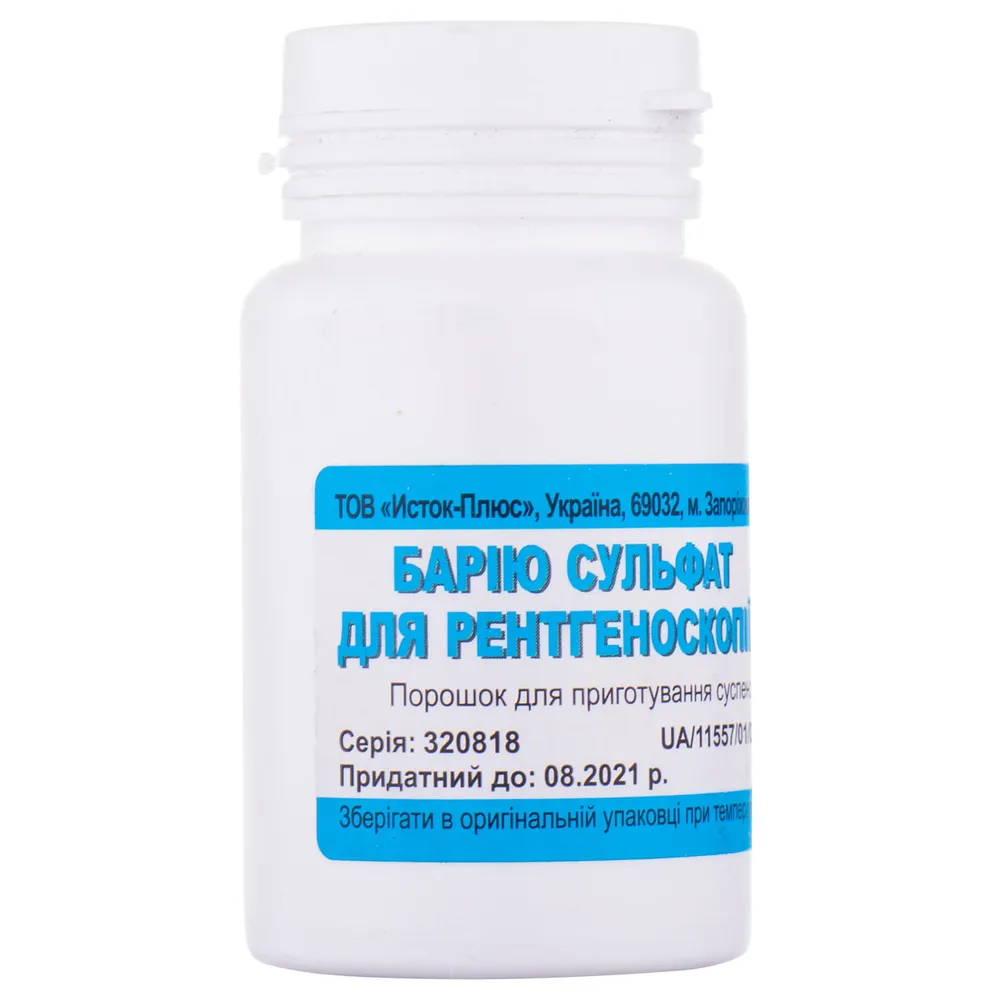
Table of Contents
Instructions for medical use of the medicinal product Barium Sulphate for X-ray examination (Barium Sulphate X-Ray Grade)
Composition:
Active substance: barium sulphate;
1 container contains 80 g of barium sulphate.
1 sachet contains 80 g or 100 g of barium sulphate.
Pharmaceutical form. Powder for preparation of a suspension.
Main physicochemical properties: white or almost white powder, free from extraneous particles, practically insoluble in water.
Pharmacotherapeutic group.
X-ray contrast agents not containing iodine. ATC code V08BA02.
Pharmacological properties.
Pharmacodynamics. Coats the mucous membrane of the gastrointestinal tract and provides a clear image of the mucosal microrelief during radiological examinations of the gastrointestinal tract. Enhances image contrast in radiological examinations of the gastrointestinal tract. Maximum contrast of the esophagus, stomach, and duodenum is achieved immediately after oral administration; of the small intestine – within 15–90 minutes (depending on gastric emptying rate and drug viscosity). Optimal visualization of the distal portions of the small and large intestine depends on body position and hydrostatic pressure.
Pharmacokinetics. Has low toxicity. Is not absorbed in the gastrointestinal tract and does not enter the systemic circulation. Completely excreted in feces within 24–28 hours.
Clinical characteristics.
Indications.
Radiological examination of the pharynx, esophagus, stomach, and intestines (including double-contrast technique).
Contraindications.
Hypersensitivity to the medicinal product. Impaired integrity of gastrointestinal tract walls (or suspicion thereof), esophagotracheal fistulas, swallowing disorders, complete or partial intestinal obstruction, constipation, esophageal stenosis, gastrointestinal bleeding, atresia, postoperative state following surgical interventions on gastrointestinal organs.
Do not administer immediately prior to emergency surgery on the esophagus or gastrointestinal tract.
Malabsorption syndrome; recent trauma or chemical burns of the gastrointestinal tract, gastrointestinal ischemia, necrotizing enterocolitis; megacolon or toxic megacolon.
Food allergy.
Interaction with other medicinal products and other forms of interaction.
No interaction studies have been conducted. Barium sulfate is biologically inert, and interactions with other medicinal products are unknown. However, the presence of barium sulfate in the gastrointestinal tract may alter the absorption of concurrently administered medicinal products. To minimize any potential changes in absorption, barium sulfate should, whenever possible, be administered separately from other medicinal products.
Other investigations of the same gastrointestinal region using different contrast agents may be complicated by residual barium sulfate in the gastrointestinal tract for several days after the examination.
Special precautions for use.
The drug should be administered under medical supervision.
Barium sulfate must not be administered in dry form; the method of administration is specified in the section "Dosage and administration".
Hypersensitivity
A history of bronchial asthma, atopy, confirmed hay fever and eczema, family history of allergy, or previous reaction to contrast agents requires heightened vigilance.
Prompt recognition, assessment, and diagnosis are crucial for effective management of hypersensitivity reactions. Therefore, qualified personnel must be available for diagnosis and treatment of hypersensitivity reactions.
Perforation
In patients with significant stenosis at any level of the gastrointestinal tract, especially if distal to the stomach, and in conditions or diseases that increase the risk of perforation—such as gastrointestinal fistulas and carcinoma, inflammatory bowel disease, diverticulitis and diverticulosis, amebiasis—a careful risk-benefit assessment is required before administering barium sulfate.
Aspiration
Patients prone to aspiration (neonates, elderly individuals, and post-stroke patients) should begin the procedure with a small volume of the preparation. If barium sulfate enters the larynx, further administration must be immediately discontinued.
Vomiting after oral administration of barium sulfate may lead to aspiration pneumonitis. Oral administration of barium sulfate suspension to infants via a bottle with a nipple, and administration of large volumes via catheter, may result in entry of the substance into the tracheobronchial tree. Cases of cardiorespiratory arrest leading to fatal outcomes in infants following aspiration have been reported. Aspiration of smaller amounts may cause airway inflammation and pneumonia.
Obstruction / Fluid overload
Oral administration of barium sulfate suspension has been reported to cause small bowel obstruction (impaction) in children with cystic fibrosis.
Barium sulfate suspension has been reported to cause fluid overload due to water absorption.
Children and patients with impaired renal function are most susceptible to hyperhydration.
Constipation or diarrhea
Barium sulfate should be used with caution in dehydrated patients, or in those suffering from any disease or receiving any treatment that may cause constipation. To prevent constipation, the use of mild laxatives may be necessary after completion of the radiological examination. Increased fluid intake is recommended after oral administration of barium sulfate to reduce the risk of constipation.
Other possible complications
Anxious patients may develop weakness, pallor, tinnitus, sweating, and bradycardia after administration of any diagnostic agent. These reactions are usually unpredictable and are best managed by keeping the patient in a horizontal position for an additional 10–30 minutes under observation.
Baroliths
Baroliths consist of condensed barium bound to feces. They often occur asymptomatically but may be associated with abdominal pain, appendicitis, intestinal obstruction, or perforation. Elderly patients, patients with impaired gastrointestinal motility, colonic obstruction, electrolyte imbalance, dehydration, or a low-fiber diet may be at risk of developing baroliths. To reduce this risk, adequate hydration should be maintained during and after the barium sulfate procedure. The use of laxatives should be considered.
Children, elderly, and debilitated patients
As with any other barium sulfate-containing preparations, "Barium sulfate for radiography" must be used with caution in children, elderly individuals, debilitated patients, and in patients with generally severe clinical conditions. Caution is advised in patients with pre-existing heart disease and bronchial asthma.
Barium sulfate should not be administered within 7 days following an endoscopic biopsy procedure, or within 4 weeks following radiotherapy of the rectum or prostate gland.
Use during pregnancy or breastfeeding.
Barium sulfate is not recommended during pregnancy. If examination is necessary during lactation, breastfeeding should be withheld for 24 hours after the procedure.
Ability to affect reaction speed when driving or operating machinery.
No effect.
Administration and Dosage
The suspension is prepared in boiled or distilled water immediately before use. For radiographic examination of the pharynx, esophagus, stomach, and small intestine, the agent is administered orally; for irigography, it is administered rectally.
Orally, for radiographic examination of the pharynx, esophagus, stomach, and intestines, "Barium sulfate for radiography" is given as an aqueous suspension. To prepare the suspension, the powder is mixed with warm boiled or distilled water in a ratio from 1:1 to 4:1 for adults and from 1:1.5 to 1:2 for children, and thoroughly stirred for 4–5 minutes (a mixer may be used). The dose for adults per examination depends on the method used and ranges from 50 mL to 300 mL of suspension; for children, it ranges from 50 mL to 100 mL.
Rectally in adults, for radiographic examination of the large intestine: a suspension made from 300 g of powder and 1500 mL of water is administered as an enema into the rectum; the dose per examination is 1000–1500 mL.
Children.
The medicinal product is used in pediatric practice.
Overdose.
Barium sulfate is non-toxic and is systemically absorbed only in negligible amounts.
Repeated administration within a very short period of time may cause abdominal cramps, nausea, vomiting, diarrhea, and constipation. These disturbances are usually temporary and resolve without medical intervention. If necessary, treatment should be administered according to current standards.
Adverse reactions.
When using effervescent agents during double contrast imaging – unpleasant sensations in the epigastric area.
The frequency of adverse effects is defined as: very common (≥ 1/10); common (≥ 1/100 to < 1/10); uncommon (≥ 1/1000 to < 1/100); rare (≥ 1/10000 to < 1/1000); very rare (< 1/10000); not known (frequency cannot be estimated from available data).
Immune system disorders.
Very rare: allergic reactions.
Vascular disorders.
Very rare: embolism after intravasation.
Respiratory, thoracic and mediastinal disorders.
Very rare: abscesses, inflammation after perforation into the mediastinum; foreign body granulomas in the lungs after aspiration.
Gastrointestinal disorders.
Very rare: inflammation after perforation into the abdominal cavity; colonic obstruction caused by baroliths, which may form from condensed barium sulfate mixed with feces. Unknown: onset or worsening of constipation. Barium sulfate may be retained in colonic diverticula and cause infectious complications. Isolated cases of so-called "barium appendicitis" have been reported.
Shelf life.
3 years.
Do not use the medicinal product after the expiry date stated on the packaging.
Storage conditions.
Store in the original packaging at a temperature not exceeding 25 °C.
Keep out of reach of children.
Packaging.
80 g of powder in a container, in a carton or without a carton.
80 g of powder in a sachet, 10 sachets in a box.
100 g of powder in a sachet, 5 sachets in a box.
Prescription status.
Prescription only.
Manufacturer.
LLC "Istok-Plus".
Manufacturer's address and location of business activity.
4 Makarenko Street, Zaporizhzhia, 69032, Ukraine.