Bactroban
Ukraine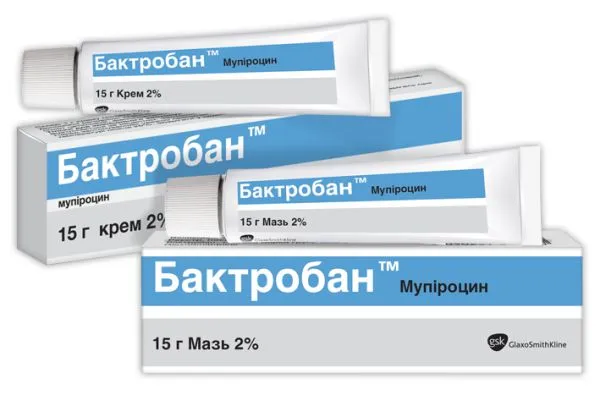
Table of Contents
INSTRUCTIONS FOR MEDICAL USE OF THE MEDICINAL PRODUCT BACTROBAN (BACTROBAN)
Composition:
Active substance: mupirocin;
1 g of ointment contains 20 mg of mupirocin (as mupirocin calcium);
Excipients: white soft paraffin, softisan 649.
Pharmaceutical form. Nasal ointment.
Main physicochemical properties: soft tube containing an almost white ointment.
Pharmacotherapeutic group. Dermatologicals. Antibiotics and chemotherapeutic agents for dermatological use. Topically applied antibiotics. Other topical antibiotics. ATC code D06AX09.
Pharmacological properties.
Pharmacodynamics.
Mupirocin is the main antibacterial component of a group of structurally related metabolites produced by fermentation of Pseudomonas fluorescens. The mechanism of action of mupirocin involves inhibition of bacterial isoleucyl-tRNA synthetase, thus cross-resistance with other antibiotics is not expected.
Mupirocin has bacteriostatic properties at minimal inhibitory concentrations and bactericidal properties at higher concentrations, which are achieved with topical application.
| Susceptible microorganisms: |
| Staphylococcus aureus* |
| Streptococcus spp. |
| Microorganisms with potential for acquired resistance: |
| Methicillin-resistant Staphylococcus aureus (MRSA) |
| Methicillin-resistant coagulase-negative Staphylococci (MRCoNS) |
| Resistant microorganisms: |
| Corynebacterium spp. |
| Micrococcus spp. |
* Clinical efficacy has been demonstrated for susceptible isolates in approved clinical indications.
Breakpoint values for mupirocin susceptibility (MIC) for Staphylococcus aureus:
Susceptible: less than or equal to 1 mg/L.
Resistant: greater than 256 mg/L.
Pharmacokinetics.
Studies have shown that systemic absorption of mupirocin following topical administration is minimal. To simulate potential enhanced systemic penetration of mupirocin when applied to damaged skin areas or vascularized regions such as mucous membranes, studies with intravenous administration of mupirocin were conducted. Mupirocin was rapidly eliminated from blood plasma via metabolism into monic acid, which in turn was predominantly excreted in urine.
Clinical characteristics.
Indications.
Local treatment of nasal cavity infections caused by Staphylococcus aureus, including methicillin-resistant strains.
Contraindications.
Hypersensitivity to mupirocin or to any of the other components of the medicinal product.
Interaction with other medicinal products and other forms of interaction.
No reports available.
Special precautions for use.
In case of occurrence of individual hypersensitivity reactions or severe local irritation during application of the nasal ointment, treatment should be discontinued, residual ointment should be removed, and an alternative medication for the treatment of inflammation should be prescribed.
As with therapy using other antibacterial agents, prolonged use of the ointment may lead to overgrowth of resistant microorganisms, including fungal flora.
Cases of pseudomembranous colitis have been reported with the use of antibacterial agents. The severity may vary from mild to life-threatening conditions. This diagnosis should be considered if diarrhea develops in a patient during or after antibacterial therapy. Although the likelihood of such events is low with topical application of mupirocin, if prolonged or severe diarrhea or abdominal cramps occur, the drug should be discontinued immediately and appropriate diagnostic evaluations should be performed.
Bactroban nasal ointment must not be used for the treatment of eye diseases.
Contact of the ointment with the eyes should be avoided. In case of accidental contact with the eyes, they should be thoroughly rinsed with water until all traces of the ointment are removed. Application of Bactroban nasal ointment for eye treatment in clinical studies resulted in severe reactions such as burning sensation in the eyes and lacrimation. These symptoms resolved within several days to several weeks after discontinuation of the ointment.
Use during pregnancy or breastfeeding.
Fertility. There are no data regarding the effect of nasal ointment on human fertility. Animal studies showed no effect on fertility.
Pregnancy. Reproductive studies of Bactroban in animals revealed no adverse effects on the fetus. Due to insufficient clinical experience with the use of nasal ointment during pregnancy, Bactroban should be used in pregnant women only if the potential benefit outweighs the possible risks of therapy.
Breastfeeding. There are no data on the excretion of Bactroban into breast milk.
Ability to influence reaction rate while driving or operating machinery.
Has no effect.
Method of Administration and Dosage
Adults, children and elderly patients
Apply a small amount of ointment (approximately the size of a match head) into each nostril 2–3 times daily for 5 days.
Dosage adjustment is not required in patients with hepatic or renal impairment.
After applying the ointment, close the nostrils with fingers, press several times on the nasal alae from both sides, and gently rub the nasal alae to ensure better distribution of the ointment inside the nose.
Clearance of pathogens from the nasal cavity usually occurs within 3–5 days of treatment.
Treatment should not last longer than 10 days.
Do not mix the ointment with other medicinal products, as dilution of the ointment may reduce its antibacterial activity and compromise the stability of the active ingredient.
Children
The ointment is indicated for treatment of children aged 12 years and older. Safety of use in children under 12 years of age has not been established.
Overdose
Currently, experience with mupirocin overdose is limited.
There is no specific antidote for mupirocin overdose. In case of overdose, supportive therapy with appropriate monitoring of the patient's condition should be administered if necessary. The decision regarding further use of the medicinal product should be made by a physician, taking into account the patient's clinical status.
Adverse Reactions
Adverse reactions are classified by organ systems and frequency of occurrence. The frequency of adverse effects is defined according to the following classification: very common (> 1/10), common (> 1/100, < 1/10), uncommon (> 1/1000, < 1/100), rare (> 1/10000, < 1/1000), very rare (< 1/10000), including isolated cases.
Uncommon adverse reactions were identified based on pooled safety data from 422 patients in 12 clinical studies.
Very rare adverse reactions were primarily identified from post-marketing data; therefore, their frequency reflects reporting rates more than actual incidence rates of these reactions.
Immune system disorders
Very rare: skin hypersensitivity reactions; systemic allergic reactions, including anaphylaxis, generalized rash, urticaria, and angioedema.
Respiratory, thoracic and mediastinal disorders
Uncommon: nasal mucosal reactions: itching, burning sensation, redness, as well as rhinitis, sneezing, nasal congestion, cough, pharyngitis.
Nervous system disorders: headache, altered taste sensation.
Reporting suspected adverse reactions
Reporting of suspected adverse reactions after marketing authorization is of great importance. It enables continuous monitoring of the benefit-risk balance of the medicinal product. Healthcare professionals and patients can report suspected adverse reactions to GlaxoSmithKline Pharmaceuticals Ukraine LLC via the 24-hour hotline (044) 585-51-85 or by email at [email protected].
Shelf life. 3 years.
Storage conditions.
Store at temperatures not exceeding 25 °C. Keep out of reach of children.
Packaging. 3 g of ointment in an aluminum tube with a polyethylene cap. One tube per cardboard box.
Prescription status. Prescription only.
Manufacturer. Glaxo Operations UK Ltd, United Kingdom.
Manufacturer's address and place of business.
Harmire Road, Barnard Castle, DL12 8DT, United Kingdom.