Atropine-darnitsa®
Ukraine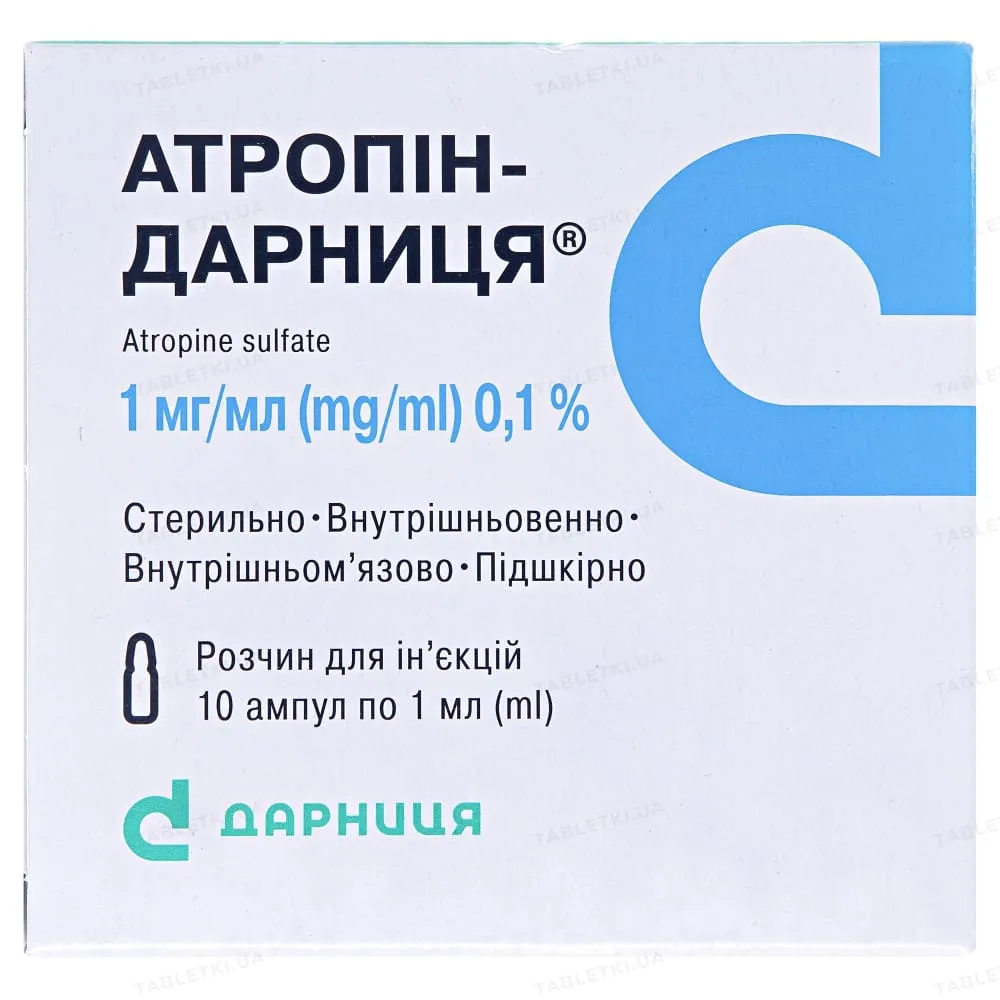
Table of Contents
INSTRUCTION FOR MEDICAL USE OF THE MEDICINAL PRODUCT ATROPINE-DARNITSA® (ATROPINE-DARNITSA)
Composition:
Active ingredient: atropine;
1 ml of solution contains atropine sulfate 1 mg;
Excipients: hydrochloric acid, water for injections.
Pharmaceutical form. Injection solution.
Main physicochemical properties: clear colorless liquid.
Pharmacotherapeutic group. Drugs for treatment of functional gastrointestinal disorders. Belladonna alkaloids, tertiary amines. Atropine. ATC code A03BA01.
Pharmacological properties.
Pharmacodynamics.
Atropine is an alkaloid found in plants of the Solanaceae family, a muscarinic receptor blocker that binds equally to M1-, M2-, and M3-subtypes of muscarinic receptors. It affects both central and peripheral muscarinic cholinergic receptors. It also acts (although significantly weaker) on nicotinic cholinergic receptors. It antagonizes the stimulatory effects of acetylcholine; reduces secretion of salivary, gastric, bronchial, lacrimal, and sweat glands. It decreases the tone of smooth muscles of internal organs (bronchi, gastrointestinal tract, pancreas, bile ducts and gallbladder, urinary tract, urinary bladder); causes tachycardia, improves atrioventricular conduction. It reduces gastrointestinal motility and has virtually no effect on bile and pancreatic secretion. It causes mydriasis, impairs outflow of intraocular fluid, increases intraocular pressure, and induces cycloplegia. In medium therapeutic doses, it affects the central nervous system (CNS), producing a delayed but prolonged sedative effect, and stimulates respiration.
Pharmacokinetics.
Atropine sulfate is rapidly absorbed into the bloodstream from the site of administration. It is rapidly distributed throughout the body, crosses the blood-brain barrier, placental barrier, and is excreted into breast milk. After intravenous administration, the maximum effect occurs within 2–4 minutes. Bioavailability is 25%. Approximately 50% is metabolized in the liver via enzymatic hydrolysis to tropine and tropic acid. Plasma protein binding is 18%. Significant concentrations in the CNS are detected within 0.5–1 hour. The elimination half-life is 2 hours. The drug is excreted by the kidneys: 50% unchanged, and the remaining portion as hydrolysis and conjugation products.
Clinical characteristics.
Indications.
Use as a symptomatic agent in peptic ulcer of the stomach and duodenum, pylorospasm, acute pancreatitis, cholelithiasis, cholecystitis, intestinal spasms, urinary tract spasms, bronchial asthma, bradycardia due to increased vagal tone, to reduce secretion of salivary, gastric, bronchial, and sometimes sweat glands, and for performing radiological examination of the gastrointestinal tract (to reduce organ tone and motor activity).
The medicinal product is indicated for use before anesthesia and surgery, and during surgical procedures, as an agent preventing broncho- and laryngospasm, reducing glandular secretion, reflex responses, and adverse effects caused by vagus nerve stimulation. Also indicated as a specific antidote in poisoning with cholinomimetic compounds and anticholinesterase agents (including organophosphorus warfare nerve-paralytic agents).
Contraindications.
Hypersensitivity to components of the medicinal product. Cardiovascular disorders in which an increase in heart rate may be undesirable: atrial fibrillation, tachycardia, chronic heart failure, ischemic heart disease (IHD), mitral stenosis, severe arterial hypertension. Acute hemorrhage. Thyrotoxicosis. Hyperthermic syndrome. Gastrointestinal disorders associated with obstruction (esophageal achalasia, pyloric stenosis, intestinal atony, and toxic megacolon). Glaucoma. Hepatic and renal insufficiency. Myasthenia gravis. Urinary retention or predisposition to it (e.g., due to prostate or urethral disease). Brain injury.
When atropine is used for life-saving indications in poisoning with cholinomimetic compounds and anticholinesterase agents (including organophosphorus nerve-paralytic warfare agents), the above contraindications do not apply.
Interaction with other medicinal products and other types of interactions.
When atropine sulfate is used concomitantly with monoamine oxidase inhibitors, cardiac arrhythmias may occur; with quinidine and procainamide – summation of cholinolytic effects is observed.
When taken orally together with Convallaria preparations or tannins, physicochemical interactions occur, leading to mutual weakening of effects.
Atropine sulfate reduces the duration and depth of action of narcotic agents and diminishes the analgesic effect of opioids.
When used simultaneously with diphenhydramine or diprazine, the effect of atropine is enhanced; with nitrates, haloperidol, and systemic corticosteroids – the risk of increased intraocular pressure rises; with sertraline – the depressive effect of both medicinal products is enhanced; with spironolactone and minoxidil – the effect of spironolactone and minoxidil is reduced; with penicillins – the effect of both medicinal products is enhanced; with nizatidine – the effect of nizatidine is enhanced; with ketoconazole – absorption of ketoconazole is reduced; with ascorbic acid and attapulgite – the effect of atropine is diminished; with pilocarpine – the effect of pilocarpine in glaucoma treatment is reduced; with oxprenolol – the antihypertensive effect of the medicinal product is diminished. Under the influence of octadine, a reduction in the antisecretory effect of atropine may occur, which weakens the action of M-cholinomimetics and anticholinesterase agents. When used concomitantly with sulfonamide medicinal products, the risk of kidney damage increases; with potassium-containing medicinal products – intestinal ulceration may occur; with nonsteroidal anti-inflammatory agents – the risk of gastric ulceration and bleeding increases.
The effect of atropine sulfate may be enhanced, increasing the risk of atropine-related adverse effects (urinary retention, constipation, dry mouth), when used concomitantly with other medicinal products having antimuscarinic effects: M-cholinoblockers, antiparkinsonian agents (amantadine), spasmolytics, certain antihistamines, mequitazine, butyrophenone-group agents, phenothiazines, disopyramide, quinidine, and tricyclic antidepressants, nonselective inhibitors of neuronal reuptake of monoamines.
Reduced peristalsis under the influence of atropine may lead to altered absorption of other medicinal products.
When atropine and pralidoxime are used concomitantly, signs of atropinization (flushing, mydriasis, tachycardia, dry mouth) are intensified, as pralidoxime may enhance the effect of atropine.
Barbiturates should be used with caution when treating seizures caused by atropine.
Special precautions for use.
Use with caution in patients with prostatic hypertrophy without urinary tract obstruction, in patients with Down's syndrome, cerebral palsy, pyloric stenosis, reflux esophagitis (since atropine may delay gastric emptying, reduce gastric motility, and relax the esophageal sphincter), hiatal hernia with reflux esophagitis, intestinal atony in elderly patients, nonspecific ulcerative colitis, megacolon, patients with xerostomia, elderly or debilitated patients, chronic lung diseases without reversible obstruction, chronic lung diseases with low production of thick, difficult-to-expectorate sputum (especially in young children and debilitated patients), autonomic (autonomic) neuropathy, patients with heart failure, arrhythmias, conduction disorders, hyperthyroidism, fever, or high ambient temperature.
Atropine should not be administered to patients with myasthenia gravis unless it is used concomitantly with anticholinesterase agents.
Use atropine with caution in patients with high-grade atrioventricular block (second-degree Mobitz type II or third-degree).
Atropine should be used with caution in patients with tachyarrhythmia, congestive heart failure, or ischemic heart disease, as blockade of vagal inhibition of the sinoatrial node pacemaker may occur.
Special considerations for the use of atropine in poisoning with cholinomimetic compounds and anticholinesterase agents (including organophosphorus nerve-paralytic warfare agents)
Atropine should not be administered until cyanosis has been corrected, as atropine may induce ventricular fibrillation and possible seizures in the presence of hypoxia.
In patients with recent myocardial infarction and/or severe ischemic heart disease, atropine-induced tachycardia may precipitate ischemia, extend or initiate myocardial infarction, and promote ectopic activity and ventricular fibrillation.
In cases of severe respiratory distress, artificial ventilation may be required in addition to atropine, since atropine is not sufficiently effective in treating weakness or paralysis of respiratory muscles.
Anhidrosis may lead to heat intolerance and impaired thermoregulation, particularly in hot environments.
Close monitoring of all patients treated with atropine is indicated for at least 48–72 hours. This is particularly important for patients who have previously experienced anaphylactic reactions to atropine and who require treatment for poisoning with cholinomimetic compounds and anticholinesterase agents (including organophosphorus nerve-paralytic warfare agents).
Use during pregnancy or breastfeeding.
The medicinal product is contraindicated during pregnancy.
The use of atropine sulfate during breastfeeding is contraindicated due to the risk of toxic effects on the infant.
Ability to affect reaction speed when driving or operating machinery.
Due to the possible occurrence of adverse reactions such as dizziness, somnolence, hallucinations, visual disturbances, and accommodation disorders, patients should refrain from driving vehicles or operating machinery while receiving this medicinal product.
Administration and Dosage
Atropine sulfate is administered subcutaneously, intramuscularly, or intravenously.
For pre-anesthetic medication to reduce the risk of vagus-mediated bradycardia and to decrease salivary and bronchial secretions: 0.3–0.6 mg subcutaneously or intramuscularly 30–60 minutes before anesthesia; when combined with morphine (10 mg of morphine sulfate) — 1 hour before anesthesia.
The maximum single dose for children according to age is:
- up to 6 months — 0.02 mg;
- from 6 months to 1 year — 0.05 mg;
- from 1 to 2 years — 0.2 mg;
- from 3 to 4 years — 0.25 mg;
- from 5 to 6 years — 0.3 mg;
- from 7 to 9 years — 0.4 mg;
- from 10 to 14 years — 0.5 mg.
Maximum doses for adults subcutaneously: single dose — 1 mg, daily dose — 3 mg.
Atropine sulfate should be administered with caution in elderly patients.
Atropine, as a specific antidote in poisoning with cholinomimetic compounds and anticholinesterase agents (including organophosphorus nerve-paralytic warfare agents), should be administered according to the severity of symptoms as outlined in Table 1.
Table 1
| Mild symptoms |
Severe symptoms |
|
|
In the pre-hospital setting, for mild symptoms, administer 2 mg as the first dose to adults. If at any time after the first dose the patient develops any of the severe symptoms listed in Table 1, an additional injection of 4 mg atropine should be administered. After this, wait 10–15 minutes for atropine to take effect. If, after 10–15 minutes, the patient does not develop any of the severe symptoms listed in Table 1, additional atropine injections are not recommended.
If the patient is unconscious or has any of the severe symptoms listed in Table 1, administer 6 mg immediately to adults.
In the hospital setting, after an initial loading dose of 2 mg for mild symptoms, subsequent injections are 2 mg, repeated every 5–10 minutes (2, 4, 8, 16, 32 mg) until the desired clinical response is achieved. In cases of severe organophosphorus compound poisoning, after the initial 6 mg dose, the dose may be repeated or increased at 15–30 minute intervals to maintain signs of atropinization (dry mouth, dilated pupils, tachycardia).
For elderly and geriatric patients, dose reduction to 1 mg may be considered in mild symptoms, and to 2–4 mg in severe symptoms.
The pediatric dose has not been sufficiently studied. For therapeutic purposes, children with signs of intoxication may receive 0.015–0.05 mg/kg every fifteen minutes as needed.
Intravenous administration is generally preferred, but subcutaneous and intramuscular routes are also possible. Administration into the outer thigh, including through clothing, is feasible, provided that pockets at the injection site are empty.
Children
Infants in the first 3 months of life are particularly sensitive to atropine.
The medicinal product should be administered to children in the doses specified in the section "Dosage and administration."
Overdose
Symptoms: intensification of adverse reactions, flushing, rash, and dry skin, dry mucous membranes, dry mouth, dry and burning tongue, dilated pupils, increased light sensitivity, elevated intraocular pressure, difficulty swallowing, rapid breathing, tachycardia, nausea, vomiting, decreased/increased blood pressure, restlessness, insomnia, drowsiness, headache, dizziness, irritability, hyperthermia, difficulty and retention of urination, intestinal atony, impaired heat dissipation, reduced sweating.
Central nervous system (CNS) stimulation symptoms include restlessness, confusion/loss of consciousness, hallucinations, paranoid and psychotic reactions, impaired coordination, delirium, tremor, and periodic seizures.
In severe overdose, drowsiness, stupor, depression of respiratory and vasomotor centers, CNS depression, coma, circulatory and respiratory failure may occur, potentially leading to fatal outcome.
Treatment: administration of antidotes—proserin (1 ml of 0.05% solution subcutaneously) or physostigmine (0.5–1 ml of 0.1% solution subcutaneously). Ensure airway patency, gastric lavage, parenteral administration of cholinomimetics and anticholinesterase agents. For hyperthermia, apply ice to the head and groin, perform wet sponging, and use antipyretics; for psychomotor agitation—administer aminazine intramuscularly (2 ml of 2.5% solution); for seizures—barbiturates (5–10 ml of 2.5% solution of sodium thiopental); for mydriasis—topical application in the form of eye drops: phosphacol, physostigmine, pilocarpine; for tachycardia—inderal; for urinary retention—catheterization; in cases of severe intoxication—forced diuresis, blood alkalinization. In the event of an acute glaucoma attack, instill 1% pilocarpine solution into the conjunctival sac every hour (2 drops), and administer subcutaneously 1 ml of 0.05% proserin solution 3–4 times daily. Diazepam may be used to control agitation and seizures, but the risk of CNS depression should be considered.
Intravenous administration of glucose with ascorbic acid is indicated. Antiarrhythmic drugs are not recommended in the event of arrhythmia.
Adverse Reactions.
The nature of adverse effects observed during the use of atropine is mostly related to its pharmacological action on muscarinic receptors and, in the case of high-dose administration, on nicotinic receptors. Adverse effects are dose-dependent and usually reversible upon discontinuation of therapy. The most common adverse reactions occurring at relatively low doses include visual disturbances, reduced bronchial secretion, dry mouth, constipation, reflux, flushing, urinary difficulties, and dry skin. Transient bradycardia followed by tachycardia, palpitations, and arrhythmia may also occur.
All adverse reactions are listed by system organ classes and frequency: very common (≥ 1/10), common (≥ 1/100 to < 1/10), uncommon (≥ 1/1,000 to < 1/100), rare (≥ 1/10,000 to < 1/1,000), very rare (< 1/10,000), frequency not known (cannot be estimated from available data).
Eye disorders: very common – mydriasis, photophobia, paralysis of accommodation, increased intraocular pressure, visual disturbances; frequency not known – eye irritation, lacrimation, conjunctivitis, dry keratoconjunctivitis, blepharitis, strabismus, reduced contrast sensitivity and light sensitivity, angle-closure glaucoma, blindness.
Respiratory, thoracic and mediastinal disorders: very common – decreased secretory activity and bronchial tone leading to formation of thick, difficult-to-expectorate mucus; frequency not known – exacerbation of chronic lung disease, laryngitis, intercostal retractions, dyspnea, wheezing, slow breathing, shallow breathing, tachypnea, respiratory failure, laryngospasm, pulmonary edema.
Gastrointestinal disorders: very common – dry mouth (dysphagia, difficulty speaking, thirst), taste disturbances, reduced intestinal motility up to atony, constipation, reflux, reduced tone of bile ducts and gallbladder, inhibition of gastric secretion, nausea, vomiting, bloating; frequency not known – pyloric stenosis, reduced absorption, abdominal pain, salivation.
Renal and urinary disorders: common – urinary hesitancy and retention; frequency not known – enuresis, imperative urges to urinate.
Nervous system disorders: common – nervousness, dizziness, coordination disturbances, disturbances of consciousness and/or auditory or visual hallucinations (especially at higher doses), hyperthermia; uncommon – psychiatric disorders (paranoia, mania, restlessness, anxiety, withdrawal, delirium, dysarthria, stupor, amnesia); rare – seizures, somnolence; frequency not known – headache, pathological reflexes, muscle twitching, dysmetria, ataxia, insomnia, coma.
Cardiac disorders: common – tachycardia, arrhythmia, transient exacerbation of bradycardia; rare – atrial arrhythmia, atrial/ventricular fibrillation, myocardial ischemia, hypertensive crisis; frequency not known – palpitations, hypotension, loss of consciousness, extrasystoles of various localization, asystole, cardiac dilation, increased or labile blood pressure, conduction disorders, ventricular arrhythmia, myocardial infarction.
Vascular disorders: common – sensation of flushing, facial flushing.
Immune system disorders: rare – hypersensitivity reactions; very rare – anaphylactic reactions, anaphylactic shock.
Skin and subcutaneous tissue disorders: very common – skin rashes, dryness of skin and/or mucous membranes, urticaria, exfoliative dermatitis; frequency not known – sweating, rashes, skin cyanosis.
General disorders and administration site conditions: very common – decreased sweating; uncommon – reactions at the injection site; frequency not known – injection site pain, chest pain, weakness, fatigue, thirst, dehydration.
Investigations: frequency not known – hyponatremia, increased or decreased hemoglobin levels, erythrocytosis, increased blood urea nitrogen, EEG changes.
Special Populations.
Atropine may cause excitement, coordination disturbances, disturbances of consciousness and/or hallucinations, especially in elderly patients. In similar epidemiological studies, decreased cognitive performance has been reported in elderly patients receiving antimuscarinic drugs.
Patients with Down syndrome may be more sensitive to antimuscarinic effects.
Reporting of suspected adverse reactions.
Reporting suspected adverse reactions after drug registration is important. It allows continuous monitoring of the benefit-risk balance of the medicinal product. Medical and pharmaceutical professionals, as well as patients or their legal representatives, should report all suspected adverse reactions and lack of drug efficacy to the State Expert Centre of the Ministry of Health of Ukraine via the following link: https://aisf.dec.gov.ua/.
Shelf life. 3 years.
Storage conditions.
Store in the original packaging at a temperature not exceeding 25 °C. Do not freeze.
Keep out of reach and sight of children.
Incompatibilities.
Do not mix with other medicinal products. Use only the recommended solvent.
Packaging.
1 ml in an ampoule; 5 ampoules in a blister pack; 2 blister packs in a carton.
Prescription status. Prescription only.
Manufacturer. JSC "Pharmaceutical Company "Darnytsia".
Manufacturer's address and place of business.
13, Boryspilska Street, Kyiv, 02093, Ukraine.