Astalin
UkraineTable of Contents
INSTRUCTION FOR MEDICAL USE OF THE MEDICINAL PRODUCT ASTHALIN (ASTHALIN)
Composition:
Active substance: salbutamol;
1 dose contains salbutamol sulfate equivalent to salbutamol 100 mcg;
Excipients: oleic acid, anhydrous ethanol, propellant HFA-134a.
Pharmaceutical form. Aerosol (suspension) for inhalation.
Main physicochemical properties: white-colored suspension.
Pharmacotherapeutic group.
Agents for the treatment of obstructive respiratory diseases. Selective β2-adrenergic agonists. ATC code R03AC02.
Pharmacological properties.
Pharmacodynamics.
Salbutamol is a sympathomimetic agent and a selective β2-adrenergic receptor agonist. At therapeutic doses, salbutamol acts on β2-adrenergic receptors in bronchial smooth muscle, and has minimal or no effect on β2-adrenergic receptors in cardiac muscle. Salbutamol provides rapid (within 5 minutes) and short-acting (4–6 hours) bronchodilation in patients with reversible airway obstruction.
Special patient groups: children under 4 years of age.
Clinical studies in paediatrics using the recommended dose in patients under 4 years of age with bronchospasm associated with reversible airway obstruction have shown that nebulized salbutamol has a similar safety profile in children under 4 years of age compared to children aged 4 years and older, adolescents, and adults.
Pharmacokinetics.
Salbutamol is readily absorbed from the gastrointestinal tract; however, systemic absorption of the active substance after inhalation is low. The effect of inhaled salbutamol depends on direct stimulation of receptors in the lungs.
Onset of action usually occurs within 10 minutes after inhalation and lasts for 4–6 hours in most patients.
Salbutamol undergoes extensive first-pass metabolism in the liver. Approximately half of the dose is excreted in urine as an inactive sulfate conjugate. It is unlikely that salbutamol is metabolized in the lungs; therefore, further inhaled therapy depends on the delivery method, which determines the amount of inhaled salbutamol relative to the amount inadvertently swallowed. A slightly prolonged elimination half-life after inhalation is likely to reflect slow release of the active substance from the lungs.
Clinical characteristics.
Indications.
The medicinal product is prescribed to adults, adolescents, and children aged 4 to 11 years.
Treatment of bronchial asthma, as needed — to relieve wheezing and dyspnea.
Management of acute episodes of dyspnea.
For prophylactic purposes — prior to exacerbation or to prevent exercise-induced asthma.
Treatment of the reversible component of airway obstruction.
Contraindications.
Hypersensitivity to salbutamol or to any of the excipients of the medicinal product.
Astalin is contraindicated for the treatment of premature labor and threatened abortion.
Interaction with other medicinal products and other forms of interaction.
Propranolol and other non-cardioselective β-adrenoreceptor blockers have an antagonistic effect on the action of salbutamol; therefore, they should not be administered concurrently.
Monoamine oxidase inhibitors, tricyclic antidepressants, and digoxin increase the risk of cardiovascular disturbances.
Patients should discontinue the use of salbutamol, if possible, at least 6 hours before scheduled anesthesia with halogenated anesthetics.
Hypokalemia, which may occur during treatment with β2-agonists, can be exacerbated by concomitant use of the medicinal product with xanthines, steroids, diuretics, and long-acting laxatives.
Since the medicinal product contains alcohol, there is a theoretical possibility of interaction in patients taking disulfiram or metronidazole. The amount of alcohol in the medicinal product is small, but it may be sufficient to trigger a reaction in some sensitive patients.
Special precautions for use.
Asthma treatment is usually managed according to a stepwise treatment approach, in which the patient's response is monitored clinically and by lung function tests. Since sudden, progressive asthma exacerbation can lead to life-threatening situations, consideration should be given to initiating or increasing the dose of corticosteroids. Therefore, daily peak flow measurement is recommended for patients at high risk.
Patients receiving regular anti-inflammatory therapy (e.g., inhaled corticosteroids) should be advised to continue taking anti-inflammatory medications even when symptoms subside and they do not require salbutamol.
Patients should be warned that if the effect diminishes or the duration of action becomes shorter, they should not increase the dose or frequency of administration, but should consult their physician. If the effect lasts less than 3 hours after inhalation, therapy must be adjusted.
An increasing need for β2-sympathomimetics indicates worsening asthma control, and patients should be advised to seek medical help as soon as possible. In such cases, the treatment regimen must be adjusted.
Excessive use of short-acting beta-agonists may mask the progression of the underlying disease and lead to poorer asthma control, increasing the risk of severe asthma exacerbations and death.
Patients using salbutamol more than twice a week on an as-needed basis (excluding prophylactic use before physical exertion) should be re-evaluated (e.g., assessment of daytime symptoms, nocturnal awakenings, and activity limitations due to asthma) to ensure appropriate adjustment of therapy, as these patients are at risk of excessive salbutamol use.
Sympathomimetics such as salbutamol may have cardiovascular side effects. There is some post-marketing and literature evidence suggesting that myocardial ischemia may be associated with salbutamol use. Patients with pre-existing severe heart conditions (such as ischemic heart disease, arrhythmia, or severe heart failure) who are prescribed salbutamol should be warned to consult a physician if they experience chest pain or other symptoms of cardiac disease exacerbation.
Particular attention should be paid to symptoms that may occur, such as dyspnea and chest pain. These symptoms may have either respiratory or cardiac origin.
Caution is recommended when used concomitantly with cardiac glycosides. Increased doses of the medicinal product should be used with caution in patients with thyrotoxicosis. Potentially severe hypokalemia may occur following the use of β2-sympathomimetics, particularly with nebulization or parenteral administration. Particular caution is recommended in acute, severe asthma, as this hypokalemia may be exacerbated by concomitant treatment with xanthine derivatives, steroids, diuretics, and hypoxia. Serum potassium levels should be monitored in such situations.
As with other inhaled medications, paradoxical bronchospasm may occur. In such cases, salbutamol should be discontinued immediately and alternative medications should be prescribed.
Dental caries has been reported with the use of salbutamol. Oral hygiene and regular dental check-ups are recommended, especially in children.
Important information about excipients.
This medicinal product contains a small amount of ethanol (alcohol), less than 100 mg per dose.
Use during pregnancy or breastfeeding.
The safety of using this medicinal product during pregnancy or breastfeeding has not been established. There are no data on the use of salbutamol in combination with the propellant HFA-134a in pregnant women or women who are breastfeeding.
There have been isolated reports of various congenital malformations during intrauterine development, including cleft palate, limb defects, and cardiac abnormalities in children of women who used salbutamol during pregnancy. Some of these women took multiple other medications during pregnancy.
Experience with the use of β-sympathomimetics in early pregnancy suggests no harmful effects at doses commonly used for inhaled therapy. High systemic doses at the end of pregnancy may delay labor and cause selective fetal/neonatal β2-agonist effects such as tachycardia and hypoglycemia. Inhaled therapy at recommended doses is not expected to cause such adverse effects at the end of pregnancy. Salbutamol is likely to pass into breast milk; therefore, it should be used with caution in breastfeeding women. It is unknown whether salbutamol in breast milk may have harmful effects on the newborn.
The medicinal product should be prescribed during pregnancy or breastfeeding only if the expected benefit to the mother outweighs the potential risk to the fetus/infant.
The inhaled use of salbutamol is contraindicated for the treatment of threatened miscarriage or preterm labor.
Ability to affect reaction speed when driving or operating machinery.
If dizziness occurs during treatment, patients should not drive or operate complex machinery.
Method of Administration and Dosage.
Method of administration — by inhalation.
Adults: For relief of wheezing, dyspnea, and acute attacks of dyspnea in patients with asthma or reversible airway obstruction, 1 or 2 inhalations per dose may be administered.
For prevention of exercise-induced asthma, administer 2 inhalations prior to exercise.
Management of acute bronchospasm.
Usual dose for children aged 4 to 12 years: 1 inhalation (100 mcg). The dose may be increased to 2 inhalations if necessary.
Children aged 12 years and older should receive doses as for adults.
Prevention of allergen-induced or exercise-induced bronchospasm.
Usual dose for children aged 4 to 12 years: 1 inhalation (100 mcg) prior to anticipated exposure to allergens or physical exertion. The dose may be increased to 2 inhalations if necessary.
Children aged 12 years and older should receive doses as for adults.
Long-term treatment.
Usual dose for children aged 4 to 12 years: up to 2 inhalations 4 times daily.
Children aged 12 years and older should receive doses as for adults.
Elderly patients: usual adult doses should be used.
For all patients, the maximum recommended dose should not exceed 8 inhalations within 24 hours.
Repeated inhalations should not be administered more frequently than every 4 hours.
Instructions for using the inhaler.
Checking the inhaler
Before first use or after a period of non-use exceeding 3 days, remove the mouthpiece cap by gently pressing its sides, shake the inhaler well, and release two sprays into the air to ensure proper functioning.
Using the inhaler.
Figure 1

- To remove the spray nozzle cap, hold it between the thumb and index finger, press gently and detach as shown in Figure 1. Check inside and outside to ensure the nozzle is clean and free of foreign objects.
Checking the inhaler: if the inhaler is new or has not been used for 3 days or more, one spray should be released into the air to confirm proper function.
Figure 2
- Hold the inhaler in an upright position as shown in Figure 2, using the base below the nozzle with the thumb. Breathe out fully, as much as possible.
Figure 3.
- Shake the inhaler well before use. Place the spray nozzle into the mouth between the teeth and seal the lips around it, but do not bite it.
Figure 4.
- Immediately after starting to inhale through the mouth, press down on the top of the inhaler to release a spray. Continue to inhale deeply and slowly during the spray.
Figure 5.
- Hold your breath. Remove the inhaler from the mouth and remove your finger from the top of the inhaler. Hold your breath for several seconds or as long as comfortable. Then breathe out slowly.
If a second spray is required, keep the inhaler upright and wait approximately 30 seconds before repeating steps 2 to 5.
Figure 6.
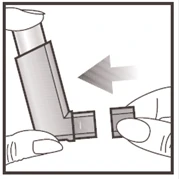
After use, always close the spray nozzle cap tightly to prevent dust from entering (Figure 6).
Important: Do not rush through steps 2, 3, 4, and 5.
It is important to inhale as slowly as possible starting from the beginning of inhaler use. For the first few times, use the inhaler in front of a mirror.
If your doctor has provided different instructions for using the inhaler, follow them and seek advice if any difficulties arise.
Children. Young children may require assistance, and it may be necessary for adults to administer inhalations. Ask the child to breathe out and administer the spray immediately after they begin to inhale. It is recommended to practice the technique together. Older children or weakened adults may hold the inhaler with both hands. Place both index fingers on top of the inhaler and both thumbs on the base below the mouthpiece.
Cleaning.
The inhaler should be cleaned at least once a week.
- Remove the metal canister from the plastic inhaler holder and remove the mouthpiece cap.
- Wash the plastic holder and mouthpiece cap with warm water.
- Dry them thoroughly inside and out.
- Replace the metal canister and mouthpiece cap.
DO NOT IMMERSE THE METAL CANISTER IN WATER.
Children
This medicinal product is not recommended for children under 4 years of age.
Overdose.
Symptoms.
Typical symptoms of salbutamol overdose include: tachycardia, palpitations, arrhythmia, restlessness, insomnia, chest pain, and pronounced tremor, especially of the hands, but possibly affecting the whole body. Nausea, dizziness, increased systolic blood pressure, and decreased diastolic blood pressure may also occur. Psychotic reactions have occasionally been observed after excessive doses of salbutamol. Overdose of salbutamol may lead to enhanced intracellular shift of potassium, resulting in hypokalemia, as well as hyperglycemia, hyperlipidemia, and hyperketonemia.
Treatment.
Treatment following overdose with β2-sympathomimetics is primarily symptomatic. Depending on individual circumstances, the following measures may be considered:
- For cardiovascular symptoms of salbutamol overdose, a cardioselective β-blocker may be used. However, β-blockers should be administered with caution and avoided, if possible, in patients with a history of bronchospasm. ECG monitoring is recommended for such patients.
In cases of significant hypotension, volume replacement (e.g., plasma expanders) is recommended.
- If hypokalemia develops, electrolyte balance should be monitored and electrolyte supplementation may be required as needed.
Adverse reactions.
The adverse reactions listed below are classified by organ systems and by frequency of occurrence: very common (≥ 1/10), common (≥ 1/100 and < 1/10), uncommon (≥ 1/1,000 and < 1/100), rare (≥ 1/10,000 and < 1/1,000), very rare (< 1/10,000), frequency not known (cannot be estimated from available data).
| Organ systems |
Frequency |
Symptoms |
| Immune system disorders |
very rare |
Hypersensitivity reactions (angioedema, urticaria, bronchospasm, arterial hypotension, collapse) |
| Metabolism and nutrition disorders |
rare |
Hypokalemia (especially in combination with xanthine derivatives, corticosteroids, and diuretics), increased serum lactate / lactic acid levels |
| Psychiatric disorders |
common |
Restlessness |
| rare |
Sleep disturbances and hallucinations (especially in children) |
|
| very rare |
Insomnia |
|
| Nervous system disorders |
common |
Headache, dizziness, muscle tremor |
| Cardiac disorders |
rare |
Palpitations, tachycardia |
| very rare |
Cardiac arrhythmia (including atrial fibrillation, supraventricular tachycardia, and extrasystoles), especially when used concomitantly with other β2-agonists |
|
| unknown |
Myocardial ischemia |
|
| Vascular disorders |
rare |
Peripheral vasodilation |
| Respiratory, thoracic and mediastinal disorders |
rare |
Throat irritation |
| very rare |
Paradoxical bronchospasm, accompanied by immediate increase in wheezing after administration (as with other inhaled therapies, paradoxical bronchospasm may occur immediately after inhalation; in such cases, salbutamol administration should be discontinued immediately and alternative treatment initiated if necessary) |
|
| Gastrointestinal disorders |
rare |
Oral irritation, nausea, vomiting, dry mouth, mouth pain |
| Skin and subcutaneous tissue disorders |
very rare |
Pruritus |
| Musculoskeletal and connective tissue disorders |
uncommon |
Myalgia |
| rare |
Muscle cramps |
|
| very rare |
Severe tremor (especially of the hands) |
Reporting of suspected adverse reactions.
Reporting of adverse reactions after marketing authorization of a medicinal product is of significant importance. It enables continuous monitoring of the benefit-risk balance of the medicinal product. Healthcare and pharmaceutical professionals, as well as patients or their legal representatives, should report all suspected adverse reactions and lack of efficacy via the Automated Pharmacovigilance Information System at the following link: https://aisf.dec.gov.ua
Shelf life. 2 years.
Storage conditions.
Store at temperatures not exceeding 25 °C in the original packaging.
Do not freeze.
Keep out of reach and sight of children.
Packaging.
200 doses per container with metering valve, spray nozzle, and actuator. One container per cardboard box.
Prescription status. Prescription only.
Manufacturer.
Cipla Ltd. (Unit II).
Manufacturer's address and location of operations.
Plots No. L-139, S-103 and M-62, Verna Industrial Estate, IN–403 722 Verna, Goa, India.