Aspangin
Ukraine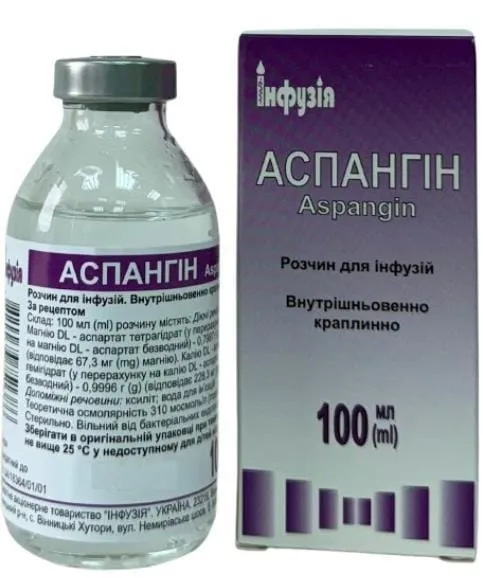
Table of Contents
INSTRUCTION FOR MEDICAL USE OF THE MEDICINAL PRODUCT ASPANGIN (ASPANGIN)
Composition:
Active substances: magnesium DL-aspartate tetrahydrate, potassium DL-aspartate hemihydrate;
100 ml of solution contain magnesium DL-aspartate tetrahydrate (calculated as anhydrous magnesium DL-aspartate) 0.7987 g (corresponds to 67.3 mg of magnesium); potassium DL-aspartate hemihydrate (calculated as anhydrous potassium DL-aspartate) 0.9996 g (corresponds to 228.3 mg of potassium);
Excipients: xylitol, water for injections.
Pharmaceutical form. Infusion solution.
Main physicochemical properties: clear, colorless or slightly yellowish liquid; theoretical osmolarity 310 mosmol/L, pH 6.0–7.4.
Pharmacotherapeutic group. Minerals. Magnesium preparations.
ATC code A12CC30.
Pharmacological Properties
Pharmacodynamics
Aspangin has antiarrhythmic properties and compensates for magnesium and potassium ion deficiencies.
Magnesium activates Na+/K+-ATPase, resulting in decreased intracellular sodium concentration and enhanced potassium influx into the cell. Reduced intracellular sodium concentration inhibits the sodium-calcium exchange in vascular smooth muscle cells, leading to their relaxation. Potassium ions stimulate the synthesis of ATP, glycogen, proteins, and acetylcholine. Potassium and magnesium maintain cellular membrane polarization.
Aspartate facilitates ion transport into cells and participates in energy metabolism. The antiarrhythmic effect is achieved due to the drug's ability to correct electrolyte imbalance and reduce myocardial excitability and conduction.
Pharmacokinetics
After intravenous infusion, the drug enters cardiomyocytes and vascular smooth muscle cells in the form of K+, Mg2+ ions and aspartate, and becomes involved in cellular metabolism. The pharmacokinetics of the drug have not been studied because the ions contained in the drug are naturally present in the human body, making such studies unfeasible.
Clinical characteristics.
Indications.
- Additional therapy in chronic heart diseases (in heart failure, post-infarction period), in cardiac arrhythmias, primarily ventricular arrhythmias;
- additional therapy in treatment with cardiac glycosides.
Contraindications.
- Hypersensitivity to the components of the medicinal product;
- acute and chronic renal failure;
- Addison's disease;
- third-degree atrioventricular block;
- cardiogenic shock (BP < 90 mm Hg).
Interaction with other medicinal products and other types of interactions.
The drug improves tolerance of cardiac glycosides, enhances the effect of medicinal products stimulating myocardial trophic processes; prevents development of hypokalemia caused by the use of diuretics, corticosteroids, and cardiac glycosides. When used concomitantly with potassium-sparing diuretics, ACE inhibitors, beta-blockers, cyclosporine, heparin, and nonsteroidal anti-inflammatory drugs, the risk of hyperkalemia increases (plasma potassium levels should be monitored).
The drug reduces cardiotoxic effects of cardiac glycosides. Administration of the drug may require an increase in the individual maintenance dose of cardiac glycosides.
When used concomitantly with non-depolarizing muscle relaxants, neuromuscular blockade is enhanced; when used with anesthetic agents (ketamine, hexenal, halothane), central nervous system depression occurs.
Special precautions for use.
Rapid administration may cause facial hyperemia.
With prolonged use of the drug, blood potassium and magnesium levels should be monitored, and regular monitoring of electrolyte balance parameters and electrocardiogram (ECG) data is required.
Asparagin, being a medicinal product containing potassium and magnesium, should be administered with caution to patients with myasthenia gravis and in conditions that may lead to hyperkalemia, such as impaired renal function, acute dehydration, and extensive tissue damage, particularly in severe burns. In these patient groups, regular assessment of serum electrolyte levels is recommended.
Since xylitol has choleretic properties, administration of the drug in patients with cholelithiasis should be performed under physician supervision. Administration of the drug to patients with diabetes mellitus should be carried out under blood glucose monitoring.
Use during pregnancy or breastfeeding.
To date, no risks have been reported with the use of this medicinal product in pregnant or breastfeeding women.
Ability to affect reaction rate when driving or operating machinery.
The medicinal product does not impair the ability to drive or operate machinery.
Administration and Dosage
The medicinal product is intended for intravenous use only.
For adults, 200–300 mL should be administered slowly by intravenous infusion 1–2 times daily, but not exceeding 600 mL per day. The infusion rate should be 20–25 drops per minute. The medicinal product may be used as part of combination therapy. The treatment duration is determined by the physician.
Children
There is insufficient experience regarding the use of this medicinal product in children; therefore, it is not recommended for this age group.
Overdose
Cases of overdose have not been reported.
Due to the kidneys' ability to excrete large amounts of potassium, increased dosage may lead to hyperkalemia only if associated with acute or marked impairment of potassium excretion.
The therapeutic index of magnesium is wide, and serious adverse effects are very rare in the absence of renal insufficiency.
Symptoms of hyperkalemia/hypermagnesemia may occur following rapid intravenous administration.
In the event of overdose, symptoms of hyperkalemia and hypermagnesemia may be observed.
Symptoms of hyperkalemia: general weakness, paresthesia, bradycardia, paralysis. Extremely high plasma potassium concentrations may lead to fatal outcomes due to cardiac depression, arrhythmias, or cardiac arrest.
Symptoms of hypermagnesemia: nausea, vomiting, drowsiness, arterial hypotension, bradycardia, weakness, slurred speech, double vision. With very high plasma magnesium concentrations, hyporeflexia, muscular paralysis, respiratory arrest, and cardiac arrest may develop.
In case of overdose, K+-, Mg2+-aspartate should be discontinued; symptomatic treatment is recommended (e.g., intravenous calcium chloride 100 mg/min, dialysis if necessary).
Adverse reactions.
Gastrointestinal system: dyspeptic symptoms, nausea, vomiting, diarrhea, stomach pain, flatulence, thirst.
Cardiovascular system: intraventricular conduction disturbances, decreased arterial pressure.
Nervous system: asthenia, disorientation, hyporeflexia, dizziness, paresthesias, seizures.
Skin: possible allergic reactions including hyperemia, itching, rash, swelling.
Respiratory system: respiratory depression, dyspnea.
Local reactions at site of administration: phlebitis, venous thrombosis.
General disorders: muscle weakness, sensation of warmth, increased sweating.
With rapid intravenous administration — hyperkalemia, hypermagnesemia. Symptoms: muscle hypotonia, limb paresthesias, slowed AV conduction, arrhythmias, cardiac arrest.
Shelf life. 5 years.
Storage conditions. Store in original packaging at a temperature not exceeding 25 °C, in a place inaccessible to children.
Packaging. 100 ml, 200 ml or 400 ml in a bottle, 1 bottle per carton.
Prescription status. Prescription only.
Manufacturer: Private Joint-Stock Company "Infuziya".
Manufacturer's address and location of its business activity:
84A Nemirovskе Highway, village Vinnitski Khotory, Vinnitsa district, Vinnitsa region, 23219, Ukraine.