Ascorutin
Ukraine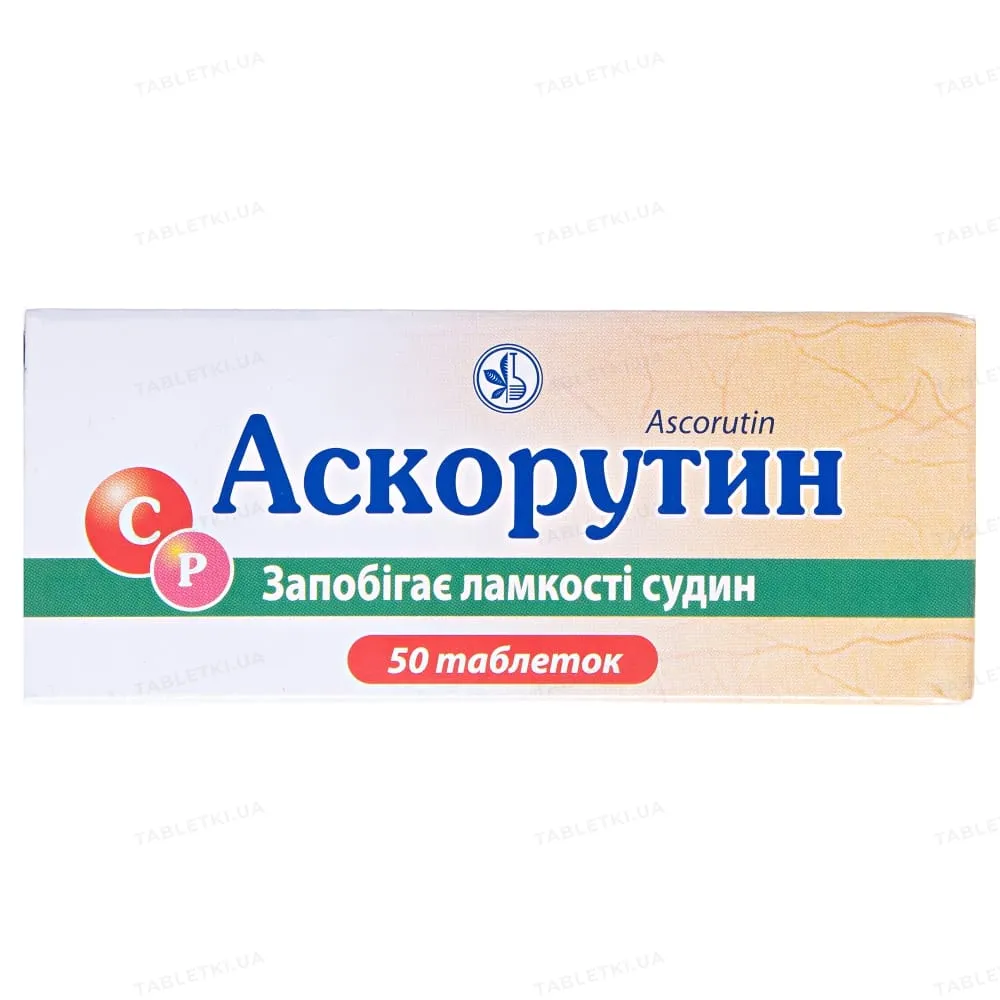
Table of Contents
INSTRUCTION FOR MEDICAL USE OF THE MEDICINAL PRODUCT AСCORUTIN (ASCORUTIN)
Composition:
Active ingredients: ascorbic acid, rutin;
One tablet contains ascorbic acid equivalent to 100% substance 50 mg, rutin equivalent to 100% anhydrous substance 50 mg;
Excipients: sugar, potato starch, corn starch, magnesium stearate, talc.
Medicinal form. Tablets.
Main physicochemical properties: tablets of light greenish-yellow color with flat surface and bevelled edge. Specks on the tablet surface may be present.
Pharmacotherapeutic group. Capillary stabilizing agents. Bioflavonoids. Rutoside, combinations. ATC code С05С А51.
Pharmacological properties.
Pharmacodynamics.
A combination medicinal product whose effects are determined by the actions of its constituent components.
Rutoside (vitamin P) promotes the conversion of ascorbic acid into dehydroascorbic acid and prevents the further transformation of the latter into diketogulonic acid. Therefore, most of the effects of rutoside are mediated through ascorbic acid.
Rutoside in combination with ascorbic acid reduces capillary permeability and fragility, strengthens the cellular membrane, decreases platelet aggregation, exerts anti-inflammatory effects (including through inhibition of hyaluronidase activity), and possesses antioxidant properties. It participates in redox processes.
In addition, rutoside has the following effects: reduction of exudation of the liquid portion of blood plasma and diapedesis of blood cells through the vessel wall; choleretic and mild antihypertensive effects.
In patients with chronic venous insufficiency, rutoside helps reduce edema and pain syndromes, trophic disorders, and diminishes or eliminates paresthesias and cramps. It reduces the severity of adverse effects of radiation therapy (cystitis, enteroproctitis, dysphagia, skin erythema) and also slows the progression of diabetic retinopathy.
Pharmacokinetics.
Each vitamin contained in the medicinal product undergoes its characteristic transformations. Ascorbic acid is rapidly absorbed primarily in the duodenum and small intestine. Within 30 minutes after administration, the concentration of ascorbic acid in the blood rises significantly, and tissue uptake begins. During this process, ascorbic acid is initially converted into dehydroascorbic acid, which penetrates through cell membranes without energy expenditure and is rapidly reduced within the cell. Ascorbic acid in tissues is almost exclusively intracellular and exists in three forms: ascorbic acid, dehydroascorbic acid, and ascorbigen (bound ascorbic acid). It is unevenly distributed among organs. High concentrations are found in endocrine glands, particularly in the adrenal glands; lower concentrations are found in the brain, kidneys, liver, and cardiac and skeletal muscles. The concentration of ascorbic acid in leukocytes and platelets is higher than in blood plasma. It is metabolized and excreted almost 90% by the kidneys, primarily as oxalate, and partially in the free form.
Rutoside, absorbed in the gastrointestinal tract, promotes the transport and deposition of ascorbate. It is excreted unchanged and as metabolites, predominantly via bile and to a lesser extent in urine.
The elimination half-life is 10–25 hours.
Clinical characteristics.
Indications.
- Deficiency of rutin and ascorbic acid.
- Diseases associated with increased vascular permeability — use Ascorutin as part of combination therapy.
- For prevention of colds and reduction of flu symptoms.
- For immune system enhancement.
Contraindications.
- Hypersensitivity to any component of the medicinal product.
- Increased blood coagulation, thrombophlebitis, predisposition to thrombosis.
- Gout, urolithiasis with urate stone formation, cystinuria, hypokalemia and hypercalcemia, oxaluria.
- Diabetes mellitus.
- Severe kidney diseases.
- Concomitant use with sulfonamides or aminoglycosides.
- Fructose intolerance, glucose-galactose malabsorption syndrome.
Interaction with other medicinal products and other types of interactions.
Acetylsalicylic acid, oral contraceptives: decreased absorption of the medicinal product.
Ascorbic acid at doses ≥1 g increases the bioavailability of oral contraceptives (estrogens, including ethinylestradiol), increases blood concentration of salicylates, enhancing their adverse effects (risk of crystalluria, effect on gastric mucosa).
Acetylsalicylic acid, barbiturates, tetracyclines: increased urinary excretion of ascorbic acid.
Penicillin (including benzylpenicillin), tetracyclines, iron preparations: high doses of ascorbic acid may increase their absorption and blood concentration.
Deferoxamine (desferrioxamine): increased iron absorption, iron excretion in urine; increased tissue toxicity of iron, especially cardiotoxicity, which may lead to circulatory decompensation. Cases of cardiac dysfunction (usually reversible after discontinuation of vitamin C) have been reported in patients with idiopathic hemochromatosis and thalassemia who received deferoxamine and high doses of ascorbic acid (more than 500 mg/day). Use of this combination in these patient groups requires caution and careful monitoring of cardiac function. Ascorbic acid may be taken only 2 hours after deferoxamine injection.
Heparin, indirect anticoagulants, phenothiazines, fluphenazine, sulfonamide drugs, aminoglycoside antibiotics: reduced effectiveness of these drugs.
Cyclosporine A: possible reduction of its bioavailability.
Vitamins of group B: mutual enhancement of therapeutic effect. High doses of ascorbic acid affect the resorption of vitamin B12.
Corticosteroids, paracetamol: increased half-life of the latter when high doses of ascorbic acid are used (this interaction has no clinical consequences when therapeutic doses are administered).
Calcitonin: increased rate of ascorbic acid absorption.
Amphetamine: increased renal excretion of amphetamine when high doses of ascorbic acid are used.
Aluminum-containing antacids: it should be noted that ascorbic acid promotes intestinal absorption of aluminum, possibly increasing urinary elimination of aluminum. Concomitant use of antacids and ascorbic acid is not recommended, especially in patients with renal insufficiency.
If long-term treatment (over 4 weeks) is required, Ascorutin should not be prescribed simultaneously with cardiac glycosides, antihypertensive agents, or nonsteroidal anti-inflammatory drugs, as it may potentiate their effects.
Ascorbic acid increases urinary excretion of oxalates, thereby increasing the risk of calcium oxalate stone formation in urine.
Combined use of very high doses of ascorbic acid with amygdalin (complementary medicine) increases the risk of cyanide toxicity.
Smoking, alcohol reduce plasma ascorbate concentration.
Disulfiram: prolonged use of large doses of ascorbic acid inhibits the "disulfiram–alcohol" reaction.
High-dose ascorbic acid (over 2 g/day) may affect biochemical test results for plasma and urine levels of creatinine, uric acid, and glucose, as well as blood levels of inorganic phosphates, liver enzymes, and bilirubin. Fecal occult blood screening tests may yield false-negative results.
Concomitant use with alkaline drinks or consumption of fresh fruit or vegetable juices reduces absorption of ascorbic acid.
Special precautions for use.
Concomitant use of the medicinal product with alkaline drinks, fresh fruit or vegetable juices reduces the absorption of vitamin C. The absorption of ascorbic acid may be impaired in intestinal dyskinesia, enteritis, and achylia.
Since ascorbic acid enhances iron absorption, its use in high doses may be hazardous for patients with hemochromatosis, thalassemia, polycythemia, leukemia, or sideroblastic anemia. Patients with high iron levels in the body should use the drug at minimal doses.
Ascorbic acid should be used with caution in patients with glucose-6-phosphate dehydrogenase deficiency and in patients with a history of kidney disease.
With prolonged use of high doses of ascorbic acid, kidney function, arterial blood pressure, and pancreatic function should be monitored.
In patients with urolithiasis (kidney stones), the daily dose of ascorbic acid should not exceed 1 g. Large doses of the drug should not be prescribed to patients with increased blood coagulation.
Since ascorbic acid has a mild stimulating effect, it is not recommended to take the medicinal product late in the day.
Ascorbic acid may alter the results of several laboratory tests (see section "Interaction with other medicinal products and other types of interactions").
The medicinal product contains sugar, which should be taken into account in patients with diabetes mellitus.
Use during pregnancy or breastfeeding.
During pregnancy, the medicinal product may be used only after consultation with a physician. Ascorutin is contraindicated in the first trimester of pregnancy. In the second and third trimesters of pregnancy or during breastfeeding, the drug should be prescribed considering the benefit/risks ratio for the woman and for the fetus/child, provided that recommended doses and treatment duration are strictly followed.
According to available clinical data on the use of rutin and vitamin C as individual medicinal products in pregnant women, no significant risks to the fetus have been identified. However, adequate and well-controlled clinical studies on the safety of combined preparations containing vitamin C and rutin in pregnant women have not been conducted.
There are no reports of embryotoxicity of rutin or its passage into breast milk.
Vitamin C is excreted in breast milk; however, even doses 10 times higher than the recommended daily dose do not lead to a significant increase in its concentration in breast milk.
Ability to influence reaction rate when driving vehicles or operating machinery.
There are no data on the effect of Ascorutin on the ability to drive vehicles or operate other machinery.
Method of Administration and Dosage.
The medicinal product should be taken orally after meals. Tablets should be swallowed whole with a small amount of water.
For therapeutic purposes, the recommended dosage is: adults – 1 tablet 3 times daily; children aged 3 years and older – 1 tablet 2 times daily. For prophylactic use, the recommended dosage is: adults – 1 tablet 2 times daily; children aged 3 years and older – 1 tablet daily.
The duration of treatment course is 3–4 weeks (depending on the nature of the disease and treatment efficacy).
Children.
The medicinal product is indicated for children aged 3 years and older.
Overdose.
Symptoms: epigastric pain, nausea, vomiting, diarrhea, itching and skin rashes, increased nervous system excitability, headache, elevated arterial pressure, thrombosis. Exacerbation of adverse reactions may occur.
Overdose may lead to changes in renal excretion of ascorbic and uric acids during urine acidification, with a risk of precipitation of oxalate calculi.
Prolonged use in high doses may result in suppression of the pancreatic islet apparatus function and impaired kidney function.
Ascorbic acid in doses exceeding 3 g/day may cause acidosis or hemolytic anemia in individuals with glucose-6-phosphate dehydrogenase deficiency.
Treatment: gastric lavage, administration of sorbents, symptomatic therapy.
Adverse Reactions.
Central nervous system: headache, fatigue, sleep disturbances, increased central nervous system excitability with prolonged use at high doses.
Renal and urinary tract: acidification of urine, hyperoxaluria in patients at risk when doses exceed 1 g/day; with prolonged use at high doses — glomerular apparatus damage, formation of urate and oxalate stones in the urinary tract, renal failure. Doses of ascorbic acid exceeding 600 mg/day have a diuretic effect.
Hematological system: with prolonged use at high doses — thrombocytosis, hyperprothrombinemia, thrombus formation, erythrocytopenia, neutrophilic leukocytosis, hemolytic anemia in some individuals with glucose-6-phosphate dehydrogenase deficiency.
Metabolic system: hypervitaminosis C, impaired tissue trophism, with prolonged use at high doses — suppression of pancreatic islet apparatus function (hyperglycemia, glucosuria) and glycogen synthesis, sodium and fluid retention, disturbances in zinc and copper metabolism.
Cardiovascular system: with prolonged use at high doses — myocardial dystrophy, increased arterial pressure, development of microangiopathies.
Gastrointestinal tract: with prolonged use at high doses — gastrointestinal mucosa irritation, heartburn, stomach spasms, nausea, vomiting, diarrhea.
Immune system: hypersensitivity reactions, including skin hyperemia, skin rashes, eczema, pruritus, angioedema (Quincke's edema), urticaria, anaphylactic shock, respiratory hypersensitivity reactions.
Shelf life.
3 years.
Storage conditions.
Store in the original packaging at a temperature not exceeding 25°C.
Keep out of reach of children.
Packaging.
10 tablets per blister; 3 or 5 blisters per carton.
Prescription status.
Over-the-counter.
Manufacturer.
JSC "VITAMINS".
Manufacturer's address and place of business.
31 Uspenska Street, Uman, Cherkasy region, 20300, Ukraine.
Marketing authorization holder.
JSC "VITAMINS".
Address of the marketing authorization holder.
31 Uspenska Street, Uman, Cherkasy region, 20300, Ukraine.