Ascoril expectorant
Ukraine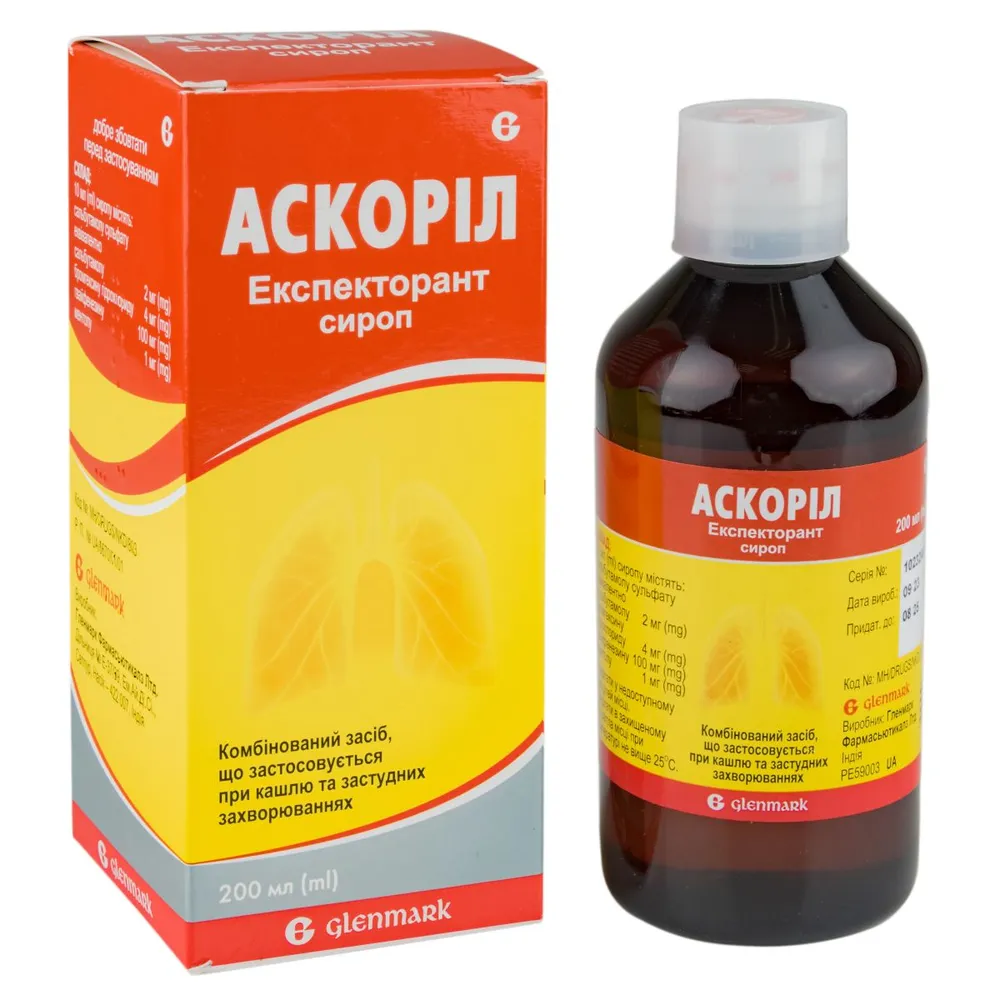
Table of Contents
INSTRUCTIONS FOR MEDICAL USE OF THE MEDICINAL PRODUCT ASCORIL EXPECTORANT (ASCORILEXPECTORANT)
Composition:
Active substances: salbutamol sulfate, bromhexine hydrochloride, guaifenesin, menthol;
10 ml of syrup contains salbutamol sulfate equivalent to 2 mg of salbutamol, bromhexine hydrochloride 4 mg, guaifenesin 100 mg, menthol 1 mg;
Excipients: sucrose, sodium benzoate (E 211), citric acid monohydrate, sorbitol solution 70% (E 420), glycerin, propylene glycol, sorbic acid, pineapple and blackcurrant flavourings ID 20158, yellow FCF colouring agent (E 110), purified water.
Pharmaceutical form. Syrup.
Main physicochemical properties: clear, viscous, orange-coloured liquid.
Pharmacotherapeutic group. Medicinal products used for cough and colds. Expectorants. Combinations.
ATC code R05C A10.
Pharmacological properties.
Pharmacodynamics. Ascoril Expectorant is a combination drug with bronchodilating, mucolytic, and expectorant properties. Due to the rational combination of salbutamol, bromhexine hydrochloride, guaifenesin, and menthol, it effectively and rapidly alleviates bronchopulmonary system dysfunction.
Salbutamol, a selective β2-adrenoreceptor agonist, effectively dilates the bronchi for a prolonged period. At therapeutic doses, it does not cause cardiac stimulation. Bromhexine hydrochloride reduces sputum viscosity and promotes its clearance from the bronchi. Guaifenesin relaxes and clears mucus from the bronchi, facilitating expectoration. Menthol relieves symptoms of irritation and inflammation in the respiratory mucosa.
Pharmacokinetics. Specific pharmacokinetic studies of the drug have not been conducted.
Clinical characteristics.
Indications.
Secretolytic therapy in respiratory tract diseases accompanied by bronchospasm and formation of viscous, difficult-to-expectorate secretions: in tracheobronchitis, chronic obstructive pulmonary diseases, bronchial asthma, pulmonary emphysema.
Contraindications.
Hypersensitivity to salbutamol, other sympathomimetics, bromhexine, guaifenesin, menthol, or to any other component of the drug. Arrhythmia, severe cardiovascular diseases, hyperthyroidism, severe hepatic dysfunction, gastric and duodenal ulcer.
Interaction with other medicinal products and other types of interactions.
Hypokalemia, which may develop during treatment with drugs containing salbutamol, can be exacerbated by concomitant use of diuretics. This increases the risk of developing arrhythmias when cardiac glycosides are used during such treatment. The effects of salbutamol may be reduced when used concomitantly with β-adrenergic blockers, especially non-selective ones (such as propranolol), and may be enhanced when used concomitantly with xanthines (e.g., theophylline).
Salbutamol should not be used concomitantly with inhalation anesthetics, epinephrine, tricyclic antidepressants, and corticosteroids.
Bromhexine should not be administered simultaneously with medicinal products containing codeine. Concomitant use of bromhexine and drugs that irritate the gastrointestinal tract may lead to mutual enhancement of mucosal irritation in the stomach. Concurrent administration with antibiotics (amoxicillin, erythromycin, cefuroxime, doxycycline) and sulfonamides promotes increased concentrations of these drugs in bronchial secretions. Concurrent use with drugs that suppress the cough center may impair the clearance of liquefied sputum (accumulation of bronchial secretions in the airways). Concurrent use with bronchodilators is possible.
Guaifenesin potentiates the effects of medicinal products that depress the central nervous system, as well as those of ethanol. It may also cause false-positive results in diagnostic tests for 5-hydroxyindoleacetic acid and vanillylmandelic acid in urine.
There are no data on negative interactions of menthol with other medicinal products.
Special precautions for use.
Shake well before use.
The drug should be used with caution in patients with essential or symptomatic hypertension, ischemic heart disease and other cardiovascular disorders, as well as in patients suffering from subcompensated diabetes mellitus, glaucoma.
Very rarely, severe skin reactions such as Stevens–Johnson syndrome and Lyell’s syndrome have been observed during bromhexine treatment. If skin or mucous membrane changes occur, medical advice must be sought immediately and administration of the drug should be discontinued.
The drug should be used with particular caution in patients with impaired bronchial motility associated with production of large amounts of bronchial secretions (i.e. primary ciliary dyskinesia), due to the possible accumulation of secretions.
Particular caution is required in patients with renal impairment (including severe renal insufficiency) or liver disorders (in cases of mild to moderate hepatic insufficiency), with dose reduction or increased dosing intervals recommended.
Periodic monitoring of liver function is recommended, especially during prolonged treatment. Propylene glycol contained in the formulation may cause symptoms resembling alcohol intoxication in children.
The drug contains sucrose; therefore, it is contraindicated in patients with rare hereditary fructose intolerance, sucrase-isomaltase deficiency, or glucose-galactose malabsorption syndrome.
Blood glucose levels should be monitored before and during treatment in such patients.
Isolated cases of myocardial ischemia associated with salbutamol use have been reported. Patients with heart disease (e.g. ischemic heart disease) treated with salbutamol sulfate should seek immediate medical attention if chest pain or other symptoms suggestive of worsening cardiac disease occur. Symptoms such as dyspnea and chest pain should be carefully evaluated, as they may result from either cardiac or respiratory disorders.
Treatment with β2-agonists may result in severe hypokalemia; therefore, serum potassium levels should be monitored.
Like other β-adrenergic agonists, salbutamol sulfate may cause reversible metabolic changes, such as increased blood glucose levels. In this context, isolated cases of ketoacidosis have been reported in patients with diabetes mellitus. Concomitant use of corticosteroids may exacerbate this condition.
Do not administer to patients prior to anesthesia.
The drug is contraindicated in patients with hypertrophic cardiomyopathy.
Syrup should be used under medical supervision in patients with a history of gastrointestinal bleeding. Adequate fluid intake is recommended during treatment, as this enhances the expectorant effect of bromhexine.
The dye tartrazine (E 110) present in the medicinal product may cause allergic reactions.
Use during pregnancy or breastfeeding.
Do not use.
Effect on ability to drive or operate machinery.
During treatment with this drug, it is advisable to avoid driving vehicles or operating machinery requiring rapid psychomotor reactions, attention, or concentration.
Dosage and Administration.
The medication should be used as prescribed and under medical supervision.
For adults and children aged 12 years and older: 10 ml three times daily.
For children aged 6 to 12 years: 5–10 ml three times daily.
For children aged 2 to 6 years: 5 ml three times daily.
The duration of treatment is determined individually by a physician.
Children.
The medication is not recommended for children under 2 years of age due to lack of experience with its use in this age group.
Overdose.
Symptoms: tachycardia, tremor, seizures, gastrointestinal discomfort, nausea, vomiting, extrasystoles, hypotension, chest pain, hypokalemia, ataxia, diplopia, drowsiness, metabolic acidosis, rapid breathing, headache, palpitations, arrhythmia, hyperglycemia, abdominal pain, exacerbation of peptic ulcer disease, excitement, confusion, and respiratory depression.
Treatment: symptomatic therapy.
Adverse reactions.
Immune system disorders: hypersensitivity reactions including rash, pruritus, anaphylactic reactions, including drug hypersensitivity syndrome with eosinophilia and systemic symptoms, anaphylactic shock, angioedema, urticaria, oropharyngeal swelling, Lyell’s syndrome; rarely, following oral administration of salbutamol in children, multiforme erythema, Stevens–Johnson syndrome, acute generalized exanthematous pustulosis, and facial swelling may occur.
Gastrointestinal disorders: dyspeptic symptoms, nausea, vomiting, diarrhea, abdominal pain, exacerbation of gastric/duodenal ulcer, gastralgia, unpleasant taste in the mouth.
Nervous system disorders: tremor, myalgia, headache, hyperactivity, dysgeusia, dizziness, restlessness, insomnia.
Cardiovascular system disorders: tachycardia; peripheral vasodilation; cardiac arrhythmias, including ventricular fibrillation, supraventricular tachycardia, and extrasystoles; hypotension or hypertension; palpitations; myocardial ischemia; collapse.
Respiratory system disorders: respiratory disorders, increased coughing.
Salbutamol may provoke paradoxical bronchospasm, which is a life-threatening condition. If this occurs, the drug must be discontinued immediately and alternative therapy initiated.
Other: muscle cramps, sensation of muscle pressure, hyperthermia, chills, mydriasis, urinary bladder atony, increased sweating, thrombocytopenia, metabolic changes such as hypokalemia.
In some patients, transient elevation of blood aminotransferase levels may develop due to bromhexine.
Shelf life.
2 years.
Storage conditions.
Store in a light-protected place at a temperature not exceeding 25 °C.
Keep out of reach of children.
Packaging.
100 ml or 200 ml in bottles; 1 bottle with a measuring cap in a cardboard package.
Prescription status.
Prescription only.
Manufacturer.
Glenmark Pharmaceuticals Ltd.
Manufacturer's address and place of business.
- Plot No E-37/39, M.I.D.C., Industrial Estate, Satpur, Nasik – 422 007, India.
- Village Kishanpura, Baddi-Nalagarh Road, Tehsil Baddi, Distt. Solan (H.P.) 173 205, India.