Artrokol
Ukraine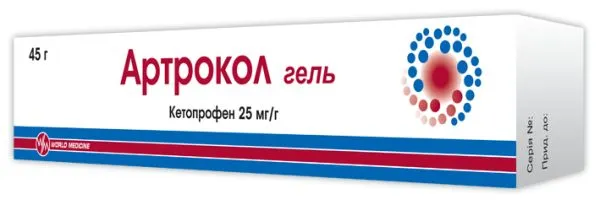
Table of Contents
INSTRUCTIONS FOR MEDICAL USE OF THE MEDICINAL PRODUCT ARTROCOL (ARTROCOL)
Composition:
Active ingredient: ketoprofen;
1 g of gel contains ketoprofen 25 mg;
Excipients: carbomer 980, triethanolamine, 96 % ethanol, methylparaben (E 218), purified water.
Pharmaceutical form. Gel.
Main physicochemical properties: homogeneous transparent gel.
Pharmacotherapeutic group.
Non-steroidal anti-inflammatory drugs for topical use. ATC code M02A A10.
Pharmacological properties.
Pharmacodynamics.
Ketoprofen belongs to the group of nonsteroidal anti-inflammatory drugs (NSAIDs), derivatives of arylpropionic acid. Its mechanism of action is associated with inhibition of prostaglandin synthesis. It exerts local analgesic, anti-inflammatory, and anti-exudative effects.
Pharmacokinetics.
Plasma and tissue levels of ketoprofen were measured in 24 patients undergoing knee surgery. After repeated topical application of ketoprofen as a gel, its plasma concentration was approximately 60 times lower (9–39 ng/g) compared to a single oral dose of ketoprofen (490–3300 ng/g). The tissue concentration of ketoprofen at the site of application was within a similar concentration range for both the gel and oral formulations, although the gel demonstrated significantly higher inter-individual variability.
The bioavailability of ketoprofen after topical application is approximately 5% of that after oral administration (based on urinary excretion data).
The extent of plasma protein binding is approximately 99%. Ketoprofen is primarily excreted by the kidneys in the form of a glucuronide conjugate.
Clinical characteristics.
Indications.
- Relief of acute painful conditions of the musculoskeletal system caused by injury, such as sports injuries, dislocations, sprains, and contusions.
- Pain associated with mild arthritis.
Contraindications.
- Known hypersensitivity reactions, such as symptoms of bronchial asthma or allergic rhinitis, occurring after administration of ketoprofen, fenofibrate, tiaprofenic acid, acetylsalicylic acid, or other NSAIDs.
- Hypersensitivity to other components of the medicinal product.
- History of photosensitization reactions.
- History of skin allergic reactions following use of dexketoprofen, ketoprofen, tiaprofenic acid, fenofibrate, ultraviolet (UV) blockers, or perfumed products.
- Exposure to sunlight (even diffused light) or UV irradiation in solarium during treatment and within 2 weeks after discontinuation of the medicinal product.
- Use in the presence of skin pathologies such as eczema or acne.
- Application to infected skin, open wounds, mucous membranes, anal or genital areas, eyes, or under occlusive dressings.
- Use during the third trimester of pregnancy.
Interaction with other medicinal products and other forms of interaction.
Systemic absorption of ketoprofen following topical application is very low; therefore, interactions are unlikely.
No reports of interaction with other medicinal products have been received; however, the following interactions have been observed with oral formulations of ketoprofen or other NSAIDs.
Serious interactions have been reported when NSAIDs, including ketoprofen, are used concomitantly with methotrexate.
Special precautions for use
The medicinal product should be used with caution in patients with cardiac, hepatic, or renal impairment. There have been reports of isolated cases of systemic adverse reactions associated with renal damage.
Topical application of large amounts of ketoprofen may lead to systemic effects such as hypersensitivity and bronchial asthma. Patients with bronchial asthma in combination with chronic rhinitis, chronic sinusitis, and/or nasal polyps have a higher risk of developing allergy to acetylsalicylic acid and/or NSAIDs than the general population.
Serious skin reactions, such as Stevens–Johnson syndrome, have been reported in association with the use of NSAIDs, including ketoprofen gel. Patients using the medicinal product should be informed about the signs and symptoms of serious skin reactions. If skin rash, mucosal lesions, or any other signs of hypersensitivity occur, the use of the medicinal product should be discontinued immediately.
Do not exceed the recommended duration of treatment, as the risk of developing contact dermatitis and photosensitivity reactions increases over time.
Additionally, the following precautionary measures should be observed during use of the medicinal product:
- Hands should be thoroughly washed after each application of the gel;
- If any skin reactions occur, including those related to concomitant use of medicinal products containing octocrylene (some cosmetic or hygiene products), use should be stopped immediately;
- The gel should not be applied under occlusive dressings;
- The gel should not be applied to mucous membranes or into the eyes;
- The gel should not be used near open flames, as it contains alcohol;
- The gel should not be diluted.
Exposure to sunlight (even on cloudy days) or ultraviolet (UV) radiation in solariums during topical application of ketoprofen may cause potentially serious skin reactions (photosensitization). To prevent photosensitivity reactions, skin areas treated with the gel should be protected with clothing during treatment and for 2 weeks after discontinuation of treatment. Solarium use should also be avoided during treatment and for 2 weeks after discontinuation.
The product contains ethanol; however, no special precautions related to the dose or route of administration of ethanol are required.
The medicinal product contains methylparaben (E 218), which may cause allergic reactions (possibly delayed).
Use during pregnancy or breastfeeding
First and second trimesters of pregnancy
No embryotoxic effects have been observed in animals. There are no clinical data on the use of topical forms of ketoprofen during pregnancy. Even though systemic exposure is lower compared to oral administration, it is unknown whether systemic exposure to ketoprofen achieved after topical application may be harmful to the embryo/fetus. During the first and second trimesters of pregnancy, the medicinal product should not be used except in cases of extreme necessity. If used, the dose should be as low as possible and the duration of treatment as short as possible.
Third trimester of pregnancy
During the third trimester of pregnancy, systemic use of prostaglandin synthetase inhibitors, including ketoprofen, may cause cardiopulmonary and renal toxicity in the fetus. Prolonged bleeding may occur in both mother and child towards the end of pregnancy, and labor may be prolonged. Therefore, the use of the medicinal product is contraindicated during the third trimester of pregnancy (see section "Contraindications").
Period of breastfeeding
Ketoprofen passes into breast milk in minimal amounts. The medicinal product should not be used during breastfeeding.
Ability to affect reaction speed when driving or operating machinery
Appropriate studies are lacking.
Method of Administration and Dosage
The medicinal product is intended for topical application (on the skin).
Apply the gel in a thin layer to the affected skin area 2–4 times daily and gently rub in until completely absorbed. The usual recommended dose of the gel is 15 g (14 cm of gel corresponds to 7.5 g). The duration of treatment is 7 days.
Elderly Patients
There are no specific dosage recommendations for elderly patients.
Children
The medicinal product must not be used in children.
Overdose
Overdose is unlikely with topical (cutaneous) application.
In case of accidental ingestion of the gel, systemic adverse reactions may occur depending on the amount ingested. If such reactions develop, supportive and symptomatic treatment should be administered.
Adverse Reactions
Adverse reactions are categorized by organ systems and frequency of occurrence: very common (≥ 1/10), common (≥1/100, <1/10), uncommon (≥1/1000, <1/100), rare (≥1/10,000, <1/1000), very rare (<1/10,000), frequency not known (frequency cannot be estimated from available data).
Immune system disorders:
Frequency not known – hypersensitivity reactions, including anaphylactic shock, angioedema.
Skin and subcutaneous tissue disorders:
Uncommon – local skin reactions such as erythema, eczema, pruritus, burning sensation; rare – photosensitivity reactions, urticaria; very rare – bullous and vesicular eczema, which may spread and become generalized; frequency not known – Stevens-Johnson syndrome.
Renal and urinary disorders:
Very rare – worsening of pre-existing renal impairment.
Reporting of suspected adverse reactions
Reporting of suspected adverse reactions after the medicine has been authorized is important. It allows continued monitoring of the benefit-risk balance of the medicine. Healthcare professionals should report any suspected adverse reactions via the national pharmacovigilance system.
Shelf life.
3 years.
Storage conditions.
Store at temperatures not exceeding 25 °C. Keep out of the reach of children.
Packaging.
45 g of gel in a tube; 1 tube per cardboard box.
Prescription status.
Prescription-only medicine.
Manufacturer.
K.O. SLAVIA PHARM S.R.L., Romania /
S.C. SLAVIA PHARM S.R.L., Romania.
Manufacturer's address and place of business.
Boulevard Theodor Pallady No. 44 C, sector 3, 032266, Bucharest /
Bulevardul Theodor Pallady nr. 44 C, sectorul 3, 032266, București.
Marketing Authorization Holder.
WORLD MEDICINE, LLC, Ukraine /
ТОВ «УОРЛД МЕДИЦИН», Україна.