Artejia® complex
Ukraine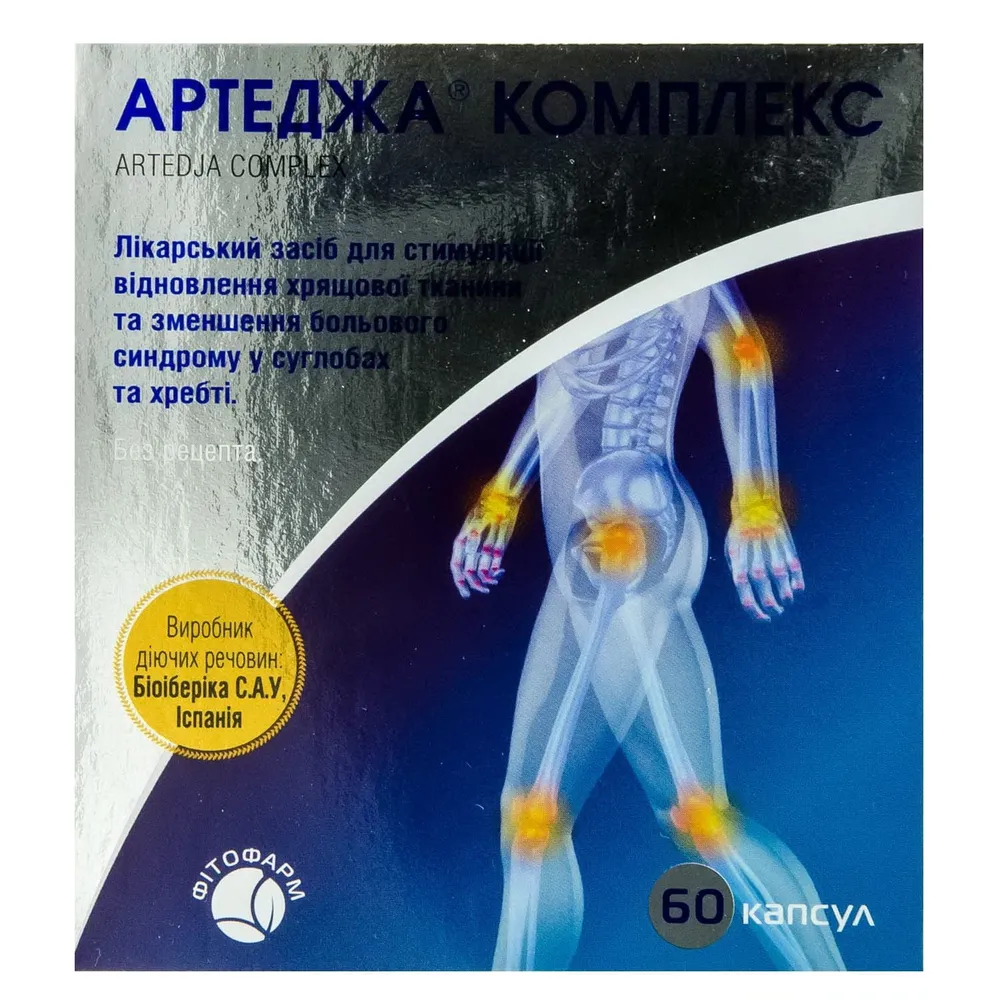
Table of Contents
INSTRUCTION FOR MEDICAL USE OF THE MEDICINAL PRODUCT AREDJA® COMPLEX (ARTEDJA COMPLEX)
Composition:
Active substances: glucosamine hydrochloride, sodium chondroitin sulfate;
1 capsule contains glucosamine hydrochloride equivalent to 100% substance 500 mg, sodium chondroitin sulfate equivalent to 100% substance 400 mg;
Excipients: sodium croscarmellose, magnesium stearate.
Pharmaceutical form. Capsules.
Main physico-chemical properties: hard gelatin capsules with colorless transparent body and colorless transparent cap.
The capsule contents – white powder with a yellowish tinge.
Pharmacotherapeutic group.
Agents used in disorders of the musculoskeletal system.
ATC code M09AX.
Pharmacological Properties.
Pharmacodynamics.
Arteza® Complex is a combination drug intended to stimulate the regeneration of cartilage tissue. The drug's action is due to its constituent components.
Chondroitin sodium sulfate is a high-molecular-weight mucopolysaccharide involved in the formation of cartilage tissue. It reduces the activity of enzymes that degrade articular cartilage and stimulates cartilage regeneration. In the early stages of inflammation, chondroitin sodium sulfate reduces inflammatory activity and thus slows down the degeneration of cartilage tissue. It helps reduce pain syndrome, improves joint function, and decreases the need for nonsteroidal anti-inflammatory drugs in patients with osteoarthritis of the knee and hip joints.
Glucosamine hydrochloride has chondroprotective properties, reduces the deficiency of glycosamines in the body, and participates in the biosynthesis of proteoglycans and hyaluronic acid. Due to its tropism for cartilage tissue, glucosamine hydrochloride initiates the process of sulfur fixation during chondroitin sulfate synthesis. Glucosamine hydrochloride selectively acts on articular cartilage, serving as a specific substrate and stimulator for the synthesis of hyaluronic acid and proteoglycans. It inhibits the formation of superoxide radicals and enzymes responsible for cartilage tissue damage (collagenases and phospholipases), prevents the destructive effects of glucocorticoids on chondrocytes, and counteracts the disruption of glycosaminoglycan biosynthesis induced by nonsteroidal anti-inflammatory drugs.
Pharmacokinetics.
After a single oral dose at the average therapeutic dose, the maximum plasma concentration of chondroitin sodium sulfate is reached within 3–4 hours and in synovial fluid within 4–5 hours. The bioavailability of the drug is 13%. Elimination occurs mainly via the kidneys within 24 hours. 90% of administered glucosamine is absorbed in the intestine. More than 25% of the administered dose reaches cartilage tissue and joint synovial membranes from plasma. In the liver, a portion of the drug is metabolized to urea, carbon dioxide, and water.
Clinical characteristics.
Indications.
Degenerative-dystrophic joint and spinal disorders: primary and secondary osteoarthritis, periarthritis of the shoulder girdle, spinal osteochondrosis, fractures (to accelerate formation of bone callus).
Contraindications.
Hypersensitivity to any component of the drug, thrombophlebitis, diabetes mellitus, severe renal or hepatic impairment, phenylketonuria, tendency to bleeding, peptic ulcer of the stomach or intestine. Do not use in patients with hypersensitivity (allergy) to seafood.
Safety precautions.
Do not exceed the recommended dose. At the beginning of treatment, monitoring of blood glucose levels is advisable in patients with diabetes mellitus.
Use with caution in patients with mild to moderate renal or hepatic insufficiency.
The drug should be used with caution in patients with asthma, as such patients are more prone to allergic reactions to glucosamine, which may exacerbate symptoms of their underlying disease.
Interaction with other medicinal products and other types of interactions.
When used concomitantly, Artedzha® Complex enhances gastrointestinal absorption of tetracyclines and reduces that of semi-synthetic penicillins and chloramphenicol. Artedzha® Complex may be used in combination with nonsteroidal anti-inflammatory drugs and glucocorticoids. During treatment, the need for nonsteroidal anti-inflammatory drugs, glucocorticoids, and analgesics may decrease.
Enhanced effect of coumarin anticoagulants has been observed. Therefore, monitoring of coagulation parameters is advisable in patients.
Concomitant use of glucosamine and warfarin may potentiate the effect of the latter and lead to bleeding. Therefore, coagulation parameters must be monitored when these agents are used together.
Glucosamine may affect blood concentration of cyclosporine.
Treatment efficacy is enhanced when the diet is enriched with vitamins A and C, and salts of manganese, magnesium, copper, zinc, and selenium.
Special precautions for use.
- Do not exceed the recommended daily dose.
- In patients with diabetes mellitus, more frequent monitoring of blood glucose levels is advisable, especially at the beginning of treatment.
- Exacerbation of asthma symptoms has been reported in patients with asthma after initiating glucosamine therapy; therefore, such patients should be aware of the potential worsening of symptoms.
- In rare cases, edema and/or fluid retention have been observed in patients with cardiac and/or renal insufficiency. This may be related to the osmotic effect of chondroitin sulfate.
Use during pregnancy or breastfeeding.
The drug is contraindicated during pregnancy. Breastfeeding should be discontinued during treatment with this drug.
Ability to influence reaction rate while driving or operating machinery.
If dizziness or drowsiness, fatigue, or visual disturbances occur during treatment with this drug, driving or operating machinery should be avoided.
Dosage and Administration.
Artezha® Complex is prescribed to adults orally, 1 capsule three times a day during the first 3 weeks; then 1 capsule twice a day for the following 2–3 months. The treatment course is usually repeated with an interval of 3 months.
Children.
The drug is not used in children.
Overdose.
Cases of overdose have not been reported. Overdose may lead to an increase in adverse effects. In case of overdose, symptomatic treatment is recommended.
If the recommended doses are exceeded, medical advice should be sought.
Adverse reactions.
Available data indicate that glucosamine and chondroitin sulfate, at commonly prescribed doses (1500 mg/day and 1200 mg/day, respectively), are non-toxic and do not cause known patterns of adverse reactions.
During the post-marketing period of the medicinal product use, the following adverse reactions have been reported:
Gastrointestinal system disorders.
Epigastric pain, dyspepsia, constipation, flatulence, diarrhea, nausea, and vomiting.
Immune system disorders.
Allergic reactions, including skin rash, urticaria, pruritus, erythema, dermatitis, maculopapular rash, swelling, and angioneurotic edema. If allergic reactions occur, treatment should be discontinued and specialist consultation is required.
Nervous system disorders.
Dizziness, headache, somnolence, insomnia, and increased fatigue.
Other adverse reactions reported in the literature.
Cases of extrasystoles, visual disturbances, and alopecia have been reported during administration of 1200 mg chondroitin sulfate; however, these are very rare.
If any adverse reactions occur, the drug should be discontinued and medical advice should be sought.
Shelf life.
3 years.
Storage conditions.
Store in the original packaging at a temperature not exceeding 25 ºC.
Keep out of reach of children.
Packaging.
30 or 60 capsules in a container, 1 container per carton; or 6 capsules in a blister,
5 or 10 blisters per carton.
Availability.
Over-the-counter.
Manufacturer. JSC «FITOPHARM».
Manufacturer’s location and address of business activity.
17 Chumatska Street, Boryspil, Kyiv Oblast, 08303, Ukraine.
Marketing authorization holder. Delta Medical Promotions AG.
Address of the marketing authorization holder.
Oetenbachstrasse 26, Zurich CH-8001, Switzerland.