Argedin bosnalek®
Ukraine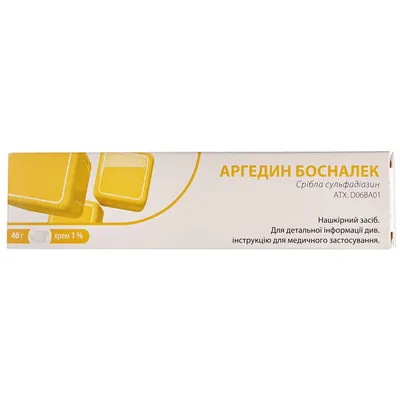
Table of Contents
INSTRUCTION FOR MEDICAL USE OF THE MEDICINAL PRODUCT ARGEDIN BOSNALEK®
Composition:
Active substance: Silver Sulfadiazine;
Composition per unit of dosage form: 1 g of cream contains 10 mg of silver sulfadiazine;
Excipients: white soft paraffin, propylene glycol, non-ionic emulsifying wax, liquid paraffin, methylparahydroxybenzoate (E 218), purified water.
Dosage form. Cream.
Main physicochemical properties: cream ranging from white to slightly yellowish, of homogeneous consistency.
Pharmacotherapeutic group.
Antibacterial and chemotherapeutic agents used in dermatology. Sulfonamides. ATC code D06B A01.
Pharmacological Properties.
Pharmacodynamics.
The mechanism of action of silver sulfadiazine has not been fully elucidated. It is believed to act as a donor of silver ions, which, through a series of reactions, bind to bacterial cell DNA. Sulfadiazine is released into the interstitial fluid. According to some data, the entire complex may bind to the bacterial cell wall.
Microbiological studies in vitro have shown that silver sulfadiazine has a broad spectrum of activity against the following microorganisms:
Sensitive microorganisms: Pseudomonas maltophilia, Pseudomonas fluorescens, Proteus (providencia) rettgeri, Proteus vulgaris, Streptococcus pyogenes, Corynebacterium diphtheriae, Herpes simplex, Herpesvirus hominis, Treponema pallidum, Microsporon audouinii, Trichophyton mentagrophytes.
Moderately sensitive microorganisms: Pseudomonas aeruginosa, Enterobacter cloacae, Escherichia coli, Klebsiella pneumoniae, Proteus mirabilis, Proteus morganii, Citrobacter sp., Herellea, Staphylococcus epidermidis, Mucor pusillus, Microsporum canis, Microsporum ferrugineum, Trichophyton violaceum, Trichophyton verrucosum, Trichophyton rubrum, Trichophyton schoenleinii, Trichophyton tonsurans, Epidermophyton floccosum; Less sensitive microorganisms.
Less sensitive microorganisms: Klebsiella spp, Enterobacter species, Serratia spp, Shigella flexneri, Staphylococcus aureus, Enterococcus (group D Streptococcus), Clostridium perfringens, Candida albicans, Aspergillus fumigatus, Aspergillus flavus, Rhizopus nigricans.
Silver sulfadiazine penetrates necrotic tissues and exudate, which is important because systemically acting agents are ineffective against bacterial flora in necrotic tissues.
Pharmacokinetics.
It is known that only a small amount (<1%) of silver is absorbed during short-term (over several days) topical application. Silver is known to have a high affinity for proteins, resulting in dissociation from sulfadiazine and temporary binding to proteins in wound exudate. A small portion of the released sulfadiazine (up to 10%) is absorbed, and two-thirds of this amount is excreted in urine.
In patients with extensive burn surface areas treated with 500–1000 g of silver sulfadiazine per day, plasma sulfadiazine concentrations ranged from 1–2 mg/100 mL.
Urinary concentrations ranged from 6–40 mg/100 mL, depending on the extent of body surface area affected by burns.
Following absorption, silver sulfadiazine temporarily binds to plasma proteins. Like other sulfonamides, it crosses the placenta.
Sulfadiazine is metabolized in the liver via acetylation and oxidation.
Clinical characteristics.
Indications.
Prevention of infection and treatment of infected burns and wounds; treatment of thermal and chemical burns.
Contraindications.
- Hypersensitivity to silver sulfadiazine or other sulfonamides, silver, or to any other ingredient of the medicinal product;
- Glucose-6-phosphate dehydrogenase deficiency (when applied to large surfaces, hemolysis may occur);
- Purulent and burn wounds with massive exudation (not advisable);
- Porphyria.
Interaction with other medicinal products and other types of interactions.
Silver sulfadiazine may inactivate enzymatic wound debriding agents when used concomitantly.
Para-aminobenzoic acid or related substances do not impair the action of silver sulfadiazine.
If silver sulfadiazine is absorbed and detected in blood plasma in significant amounts, interactions with other agents typical for systemic sulfonamides may occur, namely: reduced effect of anticoagulants, oral antidiabetic agents, local anesthetics (procaine, benzocaine, tetracaine), and enhanced effect of phenytoin. It has been reported that concomitant use of cimetidine may increase the frequency of leukopenia development.
Special precautions for use.
Local application of silver sulfadiazine requires caution in patients with impaired renal and/or hepatic function (cumulation may occur; such patients require monitoring of serum sulfonamide levels) or in those diagnosed with erythema multiforme.
The use of sulfonamides in premature infants and children under 2 months of age may cause kernicterus (see section Children). Women planning pregnancy should be prescribed silver sulfadiazine only by a physician after assessment of the risk-benefit ratio.
Serious skin reactions, such as Stevens-Johnson syndrome and toxic epidermal necrolysis, have been reported during treatment with sulfadiazine. The highest risk of such reactions occurs during the first weeks of treatment. If early signs of hypersensitivity appear (progressive skin rash, often with blistering and mucosal involvement), the drug should be discontinued immediately.
The cream may be used without medical supervision only for minor superficial burns. Patients with deeper burns should always consult a physician before initiating treatment. Burns involving 2% or more of the body surface area (approximately one patient's palm corresponds to 1% of body surface area), as well as burns affecting the eyes, ears, face, hands, feet, and/or genital area, require medical evaluation.
Medical consultation is necessary for skin wounds containing foreign material that cannot be removed; for deep puncture wounds; animal bites; wounds with significant redness, sudden onset of swelling, or those accompanied by fever.
During prolonged treatment with silver sulfadiazine of large skin areas, the risk increases of exceeding the therapeutic concentration of sulfonamides in serum, leading to characteristic adverse effects. To prevent this, blood counts, serum sulfadiazine concentration, possible presence of sulfadiazine in urine, and liver and kidney function should be monitored. When the drug is applied over a large body surface in patients with impaired renal or hepatic function, renal and hepatic function and blood parameters (including blood cell counts) should be monitored. The patient should be given plenty of alkaline fluids.
If skin or hematological reactions occur, the drug should be discontinued. An exception is the possible occurrence of transient leukopenia on the 2nd–3rd day after initiation of burn treatment, which resolves within a few days without discontinuation of silver sulfadiazine therapy. Monitoring of blood parameters is recommended.
Local application of the cream may cause porphyria.
As with other antimicrobial agents, superinfection may develop.
Very rarely, an increase in body temperature may occur, related to undesirable side effects.
The cream contains methylparahydroxybenzoate, which may cause allergic reactions (including delayed hypersensitivity reactions), and propylene glycol, which may cause skin irritation.
The presence of silver ions may lead to argyria. Argyria may manifest upon exposure to sunlight (its ultraviolet spectrum) on areas previously treated with the drug over a prolonged period. To prevent argyria, skin areas treated with the cream should not be exposed to direct sunlight (see section "Adverse reactions"). Due to the risk of contamination, the cream should preferably be used individually. The cream does not stain clothing or linen and is easily removed during daily wound hygiene.
Contact of the drug with the eyes should be avoided.
Use during pregnancy or breastfeeding.
Pregnancy.
Animal studies have not demonstrated fetal risk with topical application of silver sulfadiazine. Adequate controlled studies in pregnant women have not been conducted. Use of silver sulfadiazine during the third trimester of pregnancy may lead to kernicterus in the fetus. The drug should not be used during pregnancy. Silver sulfadiazine should be prescribed with caution to women planning pregnancy.
Breastfeeding.
There are no data confirming whether silver sulfadiazine, after absorption through the skin, passes into breast milk. It is known that sulfonamides increase the risk of bilirubin encephalopathy in infants; therefore, the use of the cream is contraindicated during breastfeeding.
Ability to affect reaction speed when driving or operating machinery.
There is no evidence of adverse effects.
Method of Administration and Dosage
The product is intended for topical use.
After cleaning the affected skin area, apply the product in a layer approximately 2–3 mm thick directly onto the wound surface or onto a sterile gauze pad. The duration of treatment is usually 10–14 days, depending on the course of the underlying disease.
Children
Since the use of sulfonamides may cause nuclear jaundice, the cream should be used in premature infants and newborns under 2 months of age only as prescribed by a physician after assessment of the risk-benefit ratio.
Overdose
An increased incidence of adverse reactions may be expected during prolonged treatment of burn wounds involving a large skin surface area (such as argyria, see section "Adverse Reactions"). In patients with severe burns, prolonged treatment has been associated with a significant increase in serum silver levels, which normalize after discontinuation of therapy. Overdose may be accompanied by neurological, renal, hepatic, respiratory, and hematological manifestations.
Treatment – symptomatic. The drug should be discontinued and appropriate supportive measures applied. If necessary, renal function and blood parameters should be monitored. Absorbed sulfadiazine is readily eliminated by hemodialysis and peritoneal dialysis.
Adverse reactions.
The drug is usually well tolerated when used at recommended doses. However, adverse reactions may occur in individual cases.
Immune system side effects: hypersensitivity, including dermatitis, erythema, and exanthema, anaphylaxis.
Blood system side effects: leukopenia; methemoglobinemia, especially in patients with hemoglobin abnormalities. Significant increase in serum osmolarity has been reported following prolonged regular use over large affected areas. This phenomenon is likely due to increased absorption of propylene glycol, an ingredient of the drug.
Skin and subcutaneous tissue side effects: skin irritation, burning sensation, pain upon application, rashes, photosensitization, hyperpigmentation, skin depigmentation, Stevens-Johnson syndrome, skin hypersensitivity reactions with redness and itching, very rarely—skin necrosis. With prolonged use, accumulation of silver in the liver, kidneys, and retina may occur. In individual cases, argyria (gray discoloration of the skin caused by silver deposition) is possible.
When applying the cream to large body surface areas (high doses), especially after severe burns, adverse reactions associated with oral administration of sulfadiazine have been reported, such as nausea, vomiting, diarrhea, glossitis, joint pain, headache, confusion, seizures, anemia, thrombocytopenia, eosinophilia, agranulocytosis, drug fever, impaired liver and/or kidney function, hepatitis, liver necrosis, crystalluria, interstitial nephritis, hypoglycemia, toxic nephrosis, Stevens-Johnson syndrome, exfoliative dermatitis.
Healthcare professionals, patients, and pharmacists are kindly requested to report any suspicion of adverse reactions or lack of therapeutic effect to the email address of Bosnalijek d.d. representative: [email protected].
Shelf life.
3 years.
Storage conditions.
Store out of reach of children at a temperature not exceeding 25 °C.
Packaging.
40 g in a tube, 1 tube in a cardboard box.
Prescription status.
Prescription only.
Manufacturer.
Bosnalijek d.d.
Manufacturer's address and place of business.
53 Yukicheva Street, Sarajevo 71000, Bosnia and Herzegovina.
Marketing authorization holder: Bosnalijek d.d.
Address of the marketing authorization holder and/or its representative:
53 Yukicheva Street, Sarajevo 71000, Bosnia and Herzegovina.