Antral
Ukraine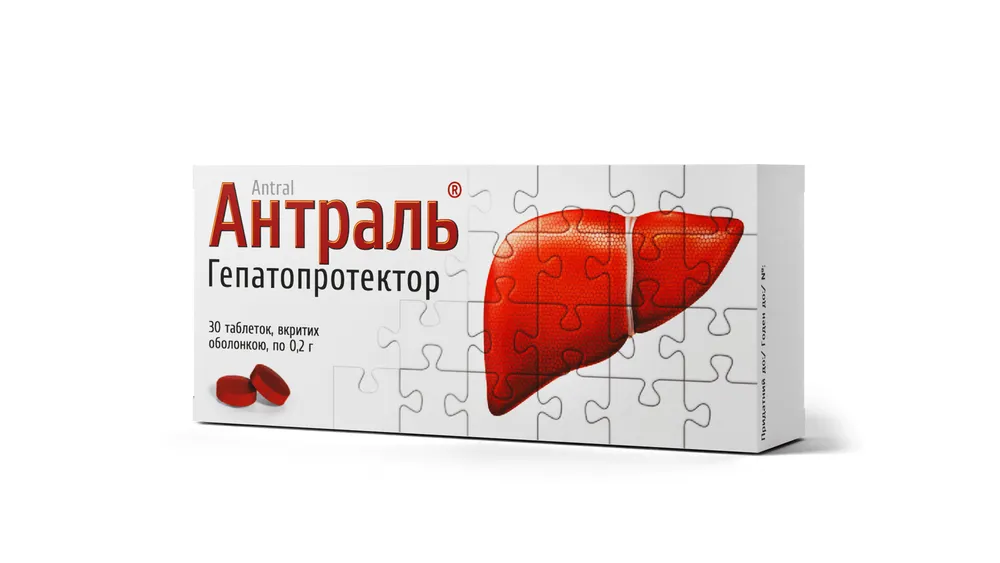
Table of Contents
INSTRUCTIONS FOR MEDICAL USE OF THE MEDICINAL PRODUCT ANTRAL® (ANTRAL®)
Composition:
Active ingredient: 1 tablet contains antral® equivalent to 100 mg (0.1 g) or 200 mg (0.2 g) of dry substance;
Excipients: magnesium carbonate heavy, potato starch, crospovidone, microcrystalline cellulose, povidone, polysorbate, colloidal anhydrous silicon dioxide, calcium stearate, Opadry II 85 G18490 white, Opadry II 85 G25557 red.
Pharmaceutical form. Film-coated tablets.
Main physico-chemical characteristics: round, biconvex tablets, film-coated with a dark red coating.
Pharmacotherapeutic group.
Agents affecting the gastrointestinal tract and metabolism.
Agents used in diseases of the liver and biliary tract.
Agents used in liver diseases, lipotropic substances.
ATC code A05BA.
Pharmacological Properties
Pharmacodynamics
Antal® exhibits hepatoprotective properties. It is effective in the treatment of acute and chronic hepatitis of various etiologies, liver cirrhosis, helps reduce asthenovegetative disorders, improves appetite and sleep, and decreases dyspeptic symptoms. With course administration, the drug normalizes blood levels of bilirubin, γ-globulins, cholesterol, prothrombin index, and the activity of transaminases (ALT and AST) as well as alkaline phosphatase. Antal® has prolonged anti-inflammatory and analgesic effects. According to preclinical studies, Antal® reduces the adverse effects of hepatotoxins, activates reparative processes in hepatocytes, and promotes practical normalization of structural and functional parameters of the liver in conditions of acute, subacute, and chronic liver damage caused by various xenobiotics and their combinations. The drug inhibits lipid peroxidation processes in blood and tissues, supports the activity of the body's antioxidant systems, and ensures stabilization of liver structure and hepatocyte membranes. As a relatively safe pharmacological agent, Antal® does not impair the functions of organs and systems, has no cumulative, immunotoxic, locally irritating, allergenic, ulcerogenic, embryotoxic, or teratogenic effects.
In preclinical studies in rats, Antal® reduced the severity of the inflammatory process in experimental chronic pancreatitis of various etiologies, improved exocrine function of the pancreas, corrected the balance of general markers of pro- and antioxidant systems—including the glutathione system (both in blood serum and pancreatic tissue)—and also improved the cytoarchitectonics of pancreatic acini and reduced fibrosis manifestations. Study results showed that regardless of dose, Antal® is capable of restoring superoxide dismutase activity to the level of intact controls.
Clinical Efficacy
A multicenter, double-blind, randomized, placebo-controlled study evaluating the efficacy and tolerability of the medicinal product Antal®, coated tablets 0.2 g, in patients with chronic pancreatitis (CP) demonstrated that this drug reduces the intensity of abdominal pain in CP patients, positively affects the severity of clinical manifestations of CP—such as decreased appetite, meteorism, postprandial fullness, nausea, vomiting, belching, and abdominal distension—and improves quality of life as assessed by the EORTC QLQ-PAN26 questionnaire.
The study included male and female patients aged 18 to 65 years with a confirmed diagnosis of CP. The per-protocol (PP) analysis (efficacy analysis performed on patients who completed the study according to protocol) included 147 patients (74 patients received Antal® and 73 received placebo). Patients in both groups received either the investigational drug Antal® or placebo orally, after meals, 1 tablet three times daily for 28 days.
Analysis of efficacy based on the primary endpoint for the PP population (all randomized patients who completed the trial according to protocol) showed that 71.52% of subjects in the Antal® group achieved the primary endpoint—maximum score of abdominal pain intensity during the last 7-day treatment period (days 22 to 28 inclusive) of 0–2 cm (absence of pain or mild pain) on the VAS (visual analog scale used to assess abdominal pain intensity)—compared to 4.1% in the placebo group. The differences between groups were statistically significant (p < 0.001).
The secondary endpoint—total severity of CP symptoms (including decreased appetite, meteorism, postprandial fullness, nausea, vomiting, belching, and abdominal distension) < 4 points after completion of treatment (day 29), with severity of each symptom ≤ 1 point on a 5-point verbal analog scale—was achieved by 78.38% of subjects in the Antal® group and 19.18% in the placebo group. The differences between groups were statistically significant (p < 0.001).
When administered at a dose of 1 tablet three times daily for 28 days in patients with CP, Antal® demonstrated a favorable safety and tolerability profile comparable to placebo. Most reported adverse reactions were mild to moderate in severity and did not require significant additional treatment. No negative impact of the investigational drug was observed on hemodynamic parameters (systolic blood pressure, diastolic blood pressure, heart rate), body temperature, laboratory parameters of blood (complete and biochemical analysis), urine analysis, or abdominal ultrasound findings (pancreas, liver, gallbladder, and spleen).
Pharmacokinetics
Maximum drug accumulation in blood occurs within 3–4 hours; the elimination half-life is 4–5 hours. The drug is excreted in urine and feces.
Clinical characteristics.
Indications.
Antral® is indicated for adults and children for the treatment of:
- acute and chronic hepatitis of various etiologies (viral, alcoholic, drug-induced, toxic);
- fatty degeneration and liver cirrhosis;
- inflammatory diseases of the gallbladder, spleen, and postcholecystectomy syndrome (after removal of the gallbladder);
- inflammatory diseases of the pancreas, particularly chronic pancreatitis – in adults only (see sections "Pharmacological properties", "Dosage and administration", "Children").
For the prevention of liver diseases caused by the negative effects of toxins of various etiologies: alimentary toxins, drugs, chemotherapy, radiation therapy.
Contraindications.
Individual hypersensitivity to the components of the drug.
Impaired renal excretory function.
Interaction with other medicinal products and other forms of interaction.
Antral® is compatible with antibacterial, detoxifying, choleretic, and vitamin preparations, allowing its inclusion into complex treatment regimens. When used concomitantly in patients with liver cirrhosis, Antral® does not affect the activity of steroid and cytostatic drugs; reduction (down to 50–70%) of previously administered steroid doses is permitted without further decrease in treatment efficacy.
Special precautions for use.
It is recommended to take Anthral® 20-30 minutes after eating, with sufficient amount of water or milk.
Use during pregnancy or breastfeeding.
Due to limited experience of use, the drug is not recommended during pregnancy or breastfeeding.
Ability to influence reaction speed when driving or operating machinery.
There is no data available regarding influence; however, drivers and operators of complex machinery should consider the possibility of developing dizziness.
Dosage and Administration.
Antral® should be administered orally after meals, three times a day:
- Adults and children aged 10 years and older: 200 mg per dose. In patients with liver cirrhosis: during the first week of treatment – 400 mg per dose, then for 2–3 weeks – 200 mg per dose;
- Children aged 4–10 years (including those with liver cirrhosis): 100 mg per dose.
Duration of treatment depends on the nature and severity of the disease. The average treatment course is 3–4 weeks. The treatment course should be repeated after 3–4 weeks.
Treatment of chronic pancreatitis (adults only): 200 mg three times daily; treatment course – 4 weeks.
Children. The drug is contraindicated in children under 4 years of age.
There is insufficient data on the use of Antral® in children with chronic pancreatitis; therefore, its use in this patient group is not recommended.
Overdose.
In case of overdose, adverse reactions may occur and intensify.
In the event of accidental ingestion of large doses, gastric lavage should be performed and, if necessary, symptomatic treatment initiated.
Side effects.
The drug is generally well tolerated by patients. In individual cases, use of Antralium® may cause weakness, dizziness, dyspeptic symptoms, nausea, abdominal pain, diarrhea, which disappear after discontinuation of the drug.
Allergic reactions, including skin rashes, urticaria, angioneurotic edema, redness and itching of the skin.
Shelf life. 3 years.
Do not use the drug after the expiry date stated on the packaging.
Storage conditions. Store in the original packaging at a temperature not exceeding 25 °C.
Keep out of reach of children.
Packaging. 10 tablets in a blister. 3 blisters in a pack.
Availability (dispensing category). Over-the-counter.
Manufacturer: JSC "Farmak".
Manufacturer's address.
74, Kyrylivska Street, Kyiv, 04080, Ukraine.