Amizon® max
Ukraine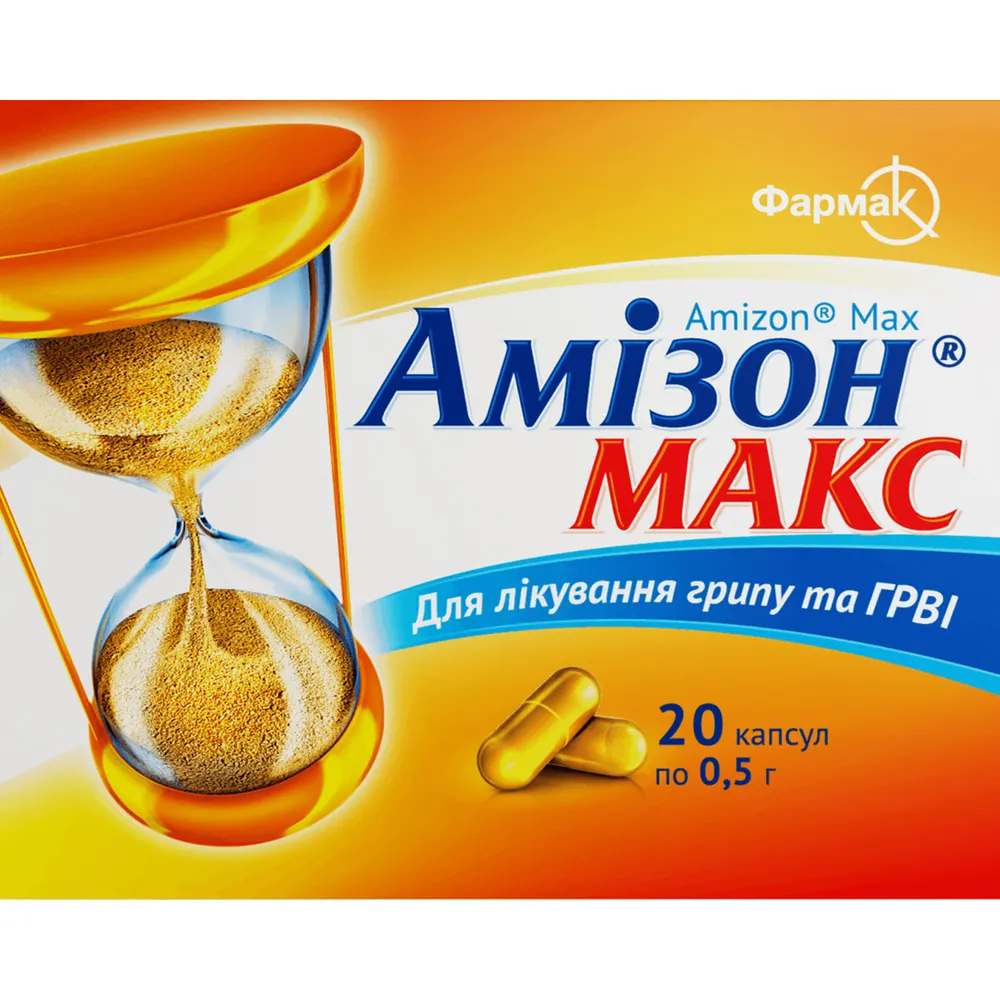
Table of Contents
INSTRUCTION FOR MEDICAL USE OF THE MEDICINAL PRODUCT AMIZON® MAX (AMIZON® MAX)
Composition:
Active substance: amizon® (eniseamium iodide);
1 capsule contains amizon® (eniseamium iodide) 0.5 g;
Excipient: magnesium stearate;
Gelatin capsule contains: gelatin, titanium dioxide (E 171), yellow FCF (E 110).
Pharmaceutical form. Capsules.
Main physicochemical properties: hard gelatin capsules of cylindrical shape.
Body is white, cap is orange.
Capsule contents – crystalline powder of yellow or yellow-green color.
Pharmacotherapeutic group.
Antiviral agents for systemic use. Direct-acting antiviral agents.
ATC code J05A X17.
Pharmacological properties.
Mechanism of action
The antiviral activity of enisamium is associated with direct inhibition of RNA-dependent RNA polymerase of influenza virus and SARS-CoV-2.
Pharmacodynamics
Enisamium exhibits antiviral activity against various strains of influenza virus A (H1N1, H3N2, H5N1, H7N9), influenza virus B, respiratory syncytial virus, as well as alpha-coronavirus NL-63 and beta-coronavirus SARS-CoV-2 in vitro.
Enisamium iodide has demonstrated efficacy against influenza virus A and B strains in in vitro studies using differentiated normal human bronchial epithelial cells (NHBE), human hepatocellular carcinoma cells (HepG2), human rhabdomyosarcoma cells (RD), and human colorectal adenocarcinoma cells (Caco-2). In ferrets, a representative animal model for influenza research, enisamium iodide reduced the duration of influenza virus shedding in nasal washes compared to the placebo control group.
Clinical efficacy
In a study of patients with acute viral respiratory infections, including influenza, treatment with enisamium iodide at a daily dose of 1500 mg (500 mg three times daily) resulted in a positive disease course, manifested by a more pronounced reduction in viral infection symptoms compared to placebo (Table 1).
An early and statistically significant reduction in viral antigens in nasal swabs was observed in patients receiving enisamium iodide compared to those in the placebo group (Table 2).
Treatment with enisamium iodide led to an increase in serum interferon levels compared to the placebo group.
Table 1. Relief of viral infection symptoms after treatment with enisamium iodide (number of patients / %)
| Day |
Cough |
Rhinitis |
Weakness |
Headache |
||||
| Enisamium iodide |
Placebo |
Enisamium iodide |
Placebo |
Enisamium iodide |
Placebo |
Enisamium iodide |
Placebo |
|
| 0 |
59 98.3% |
40 100% |
56 93.3% |
37 92.5% |
59 98.3% |
40 100% |
56 93.3% |
34 85% |
| 3 |
58 96.7% |
40 100% |
50 83.3% |
35 87.5% |
42 70% ** |
39 97.5% |
31 51.7% |
25 62.5% |
| 7 |
39 65% |
38 95% |
13 21.7% |
29 72.5% |
17 28.3% |
22 55% |
6 10% * |
13 32.5% |
| 14 |
4 6.7% |
22 55% |
0 |
2 5% |
1 1.7% |
7 17.5% |
0 |
3 7.5% |
Table 2. Dynamics of viral antigen detection (number of patients / %)
| Day |
Viral antigens |
Influenza virus antigens |
||
| Enisamium iodide |
Placebo |
Enisamium iodide |
Placebo |
|
| 0 |
60 (100 %) |
40 (100 %) |
33 (66 %) |
22 (55 %) |
| 3 |
17 (28.3 %) |
29 (72.5 %) |
8 (13 %) |
16 (40 %) |
| 7 |
1 (1.7 %) |
6 (15 %) |
1 (1.7 %) |
1 (2.5 %) |
The results of the phase III clinical study showed that enisamium iodide is well tolerated and clinically effective, as demonstrated by:
- a reduction in the duration of elevated temperature by 1.1 days;
- a reduction in the duration of catarrhal and constitutional symptoms;
- a decrease in the use of expectorants and vasoconstrictive agents;
- a reduction in the number of days of work incapacity;
- a reduction in the duration of viral shedding and a significant decrease in the number of patients in whom viral antigens were detected, compared to the placebo group.
Greater efficacy of enisamium was observed when treatment was initiated earlier.
A multicenter, double-blind, randomized, placebo-controlled study of the efficacy and safety of the medicinal product Amizon® Max included 592 patients with moderate severity COVID-19 who received either Amizon® Max or placebo in combination with standard therapy. The primary efficacy endpoint of the study was time to clinical improvement, measured as an increase of 2 points from baseline in the patient's status according to the modified WHO scale (Table 3).
Patients in the placebo group received one placebo capsule orally every 6 hours, four times daily. Patients receiving Amizon® Max received one capsule of Amizon® Max every 6 hours, four times daily. Treatment lasted for a full 7 days (168 hours).
Table 3. Modified WHO patient severity scale
| Score |
Patient status |
| 1 |
Death |
| 2 |
Hospitalized, requires invasive mechanical ventilation (IMV) or extracorporeal membrane oxygenation |
| 3 |
Hospitalized, requires non-invasive ventilation or high-flow oxygen therapy |
| 4 |
Hospitalized, requires supplemental oxygen therapy |
| 5 |
Hospitalized, does not require supplemental oxygen therapy, but requires ongoing medical care (related to COVID-19 or other) |
| 6 |
Hospitalized, does not require supplemental oxygen therapy and no longer requires ongoing medical care |
| 7 |
Not hospitalized, but has activity limitations and/or requires home oxygen support therapy |
| 8 |
Not hospitalized, no activity limitations |
The study results demonstrated that therapy using the medicinal product Amizon® Max significantly (p = 0.00945) accelerated improvement in the condition of patients with COVID-19 by 2 points on the above-mentioned modified WHO scale, compared to the placebo group. The superior efficacy of combined therapy with the medicinal product Amizon® Max in the treatment of patients with COVID-19 is also confirmed by the results regarding secondary efficacy endpoints, namely:
- On day 15 of the study, 85.7% of patients in the placebo group had been discharged, compared to 94.4% in the Amizon® Max group. The difference in proportions was 8.6%, and these differences were statistically significant (p = 0.018), indicating superior efficacy of Amizon® Max compared to placebo;
- A faster, statistically significant reduction in cough severity was observed in the Amizon® Max group compared to the placebo group on days 3, 4, and 5 of treatment (p = 0.009; 0.018; and 0.007, respectively);
- The use of Amizon® Max in combined therapy for COVID-19 significantly (p = 0.016) prevented worsening of the patient's condition and progression of respiratory failure during treatment. The proportion of patients whose condition worsened by 1 point on the modified WHO scale was 8.4% in the placebo group and 2.1% in the Amizon® Max group, and the differences between groups were significant (p = 0.016). Kaplan–Meier analysis of time to deterioration by 1 point, using the log-rank test to compare groups, demonstrated greater efficacy of Amizon® Max compared to placebo (p = 0.009) in preventing clinical deterioration, development of more severe respiratory failure, and complications;
- In the group of patients receiving Amizon® Max as part of combined therapy, there were no fatal cases, and all patients recovered within 21 days, whereas in the placebo group, three (3) fatal cases occurred and one patient did not reach the primary endpoint during the study period, providing strong evidence in favor of using Amizon® Max in combined therapy for COVID-19.
Pharmacokinetics
Absorption
Enisamium iodide is rapidly absorbed: peak plasma concentration was achieved within 1.6–2.4 hours after a single dose. Absolute bioavailability in humans has not been studied, while relative bioavailability was less than 5%. Steady-state levels following oral administration of 500 mg three times daily or 1000 mg twice daily were reached within 3 days. No drug accumulation was observed.
Studies in dogs showed that 35% of the administered dose of enisamium iodide was absorbed from the gastrointestinal tract. Absorption in rodents was less than 5%.
Food significantly reduced the bioavailability of enisamium iodide. Mean Cmax and AUCinf values after administration of 1500 mg with food were reduced by 46.8% and 26.6%, respectively, compared to administration of 1500 mg on an empty stomach. The mean tmax increased after food intake: 0.75 hours when administered fasting versus 2.75 hours when administered after food.
Distribution
The extent of binding of enisamium iodide to human serum proteins is low.
Metabolism
The parent compound (enisamium iodide) in humans is partially converted via hydroxylation and conjugation with glucuronic acid (less than 5%). CYP2D6 likely plays a minor role in the metabolism of enisamium iodide. Other studied cytochrome P450 enzymes have no significant influence on the metabolic transformation of the parent compound.
Elimination
Enisamium iodide is primarily excreted unchanged in urine. After oral administration of radiolabeled enisamium iodide to dogs, fecal excretion accounted for 32–35%. The median elimination half-life of single doses of enisamium iodide ranges from 2.69 to 3.35 hours, and from 6.00 to 7.34 hours after multiple doses administered over 10 days.
Pharmacokinetics in specific patient populations
Elderly patients
Pharmacokinetic studies involving elderly patients have not been conducted.
Patients with hepatic or renal impairment
The pharmacokinetics of enisamium iodide in special populations has not been studied. However, based on pharmacokinetic study results, considering the presence of renal and enteral elimination pathways and the low level of enisamium iodide metabolism, significant accumulation of enisamium in plasma is not expected in subjects with structural liver or kidney disease during short-term use (up to 7 days) of this medicinal product. Therefore, a deterioration in the safety profile in patients with the aforementioned organic diseases is unlikely.
Clinical characteristics.
Indications.
Treatment of influenza and acute respiratory viral infections (ARVI).
Treatment of moderate severity COVID-19 in combination with standard therapy.
Contraindications.
Hypersensitivity to drugs containing iodide, molecular iodine, or covalently bound iodine, as well as to other components of the drug.
Interaction with other medicinal products and other forms of interaction.
Enisamium iodide may reduce thyroid gland uptake of radioactive iodine isotopes for up to 6 weeks.
Concomitant use of iodine-containing medicinal products, contrast agents, and medicinal products containing covalently bound iodine should be avoided, as well as large-area wound treatment using iodine-containing antiseptics (e.g., molecular iodine), due to the possible increased risk of thyroid dysfunction.
Special precautions for use
Administration of enisamium iodide leads to an increase in plasma iodide levels. Secondary elevation of circulating iodide triggers a self-regulatory mechanism of thyroid function, whereby the uptake of inorganic iodide by thyrocytes is suppressed, thus helping to prevent excessive production of thyroid hormones; during this process, thyroid-stimulating hormone (TSH) levels transiently increase (the Wolff-Chaikoff effect). This effect lasts for several days; after completion of the treatment course, thyroid function returns to normal. In individual cases, a transient increase in TSH levels has been observed for several weeks.
There is no available information regarding the effect of enisamium iodide in patients with impaired thyroid function or in patients who previously developed hypothyroidism. However, monitoring of thyroid function during treatment with enisamium iodide is advisable.
Other iodine-containing drugs are not recommended during treatment and for 7 days after discontinuation of enisamium iodide therapy.
Excipients
The medicinal product contains Sunset Yellow FCF (E 110), which may cause allergic reactions.
Use during pregnancy or breastfeeding
The use of the drug is contraindicated during pregnancy, as clinical studies of enisamium iodide in pregnant women have not been conducted. Animal studies have not revealed any direct or indirect effects on reproductive function/fertility.
Breastfeeding
It is unknown whether enisamium iodide or its metabolites are excreted in human breast milk. The risk of enisamium iodide exposure to the newborn/infant cannot be excluded.
Ability to influence reaction speed when driving or operating machinery
Administration of Amizon® Max does not affect the ability to drive or operate machinery.
Dosage and Administration
Amizon® Max should be taken orally, without chewing, 2 hours before meals.
For adults, the recommended dose is 500 mg (0.5 g) three times daily or 1000 mg (1 g) twice daily.
For patients with COVID-19, enisamium iodide should be administered in combination with standard therapy at a dose of 500 mg (0.5 g) four times daily.
Maximum single dose – 1000 mg (1 g); maximum daily dose – 2000 mg (2 g).
Duration of treatment – 7 days.
Children. This medicinal product in the given pharmaceutical form should not be used in children.
Overdose.
No cases of overdose with Amizon® Max have been reported in clinical trials or during post-marketing use.
There is no specific antidote.
Adverse reactions
The most commonly reported adverse reactions (ARs) were taste disturbances, folliculitis, nasopharyngitis, headache, and lymphadenopathy (in phase I placebo-controlled studies). Most of these ARs were reported as single events and resolved spontaneously. In the majority of patients, the aforementioned ARs did not lead to discontinuation of enisamium iodide.
In the phase III placebo-controlled study, mild gastrointestinal disorders (bitter taste in the mouth), heartburn, and burning sensation in the throat were observed.
Only adverse events occurring more frequently in the enisamium iodide group compared to the placebo group and reported in more than two individuals were considered.
Table 4 lists the adverse reactions observed during clinical studies and post-marketing use of the drug. The frequency is defined as follows: very common (≥ 1/10), common (≥ 1/100, < 1/10), uncommon (> 1/1000, < 1/100), and frequency not known (cannot be estimated from available data).
Table 4
| System organ class |
Very common |
Common |
Uncommon |
Frequency not known* |
| Investigations |
Elevated thyroid stimulating hormone levels in blood |
Increased blood pressure |
||
| General disorders |
Fatigue |
|||
| Infections and infestations |
Folliculitis Nasopharyngitis Rhinitis |
|||
| Respiratory, thoracic and mediastinal disorders |
Dyspnea |
|||
| Blood and lymphatic system disorders |
Lymphadenopathy |
|||
| Nervous system disorders |
Headache |
Dizziness |
||
| Eye disorders |
Periorbital edema |
|||
| Musculoskeletal and connective tissue disorders |
Arthralgia |
|||
| Skin and subcutaneous tissue disorders |
Erythema Facial swelling Facial pruritus Edema Pruritus Rash Papular rash Urticaria |
|||
| Gastrointestinal disorders |
Diarrhea Dry mouth Taste disturbance Dyspepsia Nausea Vomiting |
Abdominal pain |
*Reported during the post-marketing period.
Reporting of suspected adverse reactions
Reporting of suspected adverse reactions after marketing authorization of the medicinal product is of great importance. This ensures continuous monitoring of the benefit/risk balance of the medicinal product. Healthcare professionals are requested to report any suspected adverse reactions through the national reporting system.
Shelf life.
4 years. Do not use the medicinal product after the expiry date stated on the packaging.
Storage conditions.
Store in a dry, protected from light place at a temperature not exceeding 25 °C. Keep out of reach of children.
Packaging. 10 capsules in a blister. 1 or 2 blisters per carton.
Availability. Over-the-counter.
Manufacturer. JSC "Farmak".
Manufacturer's address.
74 Kyrylivska Street, Kyiv, 04080, Ukraine.