Aminoven 10 %
Ukraine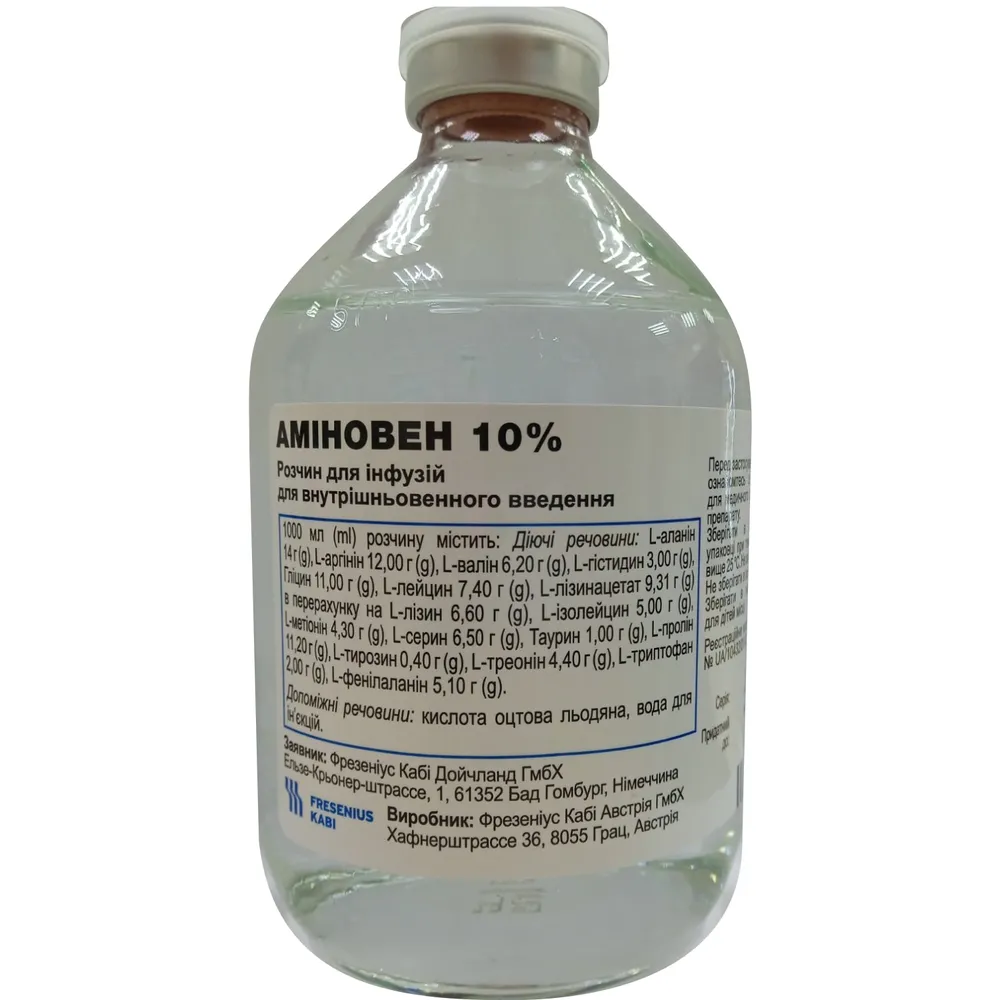
Table of Contents
INSTRUCTIONS FOR MEDICAL USE OF THE MEDICINAL PRODUCT AMINOVEN 10%, AMINOVEN 15% (AMINOVEN)
Composition:
Active substances: 1000 ml of solution contains
| Active ingredients: |
10% |
15% |
| L-alanine |
14.00 g |
25.00 g |
| L-arginine |
12.00 g |
20.00 g |
| L-valine |
6.20 g |
5.50 g |
| L-histidine |
3.00 g |
7.30 g |
| Glycine |
11.00 g |
18.50 g |
| L-leucine |
7.40 g |
8.90 g |
| L-lysine acetate equivalent to |
9.31 g |
15.655 g |
| L-lysine |
6.60 g |
11.10 g |
| L-isoleucine |
5.00 g |
5.20 g |
| L-methionine |
4.30 g |
3.80 g |
| L-serine |
6.50 g |
9.60 g |
| Taurine |
1.00 g |
2.00 g |
| L-proline |
11.20 g |
17.00 g |
| L-tyrosine |
0.40 g |
0.40 g |
| L-threonine |
4.40 g |
8.60 g |
| L-tryptophan |
2.00 g |
1.60 g |
| L-phenylalanine |
5.10 g |
5.50 g |
| Total concentration of amino acids: |
100 g/L |
150 g/L |
| Total nitrogen: |
16.2 g/L |
25.7 g/L |
| Energy value: |
1680 kJ/L (=400 kcal/L) |
2520 kJ/L (=600 kcal/L) |
| pH: |
5.5–6.3 |
5.5–6.3 |
| Titratable acidity: |
22 mmol NaOH/L |
44 mmol NaOH/L |
| Theoretical osmolarity: |
990 mOsmol/L |
1505 mOsmol/L |
Excipients: glacial acetic acid, water for injections; malic acid (for Aminoven 15%).
Dosage form. Infusion solution.
Main physicochemical properties: clear, colorless or slightly yellowish solution.
Pharmacotherapeutic group. Solutions for parenteral nutrition. Amino acids.
ATC code B05B A01.
Pharmacological Properties.
Pharmacodynamics.
Aminoven is intended for parenteral nutrition in patients with various pathologies and with low, normal, or increased protein requirements, when enteral nutrition is ineffective or impossible. The essential and non-essential L-amino acids contained in Aminoven are natural physiological compounds. Like dietary amino acids that are absorbed, parenterally administered amino acids participate in all metabolic processes of protein synthesis.
Pharmacokinetics.
The pharmacokinetic characteristics of amino acids administered intravenously are similar to those of amino acids derived from food. However, food-derived amino acids first enter the portal vein of the liver and only then enter systemic circulation, whereas intravenously administered amino acids enter directly into systemic circulation. Balanced amino acid solutions, including Aminoven 10% or 15%, when continuously and slowly infused, do not significantly alter the physiological amino acid pool.
From the intravascular space, amino acids redistribute into the interstitial fluid and are transported into cells of various tissues. Concentrations of free amino acids in blood plasma and tissues are regulated by endogenous mechanisms within a narrow range, depending on age, nutritional habits, and the patient's clinical condition. Only a small portion of infused amino acids is excreted by the kidneys. For most amino acids, the half-life in plasma ranges from 10 to 30 minutes.
Clinical characteristics.
Indications.
As a component of parenteral nutrition. Amino acid solutions are administered in combination with an adequate amount of energy source (glucose, fat emulsion).
Amiven 15% is generally used when fluid volume must be limited during parenteral nutrition.
Contraindications.
Amiven 10% is contraindicated in children under 2 years of age.
Amiven 15% is contraindicated in children.
Administration of amino acid solutions, including Amiven 10% and Amiven 15%, is contraindicated in the following conditions:
- Hypersensitivity to any component of the preparation;
- Disorders of amino acid metabolism, metabolic acidosis;
- Renal insufficiency in the absence of hemodialysis or hemofiltration;
- Severe hepatic insufficiency;
- Fluid overload, acute pulmonary edema, shock, hypoxia;
- Decompensated cardiac insufficiency;
- Phenylketonuria.
Special precautions.
Individual dose adjustment is required in patients with adrenal insufficiency, hepatic, renal, cardiac, or pulmonary insufficiency.
Careful clinical and laboratory monitoring during administration of the preparation is recommended for patients with the following conditions: hepatic insufficiency, risk of development or worsening of pre-existing neurological disorders associated with hyperammonemia; renal insufficiency, particularly in the presence of hyperkalemia, presence of risk factors favoring the development or exacerbation of metabolic acidosis, and azotemia due to impaired renal clearance. With prolonged use of the preparation (several weeks), blood parameters including coagulation factors should be closely monitored.
Interaction with other medicinal products and other forms of interaction.
Currently, data on interactions are not available.
Special precautions for use.
When using this medicinal product, it is necessary to monitor electrolyte levels, fluid balance, and renal function. In cases of hypokalemia and/or hyponatremia, adequate amounts of potassium and/or sodium should be administered concomitantly.
In patients with hypotonic dehydration, fluid and electrolyte replacement should be provided prior to initiating parenteral nutrition.
Administration of any amino acid solutions may provoke acute folate deficiency; therefore, patients should receive daily supplementation with folic acid.
Caution must be exercised when administering large volumes of fluid to patients with cardiac insufficiency.
Any infusion into a peripheral vein may cause irritation of the vessel wall and lead to thrombophlebitis. Therefore, the catheter insertion site should be examined daily. If a fat emulsion is also prescribed for the patient, it is recommended to administer it simultaneously with Amiven to reduce the risk of phlebitis.
The choice of catheter placement site (central or peripheral vein) depends on the final osmolarity of the mixture: for infusion into a peripheral vein, the osmolarity limit is 800 mOsmol/L. Patient age, clinical condition, and status of peripheral veins should also be taken into account.
Strict aseptic techniques must be followed, especially during central venous catheter placement.
The following rules must be strictly observed when using the medicinal product:
- use the product immediately after opening the vial;
- the product is intended for single use only;
- do not use the product after the expiry date has passed;
- use only from undamaged vials containing a clear solution free from foreign particles;
- any unused solution remaining in the vial and any mixture left after infusion must be discarded;
- the product may be mixed under sterile conditions with other parenteral nutrition agents, such as fat emulsions, carbohydrates, and electrolytes.
The ready-to-use mixture for total parenteral nutrition must be used immediately.
Use during pregnancy or breastfeeding.
Specific safety studies on the use of Amiven 10% or 15% during pregnancy and lactation have not been conducted. Clinical studies with similar amino acid solutions intended for parenteral administration have shown a lack of data regarding the risk of using the product during pregnancy and breastfeeding. The use of this product during pregnancy or breastfeeding may be considered if the expected benefit to the mother outweighs the potential risk to the fetus/infant.
Ability to affect reaction speed when driving or operating machinery.
No data available.
Administration and Dosage
Administer only intravenously.
Aminoven 10% and Aminoven 15%, infusion solution, must be administered into central veins as a continuous infusion.
Dosing:
Daily amino acid requirements depend on the patient's body weight and metabolic processes.
Daily amino acid requirements vary depending on the patient's clinical condition and metabolic status and may change from day to day.
Recommended duration of infusion: continuous administration for at least 14 to 24 hours, depending on the clinical situation. Bolus administration is not recommended. Infusion may continue as long as clinically indicated, taking into account the daily amino acid requirements.
Aminoven 10%, infusion solution.
Average daily dose:
10–20 mL of Aminoven 10%, infusion solution, per kg body weight/day (equivalent to 1.0–2.0 g of amino acids per kg body weight/day), corresponding to 700–1400 mL of Aminoven 10% for a 70 kg body weight/day.
Maximum daily dose:
20 mL of Aminoven 10% per kg body weight/day (equivalent to 2.0 g of amino acids per kg body weight/day), corresponding to 1400 mL of Aminoven 10% for a 70 kg body weight (equivalent to 140 g of amino acids).
Maximum infusion rate:
1.0 mL of Aminoven 10%, infusion solution, per kg body weight per hour (equivalent to 0.1 g of amino acids per kg body weight per hour).
Aminoven 15%, infusion solution.
Average daily dose:
6.7–13.3 mL of Aminoven 15%, infusion solution, per kg body weight/day (equivalent to 1.0–2.0 g of amino acids per kg body weight/day), corresponding to 470–930 mL of Aminoven 15% for a 70 kg body weight/day.
Maximum daily dose:
13.3 mL of Aminoven 15% per kg body weight/day (equivalent to 2.0 g of amino acids per kg body weight/day), corresponding to 140 g of amino acids for a 70 kg body weight.
Maximum infusion rate:
0.67 mL of Aminoven 15% per kg body weight per hour (equivalent to 0.1 g of amino acids per kg body weight per hour).
Children. Clinical studies on the use of this medicinal product in pediatric populations have not been conducted. Aminoven 15% is contraindicated in children.
Aminoven 10% is contraindicated in children under 2 years of age.
For children under 2 years of age, special amino acid solutions for parenteral administration, formulated according to their metabolic needs, should be used.
Children and adolescents (2–18 years)
Dosing:
Dosage must be adjusted according to the patient's hydration status, biological development, and body weight.
Maximum infusion rate:
Same as for adults; see information above.
Maximum daily dose:
Same as for adults; see information above.
Overdose.
In cases of Aminoven overdose or excessive infusion rate, symptoms such as chills, vomiting, nausea, and increased renal excretion of amino acids may occur. If signs of overdose appear, the infusion should be stopped immediately. Subsequently, the infusion may be resumed at a reduced dosage. Excessively rapid infusion may lead to fluid overload and electrolyte imbalances.
There is no specific antidote for overdose. Emergency treatment should be supportive and symptomatic, with particular attention to respiratory and cardiovascular functions. Close monitoring of biochemical parameters and appropriate management of any identified disturbances are essential.
Adverse Reactions
When Aminoven is used as recommended, adverse reactions usually do not occur. In case of overdose, general weakness, headache, increased body temperature, tachycardia, hypersensitivity reactions including rash, skin hyperemia, and itching may occasionally occur; bronchospasm, dyspnea, decreased arterial pressure, shock; reactions at the site of administration; chills, nausea, vomiting, and increased excretion of amino acids in urine. These symptoms disappear upon discontinuation of the drug. Administration into a peripheral vein may cause irritation of the venous wall and thrombophlebitis.
Shelf life. 2 years. Do not use after the expiry date stated on the packaging.
Storage conditions
Store in the original packaging at a temperature not exceeding 25 °C.
Do not freeze. Do not store in a refrigerator.
Keep out of reach of children.
Total parenteral nutrition mixtures should be used immediately. In exceptional cases, the mixture may be stored for up to 24 hours at +2–8 °C.
Incompatibility. Due to the increased risk of microbiological contamination and incompatibility, amino acid solutions should not be mixed with other medicinal products not intended for parenteral nutrition.
Packaging
500 ml in glass bottles. With consumer consent, for integrity assurance, up to 10 bottles may be placed in a cardboard transport outer box together with plastic retainers and the necessary number of instructions for medical use.
Prescription status
Prescription only.
Manufacturer
Fresenius Kabi Austria GmbH.
Manufacturer's address and location of its operations
Hafnerstrasse 36, 8055 Graz, Austria.
Applicant
Fresenius Kabi Deutschland GmbH.
Address of the applicant and/or the applicant's representative
Else-Kröner-Strasse 1, 61352 Bad Homburg, Germany.