Ambroxol
Ukraine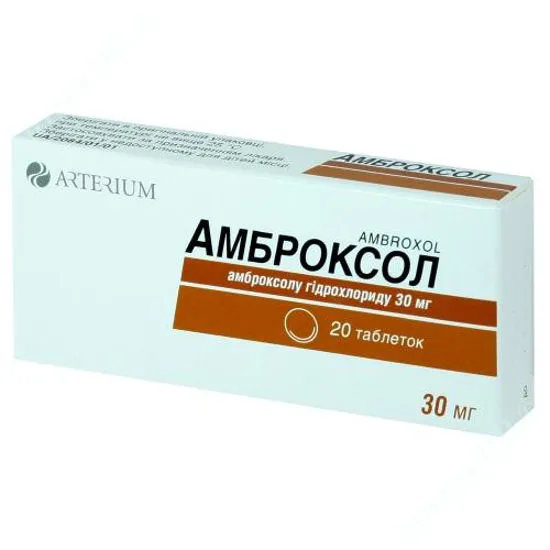
Table of Contents
INSTRUCTIONS FOR MEDICAL USE OF THE MEDICINAL PRODUCT AMBROXOL
Composition:
Active substance: ambroxol;
1 tablet contains 30 mg of ambroxol hydrochloride;
Excipients: lactose monohydrate, corn starch, colloidal anhydrous silicon dioxide, magnesium stearate.
Pharmaceutical form. Tablets.
Main physicochemical characteristics: white tablets with a slightly creamy shade, biconvex surface.
Pharmacotherapeutic group. Medicinal products used for cough and common cold. Mucolytic agents. ATC code R05C B06.
Pharmacological properties.
Pharmacodynamics. It is known that the active substance of the medicinal product, ambroxol hydrochloride, increases the secretion of the respiratory tract glands. Ambroxol enhances pulmonary surfactant secretion by directly affecting type II pneumocytes in alveoli and Clara cells in bronchioles, and also stimulates ciliary activity, thereby facilitating mucus expectoration and clearance (mucociliary clearance). Activation of fluid secretion and increased mucociliary clearance ease mucus elimination and alleviate cough.
There is evidence that ambroxol hydrochloride blocks neuronal sodium channels; this binding was reversible and concentration-dependent.
Ambroxol hydrochloride has demonstrated anti-inflammatory effects in vitro. Thus, ambroxol hydrochloride significantly reduces cytokine release from mononuclear and polymorphonuclear blood and tissue cells.
Clinical studies in patients with pharyngitis have shown a significant reduction in throat pain and redness upon administration of the drug.
Ambroxol hydrochloride increases the concentration of antibiotics (amoxicillin, cefuroxime, erythromycin, and doxycycline) in bronchopulmonary secretions and sputum.
Pharmacokinetics.
Absorption. Absorption of ambroxol hydrochloride from immediate-release oral formulations is rapid and complete, with linear dose-dependency within the therapeutic range. Maximum plasma concentration is reached within 1–2.5 hours after oral administration of immediate-release dosage forms.
Distribution. After oral administration, distribution of ambroxol hydrochloride from blood to tissues is rapid and extensive, with the highest concentration of the active substance found in the lungs. The expected volume of distribution after oral administration is 552 L. In plasma, within the therapeutic dose range, approximately 90% of the drug is protein-bound.
Metabolism and elimination. Approximately 30% of the dose is eliminated via presystemic metabolism after oral administration. Ambroxol hydrochloride is metabolized mainly in the liver through glucuronidation and cleavage to dibromanthranilic acid (approximately 10% of the dose). CYP3A4 is known to be responsible for the metabolism of ambroxol hydrochloride to dibromanthranilic acid.
Within 3 days after oral administration, about 6% of the dose is excreted unchanged in urine, and approximately 26% of the dose is excreted in conjugated form.
The elimination half-life from plasma is approximately 10 hours. Total clearance is about 660 mL/min. Renal clearance accounts for approximately 8% of total clearance. Within 5 days, approximately 83% of the total dose is excreted in urine.
Pharmacokinetics in special patient populations. In patients with impaired liver function, elimination of ambroxol hydrochloride is reduced, resulting in plasma levels 1.3–2 times higher. However, since the therapeutic range of ambroxol hydrochloride is sufficiently wide, dosage adjustment is not required.
Age and sex have no clinically significant effect on the pharmacokinetics of ambroxol hydrochloride; therefore, no dose adjustment is necessary.
Clinical characteristics.
Indications. Secretolytic therapy in acute and chronic bronchopulmonary diseases associated with impaired bronchial secretion and reduced mucus clearance.
Contraindications. Known hypersensitivity to ambroxol hydrochloride or to any of the excipients. The product is not intended for use in children under 12 years of age due to the dosage strength. For children under 12 years of age, appropriate dosage forms of ambroxol containing suitable amounts of the active substance should be used to achieve the required doses, e.g. Ambroxol-Zdorovia syrup, 15 mg/5 ml, or Ambroxol-Zdorovia Forte syrup, 30 mg/5 ml.
Interaction with other medicinal products and other forms of interaction. Concomitant use of ambroxol and antitussive agents may lead to excessive mucus accumulation due to suppression of the cough reflex. Therefore, such combination should only be used after careful assessment by a physician of the expected benefit versus possible risk.
Special precautions for use.
Only a few reports have been received on severe skin reactions: Stevens-Johnson syndrome and toxic epidermal necrolysis (Lyell's syndrome) associated with the use of expectorants such as ambroxol hydrochloride. In most cases, these reactions could be explained by the severity of the underlying disease in patients or by concomitant use of other medications. Also, during the initial stages of Stevens-Johnson syndrome or Lyell's syndrome, patients may experience nonspecific, flu-like symptoms such as malaise, myalgia, rhinitis, cough, and sore throat. In such cases, symptomatic treatment with cough and cold remedies may be mistakenly used. Therefore, if new skin lesions or mucous membrane involvement occur, immediate medical attention should be sought and treatment with ambroxol hydrochloride should be discontinued.
Since ambroxol may enhance mucus secretion, the drug should be used with caution in patients with impaired bronchial motility and increased mucus secretion (e.g., in rare conditions such as primary ciliary dyskinesia). Patients with impaired renal function or severe hepatic insufficiency should take the tablets only after consultation with a physician. When ambroxol, like any active substance metabolized in the liver and subsequently excreted by the kidneys, is administered, metabolites formed in the liver may accumulate in patients with severe renal insufficiency.
The tablets contain lactose. If the patient has been diagnosed with intolerance to certain sugars, medical advice should be sought before taking this medicinal product.
Use during pregnancy or breastfeeding. Pregnancy. Ambroxol hydrochloride crosses the placental barrier. There is no information available on direct or indirect harmful effects in animals on the course of pregnancy, embryonic/fetal development, delivery, or postnatal development.
Data indicate that use of the drug after the 28th week of pregnancy does not show any harmful effects on the fetus. However, usual precautionary measures regarding medication use during pregnancy should be observed. In particular, use of the drug is not recommended during the first trimester of pregnancy.
Breastfeeding. Ambroxol hydrochloride passes into breast milk. The drug is not recommended for use during breastfeeding.
Fertility. Available data do not indicate a direct or indirect adverse effect on fertility.
Effect on ability to drive vehicles or operate machinery. There is no information available regarding the effect on reaction speed when driving vehicles or operating machinery.
Method of administration and dosage. If not otherwise prescribed, the recommended dose is as follows:
Adults and children aged 12 years and older: Initially, the usual dose is 1 tablet three times daily for the first 2–3 days (equivalent to 90 mg ambroxol hydrochloride/day). Treatment should continue with 1 tablet twice daily (equivalent to 60 mg ambroxol hydrochloride/day).
If necessary, the therapeutic effect in adults and children aged 12 years and older may be enhanced by using 2 tablets twice daily (equivalent to 120 mg ambroxol hydrochloride/day).
The tablets should be swallowed whole with sufficient liquid (e.g., water, tea, or fruit juice) after meals.
In general, there are no restrictions on duration of use, but prolonged therapy should be conducted under medical supervision.
The drug should not be used for longer than 4–5 days without consulting a physician.
Children. For use in children aged 12 years and older. For children under 12 years of age, appropriate dosage forms of ambroxol with suitable active substance content should be used, such as Ambroxol-Health, syrup, 15 mg/5 mL, or Ambroxol-Health Forte, syrup, 30 mg/5 mL.
Overdose. There are currently no reports of overdose cases. Symptoms described in isolated reports of overdose and/or accidental misuse correspond to the known adverse effects of the drug at recommended doses and require symptomatic treatment.
Side effects.
General disorders: reactions at mucous membranes, chills.
Immune system, skin and subcutaneous tissue disorders: skin rash, urticaria, angioedema, pruritus, anaphylactic reactions including anaphylactic shock, other allergic reactions, erythema, severe skin reactions: Stevens-Johnson syndrome and toxic epidermal necrolysis (Lyell's syndrome).
Gastrointestinal disorders: diarrhea, nausea, vomiting, dyspepsia, abdominal pain, salivation.
Respiratory system disorders: dyspnea (as a hypersensitivity reaction).
Shelf life. 5 years.
Storage conditions. Store at a temperature not exceeding 25 °C in the original packaging.
Keep out of reach of children.
Packaging. Tablets № 10×2 in a blister pack in a carton.
Availability. Over-the-counter (without prescription).
Manufacturer.
Limited Liability Company "Experimental Plant "GNCLS", or
Limited Liability Company "FARMEKS GROUP", or
LIMITED LIABILITY COMPANY "CORPORATION "ZDOROVIYA".
Manufacturer's address and place of business.
8 Vorobiova Street, Kharkiv, Kharkiv region, Ukraine.
(Limited Liability Company "Experimental Plant "GNCLS")
100 Shevchenka Street, Boryspil, Kyiv region, 08301, Ukraine.
(Limited Liability Company "FARMEKS GROUP")
22 Shevchenka Street, Kharkiv, Kharkiv region, 61013, Ukraine.
(LIMITED LIABILITY COMPANY "CORPORATION "ZDOROVIYA")