Ambroxol 15
Ukraine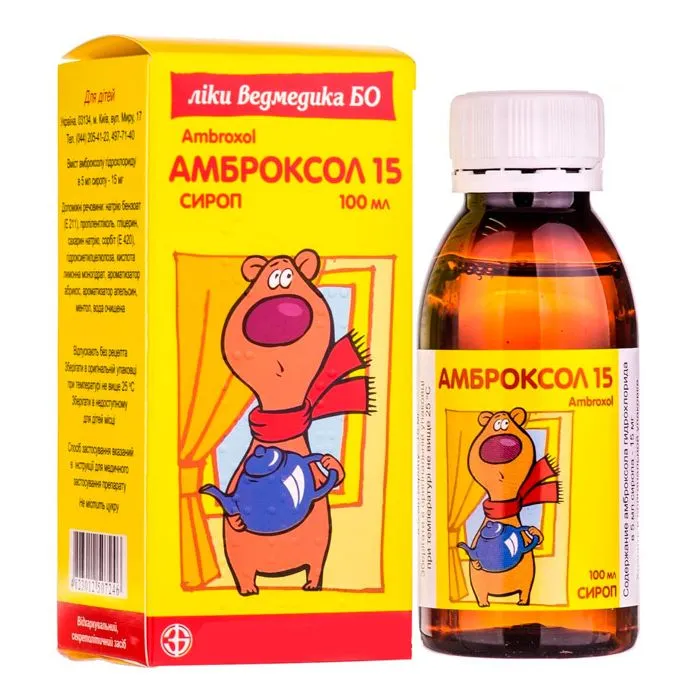
Table of Contents
INSTRUCTION FOR MEDICAL USE OF THE MEDICINAL PRODUCT Amroxol 15 (AMBROXOL 15)
Composition:
Active substance: ambroxol hydrochloride;
5 ml of syrup contain 15 mg of ambroxol hydrochloride (calculated as 100 % dry substance);
Excipients: benzoic acid (E 210), sucralose, hydroxyethylcellulose, banana flavor, vanilla-cream flavor, purified water.
Pharmaceutical form. Syrup.
Main physico-chemical properties: colorless or slightly yellowish clear liquid with a specific odor.
Pharmacotherapeutic group. Medicinal products used for cough and colds. Mucolytic agents. Ambroxol. ATC Code R05C B06.
Pharmacological properties.
Pharmacodynamics.
Ambroxol increases secretion of the respiratory tract glands, stimulates ciliary activity of the respiratory tract, enhances surfactant production in the lungs. These effects lead to improved mucus clearance and elimination (mucociliary clearance). Activation of fluid secretion and increased mucociliary clearance facilitate mucus expulsion and reduce coughing.
Pharmacokinetics.
The effect of the drug begins 30 minutes after administration and lasts about 10 hours.
The drug is rapidly and sufficiently completely absorbed. Maximum plasma concentrations are reached within 0.5–3 hours. The extent of ambroxol binding to plasma proteins is 80–90%.
Distribution of ambroxol from blood to tissues is rapid, with high concentrations of the active substance in the lungs. The drug penetrates the blood-brain and placental barriers, and is excreted into breast milk.
Ambroxol is metabolized in the liver via conjugation. The elimination half-life from plasma is 10 hours; no accumulation has been observed. Approximately 90% is excreted by the kidneys as water-soluble metabolites, 5% unchanged. The elimination half-life is prolonged in severe chronic renal insufficiency.
Clinical characteristics.
Indications.
Mucolytic therapy in acute and chronic bronchopulmonary diseases associated with impaired bronchial secretion and weakened sputum expectoration.
Contraindications.
- Hypersensitivity (allergy) to ambroxol or to any other components of the medicinal product.
Interaction with other medicinal products and other forms of interaction.
The concomitant use of ambroxol with antibiotics (amoxicillin, cefuroxime, erythromycin, doxycycline) promotes increased antibiotic concentrations in lung tissue.
The use of Ambroxol 15 together with antitussive agents leads to impaired sputum expectoration due to cough suppression. Therefore, such a combination is possible only after careful assessment by a physician of the benefit-risk ratio of the treatment.
Special precautions for use
When using mucolytic agents such as ambroxol hydrochloride, isolated cases of severe skin reactions have been reported, including erythema multiforme, Stevens-Johnson syndrome, Lyell's syndrome (toxic epidermal necrolysis), and acute generalized exanthematous pustulosis. In most cases, these reactions could be explained by the severity of the underlying disease and/or concomitant therapy. Additionally, during the initial stages of Stevens-Johnson syndrome or Lyell's syndrome, patients may present with influenza-like nonspecific prodromal symptoms such as fever, body aches, rhinitis, cough, and sore throat. Due to misinterpretation of these symptoms, patients might have received medications for symptomatic treatment of cough and cold. Therefore, if progressive skin lesions appear (sometimes associated with blister formation or mucosal involvement), the drug should be discontinued immediately and medical help should be sought.
The medication should be used with caution in patients with gastric or duodenal ulcer disease. In cases of renal impairment or severe liver disease, Ambroxol 15 should be used only after consultation with a physician; it may be necessary to prolong the dosing intervals or reduce the dose. Ambroxol hydrochloride is metabolized in the liver and excreted by the kidneys; therefore, in severe renal insufficiency, accumulation of ambroxol and/or its metabolites in the body may occur.
During treatment, it is necessary to consume sufficient fluids (juices, tea, water) to enhance the mucolytic effect of the medication.
Ambroxol 15 is sugar-free and does not contain alcohol.
Concomitant use of Ambroxol 15 with antitussive agents may impair mucus expectoration due to cough suppression.
Mucolytic agents (including ambroxol) should be used with caution in conditions associated with increased mucus secretion and impaired bronchial motility (e.g., in rare genetically determined disorders such as primary ciliary dyskinesia) due to the risk of accumulation of large amounts of mucus.
Medical advice should be sought before administering the medication to children under 2 years of age.
Use during pregnancy or breastfeeding
Pregnancy
Ambroxol hydrochloride crosses the placental barrier. Clinical studies on the use of ambroxol hydrochloride have not shown any harmful effects on the fetus after the 28th week of pregnancy. Nevertheless, standard precautions for drug use during pregnancy should be observed. Particularly, the use of the medication is not recommended during the first trimester of pregnancy.
Breastfeeding
Ambroxol hydrochloride is excreted in breast milk; therefore, the medication is not recommended during breastfeeding.
Fertility
Preclinical studies have not revealed any direct or indirect adverse effects on fertility.
Ability to influence reaction rate when driving or operating machinery
The medication is intended for use in children.
Method of Administration and Dosage.
Children:
under 2 years of age: 2.5 ml (1/2 measuring spoon) twice daily, equivalent to 15 mg of ambroxol per day;
between 2 and 6 years of age: 2.5 ml (1/2 measuring spoon) three times daily, equivalent to 22.5 mg of ambroxol per day;
between 6 and 12 years of age: 5 ml (1 measuring spoon) two to three times daily, equivalent to 30–45 mg of ambroxol per day;
adults and children aged 12 years and older: 10 ml (2 measuring spoons) three times daily (equivalent to 90 mg of ambroxol hydrochloride per day) for the first 2–3 days, followed by 10 ml (2 measuring spoons) twice daily (equivalent to 60 mg of ambroxol hydrochloride per day).
If necessary, the therapeutic effect in adults and children aged 12 years and older may be enhanced by increasing the dose to 20 ml twice daily (equivalent to 120 mg of ambroxol hydrochloride per day).
For adults and children aged 12 years and older, a syrup with higher concentration is recommended (Ambroxol 30, syrup, 30 mg/5 ml).
The medication can be taken regardless of food intake. Food consumption does not affect the drug's efficacy.
In acute conditions, consult a physician if symptoms persist and/or worsen despite treatment.
Children.
For children under 2 years of age, use only as directed by a physician.
Overdose.
Specific symptoms of ambroxol overdose are currently unknown. In cases of accidental overdose and/or misuse, symptoms corresponding to the adverse effects of ambroxol hydrochloride may occur. Treatment is symptomatic.
Side effects.
The drug is well tolerated by patients.
Gastrointestinal tract: dyspepsia, heartburn, nausea, vomiting, abdominal pain, diarrhea/constipation, hypersalivation, dry mouth, hyposthesia of the oral and/or pharyngeal mucosa.
Respiratory system: rhinorrhea, dryness of the mucous membranes of the upper respiratory tract, dyspnea (as a symptom of hypersensitivity reaction).
Urinary system: dysuria.
Nervous system: dysgeusia (disturbance of taste sensation).
Immune system, skin and subcutaneous tissues: itching, rash, urticaria, anaphylactic reactions (including angioneurotic edema, anaphylactic shock), fever, chills, other allergic reactions.
Very rarely, severe skin reactions may occur, such as erythema multiforme, Stevens-Johnson syndrome, Lyell's syndrome (toxic epidermal necrolysis), and acute generalized exanthematous pustulosis.
Other: mucosal reactions.
Shelf life. 3 years.
Do not use the drug after the expiry date stated on the packaging.
Storage conditions.
In the original packaging at a temperature not exceeding 25 °C. After opening the bottle, the shelf life is 30 days at a temperature not exceeding 25 °C. Keep out of reach of children.
Packaging.
50 ml in a bottle, 1 bottle with a dosing spoon in a carton.
100 ml in bottles and jars, 1 bottle or 1 jar with a dosing spoon in a carton.
120 ml in bottles and jars, 1 bottle or 1 jar with a dosing spoon in a carton.
Prescription status. Over-the-counter.
Manufacturer.
Public joint-stock company "Scientific and Production Center "Borshchahivskiy Chemical and Pharmaceutical Plant".
Manufacturer's address and place of business.
17 Myru Street, Kyiv, 03134, Ukraine.