Allergocort
Ukraine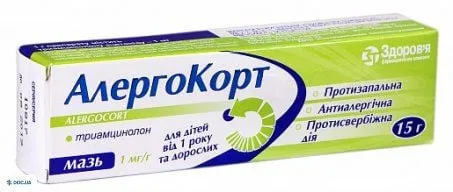
Table of Contents
INSTRUCTIONS FOR MEDICAL USE OF THE MEDICINAL PRODUCT ALEGRGOCORT (ALERGOCORT)
Composition:
Active ingredient: triamcinolone;
1 g of the preparation contains 1 mg of triamcinolone acetonide;
Excipients: methylparaben (E 218), stearic acid, polysorbate 60, cetostearyl alcohol, mineral oil, glycerin, purified water.
Pharmaceutical form. Ointment.
Main physicochemical properties: white or almost white homogeneous ointment, practically odorless.
Pharmacotherapeutic group. Corticosteroids for dermatological use. Moderately potent corticosteroids (Group II). Triamcinolone.
ATC code D07AB09.
Pharmacological Properties
Pharmacodynamics
The active ingredient of the ointment is triamcinolone acetonide – a fluorinated glucocorticosteroid that, when applied topically, exerts anti-inflammatory, antiallergic, and antipruritic effects.
The pharmacological action of glucocorticosteroids is based on regulation of the synthesis of specific proteins in the body and ensuring the body's adaptation to stress conditions by reducing glucose utilization and enhancing gluconeogenesis (hyperglycemia). They promote glycogen deposition, primarily in the liver, by enhancing insulin secretion under hyperglycemic conditions. Glucocorticosteroids reduce protein synthesis and enhance catabolism of proteins in muscle, skin, and bone tissues; they also promote lipolysis. They constrict blood vessels, reduce their permeability, and decrease tissue edema.
Numerous glucocorticosteroid receptors are also located in brain and heart tissues. Glucocorticosteroids enhance β-adrenergic responses in the lungs, dilate bronchi, and reduce pulmonary vascular resistance.
In high doses, glucocorticosteroids inhibit corticotropin secretion; in adrenal corticosteroid insufficiency, they enhance glomerular filtration and diuresis. They may cause ulceration of mucous membranes. At higher doses, they exhibit anti-allergic and anti-inflammatory properties.
Esterification of the glucocorticosteroid molecule with fatty acids at the 17 and 21 positions significantly enhances its effect on the skin. The presence of a cyclic acetonide group at positions 16 and 17 enhances local anti-inflammatory activity without affecting the systemic glucocorticosteroid effect. Fluorine further increases the local activity of the drug.
Pharmacokinetics
Triamcinolone penetrates well into deep layers of the skin and is partially absorbed into the bloodstream. When applied under occlusive dressing to affected skin areas, it is absorbed in amounts sufficient to produce systemic effects. Glucocorticosteroids are rapidly distributed in body tissues. The main metabolite of triamcinolone – 6-β-hydroxytriamcinolone – is excreted by the liver, kidneys, feces, and urine in approximately equal proportions. The plasma half-life is about 5 hours; the terminal half-life is 18–36 hours.
Clinical characteristics.
Indications.
Skin diseases sensitive to corticosteroids (eczema, psoriasis vulgaris, allergic dermatitis).
Contraindications.
Hypersensitivity to triamcinolone acetonide or to any of the excipients of the medication.
The medication must not be applied to the eyes or to skin areas near the eyes.
Do not use the medication as monotherapy without specific treatment in fungal and bacterial skin infections.
Tuberculosis; viral skin infections, particularly herpes simplex and varicella; parasitic skin infections (scabies); cutaneous manifestations of syphilis; skin reactions following vaccination; perianal and genital pruritus; leg ulcers; varicose veins; widespread plaque psoriasis; facial skin lesions (rosacea, acne vulgaris, perioral dermatitis); skin intertrigo caused by wet diapers; dry desquamation of the skin.
Do not apply the ointment directly to the breasts immediately before breastfeeding.
Do not use in children under 1 year of age.
Interaction with other medicinal products and other forms of interaction.
With topical application of corticosteroids, interaction with other medicinal products is unknown.
Special precautions for use.
If skin irritation occurs, discontinue use of the medicinal product and continue treatment with another agent.
When using occlusive dressings or treating large body surface areas, systemic effects of the drug are possible; in such cases, particular caution is required, especially in children.
During application of the ointment, microorganisms present on the skin (primarily pyogenic microorganisms, and sometimes budding yeasts) may penetrate through the softened stratum corneum and cause various pyodermas, which are treated with washable disinfectants. Fungal infections are possible; occasionally, under occlusive dressing, bruising may rarely occur. Prolonged application of the ointment to the same area of skin, especially in younger patients, may lead to atrophy of that skin area.
Certain body areas, such as the axillae and inguinal folds (where natural occlusion occurs and the skin is more delicate and thinner), are more prone to the development of striae and easily noticeable, irreversible skin atrophy. Therefore, application of the ointment to these skin areas should be short-term.
In case of fungal or bacterial skin infection, additional local or systemic therapy is required.
The ointment is not recommended for use on the hairy part of the scalp.
Prolonged application of the drug to the facial skin is not recommended due to the risk of skin atrophy. Avoid contact with the eyes. If contact occurs, rinse thoroughly with copious amounts of running water and consult a physician.
In psoriasis treatment, withdrawal syndrome, steroid dependence, generalized pustular psoriasis, and local or systemic toxicity due to impaired skin barrier function may occur. Treatment of patients with psoriasis using topical corticosteroids is possible only under strict medical supervision.
Prescribing the ointment to children aged 1 year and older is possible only in exceptional cases. The duration of treatment in children should not exceed 5 days. Use of occlusive dressings in children is contraindicated.
When used in children, one must consider the possibility of developing signs of hypothalamic-pituitary-adrenal (HPA) axis suppression and Cushing's syndrome, which occur more frequently in children than in adult patients due to the higher ratio of skin surface area to body weight, making children more susceptible to systemic toxicity. In children treated with topical corticosteroids, acute adrenal insufficiency, Cushing's syndrome, and increased intracranial pressure have been reported.
Visual disturbances
Visual disturbances may occur with both systemic and topical use of corticosteroids. If a patient experiences symptoms such as blurred vision or other visual disturbances, they should be referred to an ophthalmologist to evaluate possible causes, including cataract, glaucoma, or rare conditions such as central serous chorioretinopathy (CSCR), which has been reported with systemic and topical corticosteroid use.
Topical steroid withdrawal syndrome
Prolonged continuous or inappropriate use of topical corticosteroids may lead to recurrent flare-ups after discontinuation of treatment (topical steroid withdrawal syndrome). A severe rebound flare may develop, presenting as dermatitis with intense redness, stinging, and burning, which may extend beyond the original treatment area. Rebound flare is more likely when treating sensitive skin areas such as the face and flexures. If recurrence occurs within days or weeks after successful treatment, withdrawal reaction should be suspected. Re-administration requires caution—consultation with a specialist or consideration of alternative treatments is recommended.
Excipients
The medicinal product contains methylparaben (E 218), which may cause allergic reactions (possibly delayed), and cetyl stearyl alcohol, which may cause local skin reactions (e.g., contact dermatitis).
Use during pregnancy or breastfeeding.
Pregnancy. Use of the ointment during the first trimester of pregnancy is contraindicated. There is insufficient data to confirm the safety of the drug during the second and third trimesters of pregnancy. The decision regarding use of the drug during the second and third trimesters of pregnancy and during breastfeeding must be made by a physician on an individual basis, carefully weighing the expected therapeutic benefit against the potential risk to the fetus.
Breastfeeding. Systemic absorption of glucocorticoids is associated with their passage into breast milk and potential effects on the infant's adrenal cortex and growth.
Topical use of triamcinolone during breastfeeding is not recommended. Application of the cream directly to the mammary glands immediately before breastfeeding is contraindicated (see section "Contraindications").
Ability to affect reaction speed when driving or operating machinery.
Currently, there are no reports. However, when driving or operating machinery, particular caution is advised, considering the potential for adverse nervous system reactions.
Method of administration and dosage.
For external use only.
Adults: apply a thin layer of ointment 2–3 times daily to the affected area of skin (maximum dose for adults – no more than 15 g of ointment per day), or apply the medication under an occlusive dressing (maximum dose for adults – no more than 10 g of ointment per day).
Children aged 1 year and older: apply a thin layer of ointment up to 2 times daily to the affected area of skin. Duration of treatment in children should not exceed 5 days. Use under occlusive dressing is contraindicated in children.
Elderly patients: the medication should be used cautiously and for a short duration, considering that skin in this patient group is typically thinner.
Children: the ointment is contraindicated in children under 1 year of age.
Overdose.
Depending on the amount of steroid absorbed into the body, local and systemic adverse reactions may occur. In case of overdose, treatment should not be discontinued abruptly – it should be tapered gradually. If symptoms of adrenal cortex insufficiency develop, intravenous hydrocortisone may be required.
Side effects
Topical corticosteroid preparations are typically associated with local adverse reactions; however, depending on the amount of substance absorbed into systemic circulation, systemic effects may also occur.
With prolonged use over large skin areas, suppression of adrenal cortex function may occur, particularly in children, as well as when occlusive dressings are used. A negative nitrogen balance due to enhanced protein catabolism is also possible.
Excipients with known effect: cetostearyl alcohol – may cause local skin reactions (e.g., contact dermatitis); methylparaben (E 218) – may cause allergic reactions (possibly delayed).
The frequency of the following adverse reactions is unknown, as adequate data are not available (cannot be estimated from the available data).
Infections and parasitic diseases: infection, masking of infection symptoms, opportunistic infections.
Immune system disorders: hypersensitivity.
Endocrine disorders: adrenal cortex suppression (secondary adrenal insufficiency).
Metabolism and nutrition disorders: hypokalemic alkalosis, fluid and sodium retention, hypokalemia.
Psychiatric disorders: insomnia, psychiatric disturbances.
Nervous system disorders: seizures, dizziness, headache, increased intracranial pressure.
Eye disorders: cataract, subcapsular cataract, exophthalmos, glaucoma, optic disc edema, ulcerative keratitis, chorioretinopathy, blurred vision (see section "Special precautions").
Cardiac disorders: heart failure.
Vascular disorders: arterial hypertension.
Gastrointestinal disorders: gastric bleeding, gastrointestinal bleeding, gastrointestinal perforation, esophagitis, pancreatitis, peptic ulcer.
Skin and subcutaneous tissue disorders: dermatitis, skin burning sensation, folliculitis, acneiform eruptions, contact dermatitis, dryness and thinning of the skin, erythema, hirsutism, increased sweating, intertrigo, pruritus, skin atrophy, hypopigmentation, irritation, striae, telangiectasia. Withdrawal reactions: skin redness which may spread beyond the initial affected area, burning or stinging sensation, pruritus, skin desquamation, oozing pustules (see section "Special precautions").
Musculoskeletal and connective tissue disorders: steroid myopathy, osteoporosis, osteonecrosis, aseptic necrosis.
General disorders and administration site conditions: delayed wound healing.
Investigations: elevated intraocular pressure, negative nitrogen balance, negative skin tests.
Children
Eye disorders: higher risk of cataract development in children.
Musculoskeletal and connective tissue disorders: growth retardation.
Reporting of adverse reactions
Reporting adverse reactions after medicinal product authorization is important. It allows continuous monitoring of the benefit-risk balance of the medicinal product. Medical and pharmaceutical professionals, as well as patients or their legal representatives, should report all suspected adverse reactions and lack of efficacy via the Automated Pharmacovigilance Information System at the following link: https://aisf.dec.gov.ua.
Shelf life. 2 years.
Storage conditions. Store in the original packaging at a temperature between 2 °C and 8 °C.
Keep out of reach and sight of children.
Packaging. 15 g of the product in a tube; tube in a carton.
Prescription status. Prescription only.
Manufacturer. Limited Liability Company "Pharmaceutical Company "Zdorov'ya".
Manufacturer's address and location of manufacturing operations.
Ukraine, 61013, Kharkiv region, city of Kharkiv, Shevchenka Street, 22.
(all stages of manufacturing, quality control, batch release)
Ukraine, 08301, Kyiv region, city of Boryspil, Shevchenka Street, 100, lit. B-II (Building 4).
(all stages of manufacturing, batch release)