Allerginol plus®
Ukraine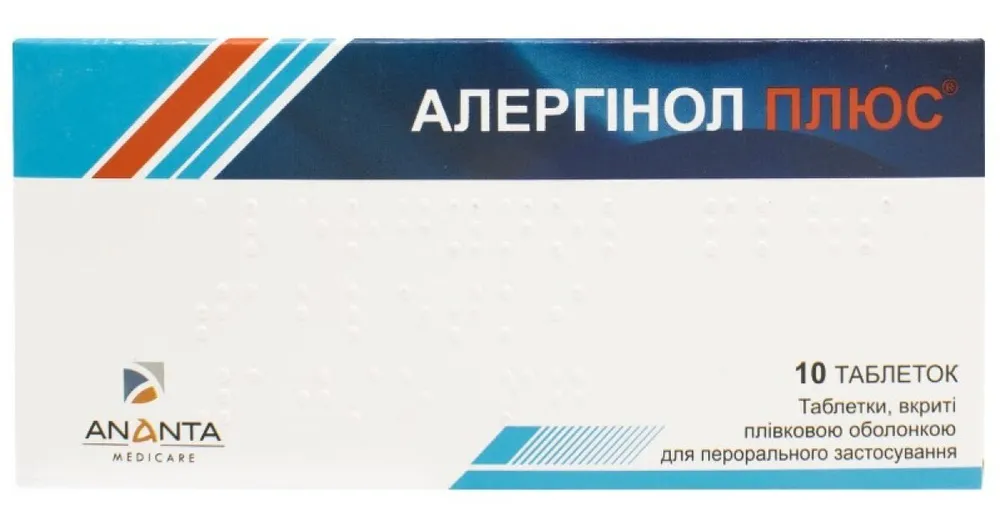
Table of Contents
INSTRUCTION FOR MEDICAL USE OF THE MEDICINAL PRODUCT ALEGRINOL PLUS® (ALLERGINOLPLUS)
Composition:
Active substances: montelukast, levocetirizine dihydrochloride;
One film-coated tablet contains montelukast sodium 10.5 mg, equivalent to montelukast 10 mg, and levocetirizine dihydrochloride 5 mg;
Excipients: microcrystalline cellulose, mannitol (E 421), sodium croscarmellose, hydroxypropylcellulose, magnesium stearate, Opadry White (polyethylene glycol, titanium dioxide (E 171), hypromellose).
Pharmaceutical form. Film-coated tablets.
Main physicochemical properties: white, round, biconvex film-coated tablets, smooth on both sides.
Pharmacotherapeutic group.
Antiasthmatics. Selective and orally active leukotriene receptor antagonist. ATC code R03DC03.
Antihistamines for systemic use. Piperazine derivatives. ATC code R06AE09.
Pharmacological properties.
Pharmacodynamics.
Alerginol Plus**®** contains a fixed combination of two active substances: montelukast and levocetirizine; therefore, the mechanisms described below for each component apply to Alerginol Plus**®**.
Montelukast
Cysteinyl leukotrienes (LTC4, LTD4, LTE4) are potent inflammatory eicosanoids released by various cells, including mast cells and eosinophils. These important pro-asthmatic mediators bind to cysteinyl leukotriene receptors (CysLT) present in human airways (including smooth muscle cells and macrophages) and other inflammatory cells (including eosinophils and certain myeloid progenitor cells). CysLTs are involved in the pathophysiology of asthma and allergic rhinitis. In asthma, leukotriene-mediated effects cause bronchoconstriction, mucus secretion, increased vascular permeability, and increased eosinophil counts. In allergic rhinitis, following allergen exposure, CysLTs are released from nasal mucosa during hypersensitivity reactions and manifest as symptoms of allergic rhinitis. Intranasal challenge with CysLTs has demonstrated increased resistance in nasal airways and symptoms of nasal obstruction.
Montelukast sodium is an active compound that selectively and with high affinity binds to CysLT1 receptors. Montelukast inhibits the physiological action of LTD4 on CysLT1 receptors without exhibiting any affinity for other receptors.
Levocetirizine hydrochloride
Levocetirizine, the R-enantiomer of cetirizine, is a potent and selective antagonist of peripheral H1-histamine receptors. Binding affinity studies have shown high affinity of levocetirizine for human H1-histamine receptors (Ki = 3.2 nmol/L). The affinity for H1-histamine receptors is twice higher with levocetirizine than with cetirizine (Ki = 6.3 nmol/L). Levocetirizine dissociates from H1-histamine receptors with a half-life of 115 minutes ± 38 minutes. After a single dose, receptor occupancy is 90% at 4 hours and 57% at 24 hours. In placebo-controlled trials using an allergen challenge chamber model, levocetirizine 5 mg began suppressing pollen-induced allergy symptoms within 1 hour after administration. In vitro studies (Boyd chamber and "cell layer" methods) demonstrated that levocetirizine inhibits eosinophil transendothelial migration induced by eotaxin in skin and lung cells. Pharmacodynamic in vivo studies (skin chamber method) showed three main inhibitory effects of levocetirizine 5 mg within the first 6 hours after pollen exposure compared to placebo in 14 adult patients: inhibition of VCAM-1 (vascular endothelial adhesion molecule type I) release, reduced vascular permeability, and decreased eosinophil activity. Studies have shown that the activity of levocetirizine at half the dose is comparable to that of cetirizine both on skin and nasal mucosa. The pharmacokinetic/pharmacodynamic relationship of levocetirizine 5 mg is similar to the pattern of histamine-induced "wheal and flare" inhibition by cetirizine 10 mg. As with cetirizine, the effect on histamine-induced skin reactions is independent of plasma concentrations. ECG data showed no clinically relevant effect of levocetirizine on QT interval.
Pharmacokinetics.
Montelukast
Absorption. In adults, following a 10 mg dose administered on an empty stomach, the mean peak plasma concentration (Cmax) is reached within 3–4 hours (time to maximum concentration – Tmax). The mean oral bioavailability is 64%. Ingestion of a standard meal in the morning does not affect the Cmax, which is reached within 2 hours. The safety and efficacy of montelukast in asthma patients have been demonstrated in clinical trials with film-coated tablets 10 mg taken in the evening, regardless of food intake. The safety of montelukast in asthma patients has also been demonstrated in clinical trials with chewable tablets 4 mg taken in the evening, regardless of food intake. The safety and efficacy of montelukast in patients with seasonal allergic rhinitis have been demonstrated in clinical trials with film-coated tablets 10 mg taken in the morning or evening, regardless of food intake.
Distribution. Over 99% of montelukast is protein-bound in plasma. The mean volume of distribution at steady state is 8–11 liters. In rat studies, radiolabeled montelukast showed minimal penetration across the blood-brain barrier. In all other animal species, radiolabeled material concentrations 24 hours after dosing were also minimal.
Metabolism. Montelukast is extensively metabolized. In studies with therapeutic doses, metabolite concentrations of montelukast in steady-state plasma in adults and pediatric patients were not detectable.
In vitro studies using human liver microsomes have shown that cytochrome P450 3A4 and 2C9 are involved in montelukast metabolism. Clinical studies on the effects of known inhibitors of cytochrome P450 3A4 (e.g., ketoconazole, erythromycin) or 2C9 (e.g., fluconazole) on montelukast pharmacokinetics have not been conducted. Further in vitro studies using human liver microsomes indicate that at therapeutic concentrations, montelukast does not inhibit cytochrome P450 3A4, 2C9, 1A2, 2A6, 2C19, or 2D6. In vitro studies have shown that montelukast is a potent inhibitor of cytochrome P450 2C8. However, data from a clinical drug interaction study using montelukast and rosiglitazone (a marker substrate initially metabolized by CYP2C8) showed that montelukast does not inhibit CYP2C8 in vivo and therefore should not alter the metabolism of drugs metabolized by this enzyme.
Elimination. The plasma clearance of montelukast in healthy adult volunteers averages 45 mL/min. After administration of an isotopically labeled oral dose, 86% was excreted in feces within 5 days and less than 0.2% in urine. Combined with the oral bioavailability of montelukast, this indicates that its metabolites are almost exclusively excreted via bile. The mean elimination half-life of montelukast in plasma in young healthy volunteers ranges from 2.7 to 5.5 hours. Montelukast pharmacokinetics are linear over the oral dose range up to 50 mg. With 10 mg once daily dosing, there is minimal accumulation (14%) of the active substance in plasma.
Levocetirizine hydrochloride
The pharmacokinetics of levocetirizine are linear, dose- and time-independent, with low inter-individual variability.
Absorption. Levocetirizine is rapidly and extensively absorbed after oral administration. Cmax is reached within 0.9 hours after intake. Steady-state concentrations are achieved within 2 days. Cmax is 270 ng/mL after a single 5 mg dose and 308 ng/mL after repeated dosing.
The extent of absorption is dose-independent and not altered by food intake; however, Cmax is reduced and Tmax is delayed when taken with food.
Distribution. There is no available information on the tissue distribution of levocetirizine in humans or its penetration across the blood-brain barrier. Levocetirizine is 90% bound to plasma proteins. Distribution is limited, with a volume of distribution of 0.4 L/kg.
Biological transformation. Approximately 14% of levocetirizine undergoes metabolism in humans; therefore, differences due to genetic polymorphism or concomitant use of enzyme inhibitors are expected to be minimal. Metabolism involves aromatic oxidation, N- and O-dealkylation, and conjugation with taurine. Dealkylation is primarily mediated by CYP 3A4, while aromatic oxidation involves multiple and/or undefined CYP isoforms. Levocetirizine does not affect the activity of CYP isoforms 1A2, 2C9, 2C19, 2D6, 2E1, or 3A4 at concentrations significantly exceeding maximum levels after a 5 mg oral dose. Given the low degree of metabolism and lack of inhibitory potential, drug interactions with levocetirizine are unlikely.
Elimination. The elimination half-life of levocetirizine in plasma in adults is 7.9 ± 1.9 hours. Mean total clearance is 0.63 mL/min/kg. The primary route of elimination of levocetirizine and its metabolites is via urine (on average, 85.4% of the administered dose is excreted). Only 12.9% of the dose is excreted in feces. Excretion of levocetirizine occurs mainly through glomerular filtration and active tubular secretion.
Clinical characteristics.
Indications.
For reduction of symptoms associated with seasonal and perennial allergic rhinitis, as well as rhinitis in patients with bronchial asthma.
Contraindications.
Hypersensitivity to montelukast sodium, levocetirizine or cetirizine, hydroxyzine, or to any other component of the drug. The drug is also contraindicated in severe renal insufficiency (creatinine clearance < 10 mL/min). Pediatric age under 15 years.
Interaction with other medicinal products and other types of interactions.
Montelukast
Theophylline, prednisone and prednisolone: when montelukast is used concomitantly with theophylline, prednisone, prednisolone, oral contraceptives, terfenadine, digoxin, warfarin, thyroid hormones, sedative decongestants, and cytochrome P450 (CYP) enzyme inducers, dosage adjustment of these agents is not required. Oral contraceptives, terfenadine, digoxin and warfarin: in drug interaction studies using the recommended clinical dose of montelukast, no clinically significant effect of this compound on the following agents was observed: oral contraceptives (norethindrone 1 mg/ethinyl estradiol 35 mcg), terfenadine, digoxin, and warfarin.
Thyroid hormones, sedative hypnotics, nonsteroidal anti-inflammatory agents, benzodiazepines, and antiedema agents: no forms of interaction have been observed.
Cytochrome P450 (CYP) enzyme inducers: during concomitant administration of phenobarbital, which stimulates hepatic metabolism, the area under the plasma concentration–time curve (AUC) of montelukast following a single 10 mg dose was reduced by approximately 40%. However, dose adjustment of montelukast is not recommended. Montelukast is a potent inhibitor of cytochrome CYP2C8 in vitro. However, in a clinical drug interaction study involving montelukast and rosiglitazone (a marker substrate for drugs primarily metabolized by CYP2C8) in 12 healthy volunteers, the pharmacokinetics of rosiglitazone remained unchanged when coadministered with montelukast, indicating absence of CYP2C8 inhibition by montelukast in vivo. Therefore, montelukast is not expected to alter the metabolism of drugs metabolized by this enzyme (e.g., paclitaxel, rosiglitazone, repaglinide).
Levocetirizine dihydrochloride
In vitro data indicate that levocetirizine is not expected to cause pharmacokinetic interactions via inhibition or induction of hepatic enzymes involved in drug metabolism. No in vivo drug interaction studies with levocetirizine have been conducted.
Antipyrine, azithromycin, cimetidine, erythromycin, ketoconazole, theophylline, and pseudoephedrine: pharmacokinetic interaction studies using racemic cetirizine showed no interaction with antipyrine, pseudoephedrine, erythromycin, azithromycin, ketoconazole, or cimetidine. However, a slight decrease (by 16%) in cetirizine clearance was observed when theophylline was administered at a dose of 400 mg. Higher theophylline doses may produce a more pronounced effect.
Ritonavir increased plasma concentration of cetirizine by approximately 42%, prolonged its half-life by 53%, and reduced cetirizine clearance by 29%. Ritonavir distribution was slightly altered (–11%) when coadministered with cetirizine. There are no data on potentiation of sedative effects when cetirizine is used at therapeutic doses. However, concomitant use of sedatives should be avoided during treatment with this drug. Food intake does not affect the extent of drug absorption, but coadministration with food reduces the rate of absorption.
Concomitant administration of cetirizine or levocetirizine with alcohol or other central nervous system (CNS) depressants in sensitive patients may result in additional reduction in attention and ability to perform tasks.
Special precautions for use.
Montelukast
Acute episode of bronchial asthma.
Montelukast is not indicated for relief of bronchospasm in acute asthmatic attacks, including status asthmaticus. Patients should be advised to use appropriate medications in such cases. Montelukast therapy may be continued during acute asthma attacks. Montelukast should not abruptly replace inhaled or oral corticosteroid therapy; the dose of inhaled corticosteroids may be gradually reduced under medical supervision.
Montelukast should not be used as monotherapy for prevention of exercise-induced bronchospasm. If acute asthma attacks occur after physical exertion, patients should continue using inhaled β-agonists as prophylactic agents in their usual regimen and should carry short-acting inhaled β-agonists for emergency relief.
Concomitant use with corticosteroids
While the dose of inhaled corticosteroids may be gradually reduced under medical supervision, montelukast should not abruptly replace inhaled or oral corticosteroids.
Hypersensitivity to acetylsalicylic acid
Patients with known hypersensitivity to acetylsalicylic acid should avoid using acetylsalicylic acid or nonsteroidal anti-inflammatory drugs during montelukast therapy. Although montelukast is effective in improving respiratory function in patients with bronchial asthma and documented hypersensitivity to acetylsalicylic acid, it does not reduce the bronchoconstrictor response to acetylsalicylic acid or other nonsteroidal anti-inflammatory drugs in patients with acetylsalicylic acid-sensitive asthma.
Neuropsychiatric disorders
Cases of neuropsychiatric events have been reported during montelukast use in adults, adolescents, and children. Post-marketing surveillance has reported adverse events including agitation, aggressive behavior or hostility, anxiety, depression, disorientation, sleep disturbances, hallucinations, insomnia, irritability, restlessness, tremor, somnambulism, suicidal thoughts, and suicidal behavior (including suicide). Clinical details of some post-marketing reports of adverse events during montelukast use are consistent with a drug-induced effect. Physicians prescribing this medication and patients should be aware of the potential for neuropsychiatric disorders. Patients should be warned to report any such symptoms to their physician. If such events occur, the physician should carefully weigh the risks and benefits of continuing montelukast therapy.
Eosinophilia
In isolated cases, systemic eosinophilia, sometimes with clinical signs of vasculitis (Churg-Strauss syndrome), has been observed in patients receiving montelukast. Treatment of this condition typically involves systemic corticosteroid therapy. These cases usually occurred in association with tapering of oral corticosteroid doses. Physicians should closely monitor patients for early signs of eosinophilia, vasculitic skin rashes, worsening pulmonary symptoms, or cardiac and/or neuropathic complications.
Since montelukast is primarily excreted via bile, this combination product should be administered with caution in patients with hepatic impairment.
No differences in safety or efficacy profile have been observed when this medicinal product is used in elderly versus younger patients; clinical experience has not revealed any evidence suggesting a different response in these two populations. However, increased sensitivity in some elderly patients cannot be excluded.
Levocetirizine hydrochloride
Alcohol consumption should be avoided during treatment with this medication. Clinical trials of levocetirizine for each approved indication have not included sufficient numbers of patients aged 65 years and older to determine whether they respond differently from younger patients. Other clinical studies have not revealed any differences in response between elderly and younger patients. In general, this medication should be prescribed with caution in elderly patients and treatment should be initiated at the lowest dose, considering the higher likelihood of decreased hepatic, renal, or cardiac function and concomitant diseases or drug therapies.
Since levocetirizine is primarily excreted via urine, patients with renal impairment and elderly patients, in whom reduced glomerular filtration may occur, may require dose adjustment. This combination product should be used with caution in such patients.
When prescribing this medication to patients with conditions predisposing to urinary retention (e.g., spinal cord injury, benign prostatic hyperplasia), it should be noted that levocetirizine may increase the risk of urinary retention.
Antihistamines suppress the response to skin allergy tests; therefore, administration of the drug should be discontinued at least 3 days prior to testing (elimination period).
Pruritus may occur after discontinuation of levocetirizine, even if such symptoms were not present before treatment initiation. Symptoms may resolve spontaneously. In some cases, symptoms may be severe and re-treatment with the drug may be necessary after discontinuation.
During clinical trials, cases of somnolence, increased fatigue, and general weakness have been reported in some patients receiving levocetirizine. Patients should be warned that during treatment they should avoid activities requiring high mental alertness and precise motor coordination, including operating machinery or driving vehicles. Alcohol consumption and concomitant use of CNS depressants should be avoided during levocetirizine therapy, as these may lead to additional reduction in alertness and enhanced CNS depression.
Use during pregnancy or breastfeeding.
Pregnancy
Since adequate and well-controlled safety studies on montelukast or levocetirizine use during pregnancy have not been conducted, this combination is contraindicated in pregnant women.
Breastfeeding period.
Since levocetirizine is excreted in breast milk, this combination should not be used during breastfeeding.
Animal studies have shown that montelukast is excreted in breast milk.
Fertility
There are no clinical data (including animal studies) on the effect of levocetirizine on fertility.
Ability to influence reaction speed when driving or operating machinery.
No studies have been conducted on the effect of the fixed-dose combination of montelukast and levocetirizine on the ability to drive a vehicle or operate machinery.
Some patients may experience somnolence, increased fatigue, and weakness during levocetirizine therapy. Patients should refrain from driving vehicles and operating potentially hazardous machinery during treatment with this medication.
Dosage and Administration
For adults and children aged 15 years and older, the recommended dose is 1 tablet once daily in the evening, regardless of food intake. The tablets should be swallowed whole, without chewing. The treatment course is 14 days.
Children
The medication is indicated for children aged 15 years and older.
Overdose
There is no available data on overdose with this combined medication. However, cases of overdose with individual components have been reported.
Montelukast
During post-marketing use and clinical trials, reports of acute montelukast overdose have been received. These reports involved doses exceeding 1000 mg in both adults and children. The observed clinical and laboratory findings were consistent with the safety profile of montelukast in adult and pediatric patients. In most cases, no adverse events were observed. The most commonly reported adverse effects were consistent with the known safety profile of montelukast and included abdominal pain, somnolence, thirst, headache, vomiting, and psychomotor hyperactivity. It is unknown whether montelukast is removed by peritoneal dialysis or hemodialysis.
Treatment is symptomatic.
Levocetirizine dihydrochloride
Symptoms of overdose may include drowsiness in adults and agitation and restlessness, which may alternate with drowsiness, in children. There is no specific antidote for levocetirizine. In case of overdose, standard measures to remove unabsorbed drug should be considered. Gastric lavage may be performed soon after ingestion. Hemodialysis is not effective in eliminating levocetirizine.
Treatment is symptomatic.
Adverse reactions.
Data on adverse effects of this combined medicinal product are lacking. However, adverse effects of individual components have been reported.
Adverse events were classified according to frequency of occurrence: common (> 1/100, < 1/10); uncommon (> 1/1,000, < 1/100); rare (> 1/10,000, < 1/1,000); and very rare (< 1/10,000).
Montelukast
The most common adverse effects include dyspepsia, abdominal pain, rash, dizziness, headache, fatigue, fever, injury, cough, nasal congestion, influenza.
Adverse reactions reported during the post-marketing period:
Blood and lymphatic system disorders:
Rare: tendency towards increased bleeding.
Very rare: thrombocytopenia.
Immune system disorders:
Uncommon: hypersensitivity reactions, including anaphylaxis.
Very rare: eosinophilic infiltration of the liver.
Psychiatric disorders:
Uncommon: sleep disorders, including nightmares, hallucinations, insomnia, disorientation, restlessness, irritability, anxiety, anger, impatience, agitation, including aggressive behavior or hostility, depression.
Rare: psychomotor hyperactivity, tremor, tic.
Very rare: suicidal ideation and suicidal behavior, disorientation, attention disturbances, memory impairment.
Nervous system disorders:
Uncommon: headache, lethargy and dizziness, paresthesia/hypoaesthesia, convulsions, somnolence, hyperkinesia.
Respiratory, thoracic and mediastinal disorders:
Uncommon: epistaxis, nosebleed.
Very rare: Churg–Strauss syndrome, pulmonary eosinophilia.
Cardiac disorders:
Rare: palpitations.
Gastrointestinal disorders:
Common: diarrhea, nausea, vomiting.
Uncommon: abdominal pain, dry mouth, dyspepsia.
Infections and infestations:
Very common: upper respiratory tract infections.
Hepatobiliary disorders:
Common: elevated serum transaminase levels (ALT, AST) have been observed in patients taking montelukast.
Very rare: hepatitis (including cholestatic, hepatocellular, and mixed liver injury). Most such cases were associated with other confounding factors such as concomitant use of other medicinal products or predisposition to liver disease, specifically alcohol abuse or hepatitis.
Skin and subcutaneous tissue disorders:
Common: rash.
Uncommon: bruising, urticaria, pruritus.
Rare: angioedema.
Very rare: nodular erythema, erythema multiforme, eczematous dermatitis.
Musculoskeletal and connective tissue disorders:
Uncommon: arthralgia, myalgia, including muscle cramps.
Renal and urinary disorders:
Uncommon: enuresis in children.
General disorders and administration site conditions:
Uncommon: asthenia/fatigue, discomfort, swelling, malaise, thirst.
In isolated cases during montelukast treatment of asthmatic patients, Churg–Strauss syndrome (CSS) has been reported. In rare cases, systemic eosinophilia, sometimes with clinical features of vasculitis, known as Churg–Strauss syndrome, may occur in patients with asthma receiving montelukast.
Levocetirizine dihydrochloride
The following adverse reactions have been reported during clinical trials:
Common (> 1/100, < 1/10): headache, somnolence, dry mouth, increased fatigue.
Uncommon (≥ 1/1,000, < 1/100): general weakness, abdominal pain.
Administration of levocetirizine to patients aged 12 years and older has been associated with adverse effects such as somnolence, fatigue, rhinopharyngitis, dry mouth, and pharyngitis. Among uncommon adverse effects, asthenia and abdominal pain were observed. Isolated cases of adverse reactions reported during the post-marketing period include:
Immune system disorders: hypersensitivity, including anaphylaxis.
Psychiatric disorders: aggression, agitation, sleep disorders, hallucinations, depression, insomnia, suicidal thoughts, nightmares.
Nervous system disorders: somnolence, headache, increased fatigue, weakness, asthenia, seizures, paresthesia, dizziness, syncope, tremor, vertigo, dysgeusia.
Eye disorders: visual disturbances, blurred vision, oculogyration.
Cardiac disorders: palpitations, tachycardia.
Respiratory, thoracic and mediastinal disorders: dyspnea.
Skin and subcutaneous tissue disorders: angioedema, fixed drug eruption, pruritus, rash, urticaria.
Musculoskeletal and connective tissue disorders: myalgia, arthralgia.
Investigations: increased body weight; abnormal liver function tests.
Gastrointestinal disorders: nausea, diarrhea, vomiting, constipation, increased appetite, dry mouth, abdominal pain.
Hepatobiliary disorders: hepatitis.
Renal disorders: dysuria, urinary retention.
General disorders: edema.
Description of selected adverse reactions
Pruritus has been reported after discontinuation of levocetirizine.
Reporting of suspected adverse reactions
Reporting of suspected adverse reactions after medicinal product authorization is important. It allows continued monitoring of the benefit-risk balance of the medicinal product.
Healthcare professionals are encouraged to report any suspected adverse reactions.
Shelf life. 2 years.
Storage conditions.
Store in the original packaging at a temperature not exceeding 25°C, in a place inaccessible to children.
Packaging.
Pack size No. 10 (10x1): 10 tablets in a blister, 1 blister in a cardboard pack.
Pack size No. 20 (10x2): 10 tablets in a blister, 2 blisters in a cardboard pack.
Prescription category. Prescription only.
Manufacturer. Bafna Pharmaceuticals Ltd., India.
Manufacturer's address.
147, Madhavaram Red Hills Road, Grantlyon Village, Vadakarai, Chennai, Tamil Nadu IN 600052, India.
Marketing authorization holder. JIVDHARA PHARMA PRIVATE LIMITED.
Address of the marketing authorization holder.
504, Block-B, Shiv Angan Complex, Sallaiya, Bhopal, Madhya Pradesh, 462026, India.