Albuvien
Ukraine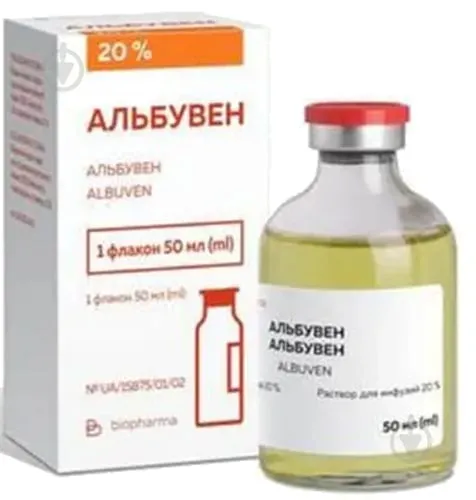
Table of Contents
I N S T R U C T I O N for medical use of the medicinal product A L B U V E N (ALBUVEN)
Composition:
active substance: human albumin;
1 l of solution contains 200 g of total protein, of which not less than 96 % is human albumin;
excipients: sodium caprylate, sodium chloride, sodium hydroxide, water for injections.
Sodium content does not exceed 160 mmol/l.
Pharmaceutical form. Infusion solution.
Main physicochemical properties: clear, slightly viscous, almost colorless liquid, yellowish, amber, or green in color.
Pharmacotherapeutic group.
Blood and related agents. Plasma substitutes and plasma protein fractions. Albumin.
ATC code B05A A01.
Pharmacological properties.
Pharmacodynamics.
Human albumin quantitatively constitutes more than half of the total plasma protein and approximately 10% of the total amount of protein synthesized by the liver.
Human albumin, 200 g/L, exerts a corresponding hyperoncotic effect.
The most important physiological function of albumin is its participation in the oncotic pressure of blood and its transport functions. Albumin stabilizes the circulating blood volume and acts as a carrier for hormones, enzymes, drugs, and toxins.
Pharmacokinetics.
Under normal conditions, the total exchangeable albumin pool is 4–5 g/kg body weight, of which 40–45% is located in the intravascular space and 55–60% in the extravascular space. Increased capillary permeability alters albumin kinetics, and under such conditions as severe burns or septic shock, abnormal distribution may occur.
Under normal conditions, the mean half-life of albumin is approximately 19 days. The balance between synthesis and degradation is usually maintained via feedback regulation. Elimination occurs predominantly intracellularly with the involvement of lysosomal proteases.
In healthy individuals, less than 10% of the administered albumin leaves the intravascular space within the first 2 hours after administration. There is considerable individual variability in the effect on blood plasma volume. In some patients, blood plasma volume may remain elevated for several hours. However, in critically ill patients, albumin may leave the vascular space in significant amounts at an unpredictable rate.
Safety preclinical data.
Human albumin is a normal component of human blood plasma and acts as a physiological albumin.
Single-dose toxicity studies in animals are of limited relevance and do not allow assessment of toxic or lethal doses or dose-effect relationships. Repeated-dose toxicity studies are not feasible due to the development of antibodies against the heterologous protein in animal models.
To date, there have been no reports of any association between human albumin and embryotoxicity or fetotoxicity, oncogenic potential, or mutagenic potential.
No signs of acute toxicity were observed in experimental animal models.
Clinical characteristics.
Indications.
Restoration and maintenance of circulating blood volume in conditions of hypovolemia and when colloids are indicated.
Contraindications.
Hypersensitivity to albumin preparations or to any of the excipients.
Interaction with other medicinal products and other forms of interaction.
Specific interactions of human albumin with other medicinal products are not known.
Special precautions for use
Standard measures to prevent transmission of infectious agents when using medicinal products derived from human blood or plasma include donor selection, testing of individual donor plasma units and plasma pools for specific markers of infection, and implementation of effective viral inactivation/removal steps during manufacturing. Nevertheless, when administering medicinal products manufactured from human blood or plasma, the possibility of transmitting infectious agents cannot be completely excluded. This also applies to unknown or new viruses and other pathogens.
There are no data confirming transmission of viruses with albumin properly manufactured according to the specifications of the European Pharmacopoeia.
Traceability
It is recommended to record the name and batch number of the product in the patient's primary medical documentation each time ALBUREN is administered, in order to ensure traceability between the patient's condition and the use of a specific batch of this medicinal product.
Suspicion of allergic or anaphylactic reactions requires immediate discontinuation of the infusion. In case of shock development, standard anti-shock therapy should be initiated.
Albumin should be administered with caution in cases of hypervolemia and its consequences or hemodilution, which may pose a particular risk for the patient, for example:
- decompensated heart failure;
- arterial hypertension;
- esophageal varices;
- pulmonary edema;
- hemorrhagic diathesis;
- severe anemia;
- renal and post-renal anuria.
The colloidal-osmotic effect of 200 g/L human albumin is approximately equivalent to four times that of plasma. Therefore, when administering concentrated albumin, care must be taken to ensure adequate hydration of the patient. The patient's condition should be closely monitored to prevent circulatory overload and hyperhydration.
The 200 g/L human albumin solution has a relatively low electrolyte content compared to 40–50 g/L human albumin solution. During albumin administration, the patient's electrolyte status should be regularly monitored (see section "Method of administration and dosage") and appropriate measures taken to restore and maintain electrolyte balance.
Albumin solutions should not be diluted with water for injections, as this may cause hemolysis in recipients.
When replacing relatively large blood volumes, coagulation and hematocrit should be monitored.
Adequate replacement of other blood components (coagulation factors, electrolytes, platelets, and erythrocytes) should be ensured.
If the dosage and infusion rate do not correspond to the patient's circulatory status, hypervolemia may develop. In the presence of initial clinical signs of cardiovascular overload (headache, dyspnea, distended neck veins) or elevated arterial pressure, elevated central venous pressure, or pulmonary edema, administration should be stopped immediately.
The total sodium (Na+) content in the product does not exceed 160 mmol/L. This should be taken into account when treating patients on a sodium-controlled diet.
When large volumes are administered, the product should be warmed to room temperature or body temperature prior to use.
Do not use if the solution is cloudy or contains a precipitate. This may indicate protein instability or contamination of the solution.
Do not use if the packaging is damaged. Destroy if leakage is observed.
After opening the vial, the product should be used immediately! All unused portions of the solution should be disposed of according to local regulations.
Use during pregnancy or breastfeeding
The safety of ALBUREN in pregnant women has not been established in controlled clinical trials. However, clinical experience with albumin use has not revealed any harmful effects on pregnancy, the fetus, or the newborn.
Studies on the effect of ALBUREN on fertility in animals have not been conducted.
Animal studies are insufficient to evaluate safety with respect to reproductive function, embryonic or fetal development, course of pregnancy, and perinatal and postnatal development.
However, human albumin is a normal constituent of human blood.
Ability to affect reaction speed when driving or operating machinery
No effect on the ability to drive or operate machinery has been observed.
Method of Administration and Dosage.
The concentration of albumin, dosage, and rate of infusion should be adjusted according to individual patient requirements.
The required dose depends on the patient's body weight, the severity of injury or illness, and the degree of fluid and protein loss. The appropriate dose should be determined based on indicators of circulating volume adequacy, rather than plasma albumin levels.
When administering human albumin, hemodynamic parameters should be monitored regularly, including:
- arterial blood pressure and pulse rate;
- central venous pressure;
- pulmonary artery wedge pressure;
- diuresis;
- electrolyte concentrations;
- hematocrit/hemoglobin.
Human albumin may be administered directly intravenously or diluted with an isotonic solution (e.g., 5% glucose solution or 0.9% sodium chloride solution).
The rate of administration should be adjusted according to the individual patient's clinical condition.
During plasmapheresis, the infusion rate should be adjusted according to the plasma removal rate.
Children.
Data regarding the use of human albumin in children are limited.
Overdose.
If the dose or infusion rate is too high, hypervolemia may develop. At the first clinical signs of cardiovascular overload (headache, dyspnea, jugular vein distension) or if arterial and/or central venous pressure increases or pulmonary edema develops, administration of the drug should be stopped immediately, and hemodynamic parameters should be closely monitored.
Adverse reactions.
Minor reactions such as flushing, urticaria, fever, and nausea occur rarely. These reactions usually resolve quickly when the infusion rate is slowed or administration of the drug is discontinued. Very rarely, serious reactions such as shock may occur. In case of severe reactions, the infusion should be stopped immediately and appropriate therapy should be initiated.
Criteria for assessing the frequency of adverse drug reactions: very common (≥1/10); common (≥1/100 to <1/10); uncommon (≥1/1000 to <1/100); rare (≥1/10,000 to <1/1000); very rare (<1/10,000).
| Organ systems |
Reactions |
Frequency |
| Immune system disorders |
Anaphylactic shock |
Rare |
| Anaphylactic reaction |
Rare |
|
| Hypersensitivity |
Rare |
|
| Allergic reactions, including skin reactions, angioneurotic edema, urticaria |
Rare |
|
| Nervous system disorders |
Headache |
Isolated |
| Cardiac disorders |
Tachycardia |
Isolated |
| Bradycardia |
Isolated |
|
| Vascular disorders |
Arterial hypertension |
Isolated |
| Arterial hypotension |
Isolated |
|
| Facial flushing (hot flushes) |
Isolated |
|
| Respiratory, thoracic and mediastinal disorders |
Dyspnea |
Rare |
| Pulmonary edema |
Rare |
|
| Increased respiratory rate |
Rare |
|
| Gastrointestinal disorders |
Nausea |
Isolated |
| Vomiting |
Isolated |
|
| Skin and subcutaneous tissue disorders |
Urticaria |
Isolated |
| Erythematous rash |
Isolated |
|
| Pruritus |
Isolated |
|
| Injection site reactions, including swelling, pain, skin rash, hyperemia, burning sensation |
Isolated |
|
| General disorders and administration site conditions |
Hyperthermia |
Isolated |
| Chills |
Isolated |
|
| Fever |
Isolated |
|
| Sensation of heat or cold |
Isolated |
|
| Numbness |
Isolated |
|
| Limb tremor |
Isolated |
|
| Edema |
Isolated |
|
| Weakness |
Isolated |
|
| Back, muscle, abdominal and chest pain |
Isolated |
|
| Cold sweat |
Isolated |
Information on preventing transmission of infectious agents via the medicinal product can be found in the section «Special precautions for use».
Reporting of suspected adverse reactions
Reporting suspected adverse reactions after authorization of the medicinal product is important. It allows continuous monitoring of the benefit-risk balance of the medicinal product. Healthcare professionals are requested to report any suspected adverse reactions to the manufacturer and/or the regulatory authority.
Shelf life. 3 years.
Storage conditions.
Store in the original packaging to protect from light at a temperature not exceeding 25 °C.
Do not freeze.
Keep out of reach of children.
Incompatibilities.
Human albumin must not be mixed with other medicinal products (except those specified in the section «Dosage and administration»), whole blood or packed red blood cells.
In addition, human albumin must not be mixed with protein hydrolysates (e.g. parenteral nutrition) or solutions containing alcohol, as such combinations may cause protein precipitation.
Packaging.
50 ml, 100 ml of the medicinal product in vials. 1 vial per cardboard box.
Prescription status. Prescription only.
Manufacturer.
LLC «BIOFARMA PLAZMA», Ukraine.
Manufacturer's address and address of the place of business.
Legal address: 37-V Kyivska Street, Bila Tserkva, Kyiv region, 09100, Ukraine
Address of the place of business:
37-V Kyivska Street, Bila Tserkva, Kyiv region, 09100, Ukraine