Albendazole-pharmex
Ukraine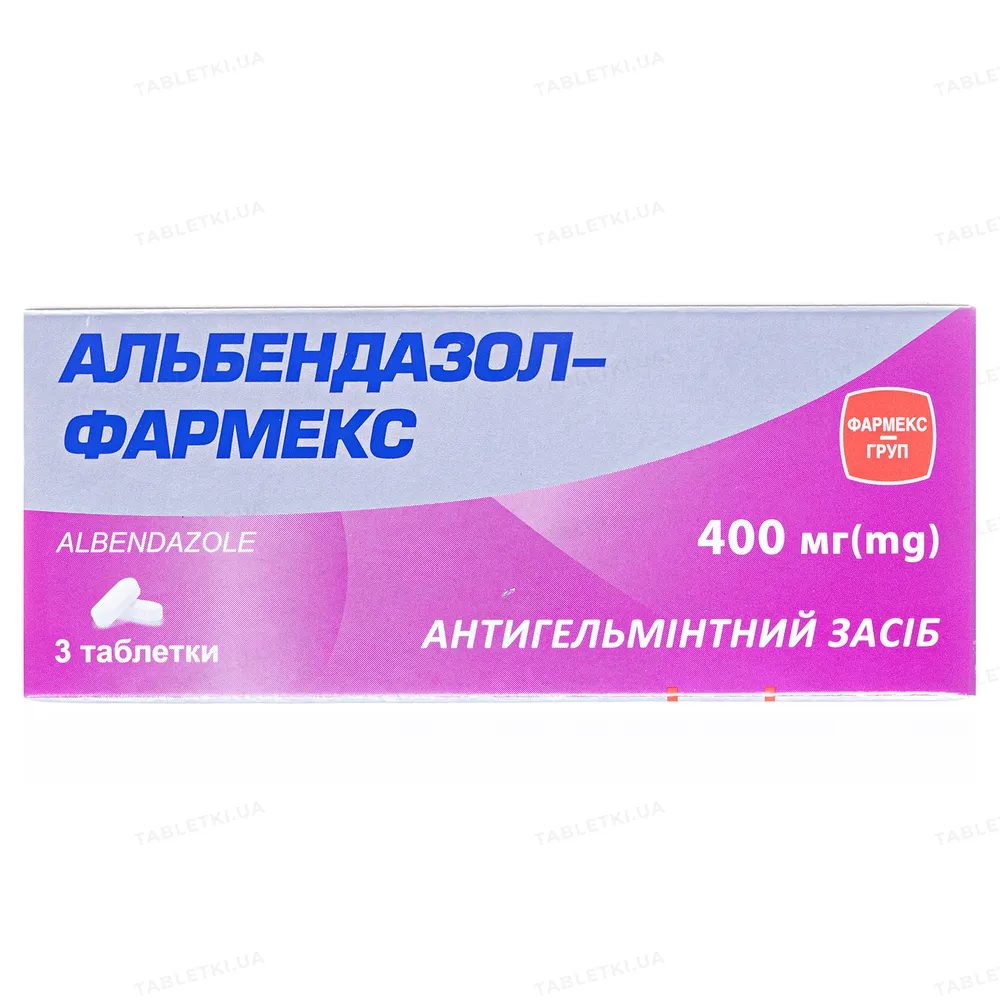
Table of Contents
INSTRUCTIONS FOR MEDICAL USE OF THE MEDICINAL PRODUCT ALBENDAZOLE-PHARMEX (ALBENDAZOLE-PHARMEX)
Composition:
Active substance: albendazole;
1 tablet contains 400 mg of albendazole;
Excipients: microcrystalline cellulose, corn starch, lactose monohydrate, sodium croscarmellose, povidone, sodium lauryl sulfate, sodium saccharin, orange flavor [aromatic substances, maltodextrin, starch sodium octenyl succinate (E 1450), glucose, butylhydroxyanisole (E 320), ascorbyl palmitate (E 304)], magnesium stearate.
Pharmaceutical form. Tablets.
Main physico-chemical properties: white or almost white, elongated-shaped tablets with a biconvex surface.
Pharmacotherapeutic group. Antihelminthic agents. Agents used in nematodosis. Benzimidazole derivatives. ATC code P02CA03.
Pharmacological Properties
Pharmacodynamics
Albendazole is an antiprotozoal and anthelmintic agent belonging to the benzimidazole carbamate group. The drug acts against both intestinal and tissue parasites in the form of eggs, larvae, and adult helminths. The anthelmintic effect of albendazole is due to inhibition of tubulin polymerization, leading to disruption of metabolism and subsequent death of helminths.
Albendazole is active against the following intestinal parasites:
Nematodes — Ascaris lumbricoides, Trichuris trichiura, Enterobius vermicularis, Ancylostoma duodenale, Necator americanus, Strongyloides stercoralis, Cutaneus Larva Migrans;
Cestodes — Hymenolepsis nana, Taenia solium, Taenia saginata;
Trematodes — Opisthorchis viverrini, Clonorchis sinensis;
Protozoa — Giardia lamblia (intestinalis or duodenalis).
Pharmacokinetics
After oral administration, albendazole is poorly absorbed (less than 5%). Systemic exposure increases when the drug is administered with fatty food, which enhances absorption by fivefold. It is rapidly metabolized in the liver during the first pass. The main metabolite, albendazole sulfoxide, is the primary active substance responsible for efficacy in tissue infections. The elimination half-life is 8.5 hours. Albendazole sulfoxide and its metabolites are primarily excreted via bile, with only a small fraction eliminated in urine. It has been established that with prolonged administration of the drug at high doses, elimination from cysts may last several weeks.
Geriatric patients
Although pharmacokinetic studies of albendazole in elderly patients have not been conducted, data from treatment of 26 patients up to 79 years of age suggest that pharmacokinetics in this age group are similar to those in young healthy volunteers.
Renal impairment
The pharmacokinetics of albendazole in this patient group have not been studied.
Hepatic impairment
The pharmacokinetics of albendazole in this patient group have not been studied.
Clinical characteristics
Indications
Intestinal forms of helminthiases and cutaneous Larva Migrans syndrome (short-term treatment with low doses): enterobiasis, ancylostomiasis and necatoriasis, hymenolepiasis, taeniasis, strongyloidiasis, ascariasis, trichocephalosis, clonorchiasis, opisthorchiasis, giardiasis in children.
Contraindications
Hypersensitivity to albendazole or to any excipient of the medicinal product.
Pregnancy and breastfeeding.
The drug is contraindicated in women who are planning to become pregnant. Women of childbearing potential must use effective non-hormonal contraceptive methods during treatment and for 1 month after completion of therapy.
Interaction with other medicinal products and other types of interactions
Albendazole induces cytochrome P450 enzyme system.
Medicinal products that may slightly reduce albendazole efficacy: anticonvulsants (e.g., phenytoin, fosphenytoin, carbamazepine, phenobarbital, primidone), levamisole, ritonavir. Treatment efficacy should be monitored—alternative dosing regimens or therapies may be required.
Cimetidine, praziquantel, and dexamethasone increase plasma levels of the albendazole metabolite responsible for systemic activity, which in turn may lead to enhanced adverse reactions.
Grapefruit juice also increases plasma levels of albendazole sulfoxide.
Due to the potential effect on cytochrome P450 activity, there is a theoretical risk of interaction with the following drugs: oral contraceptives, anticoagulants, oral hypoglycemic agents, theophylline.
Special precautions for use
Treatment of intestinal helminthiasis and cutaneous Larva Migrans syndrome
To prevent administration of albendazole during early pregnancy, women of childbearing potential should only be treated during the first week of the menstrual cycle or after a negative pregnancy test. Reliable contraception is required during treatment.
Albendazole treatment may unmask pre-existing neurocysticercosis, particularly in areas with high prevalence of Tenia solium strains. Patients may develop neurological symptoms such as seizures, increased intracranial pressure, and focal neurological signs due to inflammatory reactions caused by the death of parasites in the brain. These symptoms may occur shortly after treatment initiation; therefore, prompt therapy with corticosteroids and anticonvulsants should be initiated.
Albendazole treatment may be associated with mild to moderate elevation of liver enzymes, which usually normalizes after discontinuation of treatment. Cases of hepatitis have been reported. Therefore, liver enzyme levels should be assessed before starting each treatment course and at least every 2 weeks during treatment. If liver enzyme levels increase significantly (more than twice the upper limit of normal), albendazole treatment should be discontinued. Treatment may be restarted after normalization of enzyme levels, but the patient must be closely monitored.
Albendazole may cause bone marrow suppression; therefore, blood counts should be performed at the beginning of treatment and every 2 weeks during the 28-day treatment cycle. Patients with liver disease, including hepatic echinococcosis, are more susceptible to bone marrow suppression, which may result in pancytopenia, aplastic anemia, agranulocytosis, and leukemia, necessitating careful monitoring of blood parameters. If significant blood count reductions occur, treatment should be discontinued (see sections "Dosage and administration" and "Side effects").
To prevent administration of albendazole during early pregnancy, women of childbearing potential must:
- begin treatment only after a negative pregnancy test;
- use effective contraceptive methods during treatment and for 1 month after discontinuation of the drug.
Since the medicinal product contains glucose, patients with diagnosed intolerance to certain sugars should consult a physician before taking this medicinal product.
The medicinal product contains lactose—patients with rare hereditary conditions such as galactose intolerance, lactase deficiency, or glucose-galactose malabsorption should not take this product.
The product contains sodium saccharin, which should be taken into account in patients with diabetes mellitus.
This medicinal product contains less than 1 mmol (23 mg) of sodium per dose. Caution should be exercised when administering to patients on a sodium-restricted diet.
Use during pregnancy or breastfeeding
The medicinal product is contraindicated during pregnancy or breastfeeding and in women planning to become pregnant (see section "Contraindications").
Effect on ability to drive or operate machinery
Due to the potential for adverse reactions such as dizziness, it is recommended that patients refrain from driving or operating machinery during treatment with albendazole.
Dosage and Administration
Intestinal infections and cutaneous larva migrans syndrome
Take the medication with food. It is advisable to take it at the same time each day. If recovery does not occur within 3 weeks, the physician should prescribe a second course of treatment.
In some patients, especially children, difficulty swallowing the whole tablet may occur; in such cases, the tablet may be chewed with a small amount of water or crushed.
For use in adults and children aged 3 years and older.
| Infection |
Age |
Dosage and duration of intake |
| Enterobiasis, ancylostomiasis, necatoriasis, ascariasis, trichuriasis |
Adults and children aged 3 years and older* |
400 mg once daily (1 tablet) as a single dose |
| Strongyloidiasis, taeniasis, hymenolepiasis |
Adults and children aged 3 years and older* |
400 mg once daily (1 tablet) for 3 days. For hymenolepiasis, a repeat course is recommended from day 10 to day 21 after the previous course. |
| Clonorchiasis, opisthorchiasis |
Adults and children aged 3 years and older* |
400 mg (1 tablet) twice daily for 3 days |
| Cutaneous larva migrans |
Adults and children aged 3 years and older* |
400 mg (1 tablet) once daily for 1–3 days |
| Giardiasis |
Children aged 3 to 12 years only* |
400 mg (1 tablet) once daily for 5 days |
* For children aged 2 to 3 years, albendazole should be administered in another pharmaceutical form — oral suspension.
Elderly patients
Experience with the use of the drug in elderly patients is limited. Dose adjustment is not required; however, albendazole should be used with caution in elderly patients with impaired liver function.
Renal impairment
Since albendazole is excreted by the kidneys in very small amounts, dose adjustment is not required for this patient group. However, patients with signs of renal impairment should be closely monitored.
Hepatic impairment
Since albendazole is actively metabolized in the liver to its pharmacologically active metabolite, impaired liver function may significantly affect its pharmacokinetics. Therefore, patients with abnormal liver function tests (elevated transaminase levels) should be closely monitored at the start of albendazole therapy.
Children
The medicinal product is intended for use in children aged 3 years and older.
Administer to children according to the section "Dosage and administration".
Overdose
Depending on the dose ingested, the following symptoms may occur: diarrhea, nausea, vomiting, tachycardia, elevated transaminase levels. In case of overdose, symptomatic treatment should be provided according to the clinical condition.
Side effects
Adverse reactions are classified according to their frequency of occurrence: very common (≥1/10); common (≥1/100 and <1/10); uncommon (≥1/1000 and <1/100); rare (≥1/10,000 and <1/1000); and very rare (<1/10,000).
Side effects occurring during short-term treatment of intestinal infections and cutaneous Larva Migrans syndrome
Immune system disorders
Rare: hypersensitivity reactions including rash, pruritus, and urticaria.
Nervous system disorders
Uncommon: headache and dizziness.
Gastrointestinal disorders
Uncommon: gastrointestinal symptoms from the upper gastrointestinal tract (e.g., epigastric pain, nausea, vomiting) and diarrhea.
Hepatobiliary disorders
Rare: increased levels of liver enzymes.
Skin and subcutaneous tissue disorders
Very rare: erythema multiforme, Stevens-Johnson syndrome.
Side effects occurring during long-term treatment of systemic helminth infections
Blood and lymphatic system disorders
Uncommon: leukopenia.
Very rare: pancytopenia, aplastic anemia, agranulocytosis.
Patients with liver disease, including hepatic echinococcosis, are more susceptible to bone marrow suppression (see sections "Dosage and administration" and "Special precautions").
Immune system disorders
Uncommon: hypersensitivity reactions including rash, pruritus, and urticaria.
Nervous system disorders
Very common: headache.
Common: dizziness.
Gastrointestinal disorders
Common: gastrointestinal disturbances (abdominal pain, nausea, vomiting).
Hepatobiliary disorders
Very common: mild to moderate elevation of liver enzymes.
Uncommon: hepatitis.
Skin and subcutaneous tissue disorders
Common: reversible alopecia (thinning and moderate hair loss).
Very rare: erythema multiforme, Stevens-Johnson syndrome.
General disorders
Common: fever.
Reporting suspected adverse reactions
Reporting of suspected adverse reactions after marketing authorization is important. It allows continuous monitoring of the benefit-risk balance of the medicinal product. Medical and pharmaceutical professionals, as well as patients or their legal representatives, should report any suspected adverse reactions and lack of efficacy via the Automated Pharmacovigilance Information System at the following link: https://aisf.dec.gov.ua.
Shelf life. 2 years.
Storage conditions. Store in the original packaging at a temperature not exceeding 25 °C. Keep out of reach of children.
Packaging. 1 tablet in a blister pack, 1 or 3 blisters per carton.
Prescription status. Prescription only.
Manufacturer. LLC "FARMEKS GROUP".
Manufacturer's address
100 Shevchenka Street, Borispol, Kyiv region, 08301, Ukraine.