Acnetrex 10
Ukraine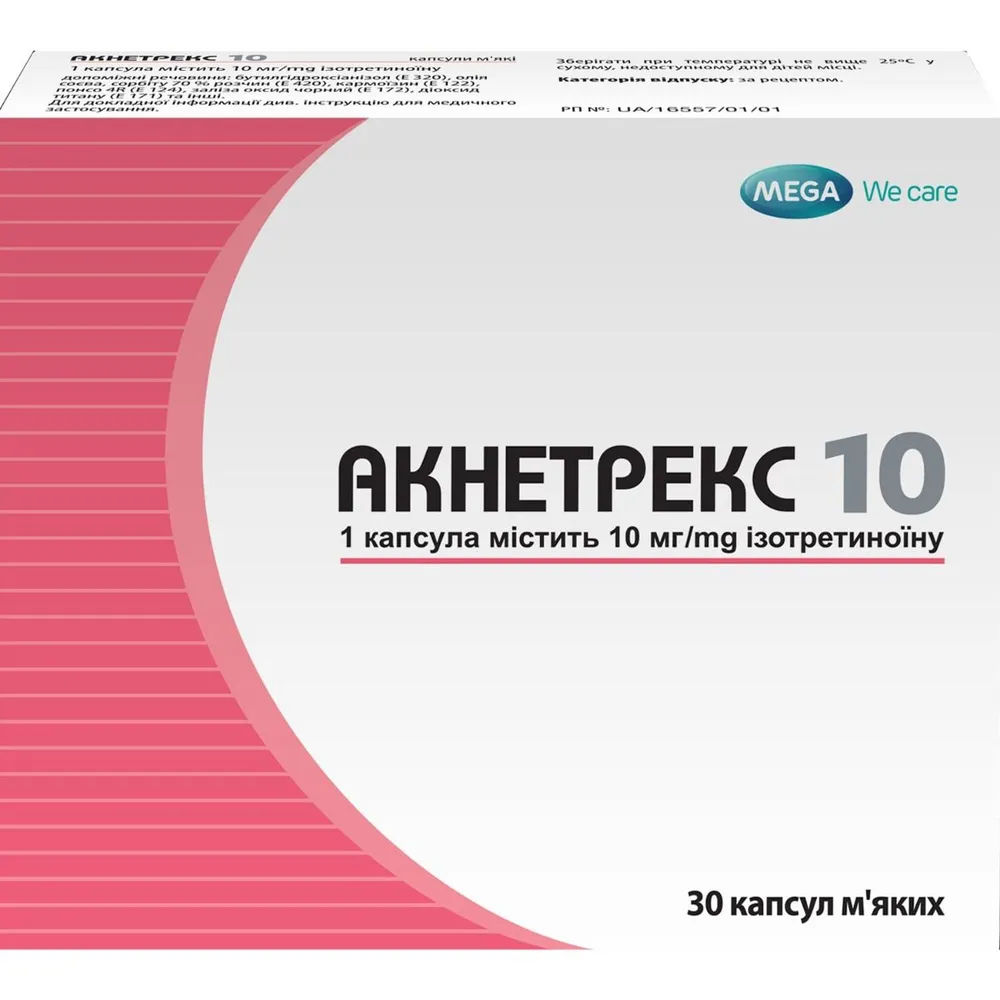
Table of Contents
INSTRUCTIONS FOR MEDICAL USE OF THE MEDICINAL PRODUCT ACNETREX 10 (ACNETREX 10) ACNETREX 20 (ACNETREX 20)
Composition:
Active substance: isotretinoin;
1 capsule contains 10 mg or 20 mg of isotretinoin;
Excipients: white wax, butylhydroxyanisole (E 320), disodium edetate, hydrogenated vegetable oil, soybean oil;
gelatin capsules: gelatin, glycerin, sorbitol 70% solution (E 420), carmoisine (E 122), brilliant blue (E 133), ponzo 4R (E 124), iron oxide black (E 172), titanium dioxide (E 171), purified water.
Medicinal form. Soft capsules.
Main physicochemical properties: 10 mg capsules – oval, purple, opaque, soft gelatin capsules; 20 mg capsules – oval, purple and opaque on one side and white and opaque on the other side, soft gelatin capsules.
Pharmacotherapeutic group. Agents for systemic treatment of acne. ATC code: D10B A01.
Pharmacological properties.
Pharmacodynamics.
Mechanism of action
Isotretinoin is a synthetic stereoisomer of trans-retinoic acid (tretinoin). The exact mechanism of action of isotretinoin has not yet been fully elucidated; however, improvement in the clinical picture of severe acne has been associated with reduced sebaceous gland activity and histologically confirmed reduction in gland size. In addition, isotretinoin has demonstrated anti-inflammatory effects on the skin.
Efficacy
Hyperkeratosis of the epithelial cells of the hair follicle and sebaceous gland leads to desquamation of corneocytes into the gland duct and subsequent obstruction of the duct by keratin and excess sebum, resulting in comedone formation, sometimes followed by an inflammatory process. The medicinal product Aknetrex suppresses sebocyte proliferation and acts on acne by restoring normal cellular differentiation processes.
Sebum is the primary substrate for the growth of Propionibacterium acnes. Reduction in sebum production inhibits bacterial colonization of the follicular duct.
Pharmacokinetics.
Absorption
Gastrointestinal absorption of isotretinoin is variable and linearly dependent on dose within the therapeutic dose range. Absolute bioavailability of isotretinoin has not been determined, as there is no intravenous formulation available; however, extrapolation of data from dog studies suggests very low and variable systemic bioavailability. Administration of isotretinoin with food increases its bioavailability approximately twofold compared to administration on an empty stomach.
Distribution
Isotretinoin is almost completely bound to plasma proteins (99.9%), primarily to albumin. The volume of distribution of isotretinoin in humans is unknown due to the lack of an intravenous formulation. Concentrations of isotretinoin in the epidermis are only about half of those in blood plasma. Plasma concentrations of isotretinoin are approximately 1.7 times higher than in whole blood due to poor penetration of isotretinoin into erythrocytes.
Metabolism
After oral administration, three main metabolites are observed in plasma: 4-oxo-isotretinoin, tretinoin (all-trans-retinoic acid), and 4-oxo-retinoic acid. These metabolites have demonstrated biological activity in several in vitro tests. 4-Oxo-isotretinoin has been shown in several clinical studies to contribute significantly to the therapeutic activity of isotretinoin (suppression of sebum excretion), independently of plasma levels of isotretinoin and tretinoin. The primary metabolite is 4-oxo-isotretinoin, whose plasma concentrations at steady state are 2.5 times higher than those of the parent drug. Other metabolites, including glucuronide conjugates, are minor.
Since isotretinoin and tretinoin (all-trans-retinoic acid) are reversibly interconverted, the metabolism of tretinoin is linked to that of isotretinoin. It has been established that 20–30% of the isotretinoin dose undergoes isomerization.
Enterohepatic recirculation may play a significant role in the pharmacokinetics of isotretinoin in humans.
In vitro metabolism studies have shown that several CYP enzymes are involved in the conversion of isotretinoin to 4-oxo-isotretinoin and tretinoin. Apparently, no single isoenzyme plays a dominant role. Isotretinoin and its metabolites do not have a significant effect on the activity of CYP enzyme system.
Elimination
After oral administration of radiolabeled isotretinoin, approximately equal amounts are excreted in urine and feces. The terminal elimination half-life of unchanged isotretinoin following oral administration in acne patients averages 19 hours. The terminal elimination half-life of 4-oxo-isotretinoin is longer, averaging 29 hours.
Isotretinoin belongs to natural (physiological) retinoids. Endogenous retinoid concentrations are restored approximately 2 weeks after discontinuation of Aknetrex.
Pharmacokinetics in special clinical situations
As isotretinoin is contraindicated in patients with impaired liver function, data on the pharmacokinetics of the drug in this patient group are limited.
Renal insufficiency does not significantly reduce the plasma clearance of isotretinoin or 4-oxo-isotretinoin.
Clinical characteristics.
Indications.
Severe forms of acne (including nodular and conglobate acne, acne with tendency to permanent scarring) that are unresponsive to standard treatment methods (systemic antibacterial therapy, topical treatment).
Contraindications.
Pregnancy and breastfeeding; the drug is contraindicated in women of childbearing potential unless all requirements of the "Pregnancy Prevention Program" are met; hypersensitivity to isotretinoin or any component of the drug; liver failure; severe hyperlipidemia; hypervitaminosis A; concomitant therapy with tetracyclines. Since the drug contains soybean oil and partially hydrogenated vegetable oil, it is contraindicated in patients with allergy to these components.
Interaction with other medicinal products and other types of interactions.
Due to the possible exacerbation of symptoms of hypervitaminosis A, simultaneous administration of the drug Aknetreks and vitamin A should be avoided.
Cases of benign intracranial hypertension (pseudotumor cerebri) have been reported with concomitant use of isotretinoin and tetracyclines. Therefore, concomitant use with tetracyclines should be avoided (see sections "Contraindications" and "Special precautions"). Combined use with topical keratolytic or exfoliating agents for acne treatment is contraindicated due to possible increased local irritation (see section "Special precautions").
Special precautions for use.
«Pregnancy Prevention Program»
This medicinal product is TERATOGENIC
The medicinal product Aknetreks is contraindicated in women of reproductive age, except when all the following conditions are met:
- the patient has been diagnosed with severe acne (nodular and conglobate acne, acne prone to permanent scarring) that is unresponsive to standard treatment (systemic antibacterial therapy, topical treatment);
- the patient understands the teratogenic risk of the drug;
- the patient understands the necessity of mandatory monthly visits to the physician;
- the patient is able to prevent pregnancy by continuously using reliable contraception methods for 1 month prior to starting Aknetreks, during treatment, and for 1 month after treatment completion; it is advisable to use two different contraceptive methods simultaneously, including a barrier method;
- even in the case of amenorrhea, the patient must use reliable contraception methods;
- the patient must confirm understanding of the preventive measures;
- the patient has been informed about the risk of pregnancy during Aknetreks treatment and understands the necessity of immediate consultation if pregnancy is suspected;
- the patient understands the necessity and agrees to undergo pregnancy testing before, during, and 5 weeks after treatment;
- the patient confirms awareness of the risks associated with isotretinoin use and the necessity of preventive measures;
- the patient should only start treatment with Aknetreks on the 2nd or 3rd day of the next normal menstrual cycle.
The use of contraceptive methods according to the above recommendations during isotretinoin treatment is necessary even for sexually inactive women, except when the physician is certain that there is no risk of pregnancy.
The physician must ensure that:
- the patient is capable of understanding and complying with all the above-mentioned conditions for pregnancy prevention and has an adequate level of comprehension;
- the patient uses at least one, preferably two, effective contraceptive methods, including a barrier method, for 1 month before starting Aknetreks, during treatment, and for 1 month after treatment ends;
- a negative result from a reliable pregnancy test has been obtained before starting treatment, during treatment, and 5 weeks after therapy ends; the date and results of the pregnancy test must be documented.
The medicinal product contains the dye Ponceau 4R (E 124), which may cause allergic reactions.
Pregnancy prevention
Patients must be informed about contraceptive methods. If they are not using effective contraception, the physician should provide appropriate recommendations.
Women who are at risk of becoming pregnant must use at least one effective contraceptive method. It is preferable to use two complementary contraceptive methods, including a barrier method. Contraceptive methods should be continued for at least 1 month after discontinuation of Aknetreks, even in patients with amenorrhea.
Pregnancy testing
According to standard practice, a pregnancy test with a minimum sensitivity of 25 mIU/mL should be performed within the first 3 days of the menstrual cycle.
Before starting treatment
To exclude possible pregnancy before starting contraception, the physician must record the result and date of the first pregnancy test. In patients with irregular menstrual cycles, the timing of the pregnancy test depends on sexual activity. The test should be performed 3 weeks after unprotected intercourse. The physician must inform the patient about contraceptive methods.
A pregnancy test should be performed on the day of prescribing Aknetreks or within 3 days prior to the patient's visit. The healthcare provider must document the test results. The drug may only be prescribed to patients who have been using effective contraception for at least 1 month prior to starting Aknetreks. The test must confirm that the patient is not pregnant at the time of initiating isotretinoin therapy.
During treatment
The patient should visit the physician every 28 days. The need for monthly pregnancy testing is determined according to local practice, considering sexual activity and the history of recent menstrual cycles (abnormal menstruation, lack of regularity, or amenorrhea). If indicated, the pregnancy test should be performed on the day of the visit or within 3 days prior.
End of treatment
A final pregnancy test should be performed 5 weeks after treatment completion to exclude pregnancy.
The pharmacist must ensure that prescriptions for Aknetreks in women of reproductive age are issued only for 30 days of treatment, and continuation requires a new prescription from the physician.
Pregnancy testing, prescription issuance, and drug dispensing are recommended to be completed on the same day. The dispensing of Aknetreks at the pharmacy should occur only within 7 days of the prescription date.
Male patients
Available data indicate that exposure of the drug from semen and seminal fluid of men who have taken Aknetreks is insufficient to cause teratogenic effects in women.
Men should ensure that the drug is not used by others, especially women.
Additional warnings
Low-dose progestin-only contraceptives may be inadequate for contraception during Aknetreks treatment.
Patients must never give this medicinal product to others and must return any unused capsules to the physician after treatment ends.
Patients must not donate blood during treatment and for one month after discontinuation due to the risk of transfusion transmission to a fetus of a pregnant woman.
Educational materials
To assist physicians, pharmacists, and patients in avoiding the teratogenic effects of Aknetreks on the fetus, the manufacturer provides educational materials on preventing teratogenic effects, recommendations for contraception use before starting therapy, and the necessity of pregnancy testing.
Complete information on teratogenic risk and pregnancy prevention measures is included in the «Pregnancy Prevention Program», which must be provided to all patients, both male and female.
Psychiatric disorders
Depression, depression with aggravation, anxiety, aggression, mood changes, psychotic symptoms, and very rarely suicidal ideation, suicide attempts, and suicide have been reported in patients receiving Aknetreks (see section «Adverse reactions»). Caution is required in patients with a history of depression, and they should be monitored for the development of depression during treatment; if necessary, patients should be referred to appropriate specialists. However, discontinuation of Aknetreks may not resolve psychiatric symptoms, and in such cases, patients require ongoing monitoring by specialists.
Disorders of the skin and subcutaneous tissue
In isolated cases, acne may worsen at the beginning of therapy, usually resolving within 7–10 days without dose adjustment.
Excessive exposure to sunlight or UV radiation should be avoided. Sunscreen with a protection factor of at least 15 should be used when sun protection is needed.
Deep chemical peels and laser treatments should not be performed during Aknetreks treatment or within 5–6 months after treatment due to a high risk of hypertrophic scarring in atypical areas and, less frequently, hyper- and hypopigmentation in treated areas. Waxing for epilation should not be performed during Aknetreks treatment or within 6 months after treatment due to the risk of epidermal detachment.
Concomitant use of Aknetreks with topical keratolytic or exfoliating agents for acne treatment should be avoided due to the potential for increased local irritation (see section «Interaction with other medicinal products and other forms of interaction»).
Patients using Aknetreks are advised to use moisturizing ointments or creams for the body and lip balm to reduce skin and lip dryness at the beginning of treatment.
During post-marketing use of isotretinoin, severe skin reactions (exudative multiform erythema, Stevens–Johnson syndrome, toxic epidermal necrolysis) have been reported. Since these cases are difficult to distinguish from other possible skin reactions (see section «Adverse reactions»), patients should be warned about the symptoms of these conditions and closely monitored for severe skin reactions. If severe skin reactions are suspected, isotretinoin treatment should be discontinued.
Allergic reactions
Anaphylactic reactions have been rarely reported, sometimes after topical use of retinoids. Allergic skin reactions have been infrequently reported. Serious cases of allergic vasculitis of the limbs, often with purpura (bruising and red spots), as well as non-cutaneous manifestations, have been documented. Serious allergic reactions require discontinuation of therapy and careful patient monitoring.
Disorders of the visual organs
Dry eyes, corneal opacity, impaired night vision, and keratitis usually resolve after discontinuation of isotretinoin. Cases of persistent dry eyes after therapy cessation have been reported. Dry eyes can be managed with ocular ointments or replacement therapy using artificial tears. Contact lens intolerance may occur, which may require patients to wear glasses during treatment.
Some patients may experience reduced night vision acuity, which may sometimes occur suddenly (see section «Ability to affect reaction speed when driving or operating machinery»). Patients with visual complaints should be referred to an ophthalmologist, and discontinuation of the drug should be considered.
Disorders of the musculoskeletal system and connective tissue
Muscle and joint pain and increased serum creatine phosphokinase levels may occur during Aknetreks treatment, especially with intense physical exertion (see section «Adverse reactions»).
Several years after isotretinoin use for treating dyskeratoses at very high doses, bone changes have been observed, including premature closure of epiphyseal growth plates, hyperostosis, ligament and tendon calcification. The doses, duration of treatment, and total cumulative dose in these patients generally exceeded those recommended for acne treatment.
Cases of sacroiliitis have been reported in patients using isotretinoin. Additional evaluation, including imaging methods such as MRI, may be required to differentiate sacroiliitis from other causes of back pain. In post-marketing cases, sacroiliitis regressed after discontinuation of Aknetreks and appropriate treatment.
Benign intracranial hypertension
Cases of benign intracranial hypertension have been reported, some of which were associated with concomitant use of tetracyclines (see sections «Contraindications» and «Interaction with other medicinal products and other forms of interaction»). Symptoms of benign intracranial hypertension include headache, nausea, vomiting, visual disturbances, and papilledema. Patients who develop benign intracranial hypertension should immediately discontinue the drug.
Hepatobiliary disorders
Liver enzymes should be monitored before treatment, 1 month after initiation, and then every 3 months, unless clinical indications require more frequent monitoring. Transient and reversible increases in liver transaminase levels have been observed, mostly within normal ranges, returning to baseline levels during treatment. If transaminase levels exceed normal values, the dose should be reduced or the drug discontinued.
Renal impairment
Renal dysfunction or renal failure does not affect the pharmacokinetics of isotretinoin. Therefore, isotretinoin may be used in patients with renal impairment. However, it is recommended to start with a low dose and titrate to the maximum tolerated dose (see section «Dosage and administration»).
Lipid metabolism
Serum lipid levels should be measured fasting (before treatment, 1 month after initiation, then every 3 months, unless clinical indications require more frequent monitoring). Elevated serum lipid levels usually normalize after dose reduction or discontinuation of isotretinoin and with dietary adherence. Isotretinoin use is associated with increased triglyceride levels. Isotretinoin should be discontinued in cases of uncontrolled hyperlipidemia or symptoms of pancreatitis. Triglyceride levels above 800 mg/dL or 9 mmol/L may be associated with acute pancreatitis, potentially fatal.
Gastrointestinal disorders
Inflammatory bowel disease (including regional ileitis) may develop during isotretinoin treatment. Patients with severe (hemorrhagic) diarrhea should immediately discontinue the drug.
Fructose intolerance
Aknetreks contains sorbitol 70% solution. This medicinal product is not recommended for patients with hereditary fructose intolerance.
High-risk groups
Patients with diabetes mellitus, obesity, alcoholism, or lipid metabolism disorders may require more frequent monitoring of serum glucose and/or lipid levels during isotretinoin treatment. Increased fasting blood glucose and new-onset diabetes mellitus have been reported during isotretinoin therapy.
Use during pregnancy or breastfeeding
Pregnancy is an absolute contraindication for the use of Aknetreks (see section «Contraindications»). Women of reproductive age must use effective contraception during treatment and for one month after treatment. If pregnancy occurs despite preventive measures during Aknetreks use or within one month after therapy ends, there is a very high risk of giving birth to a child with severe and serious congenital malformations.
Congenital malformations associated with isotretinoin exposure include central nervous system abnormalities (hydrocephalus, cerebellar malformations/abnormalities, microcephaly), facial malformations (cleft palate), external ear abnormalities (absent external ear, small or absent external auditory canal), eye malformations (microphthalmia), heart and vascular abnormalities (conotruncal heart defects such as tetralogy of Fallot, transposition of the great vessels, septal defects), and thymus and parathyroid gland abnormalities. Additionally, the risk of spontaneous abortions is increased.
If pregnancy occurs in a woman undergoing isotretinoin treatment, therapy should be discontinued immediately, and consultation with a specialist experienced in teratology should be sought for evaluation and counseling.
Period of breastfeeding
Due to the high lipophilicity of isotretinoin, it is highly likely to be excreted in breast milk. Because of potential adverse effects in the infant due to drug exposure through maternal milk, isotretinoin is contraindicated in women who are breastfeeding.
Fertility
Isotretinoin at therapeutic doses does not affect sperm count, motility, or morphology and does not endanger embryo formation or development from men taking isotretinoin.
Ability to affect reaction speed when driving or operating machinery
The drug may potentially affect the ability to drive or operate machinery.
During treatment and, rarely, after treatment, some patients have experienced reduced twilight vision acuity (see sections «Special precautions for use» and «Adverse reactions»). Since these effects may occur suddenly in some patients, patients should be informed of this possibility and advised to exercise caution when driving or operating machinery.
Very rarely, cases of somnolence, dizziness, and visual disturbances have been reported. Patients should be warned that if these symptoms occur, they should not drive, operate machinery, or engage in any other activity that could endanger themselves or others.
Method of Administration and Dosage
Standard Dosage Regimen
Isotretinoin therapy must be prescribed and supervised only by a physician experienced in the use of systemic retinoids for the treatment of severe acne and fully aware of the risks associated with retinoid therapy and the requirements for patient monitoring.
Capsules should be taken during meals, 1–2 times daily.
Adults (including adolescents and elderly patients). Treatment should be initiated at a dose of 0.5 mg/kg per day. The therapeutic response to isotretinoin and some adverse reactions are dose-dependent and vary among individual patients. Therefore, individual dose adjustment during treatment is necessary. In most patients, the dose ranges from 0.5 to 1 mg/kg body weight per day.
Long-term remission and the frequency of relapse are more closely related to the total cumulative dose administered than to the duration of treatment or the daily dose. It has been established that no additional benefit is expected from using a cumulative dose exceeding 120–150 mg/kg. The duration of therapy depends on the daily dose. A treatment course of 16–24 weeks is usually sufficient to achieve remission.
In most patients, acne completely resolves after a single course of treatment. In cases of significant relapse, a repeat course of Acnetrex should be administered using the same daily and cumulative doses as the first course. Since improvement may continue for up to 8 weeks after completion of treatment, a repeat course should not be initiated earlier than at the end of this period.
Dosage in Special Situations
Patients with severe renal impairment. In patients with severe renal impairment, treatment should be initiated at a lower dose (e.g., 10 mg daily), and then gradually increased to 1 mg/kg/day or to the maximum tolerated dose.
Children. Isotretinoin is contraindicated for the treatment of acne in prepubertal children and in patients under 12 years of age due to lack of data on efficacy and safety.
Patients with intolerance. In patients who develop severe intolerance to the recommended dose, treatment may be continued at a lower dose. In such cases, the duration of therapy will be longer and the risk of relapse higher. To achieve maximal possible efficacy, the highest tolerated dose should be used.
Children.
The use of isotretinoin in children under 12 years of age has not been studied; therefore, the drug should not be prescribed to patients in this age group.
Overdose.
Isotretinoin is a derivative of vitamin A. Although the acute toxicity of isotretinoin is low, signs of hypervitaminosis A may occur in cases of accidental overdose. Symptoms of acute vitamin A toxicity include severe headache, nausea or vomiting, drowsiness, irritability, and pruritus. Symptoms following accidental or intentional isotretinoin overdose are likely to be similar. These symptoms are reversible and resolve without the need for specific treatment.
Adverse Reactions
Some adverse reactions of isotretinoin are dose-dependent. Usually, adverse reactions are reversible after dose adjustment or discontinuation of the drug, but some may persist after stopping treatment. The most commonly reported symptoms during isotretinoin use include: dryness of the skin and mucous membranes, including lips (cheilitis), nasal cavity (epistaxis), eyes (conjunctivitis).
The following categories are used to describe the frequency of adverse reactions: very common (≥ 1/10), common (≥ 1/100, < 1/10), uncommon (≥ 1/1000, < 1/100), rare (≥ 1/10,000, < 1/1000), very rare (≤ 1/10,000); frequency not known (cannot be estimated from available data).
Infections: very rare – gram-positive bacterial infections of the skin and mucous membranes.
Blood and lymphatic system disorders: very common – anemia, increased erythrocyte sedimentation rate (ESR), thrombocytopenia, thrombocytosis; common – neutropenia; very rare – lymphadenopathy.
Immune system disorders: uncommon – skin allergic reactions, anaphylactic reactions, hypersensitivity reactions.
Metabolism and nutrition disorders: very rare – diabetes mellitus, hyperuricemia.
Psychiatric disorders: uncommon – depression, worsening of depression, tendency towards aggression, anxiety, mood changes; very rare – behavioral disturbances, psychotic disorders, suicide attempts, suicide.
Nervous system disorders: common – headache; very rare – benign intracranial hypertension, seizures, somnolence, dizziness.
Eye disorders: very common – blepharitis, conjunctivitis, dry eyes, eye irritation; very rare – blurred vision, cataract, color vision disturbances, contact lens intolerance, corneal opacity, decreased twilight vision, keratitis, optic disc edema (as a manifestation of benign intracranial hypertension), photophobia, visual disturbances.
Ear and labyrinth disorders: very rare – hearing disturbances.
Vascular disorders: very rare – vasculitis (e.g., Wegener's granulomatosis, allergic vasculitis).
Respiratory, thoracic and mediastinal disorders: common – epistaxis, nasal dryness, nasopharyngitis; very rare – bronchospasm (especially in patients with asthma), dysphonia.
Gastrointestinal disorders: very rare – colitis, ileitis, throat dryness, gastrointestinal bleeding, hemorrhagic diarrhea, inflammatory bowel disease, nausea, pancreatitis. Cases of severe diarrhea have also been reported (see section "Special warnings and precautions for use").
Hepatobiliary disorders: very common – increased transaminases (see section "Special warnings and precautions for use"); very rare – hepatitis.
Skin and subcutaneous tissue disorders: very common – cheilitis, dermatitis, skin dryness, localized desquamation, pruritus, erythematous rash, skin fragility (risk of injury due to friction); uncommon – alopecia; very rare – fulminant forms of acne, acne exacerbation (acne erythema), erythema (face), exanthema, hair disorders, hirsutism, onychodystrophy, paronychia, photosensitization, pyogenic granuloma, skin hyperpigmentation, hyperhidrosis; frequency not known – erythema multiforme, Stevens-Johnson syndrome, toxic epidermal necrolysis.
Musculoskeletal and connective tissue disorders: very common – arthralgia, myalgia, back pain (especially in children and adolescents); very rare – arthritis, calcinosis (calcification of ligaments and tendons), premature closure of epiphyseal growth plates, exostosis, hyperostosis, decreased bone density, tendinitis; frequency not known – rhabdomyolysis, sacroiliitis.
Renal and urinary disorders: very rare – glomerulonephritis; frequency not known – urethritis.
Reproductive system and breast disorders: frequency not known – sexual dysfunction, including erectile dysfunction and decreased libido, gynecomastia, vulvovaginal dryness.
General disorders: very rare – tissue granulation (increased formation), fatigue.
Laboratory findings: very common – hypertriglyceridemia, decreased high-density lipoprotein levels; common – hypercholesterolemia, hyperglycemia, hematuria, proteinuria; very rare – increased blood creatine phosphokinase (CPK).
Reporting suspected adverse reactions after drug registration is important. It allows continuous monitoring of the benefit-risk balance of the drug. Healthcare professionals, pharmacists, patients, and their legal representatives should report all suspected adverse reactions and lack of efficacy through the Automated Pharmacovigilance Information System at: https://aisf.dec.gov.ua
Shelf life
2 years.
Storage conditions
Store at a temperature not exceeding 25 °C in a dry, child-proof place.
Packaging
10 capsules in a blister pack, 3 blisters per cardboard box.
Prescription status
Prescription only.
Manufacturer
Mega Lifesciences Public Company Limited
Plant 2, 515/1 Moo 4, Soi 8, Bangpoo Industrial Estate, Pattana 3 Road, Phraeksa, Mueang, Samutprakarn 10280, Thailand.