Aertal
Ukraine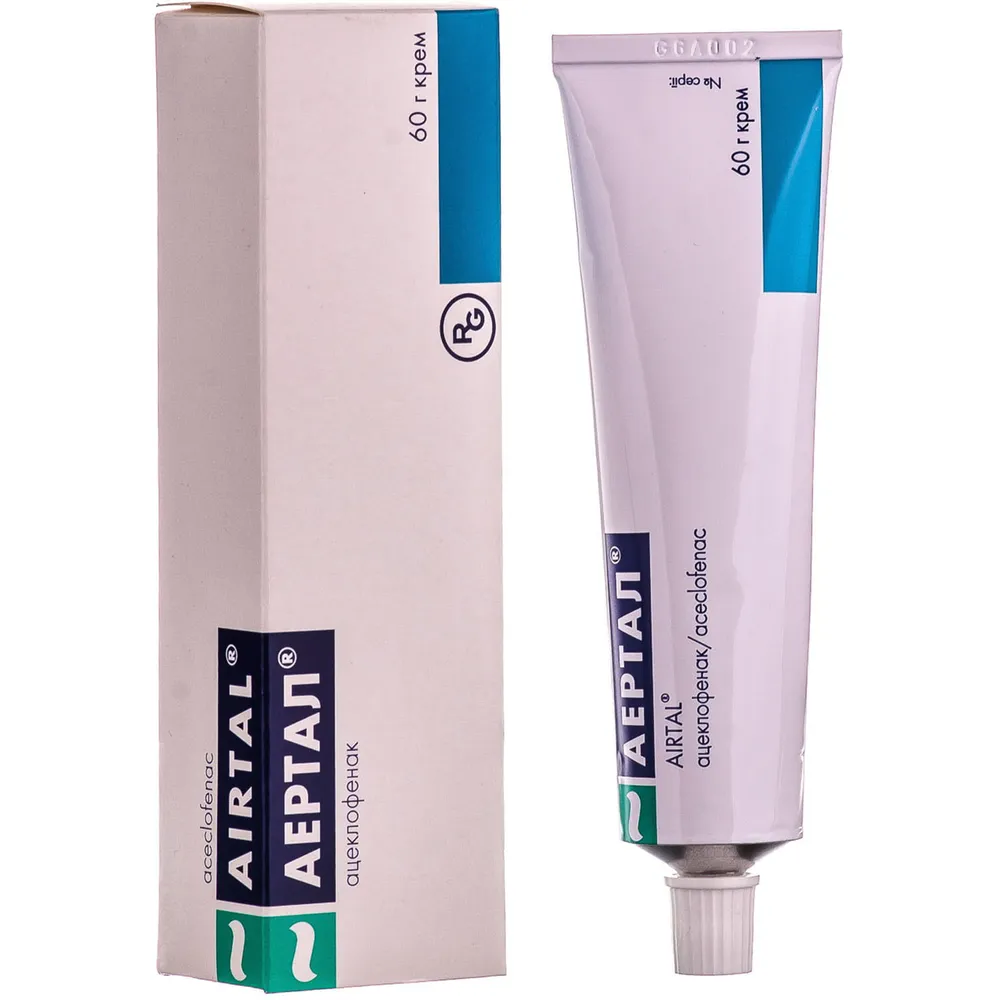
Table of Contents
INSTRUCTIONS FOR MEDICAL USE OF THE MEDICINAL PRODUCT AERTAL® (AIRTAL®)
Composition:
Active substance: aceclofenac;
1 g of cream contains 15 mg of aceclofenac;
Excipients: emulsifying wax, liquid paraffin, methylparaben (E 218), propylparaben (E 216), purified water.
Pharmaceutical form. Cream.
Main physicochemical characteristics: white-colored cream.
Pharmacotherapeutic group. Agents used locally for joint and muscular pain. Topical non-steroidal anti-inflammatory drugs.
ATC code M02A A25.
Pharmacological Properties.
Pharmacodynamics.
Mechanism of action
Aceclofenac is a non-steroidal anti-inflammatory drug with analgesic and antipyretic effects. In experimental models, it inhibits the development of edema and hyperemia regardless of the nature of inflammation. Studies on the mechanism of action of this drug in both animals and humans have shown that aceclofenac most likely inhibits the secretion of prostaglandins and leukotrienes by reversible inhibition of cyclooxygenase.
Clinical efficacy and safety
In a four-day study on skin tolerance (irritant effect), the cream containing aceclofenac showed significantly less irritant effect compared to placebo cream and twice-distilled water when analyzed comparatively.
In another study involving 12 volunteers, the extent of hyperemia induced by ultraviolet radiation was evaluated before and after application of the cream containing aceclofenac. It was established that 7 hours after application, the area of hyperemia was smaller in areas treated with aceclofenac compared to placebo-treated and untreated control areas.
It has been demonstrated that the cream containing aceclofenac exerts anti-inflammatory and analgesic effects when applied topically for the treatment of musculoskeletal injuries.
Comparative clinical studies have confirmed that the efficacy of aceclofenac is at least comparable to that of other topically applied drugs.
Clinical efficacy is combined with satisfactory local and systemic tolerability.
Therefore, Aerthal® cream is an effective medication for use in musculoskeletal injuries or inflammatory conditions.
Pharmacokinetics.
The pharmacokinetics of the aceclofenac-containing cream following topical application has been studied in various experimental models in animals and humans.
Absorption.
Aerthal® cream is absorbed from the site of application and rapidly reaches saturation. It accumulates at the site of absorption, which contributes to enhanced anti-inflammatory activity, and gradually enters the systemic circulation in low concentrations, thereby minimizing the risk of adverse reactions, including those affecting the gastrointestinal tract.
Distribution.
Aceclofenac is distributed throughout the body.
Elimination.
Aceclofenac is metabolized in the liver and slowly eliminated, partially in unchanged form, via urine and feces.
Clinical characteristics.
Indications.
Treatment of all types of local pain and inflammation resulting from any injuries of the musculoskeletal system, including sports injuries.
Reduction of inflammation in tendons, ligaments, muscles and joints in cases of strain, overexertion or trauma, as well as as part of combination therapy for the treatment of lumbago, torticollis and periarthritis.
Contraindications.
Hypersensitivity to aceclofenac or to any of the excipients.
History of hypersensitivity to other non-steroidal anti-inflammatory drugs (NSAIDs). Although cross-sensitivity with diclofenac has not been confirmed, this drug is not recommended for patients with a history of hypersensitivity to diclofenac.
Aceclofenac, like other non-steroidal anti-inflammatory drugs, is contraindicated in patients in whom acetylsalicylic acid or other non-steroidal anti-inflammatory drugs induce asthma attacks, urticaria, or acute rhinitis.
Third trimester of pregnancy.
Interaction with other medicinal products and other forms of interaction.
Although data on possible interactions of aceclofenac with other drugs have not been reported to date, caution should be exercised when prescribing the drug to patients receiving other medicinal products, especially those containing lithium or digoxin, or in cases of concomitant therapy with anticoagulants, diuretics or analgesics.
Special precautions for use.
- If irritation occurs at the site of application of Aertal® cream, treatment should be discontinued and appropriate therapy initiated.
- The cream must not be used for the treatment of open wounds, mucous membranes, skin irritation (eczematous), or in cases where any other pathological process is present on the skin at the site of cream application.
- To prevent photosensitivity reactions, areas treated with the cream should be protected from exposure to sunlight.
- Hypersensitivity and skin reactions: as with other NSAIDs, aceclofenac may cause allergic reactions, including anaphylactic/anaphylactoid reactions, particularly at the beginning of treatment. There have been reports of rare but serious skin reactions, some with fatal outcomes, including exfoliative dermatitis, Stevens-Johnson syndrome, and toxic epidermal necrolysis (see section "Adverse reactions"). The risk of such reactions is highest at the beginning of treatment, primarily during the first month of therapy. If a skin rash, mucosal lesions, or other signs of hypersensitivity occur, aceclofenac treatment must be discontinued immediately.
- In rare cases, Varicella virus may cause serious complications such as skin and soft tissue infections. At this time, a negative influence of NSAIDs on the course of such infections cannot be completely ruled out. Therefore, the use of aceclofenac is not recommended in Varicella virus infection.
- Aertal® cream contains 0.2 g of methylparaben (E 218) and 0.05 g of propylparaben (E 216), which may cause allergic reactions (including delayed-type reactions). Aertal® cream also contains cetylstearyl alcohol (in the emulsifying wax), which may cause local skin reactions (e.g., contact dermatitis).
Use during pregnancy or breastfeeding.
Pregnancy.
There are no clinical data on the use of Aertal® cream during pregnancy.
Even though systemic exposure is lower compared to oral administration, it is unknown whether systemic exposure to Aertal® cream following topical application could be harmful to the embryo/fetus. During the first and second trimesters of pregnancy, Aertal® cream should not be used unless clearly necessary. If use is required, the dose should be as low as possible and the duration of treatment as short as possible.
During the third trimester of pregnancy, systemic use of prostaglandin synthetase inhibitors, including Aertal® cream, may cause cardiovascular and renal toxicity in the fetus. Prolonged bleeding may occur in both mother and child near term, and labor may be prolonged. Therefore, Aertal® cream is contraindicated during the last trimester of pregnancy (see section "Contraindications").
Breastfeeding period.
There are no data available on whether aceclofenac is excreted in human breast milk. Animal studies have not shown adverse effects on pregnancy, embryonic/fetal development, parturition, or postnatal development.
Ability to influence the speed of reactions while driving or operating machinery.
Aertal® cream does not affect the ability to drive or operate machinery.
Method of Administration and Dosage
Method of Administration
This medicinal product is intended for external use only and should not be applied under occlusive dressings. Hands should be washed after application, except when the hands themselves are the site of cream application. The cream must not come into contact with the eyes or oral cavity. The cream should only be applied to intact skin.
Dosage
Aertal® cream should be applied three times daily with gentle massaging movements to the affected area. The amount applied depends on the size of the affected area: 1.5−2 g of Aertal® cream (approximately corresponding to a strip of cream 5−7 cm in length).
When used without a doctor's prescription for the treatment of muscle or joint injuries (strain, sprain, contusion) or ligament inflammation, the duration of use should not exceed 2 weeks. When used without a doctor's prescription for the treatment of arthritis, the duration of use should not exceed 3 weeks. If symptoms worsen or do not improve after 7 days of use, a doctor should be consulted for further evaluation.
Elderly Patients
The standard adult dose may be used for the treatment of elderly patients.
Children. The safety and efficacy of aceclofenac in children (under 18 years of age) have not been established. Data are lacking.
Aertal® cream is not recommended for use in children.
Overdose.
The typical symptoms of aceclofenac overdose are unknown.
In case of overdose or accidental ingestion of the product, appropriate treatment should be initiated.
Adverse Reactions
Aertal® cream has demonstrated satisfactory local tolerance.
In some cases, mild or moderate local irritation has been reported, accompanied by skin hyperemia and pruritus, which resolve after discontinuation of treatment.
In rare cases, varicella virus infection in combination with NSAID therapy may lead to serious complications such as skin and soft tissue infections.
Additionally, there have been isolated reports of photosensitivity reactions (frequency ≥ 1/1,000 to < 1/100) in skin areas treated with the cream, following exposure to intense sunlight without adequate UV protection.
Based on data from clinical studies and post-marketing experience with aceclofenac, the adverse reactions listed below are categorized by organ system class and frequency: very common (≥ 1/10); common (≥ 1/100 to < 1/10); uncommon (≥ 1/1,000 to < 1/100); rare (≥ 1/10,000 to < 1/1,000); very rare (< 1/10,000).
| Organ system class |
Uncommon |
Single cases |
Rare |
| Systemic disorders and application site conditions |
Photosensitivity reaction Hyperaemia Skin pruritus |
Skin irritation |
Bullous reactions (including Stevens-Johnson syndrome and toxic epidermal necrolysis) |
There have been reports of rare cases of serious skin reactions, including fatal outcomes, such as exfoliative dermatitis, Stevens−Johnson syndrome, and toxic epidermal necrolysis, associated with the use of NSAIDs.
Reporting suspected adverse reactions
It is important to report suspected adverse reactions during the post-marketing surveillance period. This allows ongoing monitoring of the benefit/risk balance of the medicinal product. Healthcare professionals should report any suspected adverse reactions.
Shelf life. 2 years.
Storage conditions. Store at a temperature not exceeding 25 °C.
Keep out of reach and sight of children!
Packaging. 60 grams of cream in a sealed aluminium tube with a white polyethylene screw cap and perforating tip. One tube in a cardboard box.
Availability. Over-the-counter (without prescription).
Manufacturer. Gedeon Richter Plc., Hungary.
Manufacturer's address.
H-1103 Budapest, 19–21 Deményi Street, Hungary.