Advocard®
Ukraine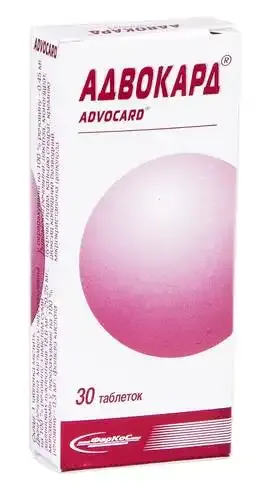
Table of Contents
INSTRUCTIONS for medical use of the medicinal product ADOVCARD® (ADVOCARD®)
Composition:
Active substances: 1 tablet contains: maglade, calculated to 100 % substance with content of sum of adenine nucleotides 18.6 – 29.25 mg, molsidomine calculated to 100 % substance – 0.3 mg, folic acid calculated to 100 % substance – 0.45 mg;
Excipients: lactose monohydrate; sucrose; colloidal anhydrous silicon dioxide; microcrystalline cellulose.
Pharmaceutical form. Tablets
Main physicochemical properties: light-yellow tablets with speckles of more intense colour, flat cylindrical shape, with bevel and score line.
Pharmacotherapeutic group.
Combined cardiological agents. ATC code C01EX
Pharmacological Properties.
Pharmacodynamics.
ADVOCARD® is an original combined medicinal product. It exerts antianginal and anti-ischemic effects, provides membrane-protective and antioxidant actions, improves myocardial metabolism by protecting cells from hypoxia, and demonstrates anti-atherosclerotic activity through normalization of homocysteine metabolism. The mechanism of action of ADVOCARD® is associated with the combined effect of its components.
Meglodine acts on purine (adenosine) receptors, thereby activating potassium channels. Activation of potassium channels leads to inhibition of calcium ion influx into cells, resulting in anti-ischemic, membrane-stabilizing, and antiarrhythmic effects. By acting on mitochondrial ATP-dependent potassium channels (KATP), meglodine promotes processes aimed at protecting the myocardium from damage associated with ischemia.
Due to its influence on purine receptors, meglodine also exhibits antiplatelet (anti-aggregatory) activity.
Molsidomine and its active metabolites SIN-1 and SIN-1A act as nitric oxide donors. Nitric oxide stimulates the guanylate cyclase system and activates ATP-sensitive potassium channels, leading to blockade of calcium ion influx into vascular cells and resulting in vasodilation. This explains the synergistic effect of meglodine and molsidomine on hemodynamic parameters.
Unlike organic nitrates, tolerance does not develop to this drug. Molsidomine exerts a beneficial effect on systemic hemodynamics by reducing myocardial load. By inhibiting platelet phospholipase synthesis and stimulating prostacyclin production in the vascular wall, molsidomine demonstrates antiplatelet properties.
Folic acid participates in numerous metabolic processes. Of particular importance is its role in homocysteine metabolism, as homocysteine is a known risk factor for atherosclerosis. By reducing homocysteine levels, folic acid exerts an anti-atherosclerotic effect. Additionally, by stimulating metabolic processes in the myocardium, folic acid improves its functional activity.
Under conditions of coronary insufficiency, the drug exerts an energy-sparing effect by reducing myocardial oxygen demand. ADVOCARD® reduces lactate levels in the myocardium, inhibits the activity of membrane-bound phospholipases, prevents structural and functional damage to cardiomyocyte membranes, and maintains stability in the quantitative and qualitative composition of membrane lipids. ADVOCARD® improves coronary blood flow, increases exercise tolerance, and reduces the frequency and severity of angina attacks. In patients with heart failure, by improving myocardial metabolic support and normalizing hemodynamic parameters, it increases left ventricular ejection fraction. The use of the drug promotes normalization of magnesium ion concentrations in tissues. ADVOCARD® exerts an antiarrhythmic effect.
Pharmacokinetics. The pharmacokinetics of the drug has not been studied.
Clinical characteristics.
Indications.
As part of complex therapy for ischemic heart disease and heart failure, exertional and rest angina; prevention and treatment of angina attacks.
Contraindications.
Individual hypersensitivity to the drug or its ingredients. Severe arterial hypotension; severe forms of bronchial asthma; cardiogenic and other types of shock; acute phase of myocardial infarction, especially with low blood pressure; head injury; sinoatrial and atrioventricular block of II–III degree; hemorrhagic stroke; glaucoma, particularly closed-angle glaucoma; untreated malignant neoplasms; childhood; pregnancy or breastfeeding period.
Interaction with other medicinal products and other forms of interaction.
When ADVOKARD® is used concomitantly with antihypertensive agents (including nitrates), their effects are potentiated. Concomitant use with sildenafil citrate is not recommended, as arterial hypotension may develop.
Dipyridamole enhances the therapeutic effect of the drug, whereas xanthinol nicotinate, caffeine, theophylline, aminophylline reduce it.
The drug enhances the antianginal effect of α- and β-adrenoblockers, calcium channel blockers, and nitrates.
Alcohol consumption during treatment is strictly prohibited.
Concomitant use of molsidomine with peripheral vasodilators, calcium ion antagonists, and antihypertensive agents potentiates the antiplatelet effect.
In patients receiving long-term treatment with antiepileptic agents (phenobarbital, phenytoin, and primidone), folate deficiency may occur. Therefore, administration of folic acid may reduce plasma levels of antiepileptic drugs and provoke epileptic seizures.
Oral contraceptives, ethanol, sulfasalazine, cycloserine, glutethimide, and methotrexate may affect folate metabolism.
Folic acid increases the metabolism of phenytoin. Decreased or altered absorption may occur when cholestyramine and folic acid are used concomitantly. Therefore, the drug should be taken 1 hour before or 4–6 hours after cholestyramine administration.
Special precautions for use.
Elderly patients may have increased sensitivity to the drug; therefore, treatment should be initiated with a dose of 1 tablet three times daily. If the drug is well tolerated, the dose may be increased to the standard regimen.
The drug is contraindicated in patients with atrioventricular block combined with other rhythm disturbances. Its use is not recommended in cases of significant arterial hypotension. Use with caution in patients predisposed to bronchospasm or with obstructive diseases of the bronchopulmonary system.
Each tablet contains a small amount of sucrose powder (1 tablet contains 0.01 bread unit (BU)), which should be taken into account in patients with diabetes mellitus.
The drug contains lactose and therefore should not be administered to patients with rare hereditary disorders of galactose intolerance, lactase deficiency, or glucose-galactose malabsorption syndrome.
During treatment with this drug, consumption of products containing caffeine (coffee, tea) should be limited.
The drug should be used with caution in patients with vitamin B12 deficiency, malignant neoplasms, or anemias of unknown etiology, as folic acid may mask the diagnosis of pernicious anemia by improving hematological manifestations, while allowing neurological complications to progress. In cases of pernicious anemia, the drug should be used only concomitantly with cyanocobalamin.
Prolonged use of folic acid, especially in high doses, is not recommended due to the risk of decreased cyanocobalamin concentration in blood.
During prolonged treatment with the drug, serum magnesium levels should be monitored.
Use during pregnancy and breastfeeding.
There are no clinical data on the safety and efficacy of the drug during pregnancy; therefore, its use in pregnant women is contraindicated.
Breastfeeding should be discontinued during treatment.
Ability to affect reaction rate while driving or operating machinery.
The drug does not impair the ability to drive a vehicle or operate machinery. However, if dizziness or decreased arterial pressure occurs during treatment for any reason, patients should refrain from driving or operating machinery.
Method of Administration and Dosage.
ADVOCARD® tablets should be taken sublingually (under the tongue) and held under the tongue until completely dissolved. The single dose is 1–3 tablets, 3–4 times daily, independent of food intake. The treatment course lasts 20–30 days. In the event of an angina attack, 1–3 tablets should be taken. The maximum single dose is 3 tablets. The maximum daily dose is 20 tablets.
Children.
There is no clinical experience with the use of the drug in children under 18 years of age; therefore, it is not prescribed to this patient group.
Overdose.
Overdose is characterized by headache, dizziness, and visual disturbances. In such cases, caffeine or caffeine-containing medications may be used.
Arterial hypotension accompanied by nausea and vomiting; bradycardia, development of atrioventricular block, syncope associated with a sudden drop in arterial pressure, collapse. Rarely, increased diuresis, discomfort in the chest, hyperthermia, and, in isolated cases, hypermagnesemia may occur. Treatment: symptomatic.
Adverse reactions.
The drug is generally well tolerated. In very rare cases, the following may occur:
Cardiovascular system: arterial hypotension, up to collapse, tachycardia.
Nervous system: at the beginning of treatment – headache, dizziness, sensation of heaviness in the head.
Gastrointestinal tract: nausea, bitter taste in the mouth, epigastric discomfort, flatulence.
Other: facial flushing, general weakness, allergic reactions, skin rash, pruritus, urticaria, bronchospasm, anaphylactic reactions.
Shelf life. 3 years.
The drug should not be used after the expiry date stated on the packaging.
Storage conditions.
Store in the original packaging at a temperature not exceeding 25 °C.
Keep out of reach of children.
Packaging.
10 tablets per blister; 3 or 4 blisters per carton with labeling in Ukrainian; 1 blister without secondary packaging.
Prescription status. Prescription only.
Manufacturer.
LLC "Pharmaceutical Company "FarkoS".
Manufacturer's address and place of business
360, Sviato-Pokrovska Street, Gostomel Settlement, Irpin, Kyiv Region, 08290, Ukraine.