Adenorm
Ukraine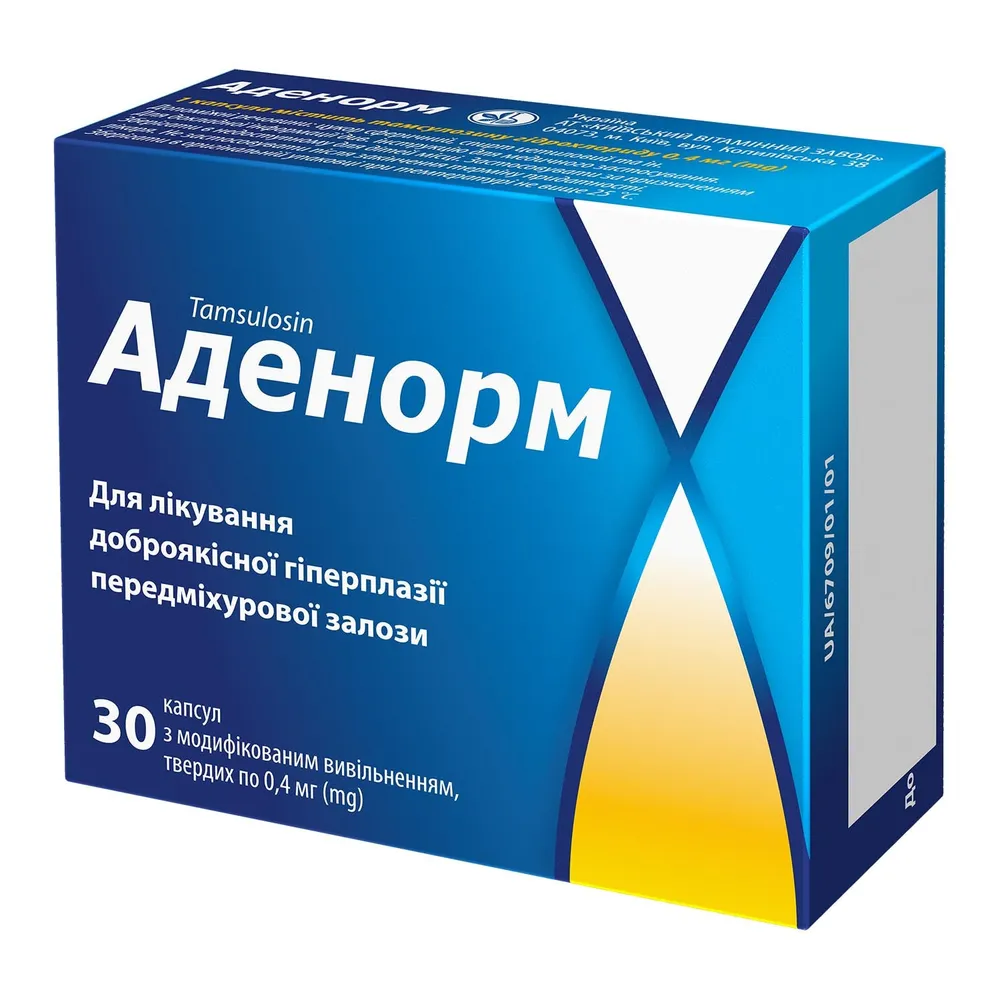
Table of Contents
INSTRUCTIONS FOR MEDICAL USE OF THE MEDICINAL PRODUCT ADEONRM (ADENORM)
Composition:
Active substance: 1 capsule contains tamsulosin hydrochloride (as tamsulosin hydrochloride 0.15% SR, pellets) 0.4 mg;
Excipients: spherical sugar, ethylcellulose, hypromellose (hydroxypropylmethylcellulose), povidone, hypromellose phthalate (hydroxypropylmethylcellulose phthalate), cetyl alcohol, diethyl phthalate, talc;
Composition of hard gelatin capsule: gelatin, iron oxide red (E 172), iron oxide yellow (E 172), titanium dioxide (E 171), indigotine (E 132).
Pharmaceutical form. Modified-release hard capsules.
Main physicochemical characteristics: hard gelatin capsules with a light green cap and an orange body. The capsule contents are white or almost white spherical pellets.
Pharmacotherapeutic group. Agents used in benign prostatic hyperplasia. α1-Adrenergic receptor antagonists. ATC code G04C A02.
Pharmacological Properties
Pharmacodynamics
Adenorm selectively and competitively blocks postsynaptic α1-adrenoceptors, particularly α1A and α1D subtypes, located in the smooth muscle of the prostate gland, bladder neck, and prostatic urethra. This leads to reduced smooth muscle tone in the prostate gland, bladder neck, and prostatic urethra, resulting in improved urinary flow. At the same time, obstructive and irritative symptoms associated with benign prostatic hyperplasia are reduced (difficulty initiating urination, weakened urinary stream, post-void dribbling, sensation of incomplete bladder emptying, frequent urges to urinate, nocturia, urinary urgency).
These effects are maintained over long-term treatment and significantly delay the need for surgical intervention or catheterization.
α1-Adrenoceptor antagonists have the potential to reduce blood pressure by decreasing peripheral vascular resistance. However, during clinical trials of Adenorm, no clinically significant reduction in arterial blood pressure was observed.
Pharmacokinetics
Absorption: Tamsulosin is well absorbed from the gastrointestinal tract, with a bioavailability of nearly 100%. Absorption of tamsulosin is slightly slower following food intake. Consistent absorption is achieved when the patient takes Adenorm at the same time each day after a meal. The pharmacokinetics of tamsulosin are linear in nature.
After a single dose administered following food intake, peak plasma concentration of tamsulosin is reached in approximately 6 hours. Steady-state plasma concentration is achieved by the fifth day of daily dosing. The Cmax at steady state is approximately two-thirds higher than that observed after a single dose.
Distribution: In men, tamsulosin is approximately 99% bound to plasma proteins. The volume of distribution of the drug is low (approximately 0.2 L/kg).
Metabolism: Tamsulosin hydrochloride does not undergo a first-pass effect and is slowly metabolized in the liver, forming pharmacologically active metabolites that retain high selectivity for α1-adrenoceptors. The majority of the active substance in the blood is present in unchanged form.
Elimination: Tamsulosin and its metabolites are primarily excreted from the body via urine. Approximately 9% of the administered dose is excreted as unchanged active substance.
After a single dose taken after food intake and at steady-state plasma concentrations, elimination half-lives are approximately 10 and 13 hours, respectively.
Clinical characteristics.
Indications.
Treatment of functional disorders of the lower urinary tract in benign prostatic hyperplasia.
Contraindications.
Hypersensitivity to tamsulosin hydrochloride, including drug-induced angioneurotic edema, or to any of the excipients; history of orthostatic hypotension; severe hepatic impairment.
Interaction with other medicinal products and other forms of interaction.
Interaction studies have been conducted only in adults.
No drug interactions were observed when tamsulosin hydrochloride was administered concomitantly with atenolol, enalapril, or theophylline. Concomitant administration with cimetidine increases, while with furosemide decreases, the plasma concentration of tamsulosin; however, since these levels remain within the normal range, no special dose adjustment of tamsulosin is required.
Available data indicate that diazepam, propranolol, trichlormethiazide, chlormadinone, amitriptyline, diclofenac, glibenclamide, simvastatin, and warfarin do not affect the free fraction of tamsulosin in human plasma. Similarly, tamsulosin does not alter the levels of free fractions of diazepam, propranolol, trichlormethiazide, and chlormadinone in human plasma.
However, diclofenac and warfarin may increase the elimination rate of tamsulosin.
Concomitant administration of tamsulosin hydrochloride with strong CYP3A4 inhibitors may lead to increased effects of tamsulosin hydrochloride. Co-administration with ketoconazole (a known strong CYP3A4 inhibitor) resulted in increases in AUC and Cmax by up to 2.8- and 2.2-fold, respectively.
Tamsulosin hydrochloride should not be prescribed in combination with strong CYP3A4 inhibitors to patients who are poor metabolizers of CYP2D6.
Tamsulosin hydrochloride should be used with caution in combination with strong and moderate CYP3A4 inhibitors.
Concomitant administration of tamsulosin hydrochloride and paroxetine (a strong CYP2D6 inhibitor) leads to increases in Cmax and AUC by up to 1.3- and 1.6-fold, respectively, but this increase is not considered clinically significant.
Concomitant administration with other α1-adrenoblockers may enhance the hypotensive effect.
Special precautions for use
As with other α1-adrenoblockers, administration of the medicinal product Adenorm may in individual cases lead to a reduction in blood pressure, which might occasionally result in loss of consciousness. If early symptoms of orthostatic hypotension (dizziness, weakness) occur, the patient should sit down or assume a horizontal position until the aforementioned symptoms subside.
Prior to initiating treatment with Adenorm, a medical examination should be performed to identify other concomitant conditions that may cause such symptoms as benign prostatic hyperplasia. Before starting treatment, a digital rectal examination of the prostate gland should be carried out, and, if necessary, a test to determine the level of prostate-specific antigen (PSA) should be performed prior to treatment and at regular intervals during therapy.
The medicinal product should be administered with particular caution to patients with severe renal impairment (creatinine clearance < 10 mL/min), as clinical studies with this medicinal product have not been conducted in such patients.
In some patients receiving or who have previously received tamsulosin, intraoperative floppy iris syndrome (IFIS, a variant of intraoperative miosis) has been reported during cataract or glaucoma surgery, which may lead to an increased risk of complications during or after the procedure.
Generally, it is recommended to discontinue tamsulosin treatment 1–2 weeks prior to cataract or glaucoma surgery; however, the clinical benefit of such discontinuation has not yet been definitively established.
Cases of floppy iris syndrome have also been reported in patients who had discontinued tamsulosin long before undergoing cataract surgery.
Initiating tamsulosin hydrochloride therapy in patients scheduled for elective cataract or glaucoma surgery is not recommended. Surgeons and ophthalmologists should be informed whether the patient is currently taking (or has previously taken) tamsulosin to prevent potential complications associated with IFIS.
Tamsulosin hydrochloride should not be administered in combination with strong CYP3A4 inhibitors to patients who are poor metabolizers of CYP2D6.
Tamsulosin hydrochloride should be used with caution in combination with strong and moderate CYP3A4 inhibitors (see section "Interaction with other medicinal products and other forms of interaction").
The medicinal product contains sugar, which should be taken into account in patients with diabetes mellitus.
Allergic reactions to tamsulosin have been reported in patients with a history of allergy to sulfonamides. Caution should be exercised when administering tamsulosin hydrochloride to patients who have previously experienced allergic reactions to sulfonamides.
Use during pregnancy or breastfeeding
Adenorm is not indicated for use in women.
Fertility
Available data indicate that disturbances in ejaculation, including retrograde ejaculation and insufficient ejaculation, have been observed during tamsulosin use.
Ability to affect reaction speed when driving or operating machinery
Studies on the effect of the medicinal product on the ability to drive vehicles or operate machinery have not been conducted. However, patients should be warned about the possible occurrence of dizziness.
Method of administration and dosage.
The recommended dose for adults is 1 capsule daily, taken after breakfast or after the first meal of the day. The capsule should be swallowed whole and must not be crushed or chewed, as this would interfere with the modified release of the active ingredient.
Dose adjustment is not required in patients with renal impairment.
Dose adjustment is not required in patients with moderate to severe hepatic impairment. (See section "Contraindications").
Children. The medicinal product is not intended for use in children.
The safety and efficacy of tamsulosin in children under 18 years of age have not been established.
Overdose.
Symptoms.
Overdose with tamsulosin hydrochloride may potentially cause severe hypotensive effects. Severe hypotension has been observed at various levels of overdose.
Treatment.
In case of acute drop in blood pressure due to overdose, supportive therapy should be administered to restore normal cardiovascular function (e.g., the patient should be placed in a supine position). If this measure is ineffective, intravenous fluid therapy should be initiated and vasopressor agents administered. Renal function should be monitored, and general supportive treatment provided. Due to the high degree of plasma protein binding of tamsulosin, hemodialysis is unlikely to be beneficial.
To prevent further absorption of the drug, induced vomiting may be considered. In case of ingestion of a large amount of the drug, gastric lavage with activated charcoal, followed by administration of low-osmotic laxatives such as sodium sulfate, should be performed.
Adverse Reactions.
Central nervous system disorders: dizziness; headache; fainting.
Eye disorders: blurred vision, visual disturbances.
Cardiac disorders: palpitations.
Vascular disorders: orthostatic hypotension.
Respiratory, thoracic and mediastinal disorders: rhinitis; nosebleeds.
Gastrointestinal disorders: constipation, diarrhoea, nausea, vomiting.
Skin and mucous membrane disorders: rash, pruritus, urticaria; angioneurotic oedema; Stevens-Johnson syndrome; erythema multiforme, exfoliative dermatitis.
Reproductive system disorders: ejaculation disorders, including retrograde ejaculation and ejaculatory insufficiency.
General disorders: asthenia.
Cases of intraoperative iris instability (intraoperative floppy iris syndrome, IFIS, a variant of the small pupil syndrome) have been reported during cataract and glaucoma surgery in patients treated with tamsulosin (see section "Special precautions").
In addition to the above-mentioned adverse reactions, cases of atrial fibrillation, arrhythmia, tachycardia, and dyspnoea have been reported, the frequency of which cannot be reliably established.
Shelf life. 3 years.
Storage conditions.
Store in the original packaging at a temperature not exceeding 25 °C.
Keep out of the reach of children.
Packaging.
10 capsules in a blister; 3 blisters in a carton.
Prescription category. Prescription only.
Manufacturer. JSC "KYIV VITAMIN FACTORY".
Manufacturer's address and place of business.
38 Kopylivska Street, Kyiv, 04073, Ukraine.
Web-site: www.vitamin.com.ua.
INSTRUCTIONS
for medical use of medicinal product
ADENORM
(ADENORM)
Composition:
Active ingredient: 1 capsule contains tamsulosin hydrochloride (as tamsulosin hydrochloride 0.15% CR, pellets) 0.4 mg;
Excipients: spherical sugar, ethylcellulose, hypromellose (hydroxypropylmethylcellulose), povidone, hypromellose phthalate (hydroxypropylmethylcellulose phthalate), cetyl alcohol, diethyl phthalate, talc;
Composition of hard gelatin capsule: gelatin, iron oxide red (E 172), iron oxide yellow (E 172), titanium dioxide (E 171), indigotine (E 132).
Pharmaceutical form. Modified-release hard capsules.
Main physicochemical properties: hard gelatin capsules with a light green cap and orange body. Capsule contents – white or almost white spherical pellets.
Pharmacotherapeutic group. Drugs used in benign prostatic hyperplasia. α1-adrenergic receptor antagonists.
ATC code G04CA02.
Pharmacological properties.
Pharmacodynamics.
Adenorm selectively and competitively blocks postsynaptic α1-adrenoceptors, particularly α1A and α1D subtypes, located in the smooth muscle of the prostate gland, bladder neck, and prostatic urethra. This leads to reduced smooth muscle tone in the prostate, bladder neck, and prostatic urethra, resulting in improved urinary flow. Simultaneously, symptoms of obstruction and irritation associated with benign prostatic hyperplasia (difficulty initiating micturition, weak urinary stream, post-micturition dribbling, sensation of incomplete bladder emptying, frequent micturition, nocturia, urinary urgency) are reduced.
These effects are maintained during long-term treatment and significantly delay the need for surgical intervention or catheterization.
α1-adrenoceptor antagonists may reduce blood pressure by decreasing peripheral vascular resistance. During clinical trials of Adenorm, no clinically significant reduction in blood pressure was observed.
Pharmacokinetics.
Absorption: tamsulosin is well absorbed from the gastrointestinal tract, with bioavailability of nearly 0.4 mg. Absorption is slightly slower when taken with food. Consistent absorption is achieved when Adenorm is taken at the same time after meals. The pharmacokinetics of tamsulosin are linear.
After a single dose taken with food, peak plasma concentration of tamsulosin is reached approximately 6 hours later. Steady-state concentration is achieved by day 5 of daily dosing. The Cmax is approximately two-thirds higher than that observed after a single dose.
Distribution: in men, tamsulosin is approximately 99% bound to plasma proteins. The volume of distribution is low (approximately 0.2 L/kg).
Metabolism: tamsulosin hydrochloride undergoes negligible first-pass metabolism and is slowly metabolized in the liver, forming pharmacologically active metabolites that retain high selectivity for α1-adrenoceptors. Most of the active substance circulates in the bloodstream unchanged.
Elimination: tamsulosin and its metabolites are primarily excreted in urine. Approximately 9% of the dose is excreted unchanged.
After a single dose taken with food and at steady-state plasma concentrations, elimination half-lives are approximately 10 and 13 hours, respectively.
Clinical characteristics.
Indications.
Treatment of lower urinary tract symptoms associated with benign prostatic hyperplasia.
Contraindications.
Hypersensitivity to tamsulosin hydrochloride, including drug-induced angioedema, or to any excipient; history of orthostatic hypotension; severe hepatic impairment.
Interaction with other medicinal products and other forms of interaction.
Interaction studies have been conducted only in adults.
No drug interactions were observed when tamsulosin hydrochloride was co-administered with atenolol, enalapril, or theophylline. Concomitant use with cimetidine increases, while co-administration with furosemide decreases, plasma concentrations of tamsulosin. However, since these levels remain within normal limits, dose adjustment of tamsulosin is not required.
Available data indicate that diazepam, propranolol, trichlormethiazide, chlormadinone, amitriptyline, diclofenac, glyburide, simvastatin, and warfarin do not affect the free fraction of tamsulosin in human plasma. Similarly, tamsulosin does not alter the free fractions of diazepam, propranolol, trichlormethiazide, and chlormadinone in human plasma.
However, diclofenac and warfarin may increase the elimination rate of tamsulosin.
Concomitant administration of tamsulosin hydrochloride with strong CYP3A4 inhibitors may increase the effects of tamsulosin hydrochloride. Co-administration with ketoconazole (a known strong CYP3A4 inhibitor) resulted in increases in AUC and Cmax by up to 2.8- and 2.2-fold, respectively.
Tamsulosin hydrochloride should not be prescribed in combination with strong CYP3A4 inhibitors in patients with poor CYP2D6 metabolism.
Tamsulosin hydrochloride should be used with caution in combination with strong and moderate CYP3A4 inhibitors.
Concomitant use of tamsulosin hydrochloride and paroxetine (a strong CYP2D6 inhibitor) leads to increases in Cmax and AUC by up to 1.3- and 1.6-fold, respectively, but this is not considered clinically significant.
Concomitant use with other α1-adrenergic blockers may enhance the hypotensive effect.
Special precautions.
As with other α1-adrenergic blockers, use of Adenorm may cause a decrease in blood pressure, which in some cases may lead to loss of consciousness. If early signs of orthostatic hypotension (dizziness, weakness) occur, the patient should sit or lie down until symptoms subside.
Prior to initiating treatment with Adenorm, a medical examination should be performed to rule out other conditions that may cause symptoms similar to benign prostatic hyperplasia. Digital rectal examination of the prostate and, if necessary, measurement of prostate-specific antigen (PSA) levels should be performed before treatment initiation and at regular intervals during treatment.
Tamsulosin hydrochloride should be administered with caution in patients with severe renal impairment (creatinine clearance < 10 mL/min), as clinical studies in such patients have not been conducted.
In some patients undergoing cataract or glaucoma surgery while taking or having previously taken tamsulosin, intraoperative floppy iris syndrome (IFIS, a variant of the small pupil syndrome) has been observed, which may increase the risk of intraoperative or postoperative complications.
It is generally recommended to discontinue tamsulosin 1–2 weeks before cataract or glaucoma surgery; however, the benefit of such discontinuation has not been definitively established.
Cases of IFIS have also been reported in patients who had discontinued tamsulosin long before cataract surgery.
Initiating tamsulosin hydrochloride treatment is not recommended in patients scheduled for cataract or glaucoma surgery. Surgeons and ophthalmologists should be informed if a patient is currently taking or has previously taken tamsulosin to prevent possible IFIS-related complications.
Tamsulosin hydrochloride should not be prescribed in combination with strong CYP3A4 inhibitors in patients with poor CYP2D6 metabolism.
Tamsulosin hydrochloride should be used with caution in combination with strong and moderate CYP3A4 inhibitors (see section "Interaction with other medicinal products and other forms of interaction").
The product contains sugar, which should be considered in diabetic patients.
Allergic reactions to tamsulosin have been reported in patients with a history of sulphonamide allergy. Caution should be exercised when prescribing tamsulosin hydrochloride to patients with a history of sulphonamide allergy.
Use during pregnancy or breastfeeding.
Adenorm is not indicated for use in women.
Fertility.
Available data indicate that during tamsulosin use, disorders of ejaculation, retrograde ejaculation, and ejaculatory insufficiency may occur.
Ability to affect reaction time when driving or operating machinery.
Studies on the effect of the drug on the ability to drive or operate machinery have not been conducted. However, patients should be warned about the possibility of dizziness.
Dosage and administration.
The recommended dose for adults is 1 capsule daily, taken after breakfast or the first meal of the day. The capsule should be swallowed whole, without breaking or chewing, to ensure modified release of the active ingredient.
Dose adjustment is not required in patients with renal impairment.
Dose adjustment is not required in patients with moderate or mild hepatic impairment (see section "Contraindications").
Children. The drug is not intended for use in children.
The safety and efficacy of tamsulosin in children under 18 years of age have not been established.
Overdose.
Symptoms.
Overdose with tamsulosin hydrochloride may potentially cause severe hypotension. Severe hypotension has been observed at various overdose levels.
Treatment.
In case of significant hypotension due to overdose, supportive therapy should be initiated to restore normal cardiovascular function (e.g., the patient should be placed in a supine position). If this measure is ineffective, intravenous fluid therapy and vasopressor agents should be administered. Renal function should be monitored, and general supportive therapy provided. Due to the high plasma protein binding of tamsulosin, haemodialysis is unlikely to be effective.
To prevent further absorption, induced vomiting may be considered. In cases of significant overdose, gastric lavage with activated charcoal and low-osmotic laxatives such as sodium sulfate should be performed.
Adverse reactions.
Nervous system disorders: dizziness; headache; fainting.
Eye disorders: blurred vision, visual disturbances.
Cardiac disorders: palpitations.
Vascular disorders: orthostatic hypotension.
Respiratory, thoracic and mediastinal disorders: rhinitis; nosebleeds.
Gastrointestinal disorders: constipation, diarrhoea, nausea, vomiting.
Skin and mucous membrane disorders: rash, pruritus, urticaria; angioneurotic oedema; Stevens-Johnson syndrome; erythema multiforme, exfoliative dermatitis.
Reproductive system disorders: ejaculation disorders, including retrograde ejaculation and ejaculatory insufficiency.
General disorders: asthenia.
Cases of intraoperative iris instability (small pupil syndrome) during cataract and glaucoma surgery have been reported in patients taking tamsulosin (see section "Special precautions").
In addition to the above-mentioned adverse reactions, cases of atrial fibrillation, arrhythmia, tachycardia, and dyspnoea have been reported, the frequency of which cannot be reliably established.
Shelf life. 3 years.
Storage conditions.
Store in the original packaging at a temperature not exceeding 25 °C.
Keep out of the reach of children.
Packaging.
10 capsules in a blister; 3 blisters in a carton.
Prescription category. Prescription only.
Manufacturer. JSC "KYIV VITAMIN FACTORY".
Manufacturer's address and place of business.
38 Kopylivska Street, Kyiv, 04073, Ukraine.
Web-site: www.vitamin.com.ua.