Zyrtec
Poland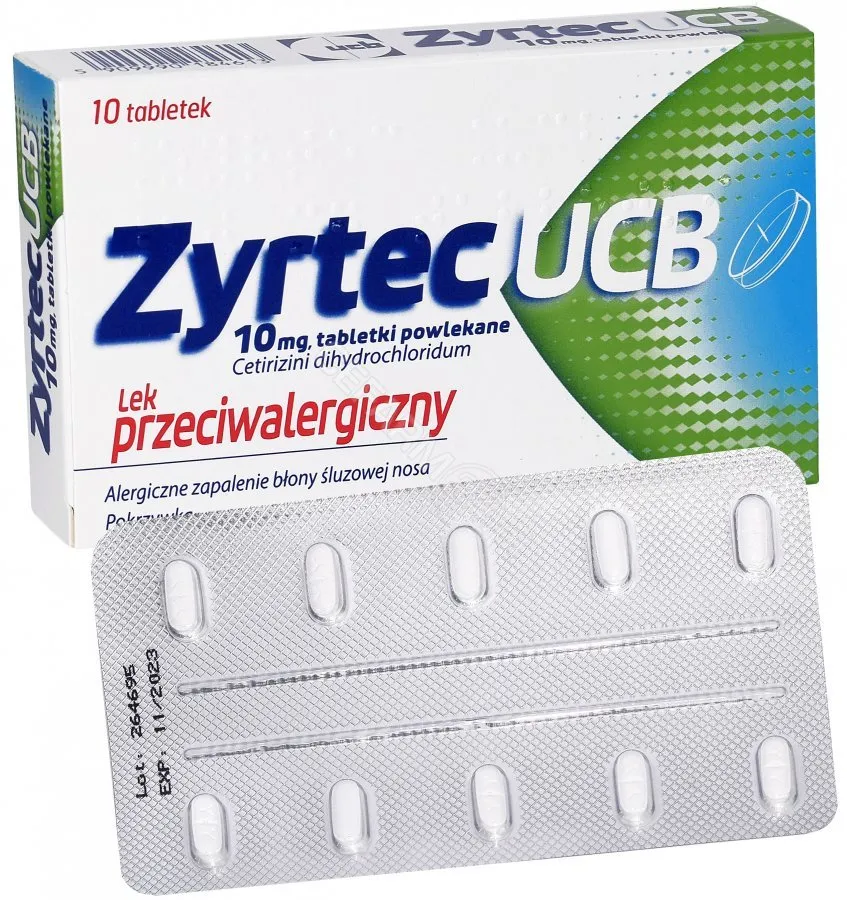
Table of Contents
Package leaflet: Information for the user
Zyrtec, 10 mg, film-coated tablets
Cetirizini dihydrochloridum
Please read all of this leaflet carefully before taking this medicine because it contains
important information for you.
- Keep this leaflet. You may need to read it again.
- If you have any further questions, ask your doctor or pharmacist.
- This medicine has been prescribed for you personally. Do not pass it on to others. It may harm someone else even if their symptoms are the same as yours.
- If you experience any side effects, including any not listed in this leaflet, tell your doctor or pharmacist. See section 4.
Contents of the leaflet:
- What Zyrtec is and what it is used for
- Before you take Zyrtec
- How to take Zyrtec
- Possible side effects
- How to store Zyrtec
- Contents of the pack and other information
1. What Zyrtec is and what it is used for
The active substance in Zyrtec is cetirizine dihydrochloride.
Zyrtec is an antiallergy medicine.
Zyrtec 10 mg film-coated tablets are indicated for use in adults and children aged 6 years and older:
- for the relief of nasal and ocular symptoms associated with seasonal and perennial allergic rhinitis,
- for the relief of symptoms of urticaria.
2. Important information before using Zyrtec
When not to use Zyrtec
- if the patient has end-stage renal failure (severe kidney failure requiring dialysis),
- if the patient is allergic to cetirizine hydrochloride or any of the other ingredients of this medicine (listed in section 6), hydroxyzine, or piperazine derivatives (substances with similar chemical structure contained in other medicines).
Warnings and precautions
Before starting treatment with Zyrtec, discuss it with your doctor or pharmacist.
If the patient has kidney impairment, consult a doctor before using this medicine;
a lower dose may be required. The doctor will determine the appropriate dose.
If the patient has problems with urination (e.g. due to spinal cord or prostate disorders,
or bladder problems), consult a doctor.
If the patient has epilepsy or is at risk of seizures, consult a doctor.
No clinically significant interactions between alcohol (at a blood concentration of 0.5 per mille (g/l), corresponding to the level after drinking one glass of wine) and cetirizine administered at recommended doses have been observed. However, there is no safety data available regarding concomitant use of higher doses of cetirizine and alcohol. Therefore, as with other antihistamine medicines, it is recommended to avoid taking Zyrtec together with alcohol.
If the patient has planned allergy testing, ask the doctor whether the patient should stop taking Zyrtec a few days before the test. Zyrtec may affect the results of allergy tests.
Children
This medicine should not be given to children under 6 years of age, because the tablet formulation does not allow appropriate dose adjustment.
Zyrtec and other medicines
Tell your doctor or pharmacist about all medicines the patient is currently taking or has recently taken, as well as any medicines the patient plans to use.
Taking Zyrtec with food and drink
Food does not affect the absorption of Zyrtec.
Pregnancy and breastfeeding
If the patient is pregnant or breastfeeding, suspects she might be pregnant, or is planning to have a child, she should consult a doctor before using this medicine.
Use of Zyrtec during pregnancy should be avoided. Accidental intake of the medicine by a pregnant woman is not expected to have harmful effects on the fetus. However, the medicine should be used only if necessary and after consultation with a doctor.
Cetirizine passes into breast milk. Adverse effects in breastfed infants cannot be excluded. Therefore, Zyrtec should not be used during breastfeeding unless otherwise decided by a doctor.
Driving and operating machinery
Clinical studies have not shown any impairment of reaction ability, concentration, or driving skills after administration of Zyrtec at the recommended dose.
If the patient intends to drive, perform potentially hazardous activities, or operate machinery after taking Zyrtec, the patient should carefully monitor the body's response to the medicine. Do not exceed the recommended dose.
Zyrtec coated tablets contain lactose; if the patient has previously been diagnosed with intolerance to certain sugars, the patient should consult a doctor before taking this medicine.
3. How to take Zyrtec
This medicine should always be taken according to the instructions given by your doctor or pharmacist. If you are unsure,
you should consult your doctor or pharmacist.
The tablets should be swallowed with a glass of liquid.
The tablet may be divided into two equal doses.
Adults and adolescents over 12 years of age:
The recommended dose is 10 mg (1 tablet) once daily.
Other formulations of this medicine may be more suitable for children. Please consult your doctor or
pharmacist.
Use in children aged 6 to 12 years:
The recommended dose is 5 mg twice daily (half a tablet twice daily).
Other formulations of this medicine may be more suitable for children. Please consult your doctor or
pharmacist.
Patients with impaired renal function
For patients with moderate renal impairment, a dose of 5 mg once daily is recommended.
If a patient has severe kidney disease, you should consult a doctor, who will adjust the dose accordingly.
If a child has kidney disease, consult a doctor, who will adjust the dose according to the child's needs.
If you feel that the effect of Zyrtec is too strong or too weak, consult your doctor.
Duration of treatment
The duration of treatment depends on the type, duration and course of symptoms and is determined by
the doctor.
Taking more Zyrtec than recommended
If you take more Zyrtec than recommended, consult your doctor.
The doctor will decide whether and what measures should be taken.
After an overdose, the following adverse effects may occur with increased intensity: disorientation, diarrhea,
dizziness, fatigue, headache, malaise, pupil dilation, itching, psychomotor agitation, sedation,
drowsiness, stupor, increased heart rate, tremor, and urinary retention (difficulty completely
emptying the bladder).
Missing a dose of Zyrtec
Do not take a double dose to make up for a missed dose.
Stopping Zyrtec
In rare cases, itching (intense pruritus) and/or urticaria may recur after discontinuation of Zyrtec.
If you have any further questions about the use of this medicine, consult your doctor or pharmacist.
4. Possible adverse reactions
Like all medicines, this medicine can cause adverse reactions, although not everyone experiences them.
The following adverse reactions occur rarely or very rarely; however, you must stop taking the medicine
and contact your doctor immediately if any of these occur:
- allergic reactions, including severe reactions and angioedema (a serious allergic reaction causing swelling of the face and throat). These reactions may occur immediately after the first dose or may appear later.
Common adverse reactions (may occur in up to 1 in 10 patients)
- drowsiness
- dizziness, headache
- pharyngitis (sore throat), rhinitis (nasal discharge, nasal congestion) (in children)
- diarrhoea, nausea, dry mouth
- fatigue
Uncommon adverse reactions (may occur in up to 1 in 100 patients)
- restlessness
- paraesthesia (sensory disturbances)
- abdominal pain
- itching, rash
- asthenia (extreme tiredness), malaise
Rare adverse reactions (may occur in up to 1 in 1000 patients)
- allergic reactions, sometimes severe (very rare)
- depression, hallucinations, aggressive behaviour, disorientation, insomnia
- seizures
- tachycardia (rapid heartbeat)
- abnormal liver function
- urticaria
- oedema
- weight gain
Very rare adverse reactions (may occur in up to 1 in 10,000 patients)
- thrombocytopenia (low platelet count)
- tics (habit spasms)
- fainting, dyskinesia (involuntary movements), dystonia (abnormal, prolonged muscle contractions), tremor, taste disturbances
- blurred vision, accommodation disorders (visual focusing problems), nystagmus (uncontrolled, circular eye movements)
- angioedema (serious allergic reaction causing swelling of the face or throat), drug eruption (skin allergic reaction to a medicine)
- urinary disorders (nocturia, pain and/or difficulty passing urine)
Adverse reactions with unknown frequency (frequency cannot be determined from available data)
- increased appetite
- suicidal behaviour (recurring suicidal thoughts or interest in suicide), nightmares
- amnesia (memory loss), memory disorders
- vertigo (sensation of spinning or loss of balance)
- urinary retention (inability to completely empty the bladder)
- itching (intense pruritus) and/or urticaria after discontinuation of the medicine
- joint pain, muscle pain
- acute generalized exanthematous pustulosis (rash with pustules containing purulent discharge)
- hepatitis
Reporting of adverse reactions
If any adverse reactions occur, including any not listed in this leaflet, inform your doctor or pharmacist. Adverse reactions can be reported directly to the Department of Monitoring Adverse Drug Reactions at the Office for Registration of Medicinal Products, Medical Devices and Biocidal Products, Al. Jerozolimskie 181 C, 02-222 Warsaw, Tel: +48 22 49 21 301, Fax: +48 22 49 21 309, website: https://smz.ezdrowie.gov.pl.
Adverse reactions can also be reported to the marketing authorization holder. Reporting adverse reactions helps provide more information on the safety of the medicine.
5. How to store Zyrtec
Keep the medicine out of the sight and reach of children.
Do not use this medicine after the expiry date stated on the carton and blister. The expiry date refers to the last day of the stated month.
There are no special storage instructions for this medicine.
6. Contents of the packaging and other information
What Zyrtec contains
- The active substance is cetirizine dihydrochloride. One coated tablet contains 10 mg of cetirizine dihydrochloride.
- Other ingredients are: microcrystalline cellulose, lactose monohydrate, colloidal anhydrous silica, magnesium stearate, Opadry Y-1-7000 (hypromellose (E 464), titanium dioxide (E 171), polyethylene glycol 400).
What Zyrtec looks like and contents of the pack
White, elongated coated tablets with a dividing score and the logo Y-Y.
The pack contains 20, 30, 60 or 100 coated tablets.
Not all pack sizes may be marketed.
Marketing Authorisation Holder and Manufacturer
Marketing Authorisation Holder:
VEDIM Sp. z o.o.
ul. Kruczkowskiego 8
00-380 Warsaw
Tel.: +48 22 696 99 20
Manufacturers:
Aesica Pharmaceuticals S.r.l., Via Praglia 15, I-10044 Pianezza (TO), Italy
UCB Pharma Limited, 208 Bath Road, Slough, Berkshire, SL1 3WE, United Kingdom
Importers:
PHOENIX Pharma Polska Sp. z o.o., ul. Rajdowa 9, Konotopa, 05-850 Ożarów Mazowiecki, Poland
ExtractumPharma Co. Ltd., 6413 Kunfehértó, IV. körzet 6, Hungary
United Drug Distributors Ireland Limited, United Drug House, Magna Drive, Magna Business Park, Citywest Road, Dublin 24, Ireland
UCB Pharma B.V., Hoge Mosten 2 A1, 4822 NH, Breda, The Netherlands
UCB Pharma AS, Haakon VIIs gate 6, NO-0161 Oslo, Norway
UCB Nordic A/S, Edvard Thomsens Vej 14, DK-2300 Copenhagen S, Denmark
UCB Pharma SA, Chemin Du Foriest 1, Braine-L’alleud, 1420, Belgium
This medicinal product is authorised in the Member States of the European Economic Area and in the United Kingdom (Northern Ireland) under the following names:
Austria Zyrtec 10 mg -Filmtabletten
Belgium Zyrtec
Bulgaria Zyrtec
Cyprus Zyrtec
Czech Republic Zyrtec
Denmark Zyrtec
Estonia Zyrtec
Finland Zyrtec
France Zyrtec
Germany Zyrtec
Greece Ziptek
Hungary Zyrtec 10 mg filmtabletta
Ireland Zirtek tablets
Italy Zirtec 10 mg compresse rivestite con film
Latvia Zyrtec
Lithuania Zyrtec
Luxembourg Zyrtec
Malta Zyrtec
The Netherlands Zyrtec
Norway Zyrtec
Poland Zyrtec
Portugal Zyrtec
Slovakia Zyrtec
Slovenia Zyrtec 10 mg filmsko obložene tablete
Spain Zyrtec 10 mg comprimidos recubiertos con película
United Kingdom (Northern Ireland) Zirtek allergy tablets