Zibor
Poland
Table of Contents
Package leaflet: Information for the user
Zibor 2 500 IU anti-Xa/0.2 mL solution for injection in ampoule-syringe
Bemiparinum natricum
Please read all of this leaflet carefully before using this medicine, because it contains
important information for the patient
- Keep this leaflet, as you may need to read it again.
- If you have any further questions, please ask your doctor or pharmacist.
- This medicine has been prescribed for a specific individual. Do not pass it on to others. It may harm them even if their symptoms are the same.
- If the patient experiences any adverse reactions, including any not listed in this leaflet, they should inform their doctor, pharmacist, or nurse. See section 4.
Contents of the leaflet
- What Zibor is and what it is used for
- What you need to know before using Zibor
- How to use Zibor
- Possible side effects
- How to store Zibor
- Contents of the pack and other information
1. What Zibor is and what it is used for
Zibor is a medicine containing sodium bemiparin as the active substance. It belongs to a group of medicines called anticoagulants, which prevent blood from clotting in blood vessels.
Zibor is used to prevent venous thromboembolic disease (e.g. blood clots in the deep veins of the legs and lungs) in patients undergoing surgical procedures, and to prevent clotting in extracorporeal circulation during hemodialysis.
2. Important information before using Zibor
When not to use Zibor:
-
If the patient is allergic to sodium bemiparin, heparin, or a similar product (such as enoxaparin, dalteparin, nadroparin), or to any of the other ingredients of this medicine (listed in section 6).
-
If the patient has had an allergic reaction after administration of any medicine containing heparin.
-
If the patient is allergic to any substance derived from pigs.
-
If the patient has heparin-induced thrombocytopenia (HIT), a condition causing a significant decrease in platelet count, or if disseminated intravascular coagulation (DIC) associated with HIT is present, in which case administration of Zibor may lead to platelet aggregation.
-
If the patient has a condition known as endocarditis (inflammation of the inner lining of the heart and heart valves).
-
If the patient has a tendency towards severe bleeding.
-
If the patient has a serious liver and/or pancreatic disease.
-
If the patient has any internal organ damage that may increase the risk of internal bleeding (e.g. active peptic ulcer, cerebral vascular malformations and aneurysms (swelling of cerebral artery walls), brain tumors).
-
If the patient has experienced intracranial hemorrhage.
-
If the patient has undergone trauma or surgery involving the brain, spine, eyes, and/or ears within the past two months, or if such a procedure is planned.
-
During treatment with Zibor, spinal anesthesia (epidural or intrathecal anesthesia prior to surgery) must not be used, as this may be dangerous. Therefore, the doctor must be informed about treatment with Zibor before any surgical procedure.
Warnings and precautions
Before starting Zibor, discuss this with your doctor.
- If the patient has liver disease.
- In case of kidney function disorders, the doctor may decide to initiate close monitoring.
- If the patient has high blood pressure that is not controlled by treatment.
- If the patient has a history of gastric and/or duodenal ulcer disease, even if currently inactive.
- If the patient has thrombocytopenia—a disorder characterized by reduced platelet count (clotting cells), which increases the risk of bruising and bleeding.
- If the patient has kidney and/or urinary stones.
- If the patient has any other medical conditions that increase the risk of bleeding.
- If the patient has eye diseases caused by vascular disorders.
- If the patient has diabetes.
- If blood tests show elevated potassium levels in the blood.
- Ensure that the doctor is fully informed about the patient’s use of Zibor if lumbar puncture (spinal tap to collect cerebrospinal fluid for laboratory testing) is planned.
Zibor and other medicines
Inform your doctor if you are taking any of the following medicines:
- any medicine administered intramuscularly, as intramuscular injections should be avoided during treatment with Zibor,
- other anticoagulant medicines, such as warfarin and/or acenocoumarol (vitamin K antagonists) used in the treatment and/or prevention of thromboembolic disorders,
- non-steroidal anti-inflammatory drugs (NSAIDs), such as ibuprofen, used, for example, in the treatment of arthritis,
- corticosteroid medicines, such as prednisolone, used in the treatment of inflammatory diseases, e.g. arthritis,
- antiplatelet drugs, such as acetylsalicylic acid, ticlopidine, or clopidogrel, used to prevent thrombotic disorders,
- medicines that increase serum potassium levels, such as diuretics (water pills) and antihypertensive medicines (used to lower blood pressure),
- medicines that increase blood volume, such as dextran,
- intravenous nitroglycerin, used in the treatment of heart disease.
Tell your doctor or pharmacist about all medicines the patient is currently taking or has recently taken, as well as any medicines the patient plans to take.
Laboratory tests
- Some patients may require monitoring of platelet count. The doctor will decide whether this is necessary and when (e.g. before starting treatment, on the first day of therapy, then regularly every 3 to 4 days, and at the end of treatment).
- If the patient has certain conditions (e.g. diabetes, kidney disease) or is taking potassium-sparing medications, the doctor may decide to order a blood test to measure potassium levels.
Pregnancy, breastfeeding, and fertility
If the patient is pregnant, breastfeeding, suspects she may be pregnant, or is planning to become pregnant, she should consult a doctor or pharmacist before using this medicine.
Driving and operating machinery
Zibor does not affect the ability to drive or operate machinery.
3. How to use Zibor
This medicine should always be used exactly as your doctor has instructed. If you are unsure, you should consult your doctor or pharmacist.
Recommended dose:
Surgical procedures with a high risk of venous thromboembolic disease:
- Zibor 2500 is usually administered by a doctor or nurse as a subcutaneous injection (this means the medicine is injected under the skin, usually into a skin fold of the patient's abdomen or upper thigh). Typically, one dose (the contents of the pre-filled syringe) is given before or after the surgical procedure. In the following days, one dose (the contents of the pre-filled syringe) is administered daily. Your doctor will inform you how long the treatment should last.
Prophylaxis of clotting in extracorporeal circulation during hemodialysis:
- In patients undergoing hemodialysis, Zibor 2500 is usually administered as a single bolus dose (the contents of the pre-filled syringe) injected into the arterial line of the dialysis device.
Zibor is usually injected subcutaneously into a skin fold of the abdomen or upper thigh. In hospital,
the medicine is administered by a doctor or nurse. After discharge from hospital, it may be
necessary to continue treatment with Zibor at home.
- Zibor must not be administered intramuscularly, nor should it be mixed with other medicines intended for intramuscular injection.
- The medicine is usually given once daily.
- Your doctor will inform you how long the treatment should last (usually for about 7–10 days).
- If your doctor has instructed you to self-administer the medicine, you must strictly follow the doctor's instructions (see below: "How to inject Zibor?").
Use in elderly patients (aged 65 years and above): dose adjustment is usually not required. If you have impaired liver or kidney function, inform your doctor, who may decide to initiate close monitoring.
Use in children and adolescents (under 18 years of age): the use of Zibor is not recommended in children.
How to inject Zibor?
Zibor must never be injected intramuscularly, as this may cause bleeding into the muscles.
Before administering the first injection yourself, you should receive detailed instructions on the correct injection technique. These instructions should be provided by your doctor or qualified medical personnel.
Follow the instructions below:
- Wash your hands thoroughly and sit or lie down in a comfortable position.
- Select an injection site on the front-lateral or back-lateral area of the abdomen, avoiding the area within 5 cm of the navel, as well as scarred or bruised areas, and clean the skin thoroughly.
- For each injection, choose a different site, for example alternating between the left and right side.
- Remove the protective cap from the Zibor pre-filled syringe.
- To maintain sterility of the needle, do not let it touch any surface.
- The pre-filled syringe is ready for use.
- Before injection, do not press the plunger to remove air bubbles, as this may result in loss of medicine.
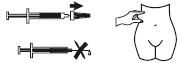
- Holding the pre-filled syringe in one hand, gently pinch the cleaned area of skin with the thumb and index finger of the other hand to form a skin fold.
- Insert the full length of the needle into the thick part of the skin fold at a 90° angle.
- Press the plunger while maintaining the skin fold throughout the injection.
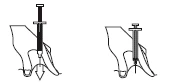
- Remove the needle by pulling it straight out vertically and release the skin fold.
- Do not rub the injection site. This helps prevent bruising.
- Do not recap the syringe. Dispose of it (needle pointing down) in a sharps container, close the container tightly, and place it out of the reach of children.
- If you feel the effect of the medicine is too strong (e.g. unexpected bleeding occurs) or too weak (no improvement), inform your doctor or pharmacist.
In some pack sizes, the filled syringe may be equipped with a safety system that should be activated after injection to reduce the risk of needle-stick injury.
For syringes with a safety system: Direct the needle away from yourself and others. Activate the safety system by firmly pressing the plunger. The protective shield will automatically cover the needle, and a clicking sound will confirm activation. Immediately dispose of the syringe into the nearest sharps container (needle pointing down), close the container tightly, and place it out of the reach of children.
Use of more than the recommended dose of Zibor
Taking too high a dose of this medicine may cause bleeding. If bleeding occurs, inform your doctor immediately or go to the nearest hospital with this leaflet.
Missed dose of Zibor
Do not use a double dose to make up for a missed dose. Contact your doctor as soon as possible.
Stopping Zibor treatment
Do not stop using Zibor without first consulting your doctor.
If you have any further questions about the use of this medicine, consult your doctor.
4. Possible adverse effects
Like all medicines, this medicine can cause adverse effects, although not everyone will experience them.
If any of the adverse effects listed below occur, stop using Zibor immediately and inform your doctor or nurse (or go immediately to the nearest hospital emergency department):
Common (may affect up to 1 in 10 patients):
- Bleeding complications, e.g. blood in urine and/or stool, which may lead to haemorrhagic anaemia.
Rare (may affect up to 1 in 1,000 patients):
- Significant decrease in platelet count (type II thrombocytopenia), leading to bruising, bleeding from the mouth, gums and nose, and skin rash.
- Dark, painful skin lesions at the injection site (skin necrosis).
- Spinal bleeding following epidural, intrathecal anaesthesia or lumbar puncture (back pain, sensation of loss of strength and feeling in the lower limbs, disturbances in bowel or bladder function), leading to neurological damage of varying severity, including transient or long-lasting paralysis.
- Severe allergic reactions (increased body temperature, chills, shortness of breath, laryngeal oedema, feeling of loss of consciousness, sweating, urticaria, itching, drop in blood pressure, hot flushes, skin eruptions, loss of consciousness, bronchospasm, laryngeal oedema).
Other adverse effects:
Very common (may affect more than 1 in 10 patients):
- Bruising, skin spots, itching and pain at the injection site.
Common (may affect up to 1 in 10 patients):
- Mild and transient increase in certain liver enzymes (aminotransferases), detectable in laboratory tests.
Uncommon (may affect up to 1 in 100 patients):
- Mild and transient decrease in platelet count (type I thrombocytopenia), detectable in laboratory tests.
- Mild skin allergic reactions: rash, urticaria, skin eruptions.
Frequency not known (cannot be estimated from available data):
- Increased blood potassium levels, detectable in laboratory tests.
Prolonged use of Zibor or of medicines with similar properties may lead to osteoporosis. The frequency of occurrence is unknown.
Reporting of adverse effects
If any adverse effects occur, including any adverse effects not listed in this leaflet, inform your doctor. Adverse effects can be reported directly to the Department of Monitoring Adverse Drug Reactions, Office for Registration of Medicinal Products, Medical Devices and Biocidal Products, Al. Jerozolimskie 181C, PL-02 222 Warsaw, Tel.: + 48 22 49 21 301, Fax: + 48 22 49 21 309, website: https://smz.ezdrowie.gov.pl
Adverse effects can also be reported to the marketing authorisation holder.
Reporting adverse effects helps to provide more information on the safety of the medicine.
5. How to store Zibor
Keep this medicine out of sight and reach of children.
Do not store above 30°C. Do not freeze.
Do not use this medicine if you notice:
- that the protective packaging has been opened.
- that the protective packaging has been damaged.
- that the contents of the ampoule-syringe are cloudy.
- that it contains small particles.
After opening the package containing the ampoule-syringe, Zibor must be used immediately.
Expiry date
Do not use this medicine after the expiry date stated on the carton after "Expiry date". The expiry date refers to the last day of the stated month.
Disposal
Single-dose container.
Used ampoule-syringes should be disposed of in a container for sharp waste.
Do not keep used ampoule-syringes.
Medicines must not be disposed of via wastewater or household waste. Ask your pharmacist how to dispose of medicines no longer in use. This will help protect the environment.
6. Contents of the packaging and other information
What Zibor contains
- The active substance is bemiparin sodium.
- The other ingredient is water for injections.
What Zibor looks like and contents of the pack
Zibor in pre-filled syringes is a colourless or slightly yellowish, clear solution, free from
particulate matter.
Zibor 2,500 IU is available in packages containing 2, 6, 10, 30 and 100 pre-filled syringes with 0.2 mL of solution for injection.
Not all pack sizes may be marketed.
Marketing Authorisation Holder and Manufacturer
Marketing Authorisation Holder
GINELADIUS, S.L.
Rufino González 50,
28037 Madrid, Spain
+(34) 91 375 62 30
Manufacturer
ROVI Pharma Industrial Services, S.A.
Julián Camarillo, 35
28037 Madrid, Spain
Laboratorios Farmacéuticos ROVI, S.A.
Julián Camarillo, 35
28037 Madrid, Spain
This medicinal product is authorised in the European Economic Area countries under the following names:
Phivor: Spain.
Ivor: Austria, Greece, Italy, Portugal.
Zibor: Czech Republic, Estonia, Hungary, Ireland, Latvia, Lithuania, Poland, Slovakia, Slovenia, United Kingdom.