Jodek sodium, na 131 i polatom for therapy
Poland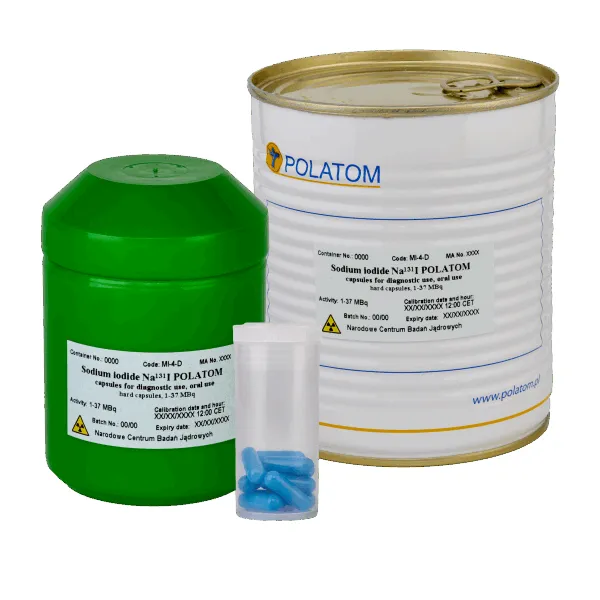
Table of Contents
Jodek sodu Na I POLATOM capsules for therapy, hard capsules,
activity from 37 to 5500 MBq
Sodium iodide (131I) capsules for therapeutic use
Please read the entire leaflet before using this medicine.
- Keep this leaflet, as you may need to read it again.
- If you have any further questions, please consult the nuclear medicine specialist physician managing your treatment.
- If you experience any adverse reactions, including any possible side effects not listed in this leaflet, inform your treating nuclear medicine specialist physician immediately.
Leaflet Contents:
What Jodek sodu Na I POLATOM capsules for therapy is and what it is used for
Important information before using Jodek sodu Na I POLATOM capsules for therapy
How to use Jodek sodu Na I POLATOM capsules for therapy
4. Possible side effects
5. How to store Jodek sodu Na I POLATOM capsules for therapy
6. Contents of the pack and other information
WHAT Jodek sodu Na I POLATOM CAPSULES FOR THERAPY IS AND WHAT IT IS USED FOR
Jodek sodu Na I POLATOM capsules for therapy is a medicinal product (radiopharmaceutical) intended exclusively for therapeutic use. The capsules contain varying amounts (activities) of radioactive sodium iodide and are administered orally for the treatment of thyroid disorders.
Jodek sodu Na I POLATOM is used in the treatment of benign thyroid diseases: nodular goitre without thyroid dysfunction, hyperthyroidism in Graves' disease and Basedow’s disease, solitary adenoma, and multinodular goitre. It is also used in the treatment of differentiated thyroid cancer: following surgical treatment to destroy residual thyroid tissue, to eliminate remaining cancer foci, and for the treatment of iodine-avid metastases of thyroid cancer.
Due to the presence of the radioactive isotope iodine-131, use of this medicine involves exposure to ionizing radiation. Your physician has determined that the benefits of the therapy outweigh the potential risks associated with ionizing radiation.
IMPORTANT INFORMATION BEFORE USING Jodek sodu Na I POLATOM CAPSULES FOR THERAPY
When not to use Jodek sodu Na I POLATOM capsules for therapy
Do not use this medicine:
- in women with confirmed or suspected pregnancy (or when pregnancy has not been excluded),
- in women who are breastfeeding,
- if the patient is allergic (hypersensitive) to the active substance or to any of the other ingredients of the medicine.
Warnings and precautions
Exercise extreme caution when administering Jodek sodu Na I POLATOM capsules for therapy to patients:
- with uncontrolled hyperthyroidism,
- with swallowing difficulties or gastrointestinal disorders causing regurgitation or vomiting (due to the risk of improper drug intake and radioactive contamination; consider administering iodine-131 in a pharmaceutical form other than capsules or by a route other than oral).
Due to the risk of radioactive contamination, exercise caution when treating patients who:
- may not comply with medical staff instructions,
- suffer from urinary incontinence.
Some patients receiving therapeutic doses of iodine-131 isotope may require hospitalization to comply with radiation protection regulations. Administration of radiopharmaceuticals poses a risk of external ionizing radiation exposure or contamination from urine, vomit, etc., to other individuals. Therefore, basic hygiene principles must be observed.
To reduce radiation dose absorbed by the urinary bladder, it is recommended to drink more fluids than usual (approximately 1–1.5 litres more per day) and to urinate frequently after administration of the medicine.
Low blood sodium levels have been observed in elderly patients following thyroidectomy. This is most likely to occur in women and in patients taking medications that increase water and sodium excretion in urine (diuretics such as hydrochlorothiazide). If the patient belongs to any of the above groups, the physician may recommend regular blood tests to monitor electrolyte concentrations (e.g. sodium).
Before administration of Jodek sodu Na I POLATOM capsules for therapy, the physician may recommend:
- a low-iodine diet (especially limiting intake of seafood),
- avoiding iodine-containing medications (e.g. iodine-containing vitamins, certain antiseptics, certain eye drops for cataracts, certain expectorants, amiodarone preparations, certain contrast agents used in radiological examinations),
- temporary discontinuation of thyroid hormones in the treatment of thyroid cancer to enhance iodine uptake by tumour tissue,
- discontinuation of antithyroid drugs (e.g. containing thiamazole or propylthiouracil) in the treatment of hyperthyroidism.
Jodek sodu Na I POLATOM capsules for therapy and other medicines
Inform your nuclear medicine specialist physician about all medicines currently taken or recently taken, including those available without prescription, as well as any medicines you plan to take.
Many substances interact with iodides, affecting protein binding mechanisms, their behaviour in the body, or modifying the effects of radioactive iodine. This necessitates that the physician review all medications taken by the patient and decide whether any should be discontinued prior to administration of sodium [131I] iodide.
Jodek sodu Na I POLATOM capsules for therapy with food and drink
Before treatment with sodium [131I] iodide, a low-iodine diet should be followed to increase iodine uptake by thyroid tissue. It is recommended that the patient remain fasting for approximately 2 hours before and after swallowing the capsule containing sodium [131I] iodide to ensure proper drug absorption.
Pregnancy and breastfeeding
Jodek sodu Na I POLATOM capsules for therapy must not be used in pregnant or breastfeeding women.
Before taking the medicine, inform the nuclear medicine specialist physician if:
- pregnancy is suspected,
- menstruation has not occurred at the expected time,
- the woman is breastfeeding.
In case of uncertainty, consultation with a nuclear medicine specialist physician managing the treatment is required. If the patient is pregnant, it is essential to inform the physician.
For both sexes, contraception is recommended for at least 4 months after treatment with sodium [131I] iodide.
If administration of sodium [131I] iodide is necessary in a breastfeeding woman, breastfeeding must be discontinued.
Driving and using machines
No data available.
Jodek sodu Na I POLATOM capsules for therapy contains sodium
The product contains 80 to 96 mg of sodium per capsule. This should be taken into account in patients on a low-sodium diet.
HOW TO USE Jodek sodu Na I POLATOM CAPSULES FOR THERAPY
There are strict regulations regarding the use, transfer, and disposal of radiopharmaceuticals. Jodek sodu Na I POLATOM capsules for therapy are administered only under appropriate clinical conditions and exclusively by appropriately qualified personnel. These individuals will take special precautions to ensure safe use of the product and will continuously monitor their actions.
Jodek sodu Na I POLATOM capsules for therapy is an oral medicinal product with varying levels of radioactive activity.
The therapeutic activity (dose) is determined by the nuclear medicine specialist physician and should be individually tailored for each patient. It will be the minimum dose necessary to achieve the desired therapeutic effect.
Depending on the type of disorder, the recommended radioactive activity of capsules is within the following ranges:
- Treatment of hyperthyroidism and euthyroid goitre: 200–800 MBq
- Ablation of thyroid tissue after surgery for thyroid cancer: 1850–3700 MBq
- Treatment of metastases of thyroid cancer: 3700–11,100 MBq
(MBq = megabecquerel – unit of radioactivity measurement)
Use in children
The use of Jodek sodu Na I POLATOM capsules for therapy in children must be carefully evaluated by a nuclear medicine specialist physician, taking into account clinical indications and risk-benefit assessment in this patient group. The therapeutic dose is calculated similarly to that in adults, but dose reduction may be considered depending on the child's age and body weight.
After administration of Jodek sodu Na I POLATOM capsules for therapy, the patient should:
- urinate frequently to eliminate residual radiopharmaceutical from the body,
- use contraception for at least 4 months after treatment, regardless of sex.
Administration of radiopharmaceuticals poses a risk of external ionizing radiation exposure or contamination from urine, vomit, sweat, etc., to other individuals. Therefore, after administration of sodium [131I] iodide, the patient should:
- avoid close contact with other people, especially young children and pregnant women, for the period recommended by the physician,
- carefully clean up any traces of urine, faeces, or sweat for the period recommended by the physician.
Use of a higher than recommended dose of the medicine
Overdose is almost impossible, as the dose administered to the patient is strictly controlled by the nuclear medicine specialist physician. The medicine is supplied in capsules of known activity, which facilitates precise dose control.
In the event of overdose, the physician may administer drugs blocking iodine-131 uptake by the thyroid gland, induce vomiting, and recommend increased fluid intake and frequent urination to eliminate residual radiopharmaceutical from the body.
If you have any further questions regarding the use of this medicine, please consult your nuclear medicine specialist physician.
4. POSSIBLE SIDE EFFECTS
Like all medicines, Jodek sodu Na I POLATOM capsules for therapy may cause side effects, although not everyone experiences them.
Early effects
Very common early adverse reactions (observed in more than 1 in 10 patients) occurring within hours or days after administration (especially at high doses) include: radiation-induced thyroiditis (manifesting as discomfort, less frequently severe neck pain; neck swelling), radiation-induced sialadenitis (usually presenting as swelling, discomfort, less frequently severe pain in the salivary gland area), dry mouth, nausea, vomiting, tracheal stenosis.
In patients treated for lung metastases of thyroid cancer (usually repeatedly, with high activities of iodine-131), radiation-induced pneumonitis or pulmonary fibrosis may occur.
Consider the possibility of local brain edema and/or worsening of existing cerebral edema in patients with metastases of thyroid cancer to the central nervous system.
Late effects
A very common (observed in more than 1 in 10 patients) late consequence of treatment with sodium [131I] iodide for benign thyroid diseases is hypothyroidism, requiring hormone replacement therapy.
All the adverse reactions listed below occur with unknown frequency, not estimable from available data.
In some patients, administration of radioactive iodine leads to increased blood levels of thyroid hormones (usually 7–10 days after treatment). In patients with poorly controlled thyroid function, this may lead to symptoms of hyperthyroidism (similar to the initial phase of thyroid disease); in extreme cases, life-threatening thyroid storm may occur. In a small proportion of patients with nodular goitre, administration of iodine-131 may induce symptoms of Graves' disease and Basedow’s disease.
Late effects also include reversible or, in very rare cases (in patients treated with high doses of iodine-131), irreversible impairment of bone marrow function. This may manifest as decreased platelet count and/or white blood cells, less frequently red blood cells.
A rare consequence of treatment with iodine-131 in patients with Graves' disease and Basedow’s disease (especially in smokers) may be worsening or onset of exophthalmos (thyroid eye disease).
Similarly rare, in patients treated with iodine-131 for thyroid nodules, immune-mediated thyroiditis may occur, usually transient but potentially causing hyperthyroidism requiring treatment.
Treatment of thyroid cancer with sodium [131I] iodide may cause transient (rarely permanent) impairment of fertility in women and men.
Administration of sodium [131I] iodide may lead to permanent damage to salivary glands, resulting in dry mouth, taste and smell disturbances (more frequently after repeated administration of iodine-131), less frequently permanent impairment of tear secretion (dry eye syndrome) or tear drainage from the conjunctiva (due to narrowing of tear ducts).
In a small number of patients after iodine-131 treatment, disturbances in parathyroid function have been observed – hyperparathyroidism or hypoparathyroidism.
Exposure to ionizing radiation may lead to increased risk of cancer (in cases of high activities of radioactive isotopes) or hereditary defects. Epidemiological data indicate increased incidence of stomach, bladder, breast cancer, and leukaemia in individuals treated with sodium [131I] iodide.
Reporting of side effects
If any adverse reactions occur, including any not listed in this leaflet, inform your physician or the nuclear medicine specialist managing your treatment.
Adverse reactions can be reported directly to the Department of Monitoring of Adverse Drug Reactions, Office for Registration of Medicinal Products, Medical Devices and Biocidal Products
Al. Jerozolimskie 181C
02-222 Warsaw
Tel.: +48 22 49 21 301
Fax: +48 22 49 21 309
e-mail: [email protected]
Adverse reactions can also be reported to the responsible entity.
Reporting side effects helps to gather more information on the safety of the medicine.
HOW TO STORE Jodek sodu Na I POLATOM CAPSULES FOR THERAPY
The patient will not be required to store this medicinal product.
Radiopharmaceuticals are stored exclusively by authorized personnel under appropriate conditions, in compliance with regulations for storage of radioactive substances.
The following information is intended for medical personnel only.
Do not use the product after the expiry date stated on the packaging.
6. CONTENTS OF THE PACKAGE AND OTHER INFORMATION
What Jodek sodu, Na 131 I POLATOM capsules for therapy contains
The active substance is sodium iodide I with activity ranging from 37 MBq to 5500 MBq.
- Other components are: Sodium carbonate, Sodium hydrogen carbonate, Disodium hydrogen phosphate dihydrate, Sodium thiosulfate pentahydrate, Hard gelatin capsule.
What Jodek sodu, Na 131 I POLATOM capsules for therapy look like and contents of the pack
The product is supplied as a capsule in a vial.
The polypropylene vial is sealed with a polypropylene stopper equipped with an iodine absorbent and placed in a lead shielding container. The package contains one capsule.
A polypropylene dispenser (type B) for administering the capsule and a radiopharmaceutical certificate are included with each package.
Marketing Authorisation Holder and Manufacturer
National Centre for Nuclear Research
Andrzeja Sołtana 7
05-400 Otwock
Phone: +48 22 7180700
Fax: +48 22 7180350
e-mail: [email protected]
For further information, please contact your doctor or representative of the Marketing Authorisation Holder.
Information intended exclusively for medical professionals.
Administration procedure for the capsule using type B applicator:
- Check the radioactivity and calibration date indicated on the outer packaging.
- Remove the metal can from the cardboard box and tear off its top lid.
- Remove the upper part of the polystyrene insert.
- Remove the shielded container with the capsule.
- Tear open the paper–foil packaging of the applicator and then remove the applicator.
- Open the shielded container with the capsule. To do so, unscrew the container's cap while holding its lower part. The vial with the capsule should remain inside the shielded container.
- Connect the vial to the applicator. To do so, screw the applicator into the vial containing the capsule.
- During administration of the capsule, it is recommended that the vial containing the capsule, connected to the applicator, remains inside the shielded container. The patient, holding the shielded container in hand, places the upper part of the applicator into the mouth and then tilts it so that the capsule drops from the applicator into the mouth. In special cases, administration of the capsule without the shielded container is possible. In such a case, the patient grasps the applicator, removes the vial containing the capsule from the shielded container, places the upper part of the applicator into the mouth, and then tilts it so that the capsule drops from the applicator into the mouth.
- After administration, the applicator together with the vial should be disposed of as radioactive waste. The shielded container should be returned to the manufacturer.
If it is necessary to disconnect the vial from the applicator, place the vial together with the applicator into the shielded container, then, holding the container with one hand, unscrew the applicator from the vial.
To perform an activity measurement of the capsule, insert the upper part of the applicator into the holder of the activity meter, then remove the applicator connected to the vial containing the capsule. Place the entire assembly into the activity meter. After completing the measurement, place the vial together with the applicator back into the shielded container. If it is necessary to transfer the capsule to another room after measurement, disconnect the applicator from the vial as described in point 9 above. After disconnecting the applicator, cover the container with its cap.
Any unused remnants of the medicinal product or its waste must be disposed of in accordance with local regulations.
Sodium Iodide Na I POLATOM capsules for therapy, hard capsules,
activity from 37 to 5500 MBq
Natrii iodidi (¹³¹I) capsulae ad usum therapeuticum
Please read the package leaflet carefully before use, as it contains important information for the patient.
- Keep this leaflet for future reference.
- If you have any further questions, consult the nuclear medicine specialist supervising the treatment.
- If the patient experiences any adverse reactions, including any possible adverse reactions not listed in this leaflet, inform the supervising nuclear medicine specialist immediately.
Contents of the leaflet:
What Sodium Iodide Na I POLATOM capsules for therapy are and what they are used for
Important information before using Sodium Iodide Na I POLATOM capsules for therapy
How to use Sodium Iodide Na I POLATOM capsules for therapy
4. Possible side effects
5. How to store Sodium Iodide Na I POLATOM capsules for therapy
6. Contents of the pack and other information
WHAT SODIUM IODIDE NA I POLATOM CAPSULES FOR THERAPY ARE AND WHAT THEY ARE USED FOR
Sodium Iodide Na I POLATOM capsules for therapy is a medicinal product (radiopharmaceutical) intended exclusively for therapeutic use. The capsules contain varying amounts (activities) of radioactive sodium iodide and are administered orally for the treatment of thyroid disorders.
Sodium Iodide Na I is used in the treatment of benign thyroid diseases: non-toxic nodular goiter without thyroid dysfunction, hyperthyroidism in Graves' disease, solitary adenoma, and multinodular goiter. It is also used in the treatment of differentiated thyroid cancer: following surgical treatment to destroy residual thyroid tissue, to eliminate remaining cancer foci, and for the treatment of iodine-avid metastases of thyroid cancer.
Due to the presence of the radioactive isotope iodine-131, use of this medicinal product involves exposure to ionizing radiation. The physician has determined that the benefits of the therapy outweigh the potential risks associated with ionizing radiation.
IMPORTANT INFORMATION BEFORE USING SODIUM IODIDE NA I POLATOM CAPSULES FOR THERAPY
When not to use Sodium Iodide Na I POLATOM capsules for therapy
The medicinal product must not be used:
- in women with confirmed or suspected pregnancy (or when pregnancy has not been excluded),
- in breastfeeding women,
- if the patient is allergic (hypersensitive) to the active substance or to any of the other components of the product.
Warnings and precautions
Extreme caution should be exercised when using Sodium Iodide Na I POLATOM capsules for therapy in patients:
- with uncontrolled hyperthyroidism, swallowing disorders, or gastrointestinal diseases causing regurgitation or vomiting (due to the risk of improper drug intake and radioactive contamination; consider administering iodine-131 in a different pharmaceutical form or by a different route than oral). Due to the risk of radioactive contamination, caution is required when treating patients with radioactive iodine who:
- may not comply with medical staff instructions or who have urinary incontinence.
Some patients receiving therapeutic activities of iodine-131 isotope may require hospitalization due to the necessity of complying with radiation protection regulations.
Administration of medicinal products containing radioactive isotopes poses a risk of exposure to external ionizing radiation or contamination from urine stains, vomit, etc., to other individuals. Therefore, basic hygiene principles must be observed.
To reduce the radiation dose absorbed by the urinary bladder, it is recommended to drink slightly more fluids than usual (approximately 1–1.5 liters more per day) and to urinate more frequently after administration of the medicinal product.
Low blood sodium concentration has been observed in elderly patients after thyroidectomy. This phenomenon is most likely to occur in women and in patients taking drugs that increase water and sodium excretion in urine (diuretics such as hydrochlorothiazide). If the patient belongs to any of the above groups, the physician may recommend regular blood tests to determine electrolyte concentrations (e.g., sodium) in blood.
Before administering Sodium Iodide Na I POLATOM capsules for therapy, the physician may recommend:
- a low-iodine diet (especially limiting consumption of seafood), and avoiding iodine-containing medications (e.g., iodine-containing vitamins, certain antiseptics, certain medications for cataracts, certain expectorants, amiodarone preparations, certain contrast agents used in radiological examinations),
- in the case of thyroid cancer treatment, temporary discontinuation of thyroid hormones to increase iodine uptake by tumor tissue,
- in the case of hyperthyroidism treatment, discontinuation of antithyroid drugs, e.g., those containing thiamazole or propylthiouracil.
Sodium Iodide Na I POLATOM capsules for therapy and other medicinal products
Inform the nuclear medicine specialist about all medicinal products currently used or recently used, including those available without prescription, as well as any medicinal products the patient plans to use.
Many substances interact with iodides in various ways. They affect protein binding mechanisms of iodides, their behavior in the body, or modify the effects of radioactive iodine. This necessitates the physician reviewing all medicinal products taken by the patient and deciding whether certain medicinal products should be discontinued before administering sodium iodide [¹³¹I].
Sodium Iodide Na I POLATOM capsules for therapy with food and drink
Before treatment with sodium iodide [¹³¹I], a low-iodine diet should be followed to increase iodine uptake by thyroid tissue. It is recommended that the patient remain fasting for approximately 2 hours before and after swallowing the capsule containing sodium iodide [¹³¹I] to ensure proper absorption of the medicinal product.
Pregnancy and breastfeeding
Sodium Iodide Na I POLATOM capsules for therapy must not be used in pregnant women or women who are breastfeeding.
Before taking the medicinal product, inform the nuclear medicine specialist if:
- there is suspicion of pregnancy,
- menstruation has not occurred at the expected time,
- the woman is breastfeeding. In case of doubt, consultation with a nuclear medicine specialist who will supervise the treatment is necessary. If the patient is pregnant, it is important to inform the physician.
For both sexes, contraception is recommended for at least 4 months after treatment with sodium iodide [¹³¹I].
If sodium iodide [¹³¹I] must be used in a breastfeeding woman, breastfeeding must be discontinued.
Driving and operating machinery
No data available.
Sodium Iodide Na I POLATOM capsules for therapy contain sodium
The product contains 80 to 96 mg of sodium per capsule. This should be taken into account in patients on a low-sodium diet.
HOW TO USE SODIUM IODIDE NA I POLATOM CAPSULES FOR THERAPY
There are strict regulations regarding the use, transfer, and disposal of radiopharmaceuticals. Sodium Iodide Na I POLATOM capsules for therapy are administered exclusively under appropriate clinical conditions and only by appropriately qualified personnel. These individuals take special precautions to ensure safe use of the product and will continuously monitor their actions.
Sodium Iodide Na I POLATOM capsules for therapy are intended for oral administration in doses of varying radioactive activity.
The therapeutic activity (dose) is determined by the nuclear medicine specialist. This activity should be individually tailored for each patient. It will be the minimum dose necessary to achieve the expected therapeutic effect.
Depending on the type of disorder, the recommended radioactive activity of capsules is in the range:
- Treatment of hyperthyroidism and non-toxic goiter: 200 – 800 MBq
- Ablation of thyroid tissue after surgery due to thyroid cancer: 1850 – 3700 MBq
- Treatment of thyroid cancer metastases: 3700 – 11 100 MBq (MBq = megabecquerel – unit of radioactivity measurement)
Use in children
The use of Sodium Iodide Na I POLATOM capsules for therapy in children must be carefully evaluated by a nuclear medicine specialist, taking into account clinical indications and risk-benefit assessment in this patient group. The therapeutic dose is calculated similarly to that in adults, but dose reduction may be considered depending on the child's age and body weight.
After administration of Sodium Iodide Na I POLATOM capsules for therapy, the patient should:
- urinate frequently to eliminate residual radiopharmaceutical from the body,
- use contraception for at least 4 months after treatment, regardless of sex.
Administration of medicinal products containing radioactive isotopes poses a risk of exposure to external ionizing radiation or contamination from isotopes present in urine stains, vomit, sweat, etc., to other individuals. Therefore, after administration of sodium iodide Na I, the following should be observed:
- avoid close contact with other individuals, especially young children and pregnant women, for the period recommended by the physician,
- carefully clean up residues of urine, feces, and sweat for the period recommended by the physician.
Use of a higher than recommended dose of the medicinal product
Overdose is almost impossible because the dose administered to the patient is strictly controlled by the nuclear medicine specialist.
The medicinal product is supplied in capsules of known activity, which facilitates dose control by the physician.
In case of overdose, the physician may administer drugs blocking the accumulation of iodine-131 in the thyroid gland or induce vomiting, and recommend increased fluid intake and frequent urination to eliminate residual radiopharmaceutical from the body.
If you have any further doubts regarding the use of the medicinal product, consult the nuclear medicine specialist.
4. POSSIBLE ADVERSE REACTIONS
Like all medicinal products, Sodium Iodide Na I POLATOM capsules for therapy may cause adverse reactions, although not everyone experiences them.
Early effects
Very common early adverse reactions (occurring in more than 1 in 10 patients) occurring within the first hours or days after administration (especially after high doses) include: radiation-induced thyroiditis (manifesting as discomfort, less frequently as severe neck pain; neck swelling), radiation-induced sialadenitis (usually manifesting as swelling, discomfort, less frequently as severe pain in the salivary gland area), dry mouth, nausea, vomiting, tracheal constriction.
In patients treated for lung metastases of thyroid cancer (usually repeatedly, with high activities of iodine-131), radiation-induced pneumonitis or pulmonary fibrosis may occur.
Local brain edema and/or worsening of existing brain edema should be considered in patients with metastases of thyroid cancer to the central nervous system.
Late effects
A very common (occurring in more than 1 in 10 patients) late consequence of treatment with sodium iodide [¹³¹I] for benign thyroid diseases is hypothyroidism, requiring hormone replacement therapy.
All adverse reactions listed below occur with unknown frequency, not estimable from available data.
In some patients, after administration of radioactive iodine, an increase in thyroid hormone concentration in blood may occur (usually 7–10 days after treatment). In patients with poorly controlled thyroid function, this may lead to symptoms of hyperthyroidism (similar to the onset of thyroid disease); in extreme cases, life-threatening thyroid storm may occur. In a small proportion of patients with nodular goiter, administration of iodine-131 may induce symptoms of Graves' disease.
Late effects also include reversible or, in very rare cases (in patients treated with high doses of iodine-131), irreversible impairment of bone marrow function. This may manifest as decreased platelet count and/or white blood cells, less frequently red blood cells.
A rare consequence of treatment with iodine-131 in patients with Graves' disease (especially smokers) may be worsening or onset of exophthalmos (thyroid eye disease). Similarly, rarely, in patients treated with iodine-131 for thyroid nodules, immune-mediated thyroiditis may occur, usually transient, but potentially causing hyperthyroidism requiring treatment.
Treatment of thyroid cancer with sodium iodide [¹³¹I] may cause transient (exceptionally permanent) impairment of fertility in women and men.
Administration of sodium iodide [¹³¹I] may lead to permanent damage to salivary glands, causing dry mouth, taste and smell disturbances (more frequently after repeated administration of iodine-131), less frequently permanent impairment of tear secretion (dry eye syndrome) or tear drainage from the conjunctiva (due to narrowing of tear ducts).
In a small number of patients, after treatment with iodine-131, disturbances in parathyroid function—hyperparathyroidism or hypoparathyroidism—have occurred.
Exposure to ionizing radiation may lead to increased incidence of cancers (in cases of high activities of radioactive isotopes) or to the development of hereditary defects. Epidemiological data indicate increased incidence of stomach cancer, bladder cancer, breast cancer, and leukemias in individuals treated with sodium iodide [¹³¹I].
Reporting of adverse reactions
If any adverse reactions occur, including any not listed in this leaflet, inform the physician or the nuclear medicine specialist supervising the treatment. Adverse reactions can be reported directly to the Department of Monitoring Adverse Drug Reactions, Office for Registration of Medicinal Products, Medical Devices and Biocidal Products
Al. Jerozolimskie 181C
02-222 Warsaw
Tel.: +48 22 49 21 301
Fax: +48 22 49 21 309
e-mail: [email protected]
Adverse reactions can also be reported to the marketing authorization holder.
Reporting adverse reactions helps to gather more information on the safety of the medicinal product.
HOW TO STORE SODIUM IODIDE NA I POLATOM CAPSULES FOR THERAPY
The patient will not need to store this medicinal product.
Radiopharmaceuticals are stored exclusively by authorized personnel under appropriate conditions. Storage of radiopharmaceuticals complies with regulations for storage of radioactive substances.
The following information is intended exclusively for medical personnel.
Do not use the product after the expiry date stated on the packaging.
6. CONTENTS OF THE PACK AND OTHER INFORMATION
What Sodium Iodide Na I POLATOM capsules for therapy contain
The active substance is sodium iodide I with activity from 37 MBq to 5500 MBq.
- Other components: Sodium carbonate, Sodium bicarbonate, Disodium hydrogen phosphate dihydrate, Sodium thiosulfate pentahydrate, Hard gelatin capsule.
What Sodium Iodide Na I POLATOM capsules for therapy look like and contents of the pack
The product is supplied as a capsule in a vial.
The polyethylene vial is closed with a polyethylene stopper equipped with an iodine absorbent and placed in a lead shielded container. The pack contains one capsule.
Each pack includes a polypropylene applicator (type A) for capsule administration and a radiopharmaceutical certificate.
Marketing Authorization Holder and Manufacturer
National Centre for Nuclear Research
Andrzeja Sołtana 7
05-400 Otwock
Tel.: 22 7180700
Fax: 22 7180350
e-mail: [email protected]
For more detailed information, contact the physician or representative of the marketing authorization holder.
Information intended exclusively for medical professionals.
Procedure for administering the capsule using type A applicator:
- Check the radioactivity and the calibration date indicated on the outer packaging.
- Remove the metal can from the cardboard box and tear off its upper lid.
- Remove the upper part of the polystyrene insert.
- Remove the shield container with the capsule.
- Tear open the paper–foil packaging of the applicator, then remove the applicator.
- Open the shield container with the capsule. To do this, unscrew the container's cap while holding its lower part. The vial with the capsule should remain inside the shield container.
- Connect the vial to the applicator. To do this, press the applicator into the vial containing the capsule.
- During capsule administration, it is recommended that the vial containing the capsule, connected to the applicator, remains placed inside the shield container. The patient, holding the shield container in hand, places the upper part of the applicator into the mouth and then tilts it so that the capsule drops from the applicator into the mouth. In special cases, administration of the capsule without the shield container is possible. In such a case, the patient grasps the applicator, removes the vial containing the capsule from the shield container, places the upper part of the applicator into the mouth, and then tilts it so that the capsule drops from the applicator into the mouth.
- After capsule administration, dispose of the applicator together with the vial as radioactive waste. Return the shield container to the manufacturer.
If it is necessary to disconnect the vial from the applicator, place the vial together with the applicator into the shield container, then, holding the container with one hand, tilt the applicator sideways to disconnect the two parts.
To perform an activity measurement of the capsule, place the upper part of the applicator into the activity meter holder, then remove the applicator connected to the vial containing the capsule. Place the entire assembly into the activity meter. After completing the measurement, place the vial together with the applicator back into the shield container. If it is necessary to transfer the capsule to another room after measurement, disconnect the applicator from the vial as described above. After disconnection, cover the container with its cap.
Any unused portions of the medicinal product or waste materials must be disposed of in accordance with local regulations.