Xalatan
Poland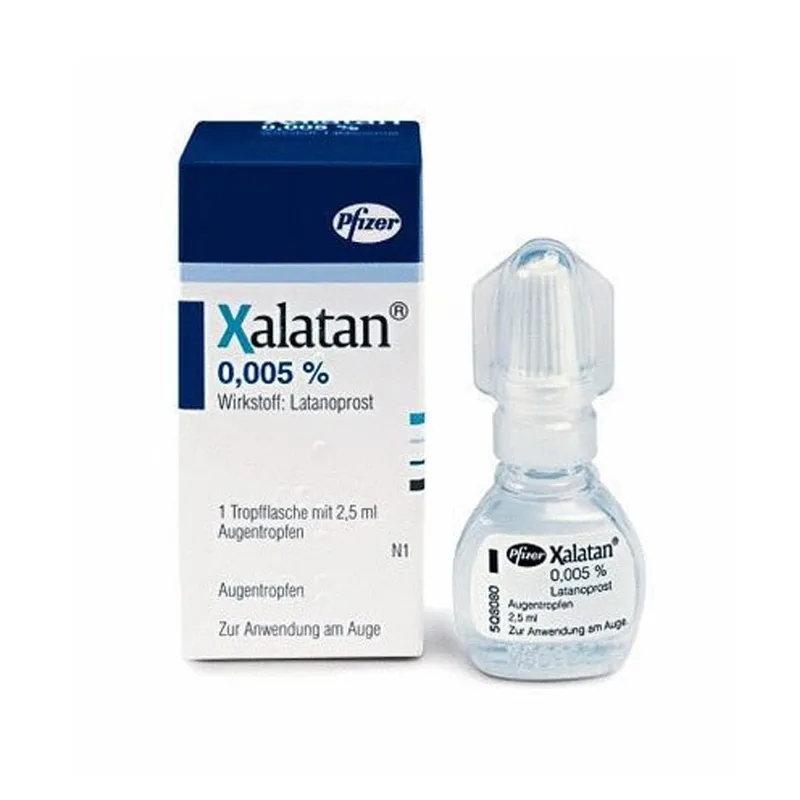
Table of Contents
Patient Information Leaflet
Xalatan, 50 μg/ml, eye drops, solution
Latanoprost
Please read all of this leaflet carefully before using this medicine, as it contains important information for you.
- Keep this leaflet, as you may need to read it again.
- If you have any further questions, please ask your doctor or pharmacist.
- This medicine has been prescribed for you personally. Do not pass it on to others. It may harm them, even if their symptoms are the same as yours.
- If you experience any side effects, including any not listed in this leaflet, tell your doctor or pharmacist. See section 4.
Contents of the leaflet
- What Xalatan is and what it is used for
- Important information before using Xalatan
- How to use Xalatan
- Possible side effects
- How to store Xalatan
- Contents of the pack and other information
1. What Xalatan is and what it is used for
Xalatan belongs to a group of medicines known as prostaglandin analogues. Xalatan works by increasing the natural outflow of aqueous humour from the eye into the bloodstream.
Xalatan is used in adults to treat open-angle glaucoma and to treat elevated intraocular pressure. Both conditions are associated with increased intraocular pressure and can affect vision.
Xalatan may also be used in children of any age to treat elevated intraocular pressure and glaucoma.
2. Important information before using Xalatan
Xalatan can be used in adult women and men (including elderly patients)
as well as in children from birth up to 18 years of age. Xalatan has not been studied in preterm newborns
(born before completion of 36 weeks of gestation).
When not to use Xalatan:
- if the patient is allergic (hypersensitive) to latanoprost or any of the other ingredients of this medicine (listed in section 6),
Warnings and precautions
If any of the following situations apply to the adult or child, discuss them with the treating physician or pharmacist before starting Xalatan:
- if the adult or child has undergone eye surgery (including cataract surgery), or such surgery is planned,
- if the adult or child has eye problems (such as eye pain, irritation or eye inflammation, blurred vision),
- if the adult or child has dry eyes,
- if the adult or child has severe or uncontrolled asthma,
- if the adult or child wears contact lenses. Xalatan may still be used, but follow the instructions for people wearing contact lenses (see section 3),
- if the adult or child has had or currently has a viral eye infection caused by herpes simplex virus (HSV).
Xalatan and other medicines
Xalatan may interact with other medicines. Inform your doctor or pharmacist about all medicines (including eye drops) currently used or recently used by the adult or child, including those obtained without a prescription, as well as any medicines the patient plans to take. In particular, consult your doctor or pharmacist if the patient is using prostaglandins, prostaglandin analogues, or prostaglandin derivatives.
Pregnancy and breastfeeding
Xalatan should not be used during pregnancy or breastfeeding unless the physician decides it is necessary.
If the patient is pregnant or breastfeeding, suspects she may be pregnant, or is planning to become pregnant, she should consult her doctor before using this medicine.
Driving and operating machinery
After using Xalatan, a short period of blurred vision may occur. In such a case, do not drive or operate machinery until vision returns to normal.
Xalatan contains benzalkonium chloride and phosphate buffers
The medicine contains 0.2 mg of benzalkonium chloride per millilitre.
Benzalkonium chloride may be absorbed by soft contact lenses and may change their colour. Contact lenses should be removed before instilling the drops and at least 15 minutes should elapse before reinserting them.
Benzalkonium chloride may also cause eye irritation, especially in patients with dry eye syndrome or corneal disorders (the transparent layer at the front of the eye). If abnormal eye sensations, stinging, or eye pain occur after using the medicine, contact your doctor.
The medicine contains 6.3 mg of phosphates per millilitre, equivalent to 0.2 mg per drop.
In patients with severe damage to the transparent front part of the eye (cornea), phosphates may very rarely cause corneal calcification and clouding during treatment.
3. How to use Xalatan
This medicine should always be used exactly as prescribed by the doctor treating the adult or
child. If in doubt, consult the doctor treating the adult or child,
or a pharmacist.
The recommended dose for adults (including elderly patients) and children is 1 drop in the affected eye (eyes) once daily, preferably in the evening.
It is not recommended to use Xalatan more than once daily, as this may reduce the effectiveness of treatment.
Xalatan should always be used for as long as prescribed by the treating doctor for the adult or child.
Contact lens use
Before administering Xalatan to the eye of an adult or child, contact lenses must be removed.
Contact lenses may be reinserted 15 minutes after using Xalatan.
Instructions for using Xalatan
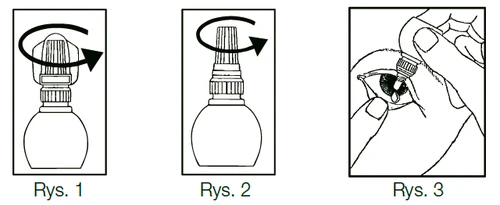
- Wash your hands and stand or sit comfortably.
- Unscrew the safety ring (which can be discarded) (Fig. 1).
- Unscrew the protective cap (Fig. 2) and keep it.
- Gently pull down the lower eyelid of the affected eye with a finger (Fig. 3).
- Place the tip of the dropper close to the eye. Do not touch the eye with the dropper tip.
- Gently squeeze the bottle so that one drop falls into the eye. Then release the lower eyelid.
- Close the eye and press with a finger on the inner corner of the eye near the nose, holding for 1 minute.
- Repeat the steps for the other eye, if instructed by the doctor.
- Close the bottle using the protective cap.
Using Xalatan with other eye drops
If other eye drops are being used, they should be administered at least 5 minutes apart from Xalatan.
Accidental overdose of Xalatan
If more drops than recommended are administered, mild eye irritation with tearing and redness may occur. These symptoms should resolve on their own, but if the patient is concerned, they should contact their doctor for advice.
If Xalatan is accidentally ingested by an adult or child, seek immediate medical advice from a doctor.
Missed dose of Xalatan
If a dose is missed, apply the next dose at the scheduled time. Do not use a double dose to make up for a missed dose. If in doubt, consult a doctor or pharmacist.
Stopping Xalatan treatment
If the patient wishes to stop using Xalatan, they should consult their doctor. If there are any further doubts regarding the use of this medicine, consult the doctor treating the adult or child, or a pharmacist.
4. Possible side effects
Like all medicines, this medicine can cause side effects, although not everybody experiences them.
Known side effects occurring after administration of Xalatan:
Very common (may occur in more than 1 in 10 people):
- Gradual change in eye colour due to increased amount of brown pigment in the coloured part of the eye, known as the iris. These changes are more noticeable in patients with mixed-coloured eyes (blue-brown, grey-brown, yellow-brown or green-brown) than in patients with uniformly coloured eyes (blue, grey, green or brown). Any changes in eye colour may develop over several years, although they are normally observed within 8 months of treatment. The change in eye colour may be permanent and may be more noticeable if Xalatan is used in only one eye. The change in eye colour does not appear to be associated with any problems. After stopping Xalatan, the change in eye colour does not progress.
- Redness of the eye.
- Eye irritation (a burning, gritty, itchy, stinging or foreign body sensation in the eye). If eye irritation occurs that is severe enough to cause excessive tearing or a desire to discontinue the medicine, consult your doctor, pharmacist or nurse immediately (within one week). Re-evaluation of treatment may be necessary to ensure appropriate management for the patient.
- Gradual change in the appearance of eyelashes and surrounding hair of the treated eye, particularly in individuals of Japanese origin. These changes include darkening, lengthening, thickening and increased number of eyelashes.
Common (may occur in no more than 1 in 10 people):
- Irritation or defects on the surface of the eye, inflammation of the eyelid margins, eye pain, light sensitivity (photophobia), inflammation of the conjunctiva.
Uncommon (may occur in no more than 1 in 100 people):
- Swelling of the eyelids, dry eye, infections or irritation of the eye surface (keratitis), blurred vision, inflammation of the coloured part of the eye (uveitis), retinal swelling (macular oedema).
- Rash.
- Chest pain (angina), sensation of rapid or irregular heartbeat (palpitations).
- Asthma, shortness of breath (dyspnoea).
- Chest pain.
- Headache, dizziness.
- Muscle pain, joint pain.
- Nausea.
- Vomiting.
Rare (may occur in no more than 1 in 1,000 people):
- Iritis, symptomatic swelling or defects/damage on the surface of the eye, swelling around the eye (periorbital oedema), changes in the direction of eyelash growth or development of an extra row of eyelashes, scarring on the surface of the eye, formation of fluid-filled areas in the coloured part of the eye (iris cysts).
- Local skin reactions on the eyelids, darkening of the eyelid skin.
- Worsening of asthma.
- Acute itching of the skin.
- Viral eye infections caused by herpes simplex virus (HSV).
Very rare (may occur in no more than 1 in 10,000 people):
- Worsening of angina in patients with heart disease, sensation of sunken eyes.
Cold and fever are side effects occurring more frequently in children and adolescents than in adults.
In very rare cases, in some patients with significantly damaged transparent membrane covering the front part of the eyeball (cornea), corneal deposits of calcium have occurred during treatment, leading to corneal spots.
Reporting of side effects
If any side effects occur, including any not listed in this leaflet, inform your doctor, pharmacist or nurse. Side effects can be reported directly to the Department of Monitoring Adverse Drug Reactions of the Office for Registration of Medicinal Products, Medical Devices and Biocidal Products
Al. Jerozolimskie 181C
02-222 Warszawa
Tel: +48 22 49 21 301
Fax: +48 22 49 21 309
Website: https://smz.ezdrowie.gov.pl
Side effects can also be reported to the marketing authorisation holder or its representative.
Reporting side effects helps provide more information on the safety of this medicine.
5. How to store Xalatan
Keep this medicine out of sight and reach of children.
Do not use this medicine after the expiry date stated on the label following: EXP. The expiry date refers to the last day of the stated month.
Store the bottle in the outer packaging to protect it from light.
Store the medicine at a temperature below 25°C. The shelf life after first opening the bottle is 4 weeks.
After using Xalatan, the bottle should be stored in the outer packaging to protect it from light.
Medicines must not be disposed of via wastewater or household waste. Ask your pharmacist how to dispose of medicines no longer required. This will help protect the environment.
6. Contents of the pack and other information
What Xalatan contains
- The active substance is: latanoprost. 1 ml of solution contains 50 micrograms of latanoprost.
- Other ingredients are: sodium chloride, benzalkonium chloride (0,2 mg/ml), monosodium dihydrogen phosphate monohydrate, disodium hydrogen phosphate anhydrous, water for injections.
One drop contains approximately 1.5 micrograms of latanoprost.
What Xalatan looks like and contents of the pack
Xalatan eye drops are a clear, colourless solution.
Pack contents:
Bottle (5 ml), dropper, white screw cap, transparent polyethylene protective cap,
in a cardboard box.
Each bottle contains 2.5 ml of eye drop solution, equivalent to approximately 80 drops.
The drops are available in packs containing 1 bottle of 2.5 ml and in packs containing 3 bottles of 2.5 ml.
Marketing Authorisation Holder:
Viatris Healthcare Limited
Damastown Industrial Park
Mulhuddart
Dublin 15
DUBLIN
Ireland
Manufacturer:
Pfizer Manufacturing Belgium NV
Rijksweg 12
2870 Puurs-Sint-Amands
Belgium
For more detailed information, please contact the Marketing Authorisation Holder's representative:
Viatris Healthcare Sp. z o.o.
tel. 22 546 64 00