Vividrin
Poland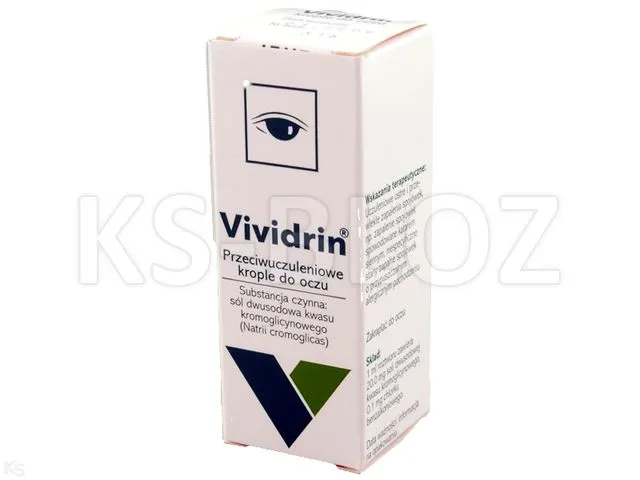
Table of Contents
- Patient Information Leaflet: Read this leaflet carefully before using the medicine, as it contains important information for you.
- 1. What Vividrin is and what it is used for
- 2. Important information before using Vividrin
- 3. How to use Vividrin
- 4. Possible adverse reactions
- 5. How to store Vividrin
- 6. Contents of the pack and other information
Patient Information Leaflet: Read this leaflet carefully before using the medicine, as it contains important information for you.
Vividrin
20 mg/ml, eye drops, solution
(Natrii cromoglicas)
You should always use this medicine exactly as described in this patient leaflet or as directed by your doctor or pharmacist.
- Keep this leaflet, so that you can read it again if necessary.
- If you need advice or further information, please consult your pharmacist.
- If you experience any adverse reactions, including any possible side effects not listed in this leaflet, inform your doctor or pharmacist. See section 4.
- If your symptoms do not improve or if you feel worse, consult your doctor.
Table of Contents
- What Vividrin is and what it is used for
- Important information before using Vividrin
- How to use Vividrin
- Possible side effects
- How to store Vividrin
- Contents of the pack and other information
1. What Vividrin is and what it is used for
The active substance in Vividrin is disodium cromoglicate.
Vividrin is indicated for the treatment of:
acute and chronic allergic conjunctivitis, such as conjunctivitis due to hay fever, or non-specific inflammatory conditions of the conjunctiva suspected to be of allergic origin.
2. Important information before using Vividrin
When not to use Vividrin
- if the patient is hypersensitive to sodium cromoglicate or to any of the excipients (listed in section 6).
Warnings and precautions
Before starting to use Vividrin, discuss this with your doctor or pharmacist.
Vividrin must not be injected into the eyes.
Do not exceed the recommended frequency of use of Vividrin.
If there is no improvement or symptoms persist, the patient should seek medical advice.
Contact lens wear
Patients who wear contact lenses should discontinue their use during episodes of vernal keratoconjunctivitis, vernal conjunctivitis, or vernal keratitis.
Contact lenses must not be worn during treatment with Vividrin.
Vividrin contains benzalkonium chloride. Further information—see below.
Vividrin and other medicines
Inform your doctor or pharmacist about all medicines currently used, recently used, or planned to be used.
If other eye medications are used, a 15-minute interval should be maintained between the application of each product. Ophthalmic ointments should be applied last.
Pregnancy, breastfeeding and fertility
If the patient is pregnant, breastfeeding, suspects she may be pregnant, or is planning to have a child, she should consult her doctor or pharmacist before using this medicine.
Pregnancy
Women who are pregnant may use Vividrin only if considered necessary by a physician.
Breastfeeding
It is unknown whether sodium cromoglicate is excreted in human milk. Use of Vividrin in breastfeeding women is not recommended unless otherwise advised by a physician.
Fertility
There is no data available on the effect of the drug on human fertility.
Animal studies have not shown any adverse effects of sodium cromoglicate on fertility.
Driving and operating machinery:
Immediately after instillation, Vividrin may cause transient (lasting several minutes) disturbances in visual acuity, such as blurred or hazy vision. Until these disturbances resolve, the patient should not drive or operate machinery.
This medicine contains 0.00306 mg of benzalkonium chloride per drop (0.0306 ml), equivalent to 0.1 mg/ml.
Benzalkonium chloride may be absorbed by soft contact lenses and may alter their color. Contact lenses must be removed before instillation, and at least 15 minutes should elapse before reinsertion.
Benzalkonium chloride may also cause eye irritation, particularly in patients with dry eye syndrome or corneal disorders (the transparent layer at the front of the eye). If abnormal sensations, stinging, or eye pain occur after using the medicine, contact your doctor.
This medicine contains polysorbate 80 (E 433) and sorbitol (E 420)
This medicine contains 0.00306 mg of polysorbate 80 per drop (0.0306 ml), equivalent to 0.1 mg/ml.
Polysorbates may cause allergic reactions. Inform your doctor if the patient has a history of allergic reactions.
This medicine contains 1.1628 mg of sorbitol per drop (0.0306 ml), equivalent to 38 mg/ml.
3. How to use Vividrin
This medicine should always be used exactly as described in this patient leaflet or as directed by your doctor or pharmacist. If in doubt, consult your doctor or pharmacist.
Recommended dose
Instill the drops into the conjunctival sac.
Unless otherwise directed, the recommended dose for adults and children is 1 drop in the conjunctival sac of each eye up to 4 times daily.
Do not touch the eye or any other surface with the dropper tip,
as this may contaminate the solution inside the bottle. Using contaminated drops may lead to serious eye damage, including loss of vision.
After symptoms have subsided, continue treatment for as long as the patient remains exposed to allergens (pollen, dust, mold spores, food allergens). The therapeutic effect should be regularly assessed by a doctor. Once symptoms have stabilized, the dose may be reduced.
If you feel that the effect of Vividrin is too strong or too weak, consult your doctor or pharmacist.
Instructions for use
- Wash your hands thoroughly.
- Remove the cap from the bottle.
- Hold the bottle upside down, using your thumb and index finger.
- Tilt your head backward.
- With the index finger of your other hand, gently pull down the lower eyelid to create a "pocket" between the eyeball and the eyelid, into which the drop will be instilled.
- Bring the dropper tip close to the eye, without touching the dropper to the eye, eyelid, surrounding area, or any other surface.
- Gently squeeze the bottle to release a single drop.
- Look upward and instill 1 drop into the formed "pocket." If the drop misses the eye, repeat the procedure.
- Close the eyelid and press with a finger on the inner corner of the eye at the bridge of the nose for 1 minute. This helps minimize the risk of the medicine entering the systemic circulation.
- If drops are to be administered to both eyes, repeat the above steps for the second eye.
- Immediately after use, close the bottle tightly.
Assistance from another person or use of a mirror may facilitate administration.
Overdose of Vividrin
There have been no reports of overdose with this medicine. Specific treatment is not known.
Missed dose of Vividrin
Do not use a double dose to make up for a missed dose.
Discontinuation of Vividrin
If you have any further questions about the use of this medicine, consult your doctor or pharmacist.
4. Possible adverse reactions
Like all medicines, this medicine can cause adverse reactions, although they do not occur in everyone. If they occur, discontinue use of Vividrin and contact your doctor. In the event of severe allergic reactions (e.g.: facial rash or swelling around the eyes, breathing difficulties or others), seek immediate medical attention from your doctor or the nearest hospital Emergency Department.
Rare adverse reactions (may occur in no more than 1 in 1,000 people):
- Eye pricking and (or) burning sensation
- Foreign body sensation in the eye
- Conjunctival swelling
- Conjunctival hyperaemia
Very rare adverse reactions (may occur in no more than 1 in 10,000 people):
- Allergic reactions including facial rash or swelling around the eyes, and very rarely breathing difficulties
Frequency not known (cannot be estimated from available data):
- Other allergic reactions
- Eye irritation
- Eye pain
- Itching of the eye
- Excessive tearing
- Hordeolum (stye)
- Visual disturbances
- Dry skin (around the eyes)
Vividrin contains preservatives which may cause sensitisation and also irritation of taste buds.
Reporting of adverse reactions
If any adverse reactions occur, including any not listed in this leaflet, inform your doctor or pharmacist. Adverse reactions can be reported directly to the Department of Monitoring Adverse Drug Reactions, Office for Registration of Medicinal Products, Medical Devices and Biocidal Products, Al. Jerozolimskie 181 C, 02-222 Warsaw, Tel.: +48 22 49 21 301, Fax: +48 22 49 21 309, Website: https://smz.ezdrowie.gov.pl. Adverse reactions may also be reported to the Marketing Authorisation Holder.
Reporting adverse reactions helps to provide more information on the safety of the medicine.
5. How to store Vividrin
Keep the medicine out of the sight and reach of children.
No special storage conditions required.
Do not use this medicine after the expiry date stated on the outer packaging or immediate container.
After first opening the bottle, the medicine remains stable for 6 weeks.
After this period, the medicine should be discarded, even if not completely used.
Medicines must not be disposed of via wastewater or household waste. Ask your pharmacist how to dispose of medicines no longer in use. This will help protect the environment.
6. Contents of the pack and other information
What Vividrin contains
The active substance is sodium cromoglicate. 1 ml of eye drops contains 20 mg of sodium cromoglicate.
Other ingredients are: benzalkonium chloride, polysorbate 80, disodium edetate, sorbitol, sodium hydroxide (for pH adjustment), water for injections.
What Vividrin looks like and contents of the pack
Vividrin is available as eye drops, solution.
After first opening the bottle, Vividrin should not be used for longer than 6 weeks.
The medicine is supplied in a polyethylene bottle with a dropper and a polyethylene cap, packed in a cardboard box.
Pack size: 10 ml
Marketing Authorisation Holder and Manufacturer
Dr. Gerhard Mann
chem.-pharm. Fabrik GmbH
Brunsbütteler Damm 165/173
13581 Berlin, Germany
e-mail: [email protected]