Wilate 500
Poland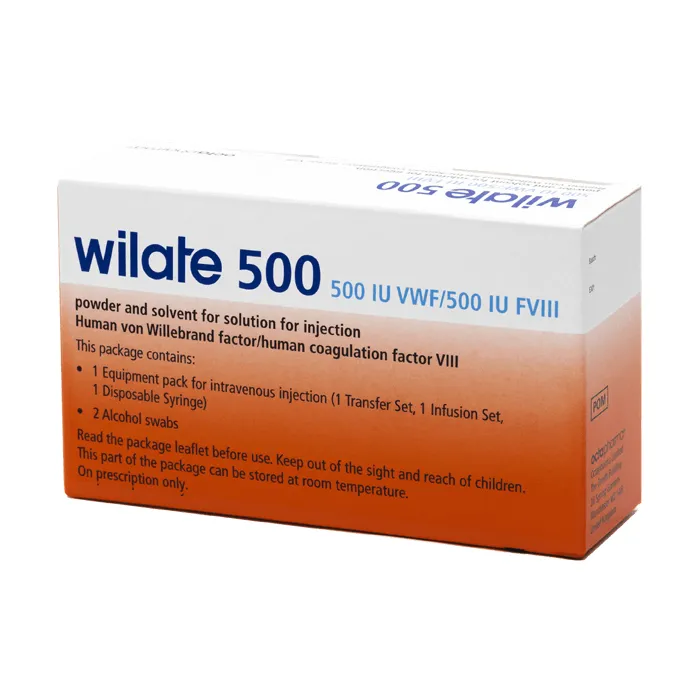
Table of Contents
Wilate 500, 500 IU VWF / 500 IU FVIII, powder and solvent for solution
for injection
Wilate 1000, 1000 IU VWF / 1000 IU FVIII, powder and solvent for solution
for injection
Human von Willebrand factor / human coagulation factor VIII
Please read the following information carefully before using this medicine, as it contains
important information for the patient.
- Keep this leaflet for future reference.
- If you have any questions, consult your doctor or pharmacist.
- This medicine has been prescribed for a specific individual. Do not pass it on to others. This medicine may harm others, even if their symptoms are the same.
- If any adverse reactions occur in the patient, including any adverse reactions not listed in this leaflet, inform your doctor or pharmacist immediately. See section 4.
Contents of the leaflet:
- What Wilate is and what it is used for
- Important information before using Wilate
- How to use Wilate
- Possible side effects
- How to store Wilate
- Contents of the pack and other information
1. What Wilate is and what it is used for
Wilate belongs to a group of medicines called coagulation factors and contains human von Willebrand factor (VWF) and coagulation factor VIII. These two proteins are involved in blood clotting.
von Willebrand Disease
Wilate is used for the treatment and prevention of bleeding episodes in patients with von Willebrand disease (VWD), which is essentially a group of related disorders. VWD is a bleeding disorder in which bleeding may last longer than expected. This condition is due either to a deficiency of von Willebrand factor in the blood or to its impaired function.
Haemophilia A
Wilate is used for the treatment and prevention of bleeding episodes in patients with haemophilia A. This is a condition characterized by prolonged bleeding due to a congenital deficiency of factor VIII in the blood.
2. Important information before using Wilate
When not to use Wilate
- if the patient has a known allergy (hypersensitivity) to human von Willebrand factor, factor VIII, or any of the other ingredients of this medicine (listed in section 6).
Warnings and precautions
Before starting treatment with Wilate, discuss this with your doctor or pharmacist.
- Like any medicine derived from human blood (containing proteins) and administered intravenously (injected into a vein), Wilate may cause allergic reactions. Be alert for early signs of allergic (hypersensitivity) reactions such as hives, skin rash, chest tightness, wheezing, drop in blood pressure, or anaphylaxis (when one or all of these symptoms occur suddenly and are severe). If any of these symptoms occur, stop using the medicine immediately and contact your doctor.
- Medicinal products made from human blood or plasma use appropriate measures to prevent transmission of infectious agents to patients. These include: strict selection of blood and plasma donors to exclude carriers of infections, testing of individual donations and plasma pools for specific viral/infection markers, and inclusion of manufacturing steps designed to inactivate or remove viruses. Despite these measures, transmission of infectious agents cannot be completely ruled out when administering medicines derived from human blood or plasma. This includes unknown or newly emerging viruses and other types of infections. The methods used are considered effective against enveloped viruses such as human immunodeficiency virus (HIV), hepatitis B virus, hepatitis C virus, and also against non-enveloped hepatitis A virus. However, the methods may have limited effectiveness against non-enveloped viruses such as parvovirus B19. Parvovirus B19 infection may be dangerous for pregnant women (risk of fetal infection) and for patients with immune disorders or certain types of anemia (e.g. sickle cell anemia or conditions involving abnormal red blood cell breakdown). It is strongly recommended that each time Wilate is administered, the product name and batch number be recorded to maintain a record of batches used. Vaccination against hepatitis A and B may be recommended by your doctor if von Willebrand factor and factor VIII derived from plasma are used regularly or repeatedly. von Willebrand disease (VWD)
- See section 4 (von Willebrand disease (VWD)) for information on adverse reactions associated with treatment of von Willebrand disease. Hemophilia A
Development of inhibitors (antibodies) is a known complication that may occur during treatment with any factor VIII-containing medicine. These inhibitors, especially at high levels, can interfere with effective treatment, and the patient will be closely monitored for their development. If bleeding in the patient is not properly controlled with Wilate, inform your doctor immediately.
- See section 4 (Hemophilia A) for information on adverse reactions associated with treatment of hemophilia A. Wilate and other medicines Inform your doctor or pharmacist about all medicines currently used or recently taken, as well as any medicines the patient plans to take. No interactions between Wilate and other medicines have been reported. Nevertheless, inform your doctor about the use of, or recent use of, other medicines (including over-the-counter medicines). Do not mix Wilate with other medicines during administration.
Pregnancy, breastfeeding, and fertility
If the patient is pregnant, breastfeeding, suspects she may be pregnant, or is planning to have a child, she should consult her doctor or pharmacist before using this medicine.
Wilate contains sodium
This medicine contains up to 58.7 mg of sodium (the main component of table salt) per 500 IU vial of von Willebrand factor and factor VIII, and up to 117.3 mg of sodium per 1000 IU vial of von Willebrand factor and factor VIII. This corresponds to 2.94% and 5.87%, respectively, of the maximum recommended daily dietary sodium intake for adults.
3. How to use Wilate
Wilate should be administered intravenously after reconstitution with the solvent provided. Treatment should be initiated under the supervision of medical personnel.
Dosage
The dose and frequency of administration should be individually determined by a physician. Wilate should always be used exactly as recommended by the doctor. Consult a doctor or pharmacist if there are any doubts.
Use of a higher than recommended dose of Wilate
Symptoms of overdose with human von Willebrand factor or factor VIII have not been observed. However, the recommended dose should not be exceeded.
Missed dose of Wilate
Do not administer a double dose to make up for a missed dose.
Consult your doctor or pharmacist if you have any further questions regarding the use of this medicine.
4. Possible adverse reactions
Like all medicines, Wilate can cause adverse reactions, although not everyone experiences them.
-
Although not common, hypersensitivity or allergic reactions have been observed. These may include: burning and stinging at the injection site, chills, flushing, headache, hypotension (low blood pressure), fatigue (lethargy), nausea, restlessness, tachycardia (rapid heartbeat), chest tightness, tingling sensation, vomiting, wheezing, sudden swelling of various body parts (angioedema). Inform your doctor if any of the above symptoms occur. Treatment with Wilate should be discontinued and medical help sought immediately if symptoms of angioedema occur, such as:
- swelling of the face, tongue or throat
- difficulty swallowing
- hives and breathing difficulties
-
Fever has also been observed, although this occurs not commonly.
-
Abdominal pain, back pain, chest pain, cough and dizziness may also occur, but the frequency of these adverse reactions is unknown.
-
In very rare cases, hypersensitivity may lead to severe allergic reactions known as anaphylaxis (when any or all of the above symptoms appear suddenly or are severe), including anaphylactic shock. In case of anaphylactic shock, appropriate medical management for shock treatment should be initiated.
Von Willebrand disease (VWD)
-
When using von Willebrand factor-containing products containing factor VIII, continuous treatment may lead to excessive increases in factor VIII levels in the blood. This may increase the risk of thrombotic events (thrombosis). Therefore, patients with increased clinical or laboratory risk should be monitored for early signs of thrombosis. Prophylactic (preventive) treatment for thrombotic complications should be decided by a physician according to current guidelines.
-
In patients with von Willebrand disease (mainly type 3), neutralizing antibodies (inhibitors) against von Willebrand factor may develop during treatment with this factor. In very rare cases, inhibitors may cause Wilate to be ineffective. If bleeding persists, tests for inhibitors should be performed. Inhibitors may increase the risk of allergic reactions (anaphylactic shock). If allergic reactions occur, testing for inhibitors should be carried out. If inhibitors are detected, contact a physician experienced in treating coagulation disorders. Consider alternative treatment options, which may be used in cases of high inhibitor titers.
Hemophilia A
- In previously untreated children receiving factor VIII-containing medicines, inhibitory antibodies (see section 2) may develop very commonly (in more than 1 in 10 patients). However, in patients who have previously been treated with factor VIII (for more than 150 days), the risk is uncommon (less than 1 in 100 patients). If this occurs, the patient's medication may stop working properly and prolonged bleeding may occur. If this happens, contact your doctor immediately. Inhibitors may increase the risk of allergic reactions (anaphylactic shock). If allergic reactions occur, testing for inhibitors should be performed.
Not common: may affect up to 1 in 100 users
Rare: may affect up to 1 in 1,000 users
Very rare: may affect up to 1 in 10,000 users
There are insufficient data to recommend administration of Wilate in previously untreated patients.
Experience with Wilate in children under 6 years of age is limited.
For information on viral safety, see section 2 (Warnings and precautions).
Reporting of adverse reactions
If any adverse reactions occur, including any not listed in this leaflet, inform your doctor, pharmacist or nurse.
Adverse reactions can be reported directly (details below). Reporting adverse reactions helps to provide more information on the safety of this medicine.
Department of Monitoring Adverse Drug Reactions
Office for Registration of Medicinal Products, Medical Devices and Biocidal Products
Al. Jerozolimskie 181C
02-222 Warsaw, Poland
Tel: +48 22 49 21 301
Fax: +48 22 49 21 309
e-mail: https://smz.ezdrowie.gov.pl
5. How to store Wilate
Keep the medicine out of the sight and reach of children.
Store the powder and solvent in a refrigerator (2°C - 8°C).
Do not freeze.
Keep the vials in the outer packaging to protect from light.
Do not use Wilate after the expiry date stated on the label.
The product may be stored at room temperature (below 25°C) for a period of 2 months. In such a case, the expiry date of the product expires at the end of the second month after the product was first removed from the refrigerator. The new expiry date should be recorded by the patient on the outer packaging.
The powder should be reconstituted immediately before injection. The prepared solution has been shown to be stable for 4 hours at room temperature. However, in order to avoid microbiological contamination, the reconstituted solution should be used immediately and is intended for single use only.
Medicines must not be disposed of via the sewage system or household waste. Ask your pharmacist how to dispose of medicines no longer required. These measures will help protect the environment.
6. Contents of the pack and other information
What Wilate contains
The active substances are human von Willebrand factor and human factor VIII.
Other components: Sodium chloride, Glycine, Sucrose, Sodium citrate, and Calcium chloride.
Solvent: Water for injections containing 0.1% Polysorbate 80.
What Wilate looks like and contents of the pack
Lyophilized powder: white or light yellow powder or solidified mass.
Solution after reconstitution: should be clear or slightly opalescent.
Wilate is supplied as a powder and solvent for solution for injection.
It is available in two pack sizes:
-
Wilate 500, 500 IU VWF and 500 IU FVIII, as powder and solvent for solution for injection containing nominally 500 IU of human von Willebrand factor and 500 IU of human factor VIII in a vial. The product contains approximately 100 IU of human von Willebrand factor and 100 IU of human factor VIII after reconstitution in 5 ml of water for injections with 0.1% Polysorbate 80 (solvent).
-
Wilate 1000, 1000 IU VWF and 1000 IU FVIII, as powder and solvent for solution for injection containing nominally 1000 IU of human von Willebrand factor and 1000 IU of human factor VIII in a vial. The product contains approximately 100 IU of human von Willebrand factor and 100 IU of human factor VIII after reconstitution in 10 ml of water for injections with 0.1% Polysorbate 80 (solvent).
Pack contents
1 vial with lyophilized powder
1 vial with solvent
1 package containing intravenous administration equipment (1 transfer set, 1 infusion set, 1 single-use syringe)
2 alcohol-impregnated swabs
Marketing Authorisation Holder and Manufacturer
Octapharma (IP) SPRL
Route de Lennik 451
1070 Anderlecht
Belgium
For more detailed information about this medicinal product, please contact the local representative of the Marketing Authorisation Holder.
Octapharma Poland Sp. z o.o.
ul. Domaniewska 39a
02-672 Warszawa
Poland
Tel. +48 22 489 52 28
Fax +48 22 489 52 29
Manufacturer
Octapharma Pharmazeutika
Produktionsges.m.b.H.
Oberlaaerstr. 235
A-1100 Vienna
Austria
This medicinal product is authorised in the member states of the European Economic Area under the following names:
Austria, Belgium, Bulgaria, Croatia, Cyprus, Czech Republic, Estonia, Germany, Hungary, Ireland, Italy, Latvia, Lithuania, Luxembourg, Malta, Netherlands, Poland, Portugal, Romania, Slovenia, Slovakia, Spain, United Kingdom: Wilate 500 / Wilate 1000
Finland, Norway, Sweden: Wilate
Denmark: Wilnativ
France: Eqwilate 500 / Eqwilate 1000
Instructions for home use
- Read all instructions carefully and follow them exactly!
- Do not use Wilate after the expiry date stated on the label.
- Maintain sterile conditions during the procedure described below.
- Visually inspect the prepared solution before administration for any particles or discoloration.
- The solution should be clear or slightly opalescent. Do not use solutions that are cloudy or contain particulate matter.
- Use the prepared solution immediately to prevent microbiological contamination.
- Use only the provided administration set. Using other injection/infusion equipment may cause additional risks and treatment failure.
Instructions for preparing the solution:
- Do not use the product directly from the refrigerator. Allow the solvent and powder in their closed vials to reach room temperature.
- Remove the caps from both vials and clean the rubber stoppers with one of the provided alcohol-impregnated swabs.
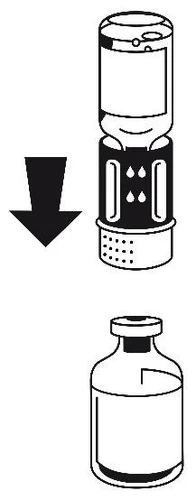
- The transfer set is shown in Fig. 1. Place the solvent vial on a flat surface and hold it firmly. Take the transfer set and turn it upside down. Place the blue part of the transfer set onto the top of the solvent vial and press firmly until it clicks into place (Fig. 2 + 3). Do not rotate while connecting.
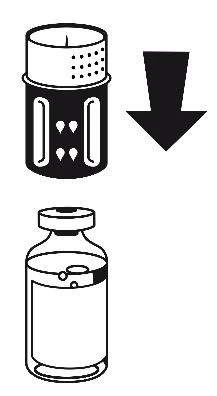
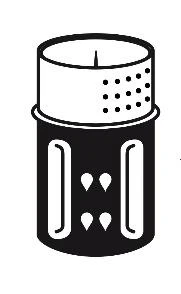
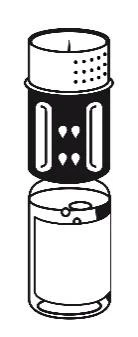
Fig. 1 Fig. 2 Fig. 3
- Place the powder vial on a flat surface and hold it firmly. Take the solvent vial with the attached transfer set and turn it upside down. Place the white part of the transfer set onto the top of the powder vial and press firmly until it clicks into place (Fig. 4). Do not rotate while connecting. The solvent will automatically flow into the vial with powder.
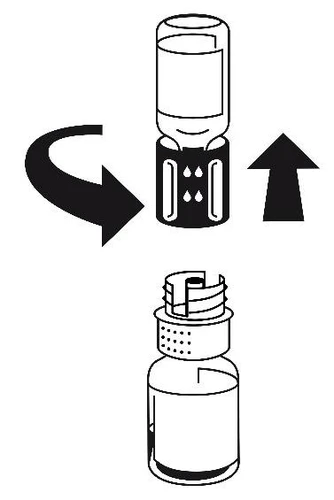
- With both vials still connected, gently rotate the powder vial until the powder is completely dissolved. Dissolution is complete within less than 10 minutes at room temperature. Slight foaming may occur during preparation. Unscrew the transfer set into two parts (Fig. 5). The foam will disappear.
Discard the empty solvent vial together with the blue part of the transfer set.
Instructions for administering the injection:
As a precaution, monitor pulse rate before and during injection. If a significant increase in heart rate occurs, reduce the injection rate or temporarily interrupt administration.
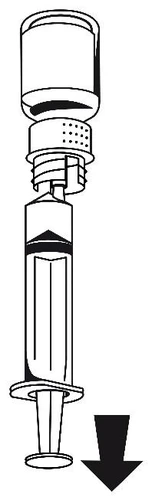
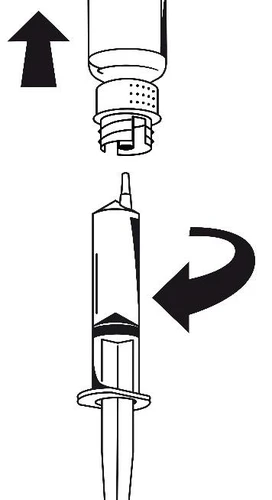
- Attach the syringe to the white part of the transfer set. Turn the vial upside down and draw the solution into the syringe (Fig. 6). The solution in the syringe should be clear or slightly opalescent. After transferring the solution, firmly hold the syringe plunger (pushing downward) and remove the syringe from the transfer set (Fig. 7).
Discard the empty powder vial together with the white part of the transfer set.
-
Clean the selected injection site with one of the provided alcohol-impregnated swabs.
-
Connect the provided infusion set to the syringe.
-
Insert the needle into the selected vein. If a tourniquet was used to visualize the vein, loosen it before starting the injection of Wilate. Blood must not enter the syringe due to the risk of fibrin clot formation.
-
Inject the solution slowly into the vein, no faster than 2–3 ml per minute. When more than one vial of Wilate powder is used in a single treatment cycle, the same needle and syringe may be reused. The transfer set is intended for single use only.
Any unused solution or waste material must be disposed of in accordance with local regulations.
Do not mix or co-administer (using the same infusion set) Wilate with other medicinal products.
Administration must be performed only with the provided infusion set. Using other injection or infusion sets may pose additional risks and lead to treatment failure (von Willebrand factor and factor VIII may adsorb to the inner surface of certain infusion sets).