Veletri
Poland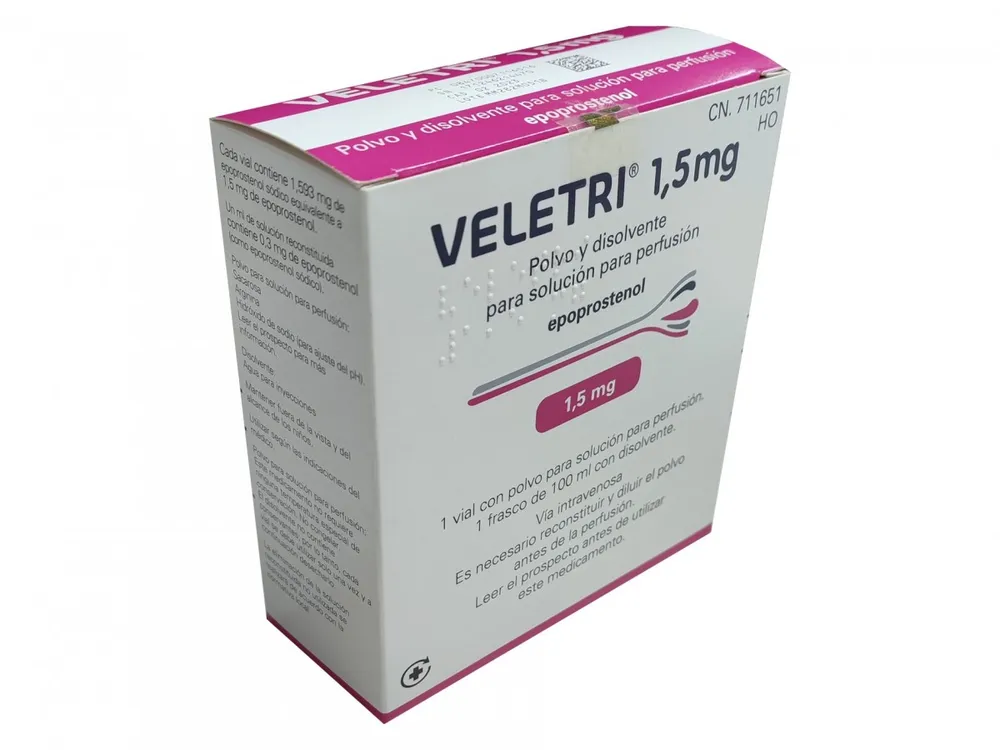
Table of Contents
- Package leaflet: Information for the user
- 1. What VELETRI is and what it is used for
- 2. Important information before using VELETRI
- 3. How to use VELETRI
- 4. Possible side effects
- 5. How to store the medicine VELETRI
- 6. Contents of the package and other information
- Information intended exclusively for healthcare professionals:
- 7. INFORMATION INTENDED FOR HEALTHCARE PROFESSIONALS
Package leaflet: Information for the user
VELETRI, 0.5 mg, powder for solution for infusion
VELETRI, 1.5 mg, powder for solution for infusion
Epoprostenol
Please read carefully this leaflet before using the medicine, because it contains
important information for the patient.
- Keep this leaflet as you may need to read it again.
- If you have any questions, please consult your doctor, pharmacist, or nurse.
- This medicine has been prescribed for a specific individual. Do not pass it on to others. The medicine may harm another person, even if their symptoms are the same.
- If you experience any adverse reactions, including any possible adverse reactions not listed in this leaflet, inform your doctor, pharmacist, or nurse. See section 4.
Leaflet contents
- What VELETRI is and what it is used for
- Important information before using VELETRI
- How to use VELETRI
- Possible side effects
- How to store VELETRI
- Contents of the pack and other information
1. What VELETRI is and what it is used for
VELETRI contains the active substance epoprostenol, which belongs to a group of medicines called prostaglandins that inhibit blood clotting and dilate blood vessels.
VELETRI is used in the treatment of a lung disease called pulmonary arterial hypertension. This is a condition in which blood pressure in the blood vessels of the lungs is too high. VELETRI dilates blood vessels, thereby reducing blood pressure in the lungs.
VELETRI is also used to prevent blood clotting during hemodialysis when heparin cannot be used.
2. Important information before using VELETRI
When not to use VELETRI
- if you are allergic to epoprostenol or any of the other ingredients of this medicine (listed in section 6);
- if you have heart failure;
- if, after starting treatment, you develop fluid accumulation in the lungs causing shortness of breath.
If you think any of these situations apply to you, do not use
VELETRI before consulting your doctor.
Warnings and precautions
Before starting treatment with VELETRI, discuss this with your doctor.
Your doctor must know:
- whether you have any problems with bleeding.
Skin damage at the injection site
VELETRI is administered intravenously. It is very important that the medicine does not leak out of the vein into the surrounding tissues. If this occurs, skin damage may result. Signs of such damage include:
- tenderness (pain upon pressure);
- burning;
- stinging;
- swelling;
- redness.
This may lead to blistering and skin peeling. The infusion site must be monitored carefully during treatment with VELETRI.
You should contact the hospital immediately for advice if the infusion site becomes painful or swollen, or if blisters or skin peeling occur.
Effect of VELETRI on blood pressure and heart rate
VELETRI may cause an increase or decrease in heart rate. It may also cause excessive lowering of blood pressure. During treatment with VELETRI, your heart rate and blood pressure will be monitored. Symptoms of low blood pressure include dizziness and fainting.
Inform your doctor if you experience such symptoms. This may require a reduction in dose or discontinuation of the medicine.
Children and adolescents
The safety and efficacy of VELETRI in children have not been established.
Other medicines and VELETRI
Inform your doctor or pharmacist about all medicines you are currently taking, have recently taken, or plan to take, including over-the-counter medicines.
Some medicines may affect the action of VELETRI or increase the likelihood of adverse effects. VELETRI may also affect the action of other medicines taken concurrently. These include:
- medicines used to treat high blood pressure;
- medicines used to prevent blood clots;
- medicines used to dissolve clots;
- anti-inflammatory and pain-relieving medicines (also known as NSAIDs);
- digoxin (a medicine used in the treatment of heart disease).
Inform your doctor or pharmacist if you are taking any of these medicines.
Pregnancy and breastfeeding
If you are pregnant, breastfeeding, think you may be pregnant, or are planning to have a baby, consult your doctor or pharmacist before using this medicine, as symptoms of the disease may worsen during pregnancy.
It is not known whether the components of VELETRI pass into human milk. Breastfeeding must be discontinued during treatment with VELETRI.
Driving and operating machinery
Treatment may affect the ability to drive and operate machinery.
Do not drive or operate machinery if you do not feel well.
VELETRI contains sodium
This medicine contains less than 1 mmol of sodium (23 mg) per vial and is therefore considered "sodium-free."
3. How to use VELETRI
This medicine should always be used as directed by your doctor or pharmacist. If you have any
doubts, consult your doctor or pharmacist.
VELETRI is supplied as a powder in a small glass vial. Before use, the powder must be dissolved.
VELETRI must not be administered as a rapid intravenous injection. It should always be given as an intravenous infusion (drip).
Your doctor will decide the appropriate dose of VELETRI for you. The dose depends on your body weight and the type of illness. Depending on your response to treatment, the dose may be increased or decreased.
VELETRI is administered by slow intravenous infusion.
Pulmonary arterial hypertension
VELETRI will initially be given in a hospital setting. This is because your doctor needs to monitor your condition and determine the optimal dose.
Treatment starts with an infusion (drip) of VELETRI. The dose is gradually increased until symptoms are relieved or reduced and side effects are manageable. Once the correct dose is established, a permanent intravenous catheter will be placed.
Treatment can then continue using an infusion pump.
Haemodialysis
You will receive VELETRI during dialysis sessions.
Using VELETRI at home (only for the treatment of pulmonary arterial hypertension)
If you are to use VELETRI at home, your doctor or nurse will instruct you on how to prepare and administer the medicine. You will also be informed about how to discontinue treatment if necessary. Discontinuation of VELETRI must be done gradually. It is very important to strictly follow all instructions.
VELETRI is supplied as a powder in a glass vial. Before use, the powder must be dissolved in an appropriate solution. This solution does not contain preservatives. Any unused solution should be discarded.
Catheter care for administering VELETRI
If you have a permanent intravenous catheter, it is very important to keep the site clean to avoid infection. Your doctor or nurse will instruct you on how to clean the catheter and the surrounding area. It is essential to carefully follow all these instructions. It is also very important to strictly follow all instructions regarding changing the medicine reservoir (cassette) in the pump and always use an infusion set with a filter, as directed by your doctor, to reduce the risk of infection. When reconnecting the extension set, always ensure that any droplets are removed so that no fluid remains in the external space between the extension set and the injection line connectors, as this may damage materials.
If you use more VELETRI than you should
Seek immediate medical help if you think you have used or received too much VELETRI. Symptoms of overdose may include headache, nausea, vomiting, rapid heartbeat, feeling of warmth or tingling, and feeling faint (weakness, dizziness).
If you forget to use VELETRI
Do not use a double dose to make up for a missed dose.
Stopping VELETRI
Discontinuation of VELETRI must be done gradually. If treatment is stopped too quickly, you may experience serious side effects, including dizziness, weakness, and difficulty breathing. If there is a problem with the infusion pump or catheter leading to interruption of VELETRI treatment, you must immediately contact your doctor, nurse, or hospital staff.
If you have any further questions about the use of this medicine, consult your doctor, pharmacist, or nurse.
4. Possible side effects
Like all medicines, this medicine can cause side effects, although they do not occur in everyone.
Very common side effects
May affect more than 1 in 10 patients:
- headache,
- jaw pain,
- pain,
- vomiting,
- nausea,
- diarrhoea,
- facial flushing (hot flushes).
Common side effects
May affect up to 1 in 10 patients:
- blood infection (septicaemia),
- fast heartbeat,
- slow heartbeat,
- low blood pressure,
- easier than usual bleeding from various sites (e.g. nose, gums) and bruising,
- abdominal discomfort or stomach pain,
- chest pain,
- joint pain,
- feeling anxious, nervousness,
- rash,
- pain at the injection site.
Common side effects which may be detected in blood tests
- decreased number of platelets (cells involved in blood clotting).
Uncommon side effects
May affect up to 1 in 100 patients:
- sweating,
- dry mouth.
Rare side effects
May affect up to 1 in 1,000 patients:
- infection at the infusion site.
Very rare side effects
May affect up to 1 in 10,000 patients:
- feeling of chest tightness,
- feeling of fatigue, weakness,
- feeling of restlessness,
- pale skin,
- redness at the injection site,
- overactive thyroid gland,
- blockage of the catheter used for administering the medicine.
Other side effects
Frequency unknown:
- enlarged or overactive spleen,
- fluid accumulation in the lungs (pulmonary oedema),
- increased blood sugar (glucose) levels,
- ascites (accumulation of fluid in the abdominal cavity),
- excessive pumping of blood from the heart, causing shortness of breath, fatigue, swelling of legs and abdomen due to fluid accumulation, persistent cough.
Reporting of side effects
Immediately inform your doctor or nurse if any of the following symptoms occur, as they may indicate blood infection (septicaemia), low blood pressure, or severe bleeding:
- the patient experiences a faster heartbeat, chest pain, or shortness of breath;
- the patient feels dizzy or lightheaded, especially when standing up;
- the patient has fever or chills;
- the patient experiences more frequent or prolonged bleeding episodes.
If any side effects occur, including those not listed in this leaflet, tell your doctor, pharmacist, or nurse. Side effects can be reported directly to:
Department of Monitoring of Adverse Drug Reactions, Office for Registration of Medicinal Products, Medical Devices and Biocidal Products
Al. Jerozolimskie 181C
02-222 Warszawa
Tel.: +48 22 49 21 301
Fax: +48 22 49 21 309
Website: https://smz.ezdrowie.gov.pl
Side effects can also be reported to the marketing authorisation holder.
Reporting side effects helps provide more information on the safety of this medicine.
5. How to store the medicine VELETRI
Keep this medicine out of the sight and reach of children.
Do not use this medicine after the expiry date stated on the carton after "EXP". The expiry date refers to the last day of the specified month.
No special temperature storage conditions are required for this medicine (prior to reconstitution).
Do not freeze.
After reconstitution, the solution must be immediately diluted to the final concentration (see section 7).
For storage conditions of the medicinal solution after reconstitution and after dilution, see section 7.
Do not use this medicine if any particulate matter is observed in the solution after reconstitution.
Medicines must not be disposed of via the sewage system or household waste. Ask your pharmacist how to dispose of medicines no longer required. Such measures help protect the environment.
6. Contents of the package and other information
What VELETRI contains
VELETRI 0.5 mg, powder for solution for infusion.
- The active substance is epoprostenol (as epoprostenol sodium). Each vial contains 0.531 mg of epoprostenol sodium, equivalent to 0.5 mg of epoprostenol. One ml of reconstituted solution contains 0.1 milligram of epoprostenol (as epoprostenol sodium).
VELETRI 1.5 mg, powder for solution for infusion.
- The active substance is epoprostenol (as epoprostenol sodium). Each vial contains 1.593 mg of epoprostenol sodium, equivalent to 1.5 mg of epoprostenol. One ml of reconstituted solution contains 0.3 milligram of epoprostenol (as epoprostenol sodium).
Other components of the medicine are: sucrose, arginine, and sodium hydroxide (for pH adjustment).
What VELETRI looks like and contents of the pack
White or almost white powder in a vial made of colourless glass (type I) closed with a rubber stopper and an aluminium "flip-off" cap.
Each pack contains one vial with 0.5 mg of powder.
Each pack contains one vial with 1.5 mg of powder.
Marketing Authorisation Holder
Janssen-Cilag International NV
Turnhoutseweg 30
B-2340 Beerse
Belgium
Manufacturer
Janssen Pharmaceutica NV
Turnhoutseweg 30
B-2340 Beerse
Belgium
For further information about this medicinal product, please contact the local representative of the Marketing Authorisation Holder:
Janssen-Cilag Polska Sp. z o.o.
tel. +48 22 237 60 00
This medicinal product is authorised in the European Economic Area countries under the following names:
Belgium VELETRI
Czech Republic VELETRI
France VELETRI
Spain VELETRI
Netherlands VELETRI
Poland VELETRI
Portugal VELETRI
United Kingdom VELETRI
Italy CARIPUL
Information intended exclusively for healthcare professionals:
7. INFORMATION INTENDED FOR HEALTHCARE PROFESSIONALS
Hemodialysis
One type of packaging for use in hemodialysis is available, containing:
- a single vial containing sterile, lyophilized VELETRI product equivalent to 0.5 mg of VELETRI.
Reconstitution:
Using a sterile syringe, withdraw 5 mL of sterile water for injection or 0.9% sodium chloride solution for injection, inject the contents of the syringe into the vial containing the sterile lyophilized VELETRI product, and gently shake until the powder is completely dissolved. The solution after reconstitution should be inspected visually before further dilution. The product must not be administered if a change in color or presence of particulate matter is observed. Any unused portion of the prepared solution should be discarded in accordance with local regulations.
Dilution:
After reconstitution, the solution should be immediately diluted to the final concentration. The same diluent used for reconstitution of the sterile lyophilized powder should be used for further dilution.
Calculation of infusion rate:
The infusion rate can be calculated using the following formula:
Dosing (ng/kg/min) × body weight (kg)
Infusion rate (mL/min) =
Concentration of solution (ng/mL)
Infusion rate (mL/hour) = infusion rate (mL/min) × 60
Pulmonary arterial hypertension
The following two types of packaging for use in the treatment of pulmonary arterial hypertension are available, containing:
- a single vial containing sterile, lyophilized VELETRI product equivalent to 0.5 mg of VELETRI.
- a single vial containing sterile, lyophilized VELETRI product equivalent to 1.5 mg of VELETRI.
Reconstitution:
Using a sterile syringe, withdraw 5 mL of sterile water for injection or 0.9% sodium chloride solution for injection, inject the contents of the syringe into the vial containing the sterile lyophilized VELETRI product, and gently shake until the powder is completely dissolved. The solution after reconstitution should be inspected visually before further dilution. The product must not be administered if a change in color or presence of particulate matter is observed. Any unused portion of the prepared solution should be discarded in accordance with local regulations.
Dilution:
After reconstitution, the solution should be immediately diluted to the final concentration. The same diluent used for reconstitution of the sterile lyophilized powder should be used for further dilution.
The VELETRI solution intended for long-term administration should be prepared in an administration container compatible with the infusion pump used.
The following ambulatory infusion pumps have been found suitable for administration of VELETRI:
- CADD-Legacy 1
- CADD-Legacy PLUS
- CADD-Solis VIP (variable infusion profile)
Manufactured by Smiths Medical.
The following pump components have been found suitable for administration of VELETRI:
- Smiths Medical CADD disposable 50 mL or 100 mL drug cassette
- Smiths Medical CADD infusion set with 0.2 micron flow filter (CADD infusion set with male luer connector, 0.2 micron air bubble filter, roller clamp, and built-in anti-siphon valve with male luer connector)
Based on available internal study data and manufacturer's instructions for accessories, materials used for preparation and administration that may be compatible include:
- Acrylic
- Acrylonitrile-butadiene-styrene terpolymer (ABS)
- Polycarbonate
- Polyethersulfone
- Polypropylene
- Polytetrafluoroethylene (PTFE)
- Polyurethane
- Polyvinyl chloride (PVC) (plasticized with DEHP)
- Silicone
It is unknown whether polyethylene terephthalate (PET) and polyethylene terephthalate glycol (PETG) are compatible with VELETRI, as these materials have not been tested with VELETRI; therefore, the use of these materials is not recommended.
Only infusion sets with a 0.22 micron in-line filter placed between the infusion pump and the catheter should be used. Use of filters with a hydrophilic polyethersulfone membrane is recommended. The infusion set and in-line filter must be replaced every 48 hours or more frequently.
The vial containing 0.5 mg of epoprostenol must be used for preparing solutions with a final concentration below 15,000 ng/mL.
Table 1 provides examples of preparation of commonly used concentrations of VELETRI solution. Each vial is for single use only.
Table 1: Commonly used concentrations – examples of reconstitution and dilution methods
| Final concentration (ng/ml) | Instructions: |
| 3 000 ng/ml | Reconstitute the contents of one 0.5 mg vial with 5 ml of sterile water for injection or 0.9% sodium chloride solution for injection. Withdraw 3 ml of the solution and dilute with the same diluent to a final volume of 100 ml. |
| 5 000 ng/ml | Reconstitute the contents of one 0.5 mg vial with 5 ml of sterile water for injection or 0.9% sodium chloride solution for injection. Withdraw the entire contents of the vial and dilute with the same diluent to a final volume of 100 ml. |
| 10 000 ng/ml | Reconstitute the contents of two 0.5 mg vials with 5 ml of sterile water for injection or 0.9% sodium chloride solution for injection per vial. Withdraw the entire contents from both vials and dilute with the same diluent to a final volume of 100 ml. |
| 15 000 ng/ml* | Reconstitute the contents of one 1.5 mg vial with 5 ml of sterile water for injection or 0.9% sodium chloride solution for injection. Withdraw the entire contents of the vial and dilute with the same diluent to a final volume of 100 ml. |
| 30 000 ng/ml* | Reconstitute the contents of two 1.5 mg vials with 5 ml of sterile water for injection or 0.9% sodium chloride solution for injection per vial. Withdraw the entire contents from both vials and dilute with the same diluent to a final volume of 100 ml. |
| 30 000 ng/ml* | Reconstitute the contents of one 1.5 mg vial with 5 ml of sterile water for injection or 0.9% sodium chloride solution for injection. Withdraw the entire contents of the vial and dilute with the same diluent to a final volume of 50 ml. |
| * Higher concentration solutions may be necessary for patients receiving VELETRI product long-term. | |
Diluted VELETRI product at the final concentration in an administration container can be administered immediately at room temperature (25°C) or stored for up to 8 days at 2°C to 8°C, according to the conditions specified in Table 2.
Table 2: Maximum administration time (in hours) at room temperature (25°C) of fully diluted solutions stored in an administration container.
| Final concentration range | Immediate administration When stored for up to 8 days at 2°C to 8°C |
| ≧3,000 ng/ml and <15,000 ng/ml | 48 hours 24 hours |
| ≧15,000 ng/ml | 48 hours 48 hours |
Do not expose the fully diluted solution to direct sunlight.
Special precautions for storage
There are no special recommendations regarding storage temperature of the medicinal product. Do not freeze.
After reconstitution, the solution should be immediately diluted to the final concentration.
Reconstitution and dilution must be performed immediately before use.
The freshly prepared diluted solution of epoprostenol intended for the treatment of pulmonary arterial hypertension may be administered immediately at 25°C or stored in a drug delivery system container protected from light for up to 8 days at 2°C to 8°C, according to the conditions specified in Table 2.