Vamin 14 electrolyte-free
Poland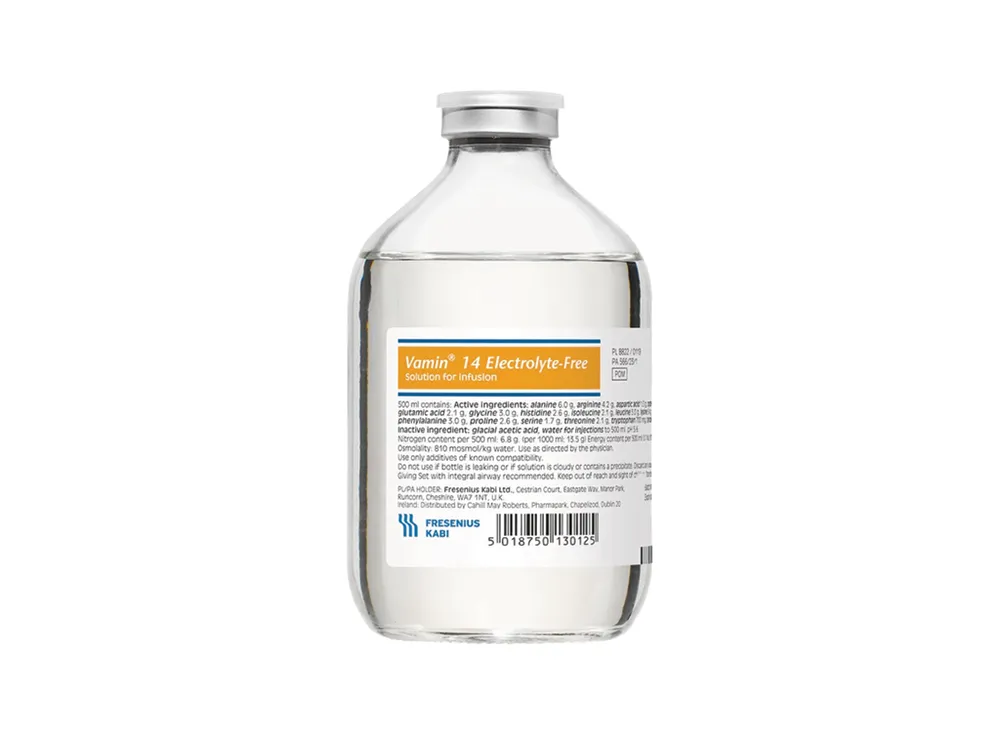
Table of Contents
- Package leaflet: Information for the user
- 1. What Vamin 14 Electrolyte-Free is and what it is used for
- 2. Information before using Vamin 14 Electrolyte-Free
- 3. How to use Vamin 14 Electrolyte-Free
- 4. Possible adverse reactions
- 5. How to store Vamin 14 Electrolyte-Free
- 6. Contents of the pack and other information
- Information intended exclusively for medical professionals:
Package leaflet: Information for the user
Vamin 14 Electrolyte-Free, infusion solution
Please read all of this leaflet carefully before the medicine is administered, as it contains
important information for the patient.
- Keep this leaflet, as you may need to read it again.
- If you have any questions, please consult your doctor, pharmacist, or nurse.
- This medicine has been prescribed for a specific individual. Do not pass it on to others. This medicine may harm other people, even if their symptoms are the same.
- If the patient experiences any side effects, including any not listed in this leaflet, inform the doctor, pharmacist, or nurse. See section 4.
Table of contents
- What Vamin 14 Electrolyte-Free is and what it is used for
- Important information before using Vamin 14 Electrolyte-Free
- How to use Vamin 14 Electrolyte-Free
- Possible side effects
- How to store Vamin 14 Electrolyte-Free
- Contents of the pack and other information
1. What Vamin 14 Electrolyte-Free is and what it is used for
Vamin 14 Electrolyte-Free is an amino acid solution for intravenous infusion in adult patients.
It contains both amino acids produced by the body and those not produced by the body, which are normally present in dietary protein.
Amino acids administered as a solution have nutritional properties. To be fully utilized, the body must also receive an adequate amount of carbohydrates and fats.
Vamin 14 Electrolyte-Free maintains a positive nitrogen balance (i.e., intake of more nitrogen than excretion), which is important for maintaining proper nutritional status.
Indications:
Vamin 14 Electrolyte-Free is indicated as a source of amino acids for parenteral nutrition in adult patients. The medicine is particularly suitable for use in patients with moderately increased requirements for amino acids.
2. Information before using Vamin 14 Electrolyte-Free
When not to use Vamin 14 Electrolyte-Free
Do not use the medicine:
- if the patient has congenital disorders of amino acid metabolism;
- if the patient has severe liver function impairment;
- if the patient has uraemia (a set of symptoms caused by end-stage kidney dysfunction) and dialysis is not possible.
Warnings and precautions
Before starting treatment with Vamin 14 Electrolyte-Free, discuss this with the doctor or nurse.
Intravenous administration of amino acid solutions increases urinary excretion of trace elements—copper and zinc. This is particularly important in the case of long-term parenteral nutrition. The doctor should take this into account when determining the dosage of copper and zinc in the patient's nutrition.
Vamin 14 Electrolyte-Free and other medicines
Tell the doctor or pharmacist about all medicines the patient is currently taking, has recently taken, or plans to take.
No interaction between Vamin 14 Electrolyte-Free and other medicines has been reported.
Pregnancy and breastfeeding
If the patient is pregnant or breastfeeding, suspects she may be pregnant, or is planning to have a baby, she should consult a doctor before using this medicine.
The doctor will decide whether this medicine can be used during pregnancy or breastfeeding.
Driving and operating machinery
Not applicable.
3. How to use Vamin 14 Electrolyte-Free
This medicine is administered only by medical personnel. Do not self-administer this medicine.
If in doubt, consult your doctor.
The dosage is determined individually by the doctor for each patient depending on body weight and health status.
Administration of a higher than recommended dose of Vamin 14 Electrolyte-Free
If a higher than recommended dose is administered, inform the doctor or nurse immediately.
If the medicine is administered at a faster rate than recommended, nausea, vomiting, sweating, and thrombophlebitis (when the medicine is given into peripheral veins) may occur.
If symptoms of overdose occur, the doctor will decide on further treatment with the medicine.
If you have any further doubts regarding the use of this medicine, consult your doctor or nurse.
4. Possible adverse reactions
Like all medicines, this medicine can cause adverse reactions, although not everyone will experience them.
The following adverse reactions may occur:
- allergic reaction (hypersensitivity), manifested by skin rash, swelling (especially of the lips, face, eyelids, tongue, and throat), shortness of breath, or fainting. In such cases, contact a doctor immediately.
- nausea (rare);
- abnormal liver function test results (increased activity of liver enzymes AspAT and AlAT);
- thrombophlebitis of the vein into which the medicine was administered (inflammation and small blood clots causing vein hardening, redness around the vein, pain, and tenderness).
Reporting of adverse reactions
If any adverse reactions occur, including any adverse reactions not listed in this leaflet, inform a doctor, pharmacist, or nurse. Adverse reactions can be reported directly to the Department of Monitoring Adverse Drug Reactions of the Office for Registration of Medicinal Products, Medical Devices and Biocidal Products
Al. Jerozolimskie 181C
02-222 Warszawa
Phone: +48 22 49 21 301
Fax: +48 22 49 21 309
Website: https://smz.ezdrowie.gov.pl
Adverse reactions can also be reported to the marketing authorization holder.
Reporting adverse reactions allows more information on the safety of the medicine to be collected.
5. How to store Vamin 14 Electrolyte-Free
Keep this medicine out of the sight and reach of children.
Store below 25°C. Keep in the original packaging to protect from light. Do not freeze.
This medicine should be used immediately after opening the container.
Any unused portion of the medicine must not be used later.
Do not use this medicine after the expiry date stated on the packaging. The expiry date refers to the last day of the stated month.
Do not use this medicine if visible solid particles are present.
Medicines must not be disposed of via wastewater or household waste. Ask your pharmacist how to dispose of medicines no longer required. Such measures will help protect the environment.
6. Contents of the pack and other information
What Vamin 14 Electrolyte-Free contains
- The active substances are:
1000 ml of solution contains:
L-alanine 12.0 g
L-arginine 8.4 g
L-aspartic acid 2.5 g
L-cysteine (+ L-cystine) 420 mg
L-glutamic acid 4.2 g
glycine (aminoacetic acid) 5.9 g
L-histidine 5.1 g
L-isoleucine 4.2 g
L-leucine 5.9 g
L-lysine acetate
corresponding to L-lysine 6.8 g
L-methionine 4.2 g
L-phenylalanine 5.9 g
L-proline 5.1 g
L-serine 3.4 g
L-threonine 4.2 g
L-tryptophan 1.4 g
L-tyrosine 170 mg
L-valine 5.5 g
- Other components (excipients): glacial acetic acid, water for injections.
Total amino acid content: 85 g/l; content of essential amino acids: 38.7 g,
including cysteine and tyrosine.
pH: 5.6
Osmolality: 810 mOsm/kg water
Nitrogen content: 13.5 g/l
Electrolytes: approximately 90 mmol acetate added as acetic acid and lysine acetate
Energy value: 1.4 MJ/l (350 kcal/l)
Antioxidants: none
What Vamin 14 Electrolyte-Free looks like and contents of the pack
The medicinal product is a clear, colourless to slightly yellow solution.
The pack consists of a colourless glass bottle containing 500 ml or 1000 ml of solution.
Marketing Authorisation Holder and Manufacturer
Marketing Authorisation Holder
Fresenius Kabi AB
S-751 74 Uppsala
Sweden
Manufacturer
Fresenius Kabi Austria GmbH
Hafnerstrasse 36
A-8055 Graz
Austria
For further information, please contact the representative of the Marketing Authorisation Holder:
Fresenius Kabi Polska Sp. z o.o.
Al. Jerozolimskie 134
02-305 Warsaw
Tel.: +48 22 345 67 89
Information intended exclusively for medical professionals:
Dosage and administration
Adult patients: the nitrogen requirement necessary to maintain protein mass depends on the
patient's clinical condition (nutritional status and degree of metabolic stress).
The requirements are as follows:
0.10 – 0.15 g nitrogen/kg body weight/day (no or mild metabolic stress and normal nutritional status),
0.15 – 0.20 g nitrogen/kg body weight/day (moderate metabolic stress with or without malnutrition),
0.20 – 0.25 g nitrogen/kg body weight/day (severe catabolism, as in burns, sepsis, and trauma).
The dosage range of 0.10 – 0.25 g nitrogen/kg body weight/day corresponds to 7 – 18 ml of Vamin 14 Electrolyte-Free/kg body weight/day.
In obese patients, the dose should be calculated based on estimated ideal body weight.
Depending on the patient's requirements, up to 1000 ml of Vamin 14 Electrolyte-Free may be administered per day by intravenous infusion. In patients with significantly increased amino acid requirements, the more concentrated Vamin 18 Electrolyte-Free may be used.
Vamin 14 Electrolyte-Free must be administered slowly at a rate not exceeding 1000 ml over 8 hours, corresponding to approximately 2 ml per minute (see Overdose section).
Overdose
If Vamin 14 Electrolyte-Free has been administered at a rate exceeding the recommended rate, an increased risk of nausea, vomiting, and sweating has been observed. When administered via peripheral veins, thrombophlebitis may occur.
In case of symptoms of overdose, the infusion rate should be reduced or the infusion discontinued.
Preparation for use
The medicinal product should be used immediately after opening the container. Any unused portion of the medicinal product is unsuitable for further use.
Pharmaceutical incompatibilities
Compatibility
Excipients
Only medicinal products, nutrient solutions, or electrolyte solutions whose pharmaceutical compatibility has been confirmed may be added to Vamin 14 Electrolyte-Free. The addition of other substances must be performed under aseptic conditions.
To 1000 ml of Vamin 14 Electrolyte-Free, the following may be added, either alone or in combination: up to 20 ml of Addamel N, 480 mmol NaCl, 480 mmol KCl, 24 mmol calcium gluconolactobionate, and 48 mmol MgSO₄.
If phosphate supplementation is required, up to 60 ml of Addiphos may be added to 1000 ml of Vamin 14 Electrolyte-Free, either alone or in combination with 480 mmol NaCl, 480 mmol KCl, and 48 mmol MgSO₄.
It should be noted that Addamel N must not be added to solutions containing inorganic phosphate due to the risk of precipitation.
Mixing in a plastic bag (phthalate-free) – example of a total parenteral nutrition mixture:
Mixing must be performed under strict aseptic conditions in a laminar airflow cabinet, following the sequence below:
- To Vamin 14 Electrolyte-Free, the following may be added:
- Addamel N;
- Glycophos;
- electrolytes.
- To glucose solution, the following may be added:
- Addiphos or another source of inorganic phosphate.
- To Intralipid, the following may be added:
- Soluvit N;
- Vitalipid N Adult.
Mixtures 1 and 2 should be transferred into a plastic bag (phthalate-free), followed by the addition of mixture 3, gently rotating the bag until a homogeneous mixture is obtained.
Stability
The medicinal product should be used immediately after opening the container. Any unused portion of the medicinal product is unsuitable for further use.
Excipients
When additional medicinal products are added to the infusion solution, the infusion should be completed within 24 hours of preparation to avoid microbiological contamination.
Mixing in a plastic bag (phthalate-free)
Mixtures prepared under aseptic conditions should be used within 7 days. Mixtures may be stored for up to 6 days in a refrigerator (2 – 8°C), then administered by intravenous infusion within 24 hours.
Data on stability and pharmaceutical compatibility with other medicinal products used in parenteral nutrition are available upon request from the representative of the marketing authorization holder.
Storage conditions
Store below 25°C. Keep in the original packaging to protect from light. Do not freeze.
Disposal of unused medicinal product or waste
Any unused residues of the medicinal product or waste materials should be disposed of in accordance with local regulations.