Utrogestan
Poland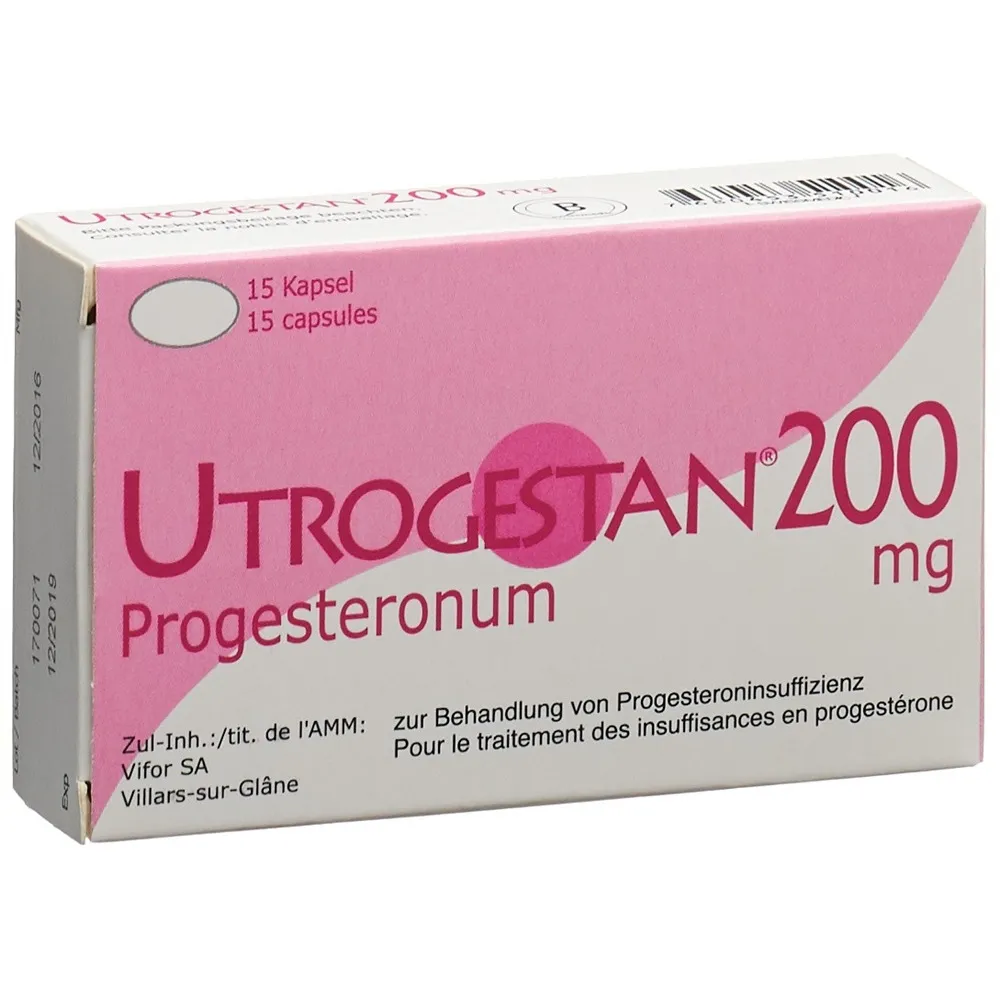
Table of Contents
Package leaflet: Information for the user
Utrogestan, 200 mg, soft vaginal capsules
progesterone
Please read all of this leaflet carefully before using this medicine, because it contains
important information for you.
- Keep this leaflet. You may need to read it again.
- If you have any further questions, ask your doctor or pharmacist.
- This medicine has been prescribed for a specific individual. Do not pass it on to others. It may harm someone else, even if their symptoms are the same.
- If you experience any side effects, including any not listed in this leaflet, tell your doctor or pharmacist. See section 4.
Contents of the leaflet
- What Utrogestan is and what it is used for
- Important information before using Utrogestan
- How to use Utrogestan
- Possible side effects
- How to store Utrogestan
- Contents of the pack and other information
1. What Utrogestan is and what it is used for
The name of this medicine is Utrogestan. Utrogestan contains a hormone called progesterone.
What Utrogestan is used for
Supporting pregnancy during fertility treatment
Utrogestan is intended for women who require additional progesterone to support early pregnancy during assisted reproductive technology (ART) treatment.
Prevention of preterm birth in women with singleton pregnancies
Utrogestan is intended for women who have previously delivered prematurely and/or who have a short cervix.
2. Important information before using Utrogestan
When not to use Utrogestan:
- If the patient has been diagnosed with hypersensitivity (allergy) to soy or peanuts;
- If the patient is allergic to progesterone or any of the other ingredients of this medicine (listed in section 6);
- If the patient has impaired liver function;
- If the patient has yellowing of the skin or eyes (jaundice);
- If the patient has vaginal bleeding of unknown cause;
- If the patient has cancer of the breast or genital organs;
- If the patient has thrombophlebitis (inflammation of a vein due to a blood clot);
- If the patient currently has or has previously had blood clots in the veins (thrombosis), for example in the legs (deep vein thrombosis) or lungs (pulmonary embolism);
- If the patient has previously experienced a cerebral haemorrhage;
- If the patient has a rare inherited blood disorder called "porphyria";
- If the patient is pregnant but the fetus has died (missed miscarriage);
- If the patient's "waters have broken".
Do not use Utrogestan if any of the above situations apply to the patient. If in doubt, discuss this with a doctor or pharmacist before using Utrogestan.
Warnings and precautions
Utrogestan is not a contraceptive.
If the patient suspects that she may have had a miscarriage, she should speak to her doctor, as use of Utrogestan must then be discontinued.
If the patient experiences vaginal bleeding, she should consult her doctor.
If the patient is using this medicine to support pregnancy during infertility treatment
Utrogestan should be used only during the first 3 months of pregnancy.
If the patient is using this medicine to prevent preterm birth in a singleton pregnancy
The doctor will discuss with the patient the risks and benefits of the available treatment options. The doctor and the patient will jointly decide on the most appropriate treatment.
If the patient is at risk of preterm delivery, she may use Utrogestan from approximately week 20 to week 34 of pregnancy. If the patient's waters break while taking this medicine, she must contact her doctor immediately. This situation may pose an immediate risk to both the patient and her baby.
In rare cases, use during the second and third trimesters of pregnancy may lead to liver problems. If the patient develops itching, which may be a sign of liver problems, she should contact her doctor.
Children
Utrogestan is not intended for use in children.
Diagnostic and monitoring examinations
Before starting treatment and regularly during treatment, the doctor will perform a full medical examination.
Utrogestan and other medicines
Tell your doctor or pharmacist about all medicines the patient is currently taking or has recently taken, as well as any medicines she plans to take. This includes medicines available without a prescription, including herbal medicines. This is because Utrogestan may affect the action of certain other medicines. Likewise, some other medicines may affect how Utrogestan works.
In particular, inform the doctor or pharmacist if the patient is using any of the following medicines:
- Bromocriptine, used to treat disorders related to the pituitary gland or Parkinson's disease;
- Cyclosporine (used to suppress the immune system);
- Rifamycin derivatives, such as rifampicin (used to treat infections);
- Ketoconazole (used to treat fungal infections).
Utrogestan with food and drink
Utrogestan is administered vaginally. Food and drink do not affect treatment.
Pregnancy, breastfeeding and fertility
- Utrogestan is used as supportive treatment to maintain pregnancy during infertility treatment or if the doctor has determined that the patient is at risk of preterm birth. Instructions on how to use Utrogestan are described in section 3.
- Breastfeeding women should not use Utrogestan.
Driving and operating machinery
Utrogestan has negligible influence on the ability to drive and operate machinery.
Utrogestan contains soy lecithin
Patients who have been diagnosed with hypersensitivity to peanuts or soy should not use this medicine.
3. How to use Utrogestan
This medicine should always be used as directed by the doctor. If in doubt, consult the doctor or pharmacist.
- This medicine should be administered by inserting it deeply into the vagina.
- Do not take this medicine orally. Accidental oral intake does not cause harmful effects, but the chances of becoming pregnant will be reduced.
Recommended dose
Support in in vitro fertilization (IVF) cycles:
- Treatment should begin no later than the third day after oocyte retrieval.
- The recommended daily dose is 600 mg of Utrogestan, as directed by the doctor. One capsule should be inserted deeply into the vagina in the morning, at noon, and at bedtime.
- If laboratory tests confirm that the patient is pregnant, the same dosing regimen should be continued for at least up to week 7 of pregnancy, but not beyond week 12 of pregnancy, as directed by the doctor.
Prevention of preterm birth in certain patients:
- One capsule (200 mg) of Utrogestan should be administered daily by inserting it deeply into the vagina in the evening before going to sleep. This treatment may be used from approximately week 20 of pregnancy until week 34 of pregnancy.
Use of a higher than recommended dose of Utrogestan
If an excessive dose of Utrogestan is used, consult a doctor or go to the hospital immediately. Bring the medicine package with you.
The following symptoms may occur: dizziness or feeling of fatigue.
Missed dose of Utrogestan
- If a dose is missed, it should be administered as soon as possible. However, if it is almost time for the next dose, the missed dose should be skipped.
- Do not administer a double dose to make up for a missed dose.
Stopping the use of Utrogestan
Before stopping the use of this medicine, consult the doctor, pharmacist, or nurse. If the patient stops using this medicine, it will not help her become pregnant.
For any further questions about the use of this medicine, consult the doctor, pharmacist, or nurse.
4. Possible adverse reactions
Like all medicines, this medicine can cause adverse reactions, although not everybody will experience them. This medicine may cause the following adverse reactions:
Frequency unknown (frequency cannot be estimated from the available data):
- itching
- oily vaginal discharge
- vaginal bleeding
- burning sensation
Within 1-3 hours after taking the medicine, the patient may experience transient fatigue or dizziness.
Reporting of adverse reactions
If any adverse reactions occur, including any adverse reactions not listed in this leaflet, inform your doctor or pharmacist. Adverse reactions can be reported directly to the Department of Monitoring Adverse Drug Reactions at the Office for Registration of Medicinal Products, Medical Devices and Biocidal Products, Al. Jerozolimskie 181C, 02-222 Warsaw, phone +48 22 49 21 301, fax +48 22 49 21 309, website https://smz.ezdrowie.gov.pl
Adverse reactions can also be reported to the marketing authorization holder.
By reporting adverse reactions, additional information on the safety of this medicine can be collected.
5. How to store Utrogestan
- Keep this medicine out of sight and reach of children.
- Do not use this medicine after the expiry date stated on the packaging after EXP. The expiry date refers to the last day of the stated month. The abbreviation Lot means batch number.
- This medicine does not require any special precautions for storage.
- Do not use this medicine if you notice any changes in its appearance.
- Medicines must not be disposed of via wastewater or household waste. Ask your pharmacist how to dispose of medicines you no longer use. Such measures help protect the environment.
- Any unused medicinal product or waste material should be disposed of in accordance with local regulations.
6. Contents of the package and other information
What Utrogestan contains
- The active substance is progesterone. Each capsule contains 200 mg of progesterone.
- The other ingredients are purified sunflower oil and soybean lecithin. The other components contained in the capsule shell are gelatin, glycerol, titanium dioxide (E 171), and purified water.
What Utrogestan looks like and contents of the pack
Utrogestan is an oval, yellowish soft capsule containing a white, oily suspension.
It is packaged in cardboard boxes containing PVC/Aluminum blisters with 15, 21, 45, or 90 capsules.
Not all pack sizes may be marketed.
Marketing Authorisation Holder
Besins Healthcare Ireland Limited
Plaza 4, Level 4 Custom House Plaza
Harbourmaster Place, IFSC
Dublin 1, D01 A9N3
Ireland
Manufacturer
Cyndea Pharma, S.L.
Poligono Industrial Emiliano Revilla Sanz
Avenida de Agreda, 31
Ólvega 42110 Soria
Spain
or
BESINS MANUFACTURING ESPAŇA S.L.
Poligono industrial el Pitarco, Parcela 4,
Muel
50450 Zaragoza
Spain
This medicinal product is authorised in the EEA Member States under the following names:
Bulgaria: Утрогестан 200 mg вагинални капсули, меки
Croatia: Utrogestan 200 mg meke kapsule za rodnicu.
Czech Republic: Progesteron Besins 200 mg měkké tobolky
Denmark: Progestan
Estonia: Utrogestan 200 mg vaginaalpehmekapslid
Spain: Utrogestan Vaginal 200 mg Cápsula blanda
Ireland: Utrogestan Vaginal 200mg Capsules, soft
Iceland: Progestan 200 mg Mjúkt skeiðarhylki
Latvia: Progesterone Besins 200 mg vaginālās mīkstās kapsulas
Lithuania: Progesterone Besins 200 mg makšties minkštosios kapsulės
Malta: Utrogestan Vaginal 200mg Capsules, soft
Netherlands: Utrogestan 200 mg, zachte capsules voor vaginaal gebruik
Norway: Utrogestan 200 mg vaginalkapsler, myke
Poland: Utrogestan, 200 mg, kapsułki dopochwowe miękkie
Portugal: Utrogestan Vaginal 200 mg Cápsula mole
Slovakia: Utrogestan 200 mg mäkké vaginálne kapsuly
Slovenia: Utrogestan 200 mg mehke vaginalne kapsule
Sweden: Utrogestan 200 mg mjuk Vaginalkapsel
Hungary: Utrogestan 200 mg lágy hüvelykapszula
United Kingdom: Utrogestan Vaginal 200mg Capsules
Italy: Utrogestan Vaginale 200 mg Capsula molle