Uniben lemon flavor
Poland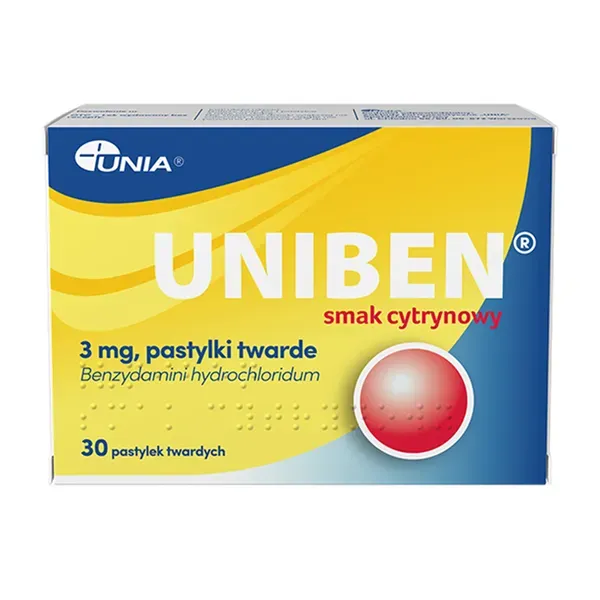
Table of Contents
Patient Information Leaflet
Uniben lemon flavour
3 mg, hard pastilles
Benzydamini hydrochloridum
Please read this leaflet carefully before using the medicine, as it contains important information for you.
This medicine should always be used exactly as described in this patient leaflet or as directed by your doctor or pharmacist.
- Keep this leaflet, so that you can read it again if necessary.
- If you need advice or further information, please consult your pharmacist.
- If you experience any side effects, including any not listed in this leaflet, please inform your doctor or pharmacist. See section 4.
- If there is no improvement after 3 days, or if you feel worse, consult your doctor.
Leaflet Contents
- What Uniben lemon flavour is and what it is used for
- What you need to know before taking Uniben lemon flavour
- How to take Uniben lemon flavour
- Possible side effects
- How to store Uniben lemon flavour
- Contents of the pack and other information
1. What Uniben lemon flavour is and what it is used for
Uniben lemon flavour contains the active substance benzydamine, which belongs to the group of indole-type non-steroidal anti-inflammatory drugs (NSAIDs) for local and general use.
Benzydamine has anti-inflammatory and analgesic properties and acts locally as a local anaesthetic and antiseptic. The drug is well absorbed locally, achieving high concentrations in tissues affected by inflammation.
This is a pastille for sucking.
Uniben is used to treat discomfort and symptoms (pain, redness, swelling) associated with inflammatory conditions of the mouth and throat in adults and children above 6 years of age.
If there is no improvement after 3 days, or if you feel worse, consult your doctor.
2. Important information before using Uniben lemon flavour
When not to use Uniben lemon flavour
- if the patient is allergic to benzidamine hydrochloride or any of the other ingredients of this medicine (listed in section 6),
- in patients with phenylketonuria, as the medicine contains aspartame, a source of phenylalanine.
Warnings and precautions
Before starting to use Uniben lemon flavour, discuss this with your doctor or
pharmacist.
- It is not recommended to use the medicine if the patient is allergic to acetylsalicylic acid (aspirin) or other non-steroidal anti-inflammatory drugs (NSAIDs).
- The medicine should be used with caution in patients who have had bronchial asthma, as it may cause breathing difficulties.
- If symptoms of inflammation in the mouth, e.g. ulceration, do not begin to improve after 3 days of using the medicine, consult a doctor, as in some patients oral ulceration may be a symptom of another, more serious disease.
Children and adolescents
Do not use in children under 6 years of age, as the medicine is in the form of hard tablets and there is
a risk of choking.
In children aged 6 to 11 years, the medicine should be used under supervision of an adult.
Uniben lemon flavour and other medicines
Tell your doctor or pharmacist about all medicines the patient is currently taking or
has recently taken, as well as any medicines the patient plans to take.
Interactions between Uniben lemon flavour and other medicines have not been studied.
Pregnancy and breastfeeding
If the patient is pregnant or breastfeeding, suspects she may be pregnant, or is planning to have
a baby, she should consult a doctor or pharmacist before using this medicine.
Do not use Uniben lemon flavour during pregnancy unless absolutely
necessary and recommended by a doctor. If use is necessary, the lowest possible dose should be used for the
shortest possible duration.
Uniben lemon flavour should not be used during breastfeeding.
Driving and operating machinery
Local use of benzidamine at recommended doses does not affect the ability to drive
or operate machinery.
Uniben lemon flavour contains isomalt (E 953), aspartame (E 951), quinoline yellow (E 104), d-limonene and citral
The medicine contains isomalt. If the patient has previously been diagnosed with intolerance to certain sugars, the patient
should consult a doctor before taking the medicine.
The medicine contains 2.10 mg of aspartame in each hard tablet. Aspartame is a source of phenylalanine.
It may be harmful to patients with phenylketonuria. This is a rare genetic disorder in which
phenylalanine accumulates in the body due to improper excretion.
The medicine contains quinoline yellow, which may cause allergic reactions.
The medicine contains a flavouring agent containing d-limonene and citral. D-limonene and citral may cause
allergic reactions.
3. How to use Uniben lemon flavour
This medicine should always be used exactly as described in this patient information leaflet or as advised by your doctor or pharmacist. If in doubt, consult your doctor or pharmacist.
The recommended dose is
1 tablet 3 times a day.
The tablet should be sucked slowly. Do not swallow or chew. Do not exceed the recommended dose.
Treatment should not last longer than 7 days.
Use in children and adolescents
Do not use in children under 6 years of age, as the medicine is in the form of hard tablets and there is a risk of choking.
In children aged 6 to 11 years, the medicine should be used under adult supervision.
If you feel the effect of the medicine is too strong or too weak, consult your doctor.
Taking more Uniben lemon flavour than recommended
If you accidentally take too many tablets, contact your doctor immediately, taking the medicine packaging with you. The doctor will initiate appropriate management.
Very rarely, symptoms of overdose (agitation, convulsions, sweating, incontinence, tremor, vomiting) have been reported in children after ingestion of medicines containing benzydamine in doses approximately one hundred times higher than the dose contained in a single tablet.
If you forget to take Uniben lemon flavour
Do not take a double dose to make up for a forgotten dose.
If it is almost time for your next dose, skip the missed dose and take only the next scheduled dose according to the dosing schedule.
If you have any further doubts about the use of this medicine, consult your doctor or pharmacist.
4. Possible side effects
Like all medicines, this medicine can cause side effects, although not everybody will experience them.
Side effects with unknown frequency (frequency cannot be estimated from the available data) are
allergic reactions, which may be severe.
Immediately inform your doctor if any of the following symptoms occur:
- sudden swelling of the mouth or throat,
- difficulty breathing,
- rash or itching, especially if affecting the whole body.
Uncommon side effects (may occur in less than 1 in 100 people):
skin reactions due to photosensitivity.
Rare side effects (may occur in less than 1 in 1,000 people): burning or dryness in the mouth.
If these symptoms occur, they can be relieved by slowly drinking a glass of water in small sips.
Very rare side effects (may occur in less than 1 in 10,000 people): laryngospasm.
Side effects with unknown frequency (frequency cannot be estimated from the available data):
- premature closure of the ductus arteriosus in the fetus,
- allergic reaction (hypersensitivity),
- severe allergic reaction (anaphylactic shock) with symptoms such as: difficulty breathing, pain or tightness in the chest, and (or) dizziness/fainting, intense itching of the skin or raised lumps on the skin, swelling of the face, lips, tongue, and (or) throat; such a reaction may be life-threatening,
- oral hypoaesthesia (localised loss of sensation of the oral mucosa).
Reporting of side effects
If any side effects occur, including any side effects not listed in this leaflet, tell your doctor, pharmacist, or nurse. Side effects can be reported directly to the Department of Monitoring of Adverse Drug Reactions at the Office for Registration of Medicinal Products, Medical Devices and Biocidal Products
Al. Jerozolimskie 181C, 02-222 Warsaw, tel.: +48 22 49 21 301, fax: +48 22 49 21 309,
website: https://smz.ezdrowie.gov.pl
Side effects can also be reported to the responsible entity.
Reporting side effects helps to provide more information on the safety of the medicine.
5. How to store Uniben lemon flavour
Keep this medicine out of the sight and reach of children.
Store below 25°C in the original packaging.
Do not use this medicine after the expiry date stated on the packaging. The expiry date refers to the last day of the stated month.
Medicines must not be disposed of via wastewater or household waste. Ask your pharmacist how to dispose of medicines no longer required. Such measures help protect the environment.
6. Contents of the pack and other information
What Uniben lemon flavour contains
- The active substance is benzidamine hydrochloride. Each hard pastille contains 3 mg of benzidamine hydrochloride, equivalent to 2.68 mg of benzidamine.
- The other ingredients are: isomalt (E 953), levomenthol, aspartame (E 951), citric acid monohydrate (E 330), natural lemon flavour (WONF) (containing, among others, d-limonene and citral), lime oil, peppermint essential oil with reduced menthol content, quinoline yellow (E 104), indigo carmine (E 132).
What Uniben lemon flavour looks like and contents of the pack
Uniben lemon flavour is in the form of yellow, round hard pastilles, approximately 18 mm in diameter,
approximately 8 mm thick, with a lemon flavour.
The pastilles are packed in blisters made of colourless polyvinyl chloride film with diofan and aluminium foil
(PVC/PVDC/Al).
Each pack contains 10 pastilles (1 blister), 20 pastilles (2 blisters), or 30 pastilles (3 blisters), together with the patient information leaflet, in a cardboard box. Not all pack sizes may be marketed.
Marketing Authorisation Holder and Manufacturer
Marketing Authorisation Holder
Zakłady Farmaceutyczne „UNIA” Spółdzielnia Pracy
ul. Chłodna 56/60
00-872 Warszawa
tel.: 22 620 90 81 ext. 190
fax: 22 654 92 40
e-mail: [email protected]
Manufacturer
Przedsiębiorstwo Produkcyjno-Handlowe „EWA” S.A.
ul. Zamkowy Folwark 9
63-700 Krotoszyn
The patient information leaflet for Uniben lemon flavour is available in the Audio Leaflet system via the national,
toll-free telephone number: 800 706 848.