Uniben
Poland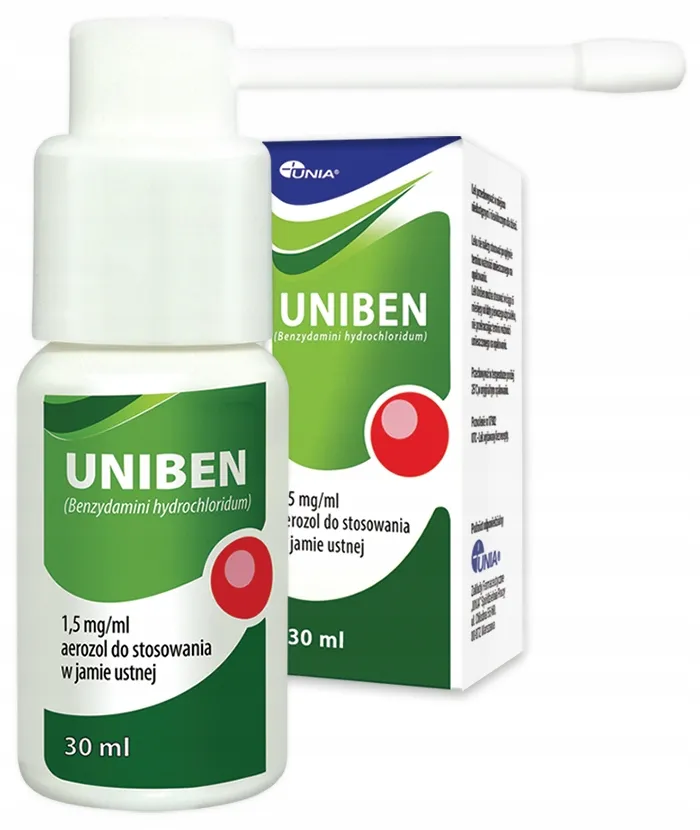
Table of Contents
Package leaflet: Information for the user
UNIBEN
1.5 mg/ml, oral aerosol
Benzydamini hydrochloridum
Please read all of this leaflet carefully before using this medicine, because it contains
important information for the patient.
This medicine should always be used exactly as described in this patient leaflet or as directed by
the doctor or pharmacist.
- Keep this leaflet, so that you can read it again if necessary.
- If advice or further information is needed, consult a pharmacist.
- If the patient experiences any adverse reactions, including any not listed in this leaflet, inform a doctor or pharmacist. See section 4.
- If there is no improvement after 7 days, or if the patient feels worse, consult a doctor.
Contents of the leaflet
- What Uniben is and what it is used for
- Important information before using Uniben
- How to use Uniben
- Possible side effects
- How to store Uniben
- Contents of the pack and other information
1. What Uniben is and what it is used for
Uniben contains the active substance benzydamine hydrochloride, a non-steroidal anti-inflammatory drug (NSAID), which acts locally with anti-inflammatory, analgesic, anaesthetic and antiseptic properties.
Due to its excellent local absorption and high concentration achieved in inflamed tissues, symptoms rapidly subside. The medicine is well tolerated and suitable for local treatment of inflammatory symptoms.
Indications
Local treatment of symptoms associated with acute inflammation of the mouth and throat.
2. Important information before using Uniben
When not to use Uniben
- if the patient is allergic (hypersensitive) to benzidamine hydrochloride or any of the other ingredients of this medicine (listed in section 6).
Warnings and precautions
The use of this medicine, especially long-term, may cause sensitisation. If there is no improvement after short-term use, consult a doctor.
Uniben with other medicines
Inform your doctor or pharmacist about all medicines the patient is currently taking or has recently taken, as well as any medicines the patient plans to take.
No interactions have been observed with other medicines applied locally.
Pregnancy and breastfeeding
If the patient is pregnant or breastfeeding, suspects she may be pregnant, or is planning to have a child, she should consult a doctor or pharmacist before using this medicine.
Uniben should not be used during pregnancy unless absolutely necessary and recommended by a doctor. If use is necessary, the smallest possible number of doses should be used for the shortest possible duration.
Driving and operating machinery
The active substance contained in this medicine has no known effect on the ability to drive or operate machinery.
Uniben contains methyl parahydroxybenzoate (E 218), ethanol, benzyl alcohol, citral, citronellol, eugenol, geraniol, d-limonene, linalool, polysorbate 20 (E 432), and sodium
This medicine contains methyl parahydroxybenzoate and may cause allergic reactions (including delayed-type reactions).
This medicine contains 8.5 mg of alcohol (ethanol) per single dose, i.e. in 0.17 ml of the medicine, which corresponds to 50 mg/ml. The amount of alcohol in a single dose of this medicine is equivalent to less than 1 ml of beer or 1 ml of wine.
The small amount of alcohol in this medicine will not cause noticeable effects.
This medicine contains a fragrance ingredient including benzyl alcohol, citral, citronellol, eugenol, geraniol, d-limonene, and linalool. These may cause allergic reactions.
This medicine contains 0.153 nanograms of benzyl alcohol per dose, i.e. in 0.17 ml of the medicine.
Benzyl alcohol may cause allergic reactions. The medicine may cause mild local irritation.
Administration of benzyl alcohol to young children is associated with the risk of serious adverse effects, including respiratory disturbances (so-called "gasping syndrome").
Do not administer to newborns (up to 4 weeks of age) without a doctor's recommendation.
Do not administer to young children (under 3 years of age) for longer than one week without a doctor's or pharmacist's recommendation.
Pregnant or breastfeeding women should consult a doctor before using this medicine, as large amounts of benzyl alcohol may accumulate in their bodies and cause adverse effects (so-called metabolic acidosis).
Patients with liver or kidney disease should consult a doctor before using this medicine, as large amounts of benzyl alcohol may accumulate in their bodies and cause adverse effects (so-called metabolic acidosis).
This medicine contains polysorbate 20. Polysorbates may cause allergic reactions.
This medicine contains less than 1 mmol (23 mg) of sodium in 0.17 ml of the medicine (1 dose), meaning the medicine is considered "sodium-free".
3. How to use Uniben
This medicine should always be used exactly as described in this patient information leaflet or as directed by a doctor or pharmacist. If in doubt, consult a doctor or pharmacist.
Uniben is applied locally by spraying onto the mucous membrane of the mouth and/or throat.
Children under 6 years of age:
1 dose per 4 kg body weight, administered 2 to 6 times daily.
Regardless of body weight, do not exceed 4 doses at a time.
Children aged 6 to 12 years:
4 doses at a time, administered 2 to 6 times daily.
Adolescents over 12 years of age and adults:
4 to 8 doses at a time, administered 2 to 6 times daily.
One dose of 0.17 ml contains 255 micrograms of benzydamine hydrochloride.

Note: Uniben should not be used for longer than 7 days; any extension of treatment must be decided by a doctor.
Doses of Uniben must not be divided.
If symptoms such as sore throat, difficulty swallowing saliva, or fever worsen or do not improve after 7 days of using Uniben, consult a doctor.
Instructions for administering Uniben:
At first use, press the pump dispenser several times firmly to prime the device and ensure proper spray function.
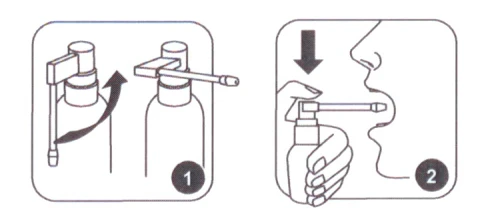
- Turn the dispenser nozzle to the position shown in figure 1.
- Direct the dispenser nozzle into the mouth – as shown in figure 2.
- Press firmly on the dispenser with the thumb or index finger. Repeat this action the required number of times according to the recommended dosage.
If the effect of the medicine seems too strong or too weak, consult a doctor.
Use of a higher than recommended dose of Uniben
There have been no reported cases of overdose with Uniben when used topically.
In case of ingestion of a dose higher than recommended or accidental swallowing of the medicine, contact a doctor or pharmacist immediately.
Missed dose of Uniben
If a dose of Uniben is missed, take it as soon as possible. If it is almost time for the next dose, skip the missed dose. Do not use a double dose to make up for a missed dose.
If you have any further questions about the use of this medicine, consult your doctor or pharmacist.
4. Possible adverse reactions
Like all medicines, this medicine can cause adverse reactions, although they do not occur in everyone.
| System Organ Class | Very rare (less than 1 in 10,000 patients), frequency unknown (cannot be estimated from available data) |
| General disorders and administration site conditions | Burning sensation of the oral mucosa |
| Gastrointestinal disorders | Dry mouth, nausea, and vomiting |
| Immune system disorders | Allergic reaction (hypersensitivity) Severe allergic reaction (anaphylactic shock) with symptoms such as: difficulty breathing, pain or tightness in the chest, and (or) dizziness/fainting, severe skin itching or raised skin rash, swelling of the face, lips, tongue, and (or) throat; these symptoms may be life-threatening. |
| Nervous system disorders | Sensory disturbances, numbness, dizziness, headache |
| Skin and subcutaneous tissue disorders | Rash |
Local adverse reactions are usually transient, resolve spontaneously, and rarely require additional treatment.
Reporting of adverse reactions
If any adverse symptoms occur, including any adverse symptoms not listed in this leaflet, inform your doctor, pharmacist, or nurse. Adverse reactions can be reported directly to the Department of Monitoring Adverse Drug Reactions at the Office for Registration of Medicinal Products, Medical Devices and Biocidal Products:
Al. Jerozolimskie 181C, 02-222 Warsaw
Phone: +48 22 49 21 301, Fax: +48 22 49 21 309
Website: https://smz.ezdrowie.gov.pl
Adverse reactions can also be reported to the marketing authorization holder.
Reporting adverse reactions helps to provide more information on the safety of the medicinal product.
5. How to store Uniben
Keep the medicine out of the sight and reach of children.
Store below 25°C. Keep in the original packaging.
Do not use this medicine after the expiry date stated on the packaging. The expiry date refers to the last day of the stated month.
Uniben can be used within 6 months after the date of first opening, without exceeding the expiry date stated on the packaging.
Enter the date of first opening of the medicine in this box.
Medicines must not be disposed of via wastewater or household waste. Ask your pharmacist how to dispose of medicines no longer required. Such measures will help protect the environment.
6. Contents of the packaging and other information
What Uniben contains
The active substance is benzidamine hydrochloride (1 ml of the medicinal product contains 1.5 mg of benzidamine hydrochloride).
The other ingredients are: glycerol (E 422), sodium saccharin, sodium hydrogen carbonate, 96% ethanol, methyl parahydroxybenzoate (E 218), polysorbate 20 (E 432), peppermint flavour (flavour "fresh peppermint" 506041T) (containing, among others, benzyl alcohol, citral, citronellol, eugenol, geraniol, d-limonene, linalool), purified water.
What Uniben looks like and contents of the pack
Uniben is an oral cavity aerosol contained in a polyethylene bottle with a dosing pump and applicator, containing 30 ml of medicinal product, packed in a cardboard box.
Marketing Authorisation Holder and Manufacturer
Zakłady Farmaceutyczne „UNIA” Spółdzielnia Pracy
ul. Chłodna 56/60
00-872 Warsaw
tel.: 22 620 90 81 ext. 190
fax: 22 654 92 40
e-mail: [email protected]
The Uniben package leaflet is available in the Audio Leaflet system via the national free telephone number: 800 706 848.