Travocort
Poland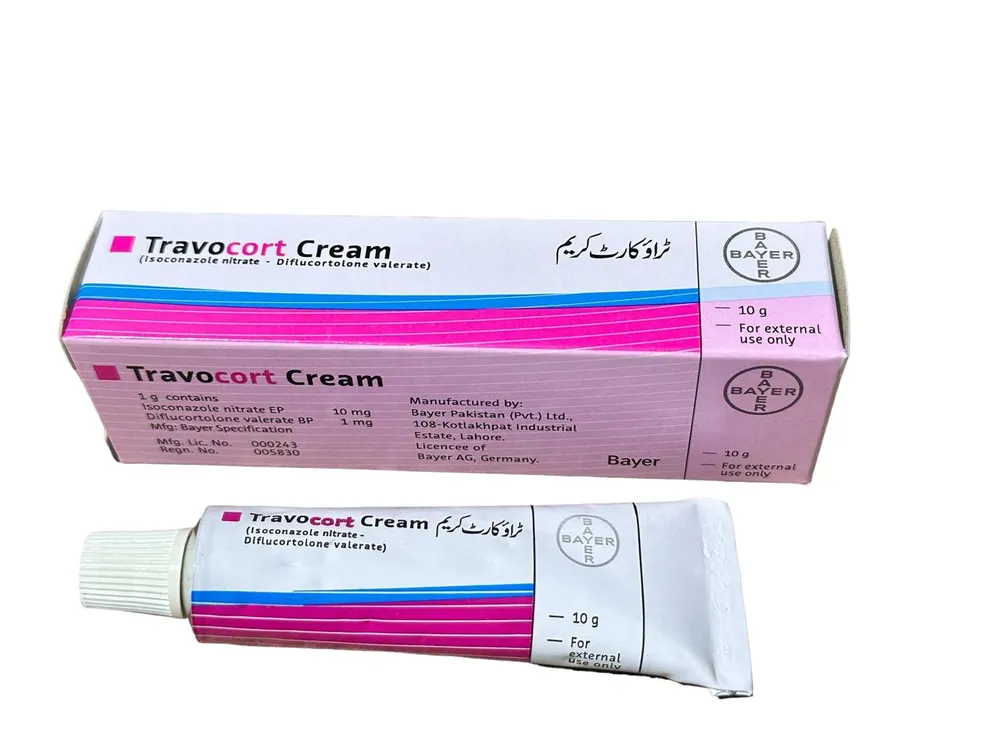
Table of Contents
Patient Information Leaflet
Warning! Keep this leaflet! The packaging contains foreign language information.
Travocort, (10 mg + 1 mg)/g, cream
Isoconazole nitrate + Diflucortolone valerate
Please read this leaflet carefully before using the medicine, as it contains
important information for the patient.
- Keep this leaflet for future reference.
- If you have any questions, please consult your doctor or pharmacist.
- This medicine has been prescribed for a specific individual. Do not pass it on to others. It may harm other people, even if their symptoms are the same.
- If you experience any adverse reactions, including any not listed in this leaflet, inform your doctor or pharmacist. See section 4.
Table of contents:
- What Travocort is and what it is used for
- Important information before using Travocort
- How to use Travocort
- Possible side effects
- How to store Travocort
- Contents of the pack and other information
1. What Travocort is and what it is used for
The medicine contains two active substances: isoconazole nitrate and diflucortolone valerate.
Isoconazole nitrate treats fungal skin infections.
Diflucortolone valerate belongs to a group of medicines called potent corticosteroids, which reduce skin inflammation and relieve symptoms such as itching, burning, and pain.
Travocort is indicated for the initial treatment of superficial fungal skin infections associated with significant inflammatory or eczematous skin changes, e.g. of the hands, interdigital areas of the feet, groin, and genital areas.
2. Important information before using Travocort
When not to use Travocort:
- if the patient is allergic (hypersensitive) to isokonazol nitrate and diflucortolone valerate or to any of the other ingredients of this medicine (listed in section 6),
- for syphilitic or tuberculous skin lesions,
- for skin changes caused by viral skin diseases (e.g. chickenpox, shingles, herpes),
- for lesions caused by rosacea, common acne, perioral dermatitis, or local reactions after vaccination.
Warnings and precautions
Before starting treatment with Travocort, discuss this with your doctor or pharmacist.
- If there is a concurrent bacterial superinfection, the doctor will initiate appropriate antibacterial treatment.
- Avoid contact of the medicine with eyes and mucous membranes. If the medicine gets into the eyes, rinse them thoroughly with water.
- Using the medicine on large areas of skin or for prolonged periods, particularly under occlusive dressings, increases the risk of systemic adverse effects.
- If the patient has glaucoma, inform the doctor. There is a risk of developing glaucoma during treatment with Travocort, especially when the medicine is used under occlusive dressings, on large skin areas, for long periods, or when applied to skin near the eyes.
- If the patient experiences blurred vision or other visual disturbances, contact a doctor.
- When Travocort is used in the genital area, some of its ingredients may damage latex in condoms and vaginal diaphragms. Therefore, they may become ineffective as mechanical contraceptives or as protection against sexually transmitted infections. For more detailed information, consult a doctor or pharmacist.
Travocort should be used with particular caution and only for a short time on facial skin and in children. In children,
there is a higher risk of systemic effects from topically applied corticosteroids
than in adults.
- Maintaining proper hygiene is essential during treatment with Travocort. To prevent recurrence of the disease, the following should be observed:
- change personal clothing, bed linen, and towels (preferably cotton) daily and wash them in very hot water or boil them,
- dry thoroughly the areas between fingers after washing,
- change socks or tights daily and wash them in very hot water or boil them.
Travocort and other medicines
Inform your doctor or pharmacist about all medicines currently used or recently used, as well as any medicines planned for use.
No interaction studies have been conducted between Travocort and other medicines.
Pregnancy, breastfeeding, and fertility
If the patient is pregnant or breastfeeding, suspects she may be pregnant, or is planning to become pregnant, she should consult a doctor or pharmacist before using this medicine. The doctor will carefully assess whether the benefits to the mother outweigh the potential risks to the fetus.
Pregnancy
Travocort should not be used during the first trimester of pregnancy. Whether the medicine can be used during the remainder of pregnancy will be decided by the doctor after considering the benefit-risk ratio. During pregnancy, particular care should be taken to avoid using the medicine on large skin areas, for prolonged periods, or under occlusive dressings.
Breastfeeding
It is not known whether Travocort passes into human milk; however, a risk to the health of a breastfed infant cannot be excluded.
During breastfeeding, avoid using Travocort:
- on the skin of the breasts,
- under occlusive dressings or on large skin areas,
- for prolonged periods.
Effect on fertility
There are no data regarding any negative effect of Travocort on fertility.
Driving and operating machinery
It is unlikely that Travocort will affect the ability to drive or operate machinery.
Travocort contains a small amount of cetostearyl alcohol.
Travocort contains cetostearyl alcohol, which may cause skin reactions (e.g. contact dermatitis).
3. How to use Travocort
This medicine should always be used as directed by a doctor or pharmacist. If you have any doubts,
consult your doctor or pharmacist.
Dosage
A thin layer of Travocort should be applied to the affected skin area twice daily.
Treatment with Travocort should be discontinued once the skin condition has improved. Treatment
usually should not last longer than two weeks. If necessary, the doctor may continue treatment with
an antifungal medicine not containing a corticosteroid, especially when the medicine is used in the
groin or genital areas.
Maintaining proper hygiene is essential during treatment with Travocort (see section 2).
Use in children and adolescents
No dosage adjustment of Travocort is necessary in children aged 2 years and older and in adolescents.
Travocort should not be used in children under 2 years of age.
Use of more than the recommended dose of Travocort
It is unlikely that Travocort will cause acute poisoning after a single application of an excessive
amount or after accidental ingestion of the medicine.
Missed dose of Travocort
Do not use a double dose to make up for a missed dose.
Apply the next dose at the scheduled time and continue treatment according to the prescribed
dosage regimen.
If you have any further doubts regarding the use of this medicine, consult your doctor or pharmacist.
4. Possible adverse reactions
Like all medicines, this medicine can cause adverse reactions, although not everyone experiences them.
The following adverse reactions observed in clinical trials are listed according to their frequency:
Common (occur in more than 1 in 10 patients)
- skin irritation or burning sensation at the application site.
Uncommon (occur in more than 1 in 100 patients)
- redness, dryness at the application site,
- skin stretch marks.
Not known (frequency cannot be estimated from available data)
- itching or blistering at the application site,
- blurred vision.
Additionally, as with topical use of other corticosteroids, the following adverse reactions (frequency not known) may occur:
skin thinning (atrophy), inflammation of hair follicles at the application site, excessive hair growth, dilation of superficial blood vessels (telangiectasia), perioral dermatitis, skin discoloration, acne-like changes and/or skin allergic reactions to any component of Travocort. Systemic adverse reactions may also occur, as the components of the medicine can penetrate through the skin.
The occurrence of adverse reactions in newborns whose mothers used this medicine for prolonged periods or over large areas of skin during pregnancy or breastfeeding cannot be ruled out.
For example, reduced adrenal cortex function or reduced child's immunity to diseases may occur.
If any of the adverse reactions worsen or if any adverse reactions not listed in this leaflet occur, inform your doctor or pharmacist.
Reporting of adverse reactions
If any adverse reactions occur, including any not listed in this leaflet, tell your doctor or pharmacist. Adverse reactions can also be reported directly to the Department of Monitoring Adverse Drug Reactions, Office for Registration of Medicinal Products, Medical Devices and Biocidal Products, Al. Jerozolimskie 181C, 02-222 Warsaw, tel.: + 48 22 49 21 301, fax: + 48 22 49 21 309, website: https://smz.ezdrowie.gov.pl.
Reporting adverse reactions helps to provide more information on the safety of the medicine.
5. How to store Travocort
Keep the medicine out of sight and reach of children.
Store below 25°C.
Do not use Travocort after the expiry date stated on the packaging. The expiry date refers to the last day of the stated month.
Medicines must not be disposed of via wastewater or household waste. Ask your pharmacist how to dispose of medicines no longer required. Such measures help protect the environment.
6. Contents of the package and other information
What Travocort contains
- The active substances in the medicine are: isokonazol nitrate and diflucortolone valerate. 1 g of cream contains 10 mg of isokonazol nitrate and 1 mg of diflucortolone valerate.
- Other components: white vaseline, liquid paraffin, cetostearyl alcohol, polysorbate 60, stearyl sorbitan ester, disodium edetate, purified water.
What Travocort looks like and contents of the pack
Travocort is a yellowish-white, opaque cream.
The packaging is an aluminium tube with a cap made of HDPE containing 15 g of cream, placed in a cardboard box.
For more detailed information, please contact the responsible entity or the parallel importer.
Responsible entity in Croatia, country of export:
LEO Pharma A/S, Industriparken 55, DK-2750 Ballerup, Denmark
Manufacturer:
LEO Pharma Manufacturing Italy S.r.l., Via E. Schering 21, 20054 Segrate (Milan), Italy
Parallel importer:
InPharm Sp. z o.o., Strumykowa 28/11, 03-138 Warsaw, Poland
Repackaged in:
InPharm Sp. z o.o. Services sp. k., Chełmżyńska 249, 04-458 Warsaw, Poland
Marketing authorisation number in Croatia, country of export: HR-H-939866694-01
Parallel import authorisation number: 16/26