Thiopental panpharma
Poland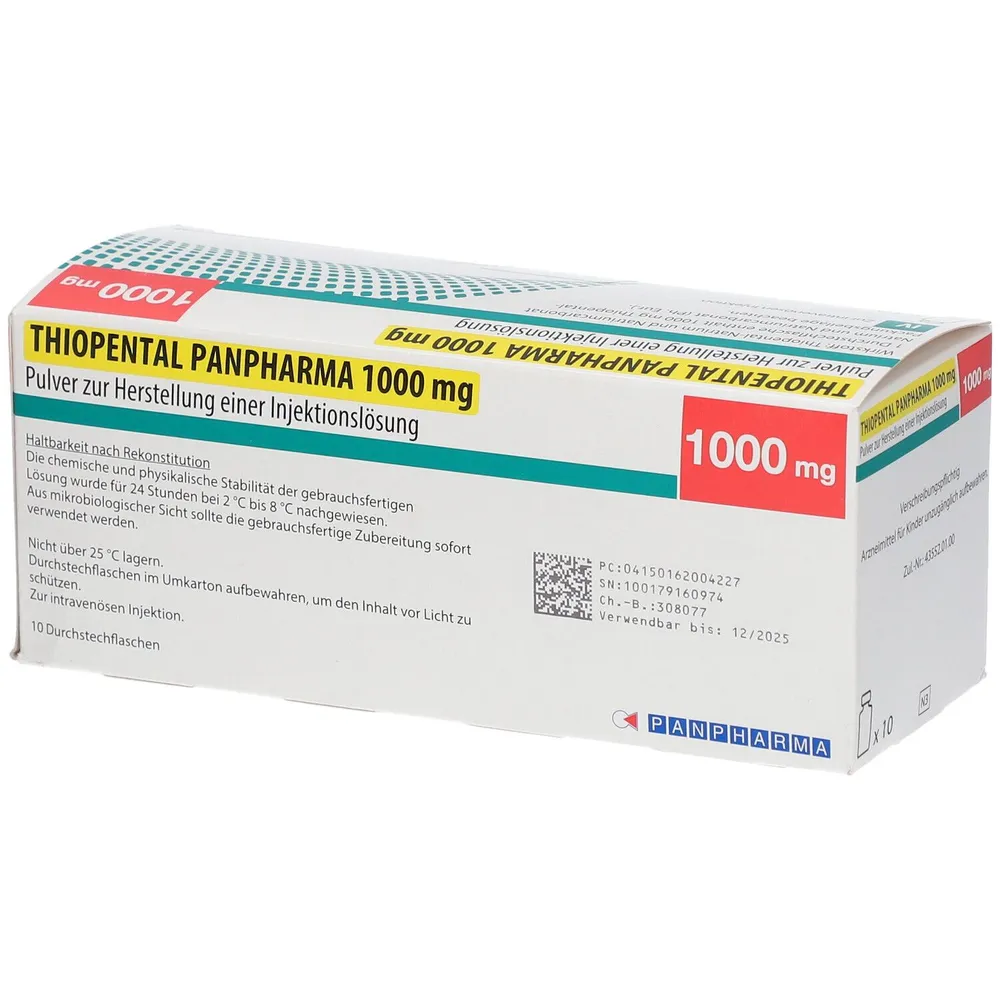
Table of Contents
- Package leaflet: Information for the patient
- 1. What Tiopental Panpharma is and what it is used for
- 2. Important information before using Tiopental Panpharma
- 3. How Tiopental Panpharma is administered
- 4. Possible adverse reactions
- 5. How to store Tiopental Panpharma
- 6. Contents of the pack and other information
Package leaflet: Information for the patient
Tiopental Panpharma, 500 mg, powder for solution for injection
Tiopental Panpharma, 1 g, powder for solution for injection
Sodium thiopental with sodium carbonate
Please read carefully the entire leaflet before using this medicine, as it contains
important information for the patient.
Keep this leaflet, so that you can read it again if necessary.
If you have any further questions, please consult your doctor or pharmacist.
- If you experience any adverse reactions, including any adverse reactions not listed in this leaflet, inform your doctor or pharmacist. See section 4.
Table of contents of the leaflet:
- What Tiopental Panpharma is and what it is used for
- Important information before using Tiopental Panpharma
- How Tiopental Panpharma is administered
- Possible side effects
- How to store Tiopental Panpharma
- Contents of the pack and other information
1. What Tiopental Panpharma is and what it is used for
Tiopental Panpharma is a barbiturate anaesthetic agent.
Tiopental Panpharma is used:
- For short-term anaesthesia without intubation (short-term anaesthesia during surgical procedures not requiring any preparation for artificial ventilation),
- For induction of general anaesthesia with or without intubation (induction of prolonged anaesthesia during surgical procedures with or without patient preparation for artificial ventilation).
Note: As with all barbiturates, administration of an analgesic agent is required
during anaesthesia with Tiopental Panpharma.
2. Important information before using Tiopental Panpharma
Do not use Tiopental Panpharma if the patient:
- is allergic to sodium thiopental and sodium carbonate or other barbiturates (medicines which are chemically similar to Tiopental Panpharma and are used in patients with seizures and for anesthesia), or any of the other ingredients of this medicine (listed in section 6),
- has acute alcohol intoxication, hypnotics, analgesics, or psychotropic drugs (medicines used in the treatment of psychiatric disorders),
- has porphyria (a serious disease caused by a disturbance in hemoglobin synthesis), malignant hypertension (very high blood pressure), shock (sudden circulatory failure), or status asthmaticus (life-threatening breathing difficulties caused by narrowing of the small airways).
If any of these conditions apply to the patient, inform the doctor or nurse.
They will usually decide to use another medicine.
Warnings and precautions
Talk to your doctor or pharmacist before receiving Tiopental Panpharma.
Tiopental Panpharma must be used only under specific conditions and with special caution. Ask your doctor for detailed information, including if any of these conditions have ever applied to the patient in the past.
Tiopental Panpharma should be used with particular caution in the following cases:
- obstructive respiratory disease (breathing disorders due to narrowing of the airways, e.g., bronchial asthma),
- hypovolemia (low circulating blood volume due to blood or fluid loss),
- severe myocardial damage,
- severe impairment of kidney or liver function,
- in infants,
- metabolic disorders, including diabetes.
Inform the doctor if any of the above conditions apply to the patient.
In such cases, Tiopental Panpharma may be administered only if all prerequisite conditions are met, including availability of personnel and equipment for managing potential emergencies such as respiratory failure and respiratory arrest.
There is a risk of severe hypotension (low blood pressure) if the drug is administered too rapidly (e.g., as a bolus injection). Therefore, Tiopental Panpharma must be administered slowly. Tiopental Panpharma is not intended for continuous infusion. Tissue necrosis has been observed following continuous infusion of Tiopental Panpharma lasting more than several hours.
If the injection is accidentally administered intra-arterially or extravasated beside a vein, tissue necrosis (tissue death) or severe painful neuritis may occur. The entire arm should be immobilized, and the doctor must take all necessary steps to aspirate the previously injected solution through a permanently placed cannula. Healing may be accelerated by applying moist dressings, possibly soaked in alcohol. In cases of larger volume extravasation, drugs promoting diffusion (e.g., hyaluronidase) may be used. Additionally, the adjacent area may be infiltrated with a 1% procaine solution. To dilute the infiltrated Tiopental Panpharma solution in tissues, isotonic sodium chloride solution should be administered subcutaneously.
Children
During diagnostic or therapeutic procedures involving the upper airways, hyperreflexia (exaggerated reflexes) and laryngospasm (spasm of the vocal cords) may occur, particularly in children.
Tiopental Panpharma and other medicines
Tell your doctor, pharmacist, or nurse about all medicines the patient is currently taking or has recently taken, including those purchased without a prescription.
The following medicines affect Tiopental Panpharma:
-
When used concomitantly with other central nervous system depressants (e.g., benzodiazepines) or alcohol, additional central nervous system depression may occur. For the same reason, combined use with other drugs that depress respiratory center function (such as opioids) may result in additive respiratory depression.
-
Furthermore, substances that compete with Tiopental Panpharma for plasma protein binding, such as sulfonamides, may enhance the effect of Tiopental Panpharma and lead to a reduced induction dose requirement.
Tiopental Panpharma affects other medicines:
- If Tiopental Panpharma is administered repeatedly at short intervals, it may induce liver enzymes. This may accelerate the breakdown of other drugs such as coumarin derivatives, corticosteroids, and oral contraceptives, thereby reducing their effectiveness.
- Additionally, it increases the toxic effects of methotrexate.
Taking Tiopental Panpharma with food, drink, and alcohol
Before and after anesthesia, under no circumstances should any food or drink containing alcohol be consumed.
Pregnancy and breastfeeding
If the patient is pregnant, breastfeeding, suspects she may be pregnant, or is planning to have a child, she should consult her doctor, pharmacist, or nurse before using this medicine.
Tiopental Panpharma crosses the placenta. Therefore, general anesthesia using Tiopental Panpharma in pregnant women should be used only if absolutely necessary and after careful assessment of risks and benefits.
Tiopental Panpharma passes into human milk. Drug concentrations in breastfed infants may be higher than in the mother due to immature metabolism. Tiopental Panpharma is detectable in human milk for up to 36 hours after injection. Breastfeeding should be avoided during this period.
Driving and operating machinery
After administration of anesthesia with Tiopental Panpharma, the patient's ability to respond quickly and appropriately to unexpected or sudden events may be impaired. Therefore, the patient should not drive a car or operate any other vehicle after an outpatient surgical procedure.
The patient should return home under supervision and must not consume alcohol under any circumstances.
Ask the doctor how long these precautions should be maintained. During this time, patients should not operate electrical equipment or machinery, nor perform any work without a stable support base.
Tiopental Panpharma contains sodium
Tiopental Panpharma 500 mg powder for solution for injection contains 53 mg of sodium (the main component of table salt) per vial. This corresponds to 2.65% of the maximum recommended daily sodium intake in the adult diet.
Tiopental Panpharma 1 g powder for solution for injection contains 106 mg of sodium (the main component of table salt) per vial. This corresponds to 5.3% of the maximum recommended daily sodium intake in the adult diet.
3. How Tiopental Panpharma is administered
This injection is administered by a doctor in a hospital. The medicine should be used according to the dosing recommendations provided below or as directed by the physician.
Tiopental Panpharma should only be used when qualified personnel and essential specialist equipment for resuscitation and endotracheal intubation are available to manage acute medical emergencies such as respiratory failure and respiratory arrest.
The recommended dose is determined based on the individual patient's sensitivity and the desired depth of anesthesia. The following information provides general guidelines; the safest method to achieve optimal effect is gradual, repeated administration of small doses.
For induction of general anesthesia, the intravenous dose averages 5 mg of Tiopental Panpharma per kilogram of body weight. The duration of action lasts from 6 to 8 minutes. Typically, a dose of 100 to 200 mg of sodium thiopental is slowly injected over 20 seconds.
Additional doses depend on the patient's sensitivity and the desired depth of anesthesia.
In the case of short-term anesthesia, the total dose should generally not exceed twice the induction dose, i.e., 100 to 200 mg of sodium thiopental.
The total dose required for a surgical procedure may range from 400 mg to 1 g of sodium thiopental.
Elderly patients
Due to slower metabolism in elderly patients, an increased effect of the medicinal product should be expected. Therefore, the dose should be appropriately reduced.
Use in patients with liver or kidney disease
In patients with impaired liver or kidney function, the dose of the medicine must be adjusted according to the degree of impairment.
In case of an overdose of Tiopental Panpharma
Treatment of overdose is symptomatic and should be carried out under intensive medical care and by qualified medical personnel or the treating physician. Nevertheless, the following adverse effects may occur in case of overdose.
If a patient has received a higher dose of Tiopental Panpharma than recommended, a sudden drop in blood pressure may occur, potentially leading to shock. Due to inadequate cardiac pumping function, pulmonary edema may develop. The drop in blood pressure may also result from an allergic reaction; if such a reaction occurs, allergic skin manifestations usually accompany it.
Additionally, overdose may cause breathing difficulties (prolonged respiratory failure or respiratory arrest), which may be life-threatening without connecting the patient to artificial ventilation. A sudden decrease in body temperature may also occur.
If you have any further questions regarding the use of this medicine, consult your doctor or pharmacist.
4. Possible adverse reactions
If any of the following symptoms occur in the patient, inform the doctor immediately – urgent medical assistance may be required:
difficulty breathing, wheezing, rash, urticaria, and dizziness. This may be a severe allergic reaction (frequency unknown, cannot be estimated based on available data).
Like all medicines, this medicine can cause adverse reactions, although not everyone experiences them.
Since Tiopental Panpharma is practically always administered in combination with other anaesthetic medicines, it is not always possible to determine which of the administered anaesthetics actually caused the observed adverse reactions.
Inform the doctor or nurse immediately if the patient experiences any of the following adverse reactions.
Common (may affect up to 1 in 10 patients):
- Breathing difficulties with short periods of apnoea
- Hiccups during spontaneous breathing and breathing through a mask
- Euphoria and dream-like states, sometimes nightmares
- Hypersensitivity reactions, e.g. bronchial asthma and laryngospasm
- Redness and swelling of the skin
Very rare (may affect up to 1 in 10,000 patients):
- Severe allergic reactions leading to sudden and serious conditions with risk of cardiac arrest (sudden loss of heart function) and respiratory arrest (absence of breathing)
- Anaesthesia-related reduction in red blood cells due to premature destruction of cells, associated with kidney damage
Frequency unknown (frequency cannot be estimated based on available data):
- Nausea and vomiting (caused by another medicine given in combination)
- Coughing and sneezing
- Pain at the site of the blood vessel following intravenous injection
- Blood clots formation
- Phlebitis (inflammation of the vein)
Reporting of adverse reactions
If any adverse reactions occur, including any adverse reactions not listed in this leaflet, inform the doctor, nurse, or pharmacist. Adverse reactions can be reported directly to the Department of Monitoring Adverse Drug Reactions of the Office for Registration of Medicinal Products, Medical Devices and Biocidal Products
Al. Jerozolimskie 181C
02-222 Warsaw
Tel.: +48 22 49 21 301
Faks: +48 22 49 21 309
e-mail: [email protected]
Adverse reactions can also be reported to the marketing authorisation holder.
Reporting adverse reactions helps to provide more information on the safety of the medicine.
5. How to store Tiopental Panpharma
The medicine should be stored out of the sight and reach of children.
There are no special storage requirements for this medicine.
For single use only after reconstitution. Any unused remnants must be discarded after use.
After reconstitution:
The medicine should be used immediately after reconstitution. If the medicine is not administered immediately,
the user assumes responsibility for the subsequent storage period and conditions, which generally should not exceed
9 hours at a temperature below 25°C and 24 hours in a refrigerator at a temperature of 2 to 8°C,
if reconstitution has not been carried out under controlled and validated aseptic conditions.
After reconstitution with Water for Injections and 0.9% sodium chloride solution,
physicochemical stability of the solution has been demonstrated for 9 hours at temperatures below 25°C
and for 24 hours in a refrigerator at 2 to 8°C.
Do not use this medicine after the expiry date stated on the packaging after the EXP abbreviation.
The expiry date refers to the last day of the stated month.
Medicines must not be disposed of via wastewater or household waste. Medical professionals
will dispose of the medicine when it is no longer needed. This will help protect
the environment.
6. Contents of the pack and other information
What Tiopental Panpharma contains
The active substance is sodium thiopental with sodium carbonate.
One vial of Tiopental Panpharma 500 mg powder for solution for injection contains 500 mg of sodium thiopental with sodium carbonate (equivalent to 470 mg of sodium thiopental).
One vial of Tiopental Panpharma 1 g powder for solution for injection contains 1 g of sodium thiopental with sodium carbonate (equivalent to 0.94 g of sodium thiopental).
What Tiopental Panpharma looks like and contents of the pack
20 mL vials made of colourless glass (type III) with a bromobutyl rubber stopper coated with Teflon, an aluminium seal, and a blue or grey polypropylene cap (blue for the 500 mg dose, grey for the 1 g dose), packed in a cardboard box.
Pack sizes: 1, 10, 25 and 50 vials.
Marketing Authorisation Holder and Manufacturer
Marketing Authorisation Holder
PANPHARMA
Z.I. du Clairay
35133 Luitré
France
Manufacturer
Panpharma
10 rue du Chênot
Parc d’Activité du Chênot
56380 Beignon
France
This medicinal product is authorised in the European Economic Area under the following names:
| Malta | Thiopental Panpharma 500mg powder for solution for injection |
| Thiopental Panpharma 1g powder for solution for injection | |
| Polska | Tiopental Panpharma |
| Romania | Thiopental sodic Panpharma 500 mg, powder for injectable solution |
| Thiopental sodic Panpharma 1 g, powder for injectable solution |
---------- --------------------------------------------------------------------------------------------------
Information intended exclusively for medical professionals:
Tiopental Panpharma, 500 mg, powder for solution for injection
Tiopental Panpharma, 1 g, powder for solution for injection
Special precautions regarding disposal and preparation of the medicinal product for use
The Tiopental Panpharma medicinal product must not be mixed with other solutions for injection or infusion (except those listed below). Furthermore, the reconstituted solution must not be administered together with other injectable solutions or infusions. Solutions prepared from the Tiopental Panpharma medicinal product are strongly alkaline and are incompatible with blood volume expanders and acidic adjuvant anaesthetic solutions, as precipitation may occur and lead to needle blockage during injection. For this reason, chemical changes in the added solution cannot be excluded.
Preparation of the injection solution:
The Tiopental Panpharma 500 mg and 1 g medicinal product is used as a 2.5% or 5% solution for injection.
For a 2.5% solution for injection, the contents of one vial of Tiopental Panpharma 500 mg should be dissolved in 20 mL of water for injections or 0.9% sodium chloride solution.
For a 5% solution for injection, the contents of one vial of Tiopental Panpharma 500 mg should be dissolved in 10 mL of water for injections or 0.9% sodium chloride solution.
For a 2.5% solution for injection, the contents of one vial of Tiopental Panpharma 1 g should be dissolved in 40 mL of water for injections or 0.9% sodium chloride solution.
For a 5% solution for injection, the contents of one vial of Tiopental Panpharma 1 g should be dissolved in 20 mL of water for injections or 0.9% sodium chloride solution.
Method of administration:
When administered by injection for anaesthesia, the Tiopental Panpharma medicinal product is dissolved in water for injections or 0.9% sodium chloride solution and then slowly injected intravenously.
Multiple injections may be given.
In some cases, acute tolerance has been observed; i.e., a higher dose may be required after the initial effective anaesthetic dose to achieve the same effect. On the other hand, when administering repeated doses, accumulation of the substance should be taken into account.
Do not administer any solution of this medicinal product if a precipitate is visible. Solutions should be used immediately after preparation.
Any unused portions of the medicinal product or waste material must be disposed of in accordance with local regulations.
Overdose:
The typical symptom of overdose is a sudden drop in blood pressure, which may lead to shock. Due to insufficient cardiac pumping function, pulmonary oedema may occur. Decreased blood pressure may also result from an allergic reaction; however, such a reaction usually occurs in conjunction with allergic skin reactions.
Overdose may cause prolonged respiratory depression or respiratory arrest, which may be life-threatening after discontinuation of artificial ventilation. A sudden decrease in body temperature occurs.
Treatment of overdose is symptomatic and should be carried out under intensive medical care conditions by qualified medical personnel or the treating physician. Nevertheless, the following adverse effects may occur in case of overdose.
Treatment with plasma volume-expanding infusion solutions is indicated as a measure to counteract decreased blood pressure and shock. Dopamine (2 to 5 μg/kg body weight/min) or norepinephrine (noradrenaline 0.1 to 0.2 μg/kg body weight/min) may be added to the infusion solution. Body temperature should be restored to normal values.