Thorens
PolandTable of Contents
Package leaflet: Information for the user
THORENS, 10,000 IU/ml, oral drops, solution
Cholecalciferol (vitamin D3)
Please read all of this leaflet carefully before taking this medicine, because it contains important information for you.
- Keep this leaflet. You may need to read it again.
- If you have any further questions, ask your doctor, pharmacist, or nurse.
- This medicine has been prescribed for a specific individual. Do not pass it on to others. It may harm someone else, even if their symptoms are the same.
- If you experience any side effects, including any not listed in this leaflet, tell your doctor, pharmacist, or nurse. See section 4.
Contents of the leaflet
- What THORENS is and what it is used for
- Important information before taking THORENS
- How to take THORENS
- Possible side effects
- How to store THORENS
- Contents of the pack and other information
1. What THORENS is and what it is used for
THORENS oral drops, solution contains cholecalciferol (vitamin D3). Vitamin D3 is found in certain foods and is also produced by the body when the skin is exposed to sunlight. Vitamin D3 helps the absorption of calcium in the kidneys and intestines and supports bone tissue formation. Vitamin D deficiency is the main cause of rickets (impaired bone mineralization in children) and osteomalacia (inadequate bone mineralization in adults).
THORENS oral drops, solution is used for the prevention and treatment of vitamin D deficiency in adults, adolescents, and children at risk of vitamin D deficiency.
THORENS oral drops, solution may also be used as an adjunct in patients taking medications for osteoporosis.
2. Important information before taking THORENS
When not to take THORENS:
- if you are allergic to vitamin D3 or any of the other ingredients of this medicine (listed in section 6);
- if you have high levels of calcium in your blood (hypercalcemia) or in your urine (hypercalciuria);
- if you have kidney stones (nephrolithiasis) or severe kidney disorders;
- if you have high levels of vitamin D in your blood (hypervitaminosis D).
Warnings and precautions
Before starting THORENS, discuss with your doctor or pharmacist if:
- you are taking certain medicines used to treat heart conditions (e.g. cardiac glycosides such as digoxin);
- you have sarcoidosis (an immune system disorder which may cause increased vitamin D levels in the body);
- you are taking medicines containing vitamin D or consuming foods or milk fortified with vitamin D;
- you are likely to be exposed to large amounts of sunlight during treatment with THORENS;
- you are taking additional calcium supplements. In this case, your doctor will monitor your blood calcium levels to ensure they do not become too high during treatment with THORENS;
- you have damaged or diseased kidneys. In such cases, your doctor may decide to measure calcium levels in your blood or urine;
- you are taking vitamin D long-term at a daily dose exceeding 1000 IU (1000 international units). In this case, your doctor should monitor your blood calcium levels through laboratory tests.
THORENS with other medicines
Tell your doctor or pharmacist about all medicines you are currently taking, have recently taken, or plan to take. This is especially important if you are taking:
- medicines affecting the heart or kidneys, e.g. cardiac glycosides (e.g. digoxin) or diuretics (e.g. bendroflumethiazide). When taken together with vitamin D3, these medicines may cause a significant increase in calcium levels in the blood and urine;
- medicines containing vitamin D3 or foods rich in vitamin D3, e.g. certain types of vitamin D3-fortified milk;
- actinomycin (a medicine used in the treatment of certain malignant tumors) and antifungal medicines that are imidazole derivatives (e.g. clotrimazole and ketoconazole, used to treat fungal infections). These medicines may affect the chemical transformations that vitamin D3 undergoes in the body;
- the following medicines, as they may affect the action of vitamin D3 or its absorption:
- anticonvulsants (antiepileptic drugs), barbiturates;
- glucocorticoids (steroid hormones, including hydrocortisone and prednisolone). These may reduce the effects of vitamin D3;
- cholesterol-lowering medicines (e.g. cholestyramine or colestipol);
- certain weight-loss medicines that reduce fat absorption from the gastrointestinal tract (e.g. orlistat);
- certain laxatives (e.g. liquid paraffin).
THORENS with food, drink, and alcohol
This medicine should preferably be taken during a main meal to enhance absorption of vitamin D3 by the body. To facilitate administration, the drops may be mixed with cold or lukewarm food. For detailed instructions, see section 3 "How to take THORENS".
Pregnancy, breastfeeding, and fertility
If you are pregnant or breastfeeding, think you may be pregnant, or are planning to have a baby, you should consult your doctor or pharmacist before using this medicine. THORENS may be used during pregnancy and breastfeeding only if recommended by a doctor.
During pregnancy, overdosage must be avoided, as prolonged hypercalcemia may lead to delayed physical and mental development in the child, supravalvular aortic stenosis, and retinopathy.
Driving and using machines
Information on the possible effect of this medicine on the ability to drive is limited. However, no effect of this medicine on the ability to drive and operate machinery is expected.
3. How to use the medicine T
This medicine should always be taken exactly as directed by the doctor or pharmacist.
If in doubt, consult your doctor or pharmacist.
Shake well before use.
Medicine T is best taken during a substantial meal.
This medicine has an olive oil flavour. It may be taken as supplied, or the prescribed number of drops may be mixed with a teaspoon or a small amount of cold or lukewarm food immediately before administration. Ensure that the entire dose is administered.
Use in adults
The recommended dose for the prevention of vitamin D deficiency and as an adjunct in patients receiving treatment for osteoporosis is 3 to 4 drops (600–800 IU) daily.
For the treatment of vitamin D deficiency, the usual dose is 4 drops (800 IU) daily.
Higher doses must be adjusted according to the desired serum concentration of 25-hydroxycholecalciferol (25(OH)D), severity of the disease, and the patient's response to treatment.
The daily dose should not exceed 4000 IU (20 drops per day).
Use in children and adolescents
For the prevention of vitamin D deficiency in children (aged 0 to 11 years) with identified risk factors, the recommended dose is 2 DROPS (400 IU) daily. For the prevention of vitamin D deficiency in adolescents (aged 12 to 18 years) with identified risk factors, the recommended dose is 3 to 4 drops (600–800 IU) daily.
For the treatment of vitamin D deficiency in children (aged 0 to 11 years) and adolescents (aged 12 to 18 years), the dose should be adjusted according to the desired serum concentration of 25-hydroxycholecalciferol (25(OH)D), severity of the disease, and the patient's response to treatment. The daily dose should not exceed 1000 IU in infants under 1 year of age, 2000 IU in children aged 1 to 10 years, and 4000 IU in adolescents.
In children, medicine THORENS may be mixed with a small amount of infant food, yoghurt, milk, cheese, or other dairy products. The medicine should not be mixed with milk in a bottle or with soft foods in containers, as the child may not consume the full portion and thus may not receive the complete dose. Ensure that the entire dose is administered. In children who are no longer breastfed, the prescribed dose should be given during a sufficiently substantial meal.
Do not store any food products or food mixtures containing medicine T for later use or for the next meal.
Use during pregnancy and breastfeeding
The recommended dose is 400 IU/day (2 drops). Higher doses may be required following confirmation of vitamin D deficiency, but the dose should not exceed that prescribed by the doctor.
Instructions for use of the bottle with dropper
The package contains 1 bottle and a dropper with a cap. The bottle is closed with a plastic screw cap with child-resistant safety feature. The dropper is protected by a plastic cover. Before use, shake the bottle and follow the instructions below:
a. To open the bottle, press down and simultaneously twist the plastic cap (see Figure 1).
b. Unscrew the plastic protective cover protecting the glass body of the dropper (see Figure 2).
c. Insert the glass tip of the dropper into the bottle to draw up the contents. Dispense the number of drops prescribed by the doctor onto a spoon.
d. To close the bottle, remove the dropper from the bottle and then screw the plastic cap back on (see Figure 3).
e. Carefully replace the plastic cover onto the dropper to protect the glass body.
f. Place the capped bottle and the dropper with the plastic cover back into the original cardboard box.
Figure 1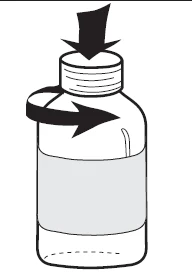 | Figure 2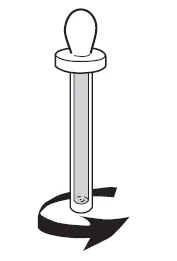 | Figure 3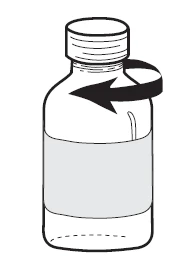 |
Instructions for using the dropper bottle
The box contains a dropper bottle. The dropper bottle is closed with a child-resistant cap. Instructions for opening and use are provided below:
a. To open the dropper bottle, press down and simultaneously twist the plastic cap.
b. Turn the dropper bottle upside down and dispense the number of drops prescribed by the doctor onto a spoon.
c. After administering the drops, turn the dropper bottle back to its normal upright position.
d. To close the dropper bottle, screw the plastic cap back on securely.
e. Return the dropper bottle to its original cardboard box.
Taking more medicine T than recommended
If you take more medicine T than prescribed, stop using it immediately and contact your doctor. If you are unable to speak with a doctor, go to the nearest hospital emergency department, taking with you the leaflet included in the medicine’s packaging.
The most common symptoms of overdose are: nausea, vomiting, increased thirst, excessive urine production over 24 hours, constipation and dehydration, elevated calcium levels in blood and urine (hypercalcemia and hypercalciuria) detected in laboratory tests.
Missing a dose of medicine T
If you miss a dose of medicine T, take it as soon as possible. Take the next dose at the usual time. However, if it is almost time for the next dose, do not take the missed dose—only take the next scheduled dose at the regular time.
Do not take a double dose to make up for a missed dose.
If you have any further doubts regarding the use of this medicine, consult your doctor or pharmacist.
4. Possible adverse reactions
Like any medicine, this medicine can cause adverse reactions, although they do not occur in all individuals.
Possible adverse reactions reported during the use of medicine T may include:
Uncommon (in less than 1 out of 100 people)
- excessive calcium in the blood (hypercalcaemia)
- excessive calcium in urine (hypercalciuria)
Rare (in less than 1 out of 1,000 people)
- skin rash
- itching
- urticaria
Reporting of adverse reactions
If any adverse symptoms occur, including any adverse symptoms not listed in this leaflet, patients should inform their doctor or pharmacist. Adverse reactions can also be reported directly to the Department of Monitoring Adverse Drug Reactions of the Office for Registration of Medicinal Products, Medical Devices and Biocidal Products:
Al. Jerozolimskie 181C, 02-222 Warsaw
tel.: + 48 22 49 21 301
fax: + 48 22 49 21 309
e-mail: https://smz.ezdrowie.gov.pl
Adverse reactions can also be reported to the marketing authorization holder.
Reporting adverse reactions helps to provide more information on the safety of the medicine.
5. How to store medicine T
Keep the medicine out of the sight and reach of children.
Do not use this medicine after the expiry date stated on the cardboard box and container after EXP. The expiry date refers to the last day of the stated month.
Do not store above 30°C.
Do not store in a refrigerator or freeze.
Keep the container in the outer packaging to protect from light.
After first opening the container: the product may be stored for up to 6 months.
Do not use this medicine if cloudiness of the solution is observed.
Medicines must not be disposed of via wastewater or household waste. Ask your pharmacist how to dispose of medicines no longer required. This will help protect the environment.
6. Contents of the packaging and other information
What Thorens contains
The active substance is cholecalciferol (vitamin D).
1 ml of oral solution (50 drops) contains 10,000 IU of cholecalciferol (vitamin D), corresponding to 0.25 mg.
1 drop contains 200 IU of cholecalciferol (vitamin D).
The other ingredient is refined olive oil.
What Thorens looks like and contents of the pack
Thorens 10,000 IU, oral drops, solution is a clear, colourless to greenish-yellow oily solution without visible solid particles and (or) sediment.
It may be supplied in the following pack types:
Bottle with dropper
A 20 ml amber glass bottle closed with a plastic screw cap with child-resistant closure.
Each pack contains 1 amber glass bottle with 10 ml of solution (corresponding to 500 drops) and 1 dropper with protective cap (CE marking 0068).
Container with dropper
A 20 ml amber glass container closed with a plastic screw cap with child-resistant closure.
Each pack contains 1 amber glass container with 10 ml of solution (corresponding to 500 drops) with dropper.
Marketing Authorisation Holder
Italfarmaco S.p.A.
Viale Fulvio Testi, 330
20126 Milan
Italy
Manufacturer
Abiogen Pharma S.p.A.
Via Meucci, 36 Loc. Ospedaletto
56121 Pisa
Italy
[email protected]
This medicinal product is authorised in the European Economic Area countries under the following names:
Sweden Deltius 10,000 IE/ml orala droppar, lösning
Norway Deltius 10,000 I.E./ml mikstur, oppløsning
Belgium Thorens 10,000 UI/ml, solution buvable en gouttes
United Kingdom Thorens 10,000 I.U./ml, oral drops, solution
Germany Thorens 10,000 IE/ml Tropfen zum Einnehmen, Lösung
Ireland Thorens 10,000 I.U./ml, oral drops, solution
Netherlands Thorens 10.000 IE/ml druppels voor oraal gebruik, oplossing
Spain Thorens
Portugal Thorens
Other sources of information
Detailed information about this medicinal product is available on the website of the Agency for the Registration of Medicinal Products, Medical Devices and Biocidal Products.