Theraflu extragrip
Poland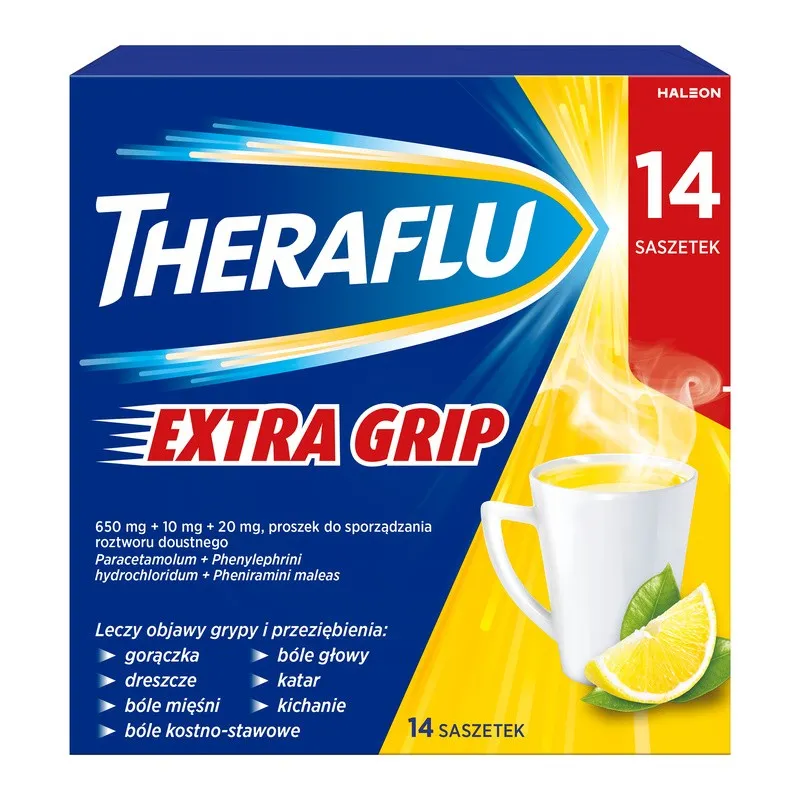
Table of Contents
Package leaflet: Information for the patient
Theraflu ExtraGRIP, 650 mg + 10 mg + 20 mg, effervescent powder for oral solution
Paracetamolum + Phenylephrini hydrochloridum + Pheniramini maleas
Please read all of this leaflet carefully before taking this medicine, because it contains
important information for you.
This medicine should always be taken exactly as described in this patient leaflet or as directed by your
doctor or pharmacist.
- Keep this leaflet, as you may need to read it again.
- If you need advice or further information, please contact your pharmacist.
- If you experience any adverse reactions, including any possible side effects not listed in this leaflet, inform your doctor or pharmacist. See section 4.
- If fever persists beyond 3 days or if symptoms last longer than 5 days or worsen, consult your doctor.
Leaflet contents:
- What Theraflu ExtraGRIP is and what it is used for
- Important information before taking Theraflu ExtraGRIP
- How to take Theraflu ExtraGRIP
- Possible side effects
- How to store Theraflu ExtraGRIP
- Contents of the pack and other information
1. What Theraflu ExtraGRIP is and what it is used for
This medicine contains as active substances: paracetamol, which has analgesic and antipyretic properties,
phenylephrine hydrochloride, which reduces nasal mucosal congestion and swelling, and pheniramine maleate – an antihistamine substance that relieves allergic symptoms such as sneezing, itching, or nasal mucosal congestion.
Indications:
Symptomatic treatment of influenza and common cold symptoms such as fever, chills, muscle pain,
bone and joint pain, headache, nasal mucosal swelling and congestion, excessive nasal mucus secretion,
and sneezing.
2. Important information before using Theraflu ExtraGRIP
When not to use Theraflu ExtraGRIP
Do not use Theraflu ExtraGRIP if:
- you are allergic (hypersensitive) to paracetamol, phenylephrine hydrochloride, pheniramine maleate, or any of the other ingredients of this medicine listed in section 6,
- you are taking or have taken within the last 14 days monoamine oxidase inhibitors (MAOIs), medicines used to treat depression or Parkinson's disease; if you are unsure whether your prescribed medicines contain MAOIs, consult your doctor or pharmacist before taking this medicine,
- you have severe heart disease or very high blood pressure (hypertension),
- you have hyperthyroidism,
- you have narrow-angle glaucoma (an eye condition involving progressive damage to the optic nerve, often associated with increased intraocular pressure),
- you have a phaeochromocytoma (a tumour near the kidneys causing high blood pressure),
- you are taking tricyclic antidepressants (e.g. amitriptyline),
- you are taking beta-blockers (medicines used to treat high blood pressure and heart conditions),
- you are taking sympathomimetic medicines such as nasal decongestants, appetite suppressants, or psychostimulants with amphetamine-like effects,
- you are allergic to peanuts or soya,
- in children under 12 years of age.
Warnings and precautions
This medicine contains paracetamol. Do NOT take this medicine together with other medicines containing paracetamol (painkillers, antipyretics, cold and flu remedies, or sleep aids). If you take more than the recommended dose, contact your doctor immediately, even if you do not have any symptoms, as severe liver damage may occur.
Before using Theraflu ExtraGRIP, consult your doctor or pharmacist:
- if you have liver disease,
- if you have kidney disease,
- if you are chronically undernourished or underweight (very low body weight),
- if you regularly drink (abuse) alcohol,
- if you have reduced glutathione levels – a protein important for immune system function,
- if you have a blood disorder,
- if you have diabetes (high blood sugar),
- if you have an enlarged prostate gland, which may cause difficulty in passing urine or urinary retention,
- if you have a blood vessel disorder such as Raynaud's syndrome, characterised by numbness, tingling, and colour changes (white, blue, then red) in fingers and toes exposed to cold,
- if you have epilepsy,
- if you have rare inherited fructose intolerance, glucose-galactose malabsorption, or sucrase-isomaltase deficiency (see Warnings concerning excipients),
- if you are pregnant, planning to become pregnant, or breastfeeding.
During treatment with Theraflu ExtraGRIP, contact your doctor immediately if:
- you have serious conditions including severe kidney dysfunction, sepsis (bacteria and their toxins circulating in the blood causing organ damage), malnutrition, chronic alcoholism, or if you are also taking flucloxacillin (an antibiotic). In these situations, patients taking paracetamol regularly over a long period or taking paracetamol with flucloxacillin have developed a serious condition called metabolic acidosis (an imbalance in blood and body fluids). Symptoms of metabolic acidosis may include: severe breathing difficulties, including rapid deep breathing, drowsiness, nausea, and vomiting.
Seek immediate medical attention if you experience a combination of these symptoms.
Consult your doctor if:
- you have breathing problems such as asthma, emphysema, or chronic bronchitis,
- your fever worsens or persists for more than 3 days,
- your pain or nasal congestion worsens or lasts longer than 5 days, or is accompanied by high fever, skin rash, or persistent headache. These may be signs of a serious illness.
Paracetamol should be used with caution in patients taking antihypertensive medicines other than beta-blockers, digoxin and cardiac glycosides, ergot alkaloids (e.g. ergotamine and methysergide), and other medicines affecting the liver such as barbiturates, antiepileptics (e.g. phenytoin, phenobarbital, carbamazepine), rifampicin, and isoniazid (see below).
Elderly patients should use this medicine with caution, as they are more likely to experience adverse effects. Avoid use in elderly patients with symptoms of impaired consciousness.
Children
Theraflu ExtraGRIP should not be used in children under 12 years of age.
Theraflu ExtraGRIP and other medicines
Tell your doctor or pharmacist about all medicines you are currently taking, have recently taken, or plan to take, especially the following:
- monoamine oxidase inhibitors (MAOIs) used to treat depression and Parkinson's disease: do not use Theraflu ExtraGRIP if you are taking MAOIs or have taken them within the last 14 days,
- medicines used to treat depression, e.g. tricyclic antidepressants,
- medicines used to lower high blood pressure, e.g. beta-blockers, bretylium, guanethidine, reserpine, and methyldopa,
- antihypertensive medicines other than beta-blockers,
- medicines used to treat heart failure and heart rhythm disorders (digoxin and other cardiac glycosides),
- medicines preventing blood clots, e.g. warfarin or other coumarin derivatives,
- medicines containing paracetamol or sympathomimetics, e.g. nasal decongestants used for colds and flu,
- anti-nausea and anti-vomiting medicines such as metoclopramide or domperidone,
- medicines used to treat tuberculosis (rifampicin and isoniazid) and bacterial infections (chloramphenicol),
- barbiturates (sleeping pills),
- medicines used to treat seizures, such as phenytoin, phenobarbital, carbamazepine, and lamotrigine,
- cholestyramine, used to lower cholesterol levels,
- zidovudine (AZT), used to treat HIV infection,
- probenecid, used to treat gout,
- ergotamine and methysergide, used to treat migraine,
- medicines used to treat Parkinson's disease,
- opioid medicines (narcotics),
- antihistamines,
- medicines containing alcohol,
- flucloxacillin (an antibiotic), due to a serious blood and fluid imbalance (called metabolic acidosis) requiring urgent treatment (see section 2).
Effect on laboratory tests:
Paracetamol may interfere with laboratory tests for uric acid when phosphotungstic acid reagents are used.
Use of Theraflu ExtraGRIP with alcohol
Do not drink alcohol while taking Theraflu ExtraGRIP.
Pregnancy, breastfeeding, and fertility
If you are pregnant, think you may be pregnant, are planning to become pregnant, or are breastfeeding, consult your doctor or pharmacist before using this medicine.
Use of this medicine during pregnancy is not recommended.
Use of this medicine during breastfeeding is not recommended.
Driving and using machines
Theraflu ExtraGRIP may cause drowsiness, dizziness, blurred vision, impaired coordination, and reduced concentration in some patients, which may significantly affect the ability to drive or operate machinery. Alcohol and other sedatives may worsen this effect. Therefore, patients should exercise caution when driving, operating machinery, or performing other tasks requiring mental alertness.
Warnings concerning excipients:
Theraflu ExtraGRIP contains:
- 12.6 g of sucrose per sachet. This should be considered in patients with diabetes. If you have previously been diagnosed with intolerance to certain sugars, consult your doctor before taking this medicine,
- sunset yellow FCF (E110). This may cause allergic reactions,
- 42.6 mg of sodium (main component of table salt) per sachet. This corresponds to 2.1% of the maximum daily recommended sodium intake for adults. This should be considered in patients on a sodium-controlled diet,
- glucose (as part of maltodextrin). If you have previously been diagnosed with intolerance to certain sugars, consult your doctor before taking this medicine,
- soya oil. Do not use if you are allergic to peanuts or soya,
- sulphites. This medicine may rarely cause severe hypersensitivity reactions and bronchospasm.
3. How to use Theraflu ExtraGRIP
This medicine should always be taken exactly as described in the patient information leaflet or as directed by a doctor or pharmacist. If in doubt, consult a doctor or pharmacist.
Recommended dose
Adults (including elderly patients) and adolescents over 12 years of age:
One sachet may be taken at a time.
The contents of one sachet should be dissolved in a glass of hot, but not boiling, water. Drink after cooling to a suitable temperature.
If further symptomatic treatment is needed, the dose may be repeated, but no more frequently than every 4–6 hours. Do not use more than 3–4 sachets per day.
Do not exceed the recommended dose. Use the lowest effective dose for the shortest possible duration.
Consult a doctor if symptoms persist or worsen after 5 days, or if fever persists for longer than 3 days.
If you feel the effect of the medicine is too strong or too weak, consult your doctor.
Use in children
Do not use in children under 12 years of age.
Patients with liver disease:
In adults weighing less than 50 kg, and in patients with mild or moderate liver impairment, Gilbert's syndrome (familial hyperbilirubinemia), dehydration, chronic malnutrition, or alcoholic liver disease, the daily effective dose of paracetamol should not exceed 60 mg/kg/day (up to 2 g/day, i.e. a maximum of 3 sachets per day).
Patients with renal impairment:
In patients with renal impairment, take the contents of one sachet at a time. The intervals between doses should be:
| Creatinine clearance (ml/min) | Dosing interval (hours) |
| 80 – 50 | 4 |
| 50 – 30 | 6 |
| 30 – 10 | 6 |
| < 10 | 8 |
Overdose of Theraflu ExtraGRIP:
If a dose higher than recommended is taken, contact a doctor immediately,
even if no symptoms are present, as this may lead to life-threatening liver damage.
Immediate medical advice must be sought, even if the patient feels well, due to the risk of delayed severe liver damage.
Overdose may lead to disturbances in consciousness or coma. Convulsions may occur in children.
Additional symptoms may include irritability, restlessness, hypertension, and probable reflex bradycardia. In severe cases, confusion, hallucinations, seizures, and arrhythmias may occur.
Missed dose of Theraflu ExtraGRIP:
Theraflu ExtraGRIP is taken on an as-needed basis when symptoms occur.
However, if the doctor has recommended regular dosing, do not take a double dose to make up for a missed dose.
The medicine should be taken according to the prescribed dosing schedule.
4. Possible adverse effects
Like all medicines, Theraflu ExtraGRIP may cause adverse effects, although not everyone will experience them.
You should STOP taking the medicine and consult a doctor immediately if any of the following symptoms occur:
- allergic reactions (rare),
- angioedema, including wheezing, shortness of breath, swelling of the face, lips, tongue or throat (rare),
- anaphylactic reaction (severe allergic reaction, rare),
- skin rash, urticaria (itchy, raised rash), itching, redness of the skin (rare),
- severe skin reactions, including skin peeling, blisters, ulcers, erosions in the mouth (very rare),
- bleeding or development of bruises (blood clotting disorders due to low platelet count) (very rare),
- breathing difficulties, when similar problems occurred previously during use of acetylsalicylic acid or other non-steroidal anti-inflammatory drugs (very rare),
- darkening of urine accompanied by pale skin, dizziness and fatigue,
- hallucinations (seeing or hearing things that are not real),
- extremely rapid heartbeat or sensation of extremely fast or irregular heartbeat,
- loss of vision, which may be caused by abnormally high intraocular pressure. This reaction is very rare and occurs more frequently in people with glaucoma,
- difficulty urinating, more common in men with prostate enlargement. These reactions occur rarely or very rarely.
Other adverse effects of the medicine:
Related to paracetamol
Rare (occur in 1 to 10 out of 10,000 patients)
- liver function disturbances, discomfort in the abdominal area
Very rare (occur in fewer than 1 out of 10,000 patients)
- thrombocytopenia (decreased number of blood platelets)
Related to pheniramine
Common (occur in 1 to 10 out of 100 patients)
- drowsiness
Rare (occur in 1 to 10 out of 10,000 patients)
- hypersensitivity, urticaria, as well as acute allergic reactions (angioedema, anaphylactic shock),
- restlessness, nervousness, insomnia,
- dizziness,
- dry mouth,
- palpitations,
- eczema, purpura, erythema, itching,
- constipation.
Very rare (occur in fewer than 1 out of 10,000 patients)
- leukopenia (decreased number of white blood cells),
- thrombocytopenia (decreased number of blood platelets).
Frequency unknown (cannot be estimated from available data)
- hallucinations, confusion (disturbance of consciousness),
- anticholinergic effects such as dilated pupils, accommodation disturbances, dryness of mucous membranes, urinary retention,
- motor coordination disturbances, tremor, memory loss or concentration difficulties, balance disorders, sedation,
- hemolytic anemia (reduced number of red blood cells due to their abnormal breakdown),
- orthostatic hypotension (excessive drop in blood pressure upon standing),
- serious condition that may lead to blood acidification (so-called metabolic acidosis) in patients with severe disease taking paracetamol (see section 2).
Related to phenylephrine
Common (occur in 1 to 10 out of 100 patients)
- nervousness,
- dizziness, headache,
- increased arterial blood pressure,
- insomnia,
- nausea,
- vomiting.
Rare (occur in 1 to 10 out of 10,000 patients)
- hypersensitivity, allergic dermatitis, urticaria,
- skin rash,
- acute glaucoma (a disease damaging the optic nerve), dilated pupils,
- increased heart rate, palpitations,
- urinary retention (most commonly occurs in individuals, e.g., with prostate enlargement), dysuria (difficulty urinating).
Frequency unknown (cannot be estimated from available data)
- hemolytic anemia (reduced number of red blood cells due to their abnormal breakdown),
- hallucinations, confusion (disturbance of consciousness).
Reporting of adverse effects
If any adverse effects occur, including any not listed in this leaflet, inform your doctor or pharmacist. Adverse effects can be reported directly to the Department of Monitoring Adverse Drug Reactions of the Office for Registration of Medicinal Products, Medical Devices and Biocidal Products, Al. Jerozolimskie 181C, 02-222 Warsaw, tel.: +48 22 4921301, fax: +48 22 4921309, website: https://smz.ezdrowie.gov.pl
Adverse effects can also be reported to the marketing authorization holder.
Reporting adverse effects helps gather more information on the safety of using the medicine.
5. How to store Theraflu ExtraGRIP
Keep the medicine out of sight and reach of children.
Do not store above 25°C.
Do not use Theraflu ExtraGRIP after the expiry date stated on the packaging.
The expiry date refers to the last day of the stated month.
Medicines must not be disposed of via wastewater or household waste. Ask your pharmacist how to dispose of medicines no longer in use. This will help protect the environment.
6. Contents of the pack and other information
What Theraflu ExtraGRIP contains
One sachet contains 14.85 g of effervescent powder with a natural lemon flavour, for oral solution. The powder dissolves in hot water.
- The active substances in one sachet are: paracetamol 650 mg, phenylephrine hydrochloride 10 mg, pheniramine maleate 20 mg.
- The other ingredients are: sucrose, potassium acesulfame (E 950), quinoline yellow (E 104), sunset yellow (E 110), maltodextrin M100 (contains glucose), colloidal anhydrous silica, lemon flavour PHS 163671 (maltodextrin – contains glucose, butylated hydroxyanisole (E320)), citric acid, sodium citrate, calcium phosphate.
What Theraflu ExtraGRIP looks like and contents of the pack
The pack contains 1, 3, 6, 10 or 14 sachets in a cardboard box. Each pack has a child-resistant closure.
Marketing Authorisation Holder:
Haleon Poland Sp. z o.o.
ul. Rzymowskiego 53
02-697 Warsaw
tel. 800 702 849
Manufacturer:
Haleon Germany GmbH
Barthstraße 4
80339 Munich
Germany
Haleon Alcala, S.A.
Ctra. De Ajalvir, Km. 2,500,
Alcalá de Henares, Madrid
28806, Spain