Tektrotyd
Poland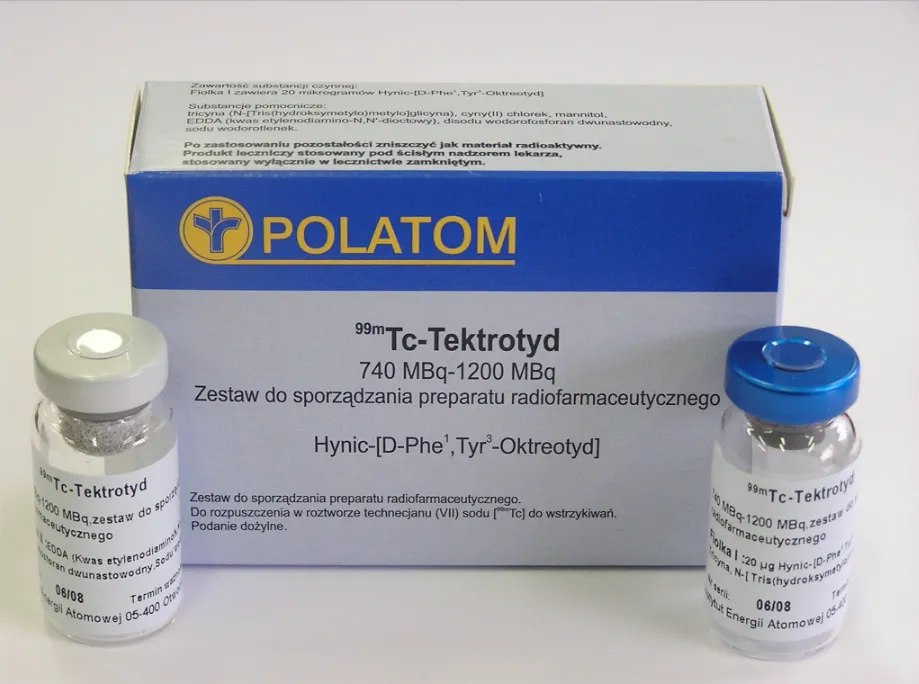
Table of Contents
Patient Information Leaflet: Information for the User
Tektrotyd, 20 micrograms, kit for the preparation of a radiopharmaceutical preparation
Hynic-[D-Phe¹,Tyr³-Octreotide] trifluoroacetate
Please read carefully all the information in this leaflet before the administration of the medicine, as it contains important information for the patient.
- Please keep this leaflet, as you may need to read it again.
- If you have any doubts, please consult your referring physician or the nuclear medicine specialist supervising the examination.
- If you experience any adverse reactions, including those not listed in this leaflet, inform the nuclear medicine specialist immediately.
Table of contents of the leaflet:
- What Tektrotyd is and what it is used for
- Important information before using Tektrotyd
- How to use Tektrotyd
- Possible side effects
- How to store Tektrotyd
- Contents of the pack and other information
1. What Tektrotyd is and what it is used for
This product is intended for diagnostic use only.
It is used to visualize specific types of cells in the stomach, small intestine, and pancreas, such as:
- abnormal tissues,
- tumour lesions.
Tektrotyd, when labeled with a radioactive isotope, binds to abnormal or tumour cells expressing specific receptors (somatostatin receptors). Subsequently, a radiation-detecting device (gamma camera) detects this radioactivity and provides images showing the location of these abnormal or tumour cells in the body.
Due to its labeling with the radioactive isotope technetium-99m (Tc), the use of Tektrotyd involves exposure to a small radiation dose. Your referring physician and the nuclear medicine specialist have determined that the benefits of the diagnostic procedure outweigh the potential risks associated with ionizing radiation.
2. Important information before using Tektrotyd
When not to use Tektrotyd
Do not use Tektrotyd if the patient is allergic to the active substance or to any of the other components of this medicine (listed in section 6), or to sodium pertechnetate (Tc) injection solution.
If the patient is pregnant or suspects she may be pregnant.
If the patient is breastfeeding (see section Pregnancy and breastfeeding below).
Warnings and precautions
Special caution should be exercised when using Tektrotyd in patients with renal insufficiency.
If any of the above conditions apply to the patient, inform the physician immediately.
Before administration of Tektrotyd
To obtain optimal quality of the scintigraphic image, the patient requires appropriate preparation prior to administration of the radiopharmaceutical.
Unless otherwise directed by the physician, a liquid diet is recommended for two days prior to the examination.
The physician may recommend administration of bowel cleansing agents the day before the examination.
On the day of the examination, the patient should remain on a liquid diet until completion of the initial imaging. However, it is recommended to drink increased amounts of fluids before the examination and to urinate as frequently as possible during the first hours after the examination in order to minimize radiation exposure to the body.
The treating physician may recommend alternative patient preparation depending on the type of examination and the location of the lesions to be imaged.
Children and adolescents
Inform the nuclear medicine specialist if the patient is under 18 years of age.
Interaction of Tektrotyd with other medicines
Many medications may significantly affect the results of the planned examination. Discuss with the physician which medications should not be taken before the examination and when they can be resumed.
Inform the physician about all medications currently used or recently used, as well as any medications the patient plans to take.
Patients treated with so-called somatostatin analogues (used in the treatment of neuroendocrine tumours) should inform the physician, as these drugs may strongly influence the examination results.
Pregnancy and breastfeeding
Consult a physician if there is suspicion of pregnancy, absence of menstruation, or if the patient is breastfeeding. It is important to consult the treating physician in case of any doubts.
Pregnancy
Tektrotyd must not be used during pregnancy due to the potential risks associated with ionizing radiation for both the mother and the fetus.
Breastfeeding
Inform the physician if the patient is breastfeeding. The physician may decide to postpone the examination until after cessation of breastfeeding or may recommend discontinuation of breastfeeding and regular expression and discarding of breast milk until the drug is completely eliminated from the woman's body.
Please consult the nuclear medicine physician regarding when it is safe to resume breastfeeding.
Driving and operating machinery
Studies on the effect of Tektrotyd on the ability to drive vehicles and operate mechanical devices have not been conducted.
However, Tektrotyd is not expected to affect the ability to drive or operate machinery.
Tektrotyd contains sodium
This medicine contains less than 1 mmol of sodium (23 mg) per vial and is therefore considered essentially "sodium-free".
3. How to use Tektrotyd
Radiopharmaceuticals may be administered only by authorized personnel.
There are strict regulations regarding the use, transfer, and disposal of radiopharmaceuticals.
The medicinal product Tektrotyd is used exclusively under appropriate clinical conditions and only by appropriately qualified personnel. These individuals take special precautionary measures to ensure the safe use of the medicinal product and will continuously inform about their actions.
The nuclear medicine specialist supervising the procedure decides on the dose of the medicinal product to be administered in each individual case. This will be the minimum dose necessary to obtain the required diagnostic information. Depending on the type of examination, the recommended dose ranges between 370 and 740 MBq (MBq = megabecquerel, a unit of measurement of radioactivity).
Administration of the medicinal product and performance of the examination
The ready-to-use injection solution will be administered as a single intravenous dose prior to the examination.
This medicinal product is not intended for regular or continuous use.
After injection of the medicinal product, you will be given fluids to drink and will be asked to empty your bladder shortly before imaging begins.
Duration of the procedure
Your doctor will inform you about the standard duration of the procedure.
After administration of Tektrotyd, you should:
- avoid close contact with young children and pregnant women during the first 24 hours after injection
- frequently empty your bladder to help eliminate the medicinal product from your body
The physician performing the examination will inform you about the need to take special precautionary measures after administration of the medicinal product. In case of doubt, please consult your physician or the nuclear medicine specialist supervising the examination.
Administration of a higher than recommended dose of Tektrotyd
Overdose is unlikely, as the dose administered to the patient is strictly controlled by the nuclear medicine specialist supervising the examination. However, in the event of an overdose, the physician may, for example, recommend increased fluid intake to promote elimination of the radiopharmaceutical from the body through frequent bladder emptying.
If you have any further doubts regarding the use of this medicinal product, please consult your physician or the nuclear medicine specialist supervising the examination.
4. Possible adverse reactions
Like any medicine, this medicinal product may cause adverse reactions, although not in everyone.
Very rarely (affecting less than 1 patient per 10,000 administrations), transient headache or
epigastric pain may occur immediately after administration.
Administration of this radiopharmaceutical results in exposure to a small dose of ionizing radiation,
which is associated with the risk of inducing malignant diseases and congenital abnormalities.
Current evidence indicates a low probability of such adverse effects occurring in the context of
diagnostic procedures in nuclear medicine.
Reporting of adverse reactions
If any adverse effects occur, including any adverse effects not listed in this leaflet, the patient should
inform their physician or nuclear medicine specialist.
Adverse reactions may be reported directly to the Department of Monitoring of Adverse Drug Reactions,
Office for Registration of Medicinal Products, Medical Devices and Biocidal Products
Al. Jerozolimskie 181 C
02-222 Warsaw
Phone: +48 22 49 21 301
Fax: +48 22 49 21 309
e-mail: [email protected]
Adverse reactions may also be reported to the marketing authorization holder.
Reporting of adverse reactions enables further safety information on the use of the medicinal product to be collected.
5. How to store Tektrotyd kit
The patient will not be required to store this medicinal product.
Radiopharmaceuticals are stored exclusively by authorized personnel under appropriate clinical conditions.
Storage of radiopharmaceuticals is carried out in compliance with local regulations concerning radioactive substances.
The following information is intended exclusively for healthcare professionals.
Do not use Tektrotyd after the expiry date stated on the packaging.
6. Contents of the packaging and other information
What Tektrotyd contains
Vials I and II contain components of the Tektrotyd medicinal product.
Vial I:
Active substance: Hynic-[D-Phe, Tyr-Octreotide] trifluoroacetate,
Excipients: N-[Tris(hydroxymethyl)methyl]glycine (tricine), tin(II) chloride dihydrate, mannitol, sodium hydroxide (for pH adjustment), hydrochloric acid (for pH adjustment), nitrogen.
Vial II:
Excipients: ethylenediamine-N,N’-diacetic acid (EDDA), disodium phosphate dodecahydrate, sodium hydroxide, sodium hydroxide (for pH adjustment), hydrochloric acid (for pH adjustment), nitrogen.
What Tektrotyd looks like and contents of the pack
The kit consists of two different 10 ml glass vials, packed in a cardboard box.
Each vial contains a white or almost white lyophilisate for preparation of a solution for injection.
Pack size: 2 vials for combined use.
Marketing Authorisation Holder and Manufacturer
National Centre for Nuclear Research
ul. Andrzeja Sołtana 7
05-400 Otwock
Tel: 22 7180700
Fax: 22 7180350
e-mail: [email protected]
The following information is intended for healthcare professionals only:
The complete Summary of Product Characteristics (SmPC) for Tektrotyd is provided as a separate document included within the packaging of the radiopharmaceutical product, to supply healthcare professionals with additional scientific and practical information regarding the administration and use of this radiopharmaceutical.