Tantum rosa
Poland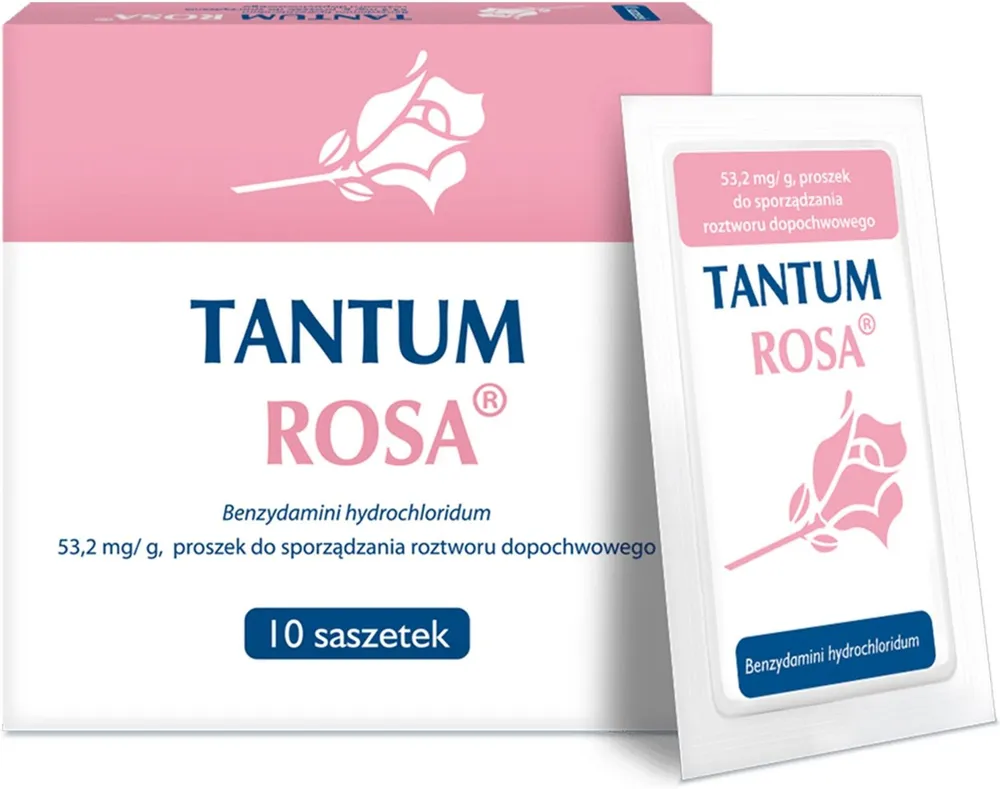
Table of Contents
Package leaflet: Information for the user
TANTUM ROSA
Benzydamini hydrochloridum
53.2 mg/g, powder for preparation of a vaginal solution
Please read the entire leaflet carefully before using the medicine, as it contains
important information for the patient.
This medicine should always be used according to the instructions provided in the patient leaflet or as directed by a physician, pharmacist, or nurse.
- Keep this leaflet for future reference.
- Consult your pharmacist if you need advice or additional information.
- If any adverse reactions occur, including any possible side effects not listed in this leaflet, inform your doctor, pharmacist, or nurse. See section 4.
- If symptoms do not improve or worsen after 7 days of treatment, consult your doctor.
Table of contents:
- What Tantum Rosa is and what it is used for
- Important information before using Tantum Rosa
- How to use Tantum Rosa
- Possible side effects
- How to store Tantum Rosa
- Contents of the pack and other information
1. What Tantum Rosa is and what it is used for
Tantum Rosa contains the active substance benzydamine, which belongs to the group of non-steroidal anti-inflammatory drugs (NSAIDs).
Benzydamine has anti-inflammatory and analgesic properties and acts locally as a local anesthetic and antiseptic. The drug is well absorbed locally, achieving high concentrations in tissues affected by inflammation. The drug is generally well tolerated. It is used for local treatment of inflammatory symptoms.
Tantum Rosa is administered vaginally and applied to the mucous membranes of the external genital organs.
It is used to treat discomfort and symptoms such as pain, burning, itching, redness, discharge, and swelling in the area of the external genital organs and vagina.
These symptoms occur as a result of inflammation of the vulva and vagina (vulvovaginitis), cervicitis of various origins (e.g. infections, mechanical irritation), including after chemotherapy or radiotherapy. The drug is also used for pre- and postoperative prophylaxis in gynecology, as well as for relief of vulvar discomfort during the postpartum period.
2. Important information before using Tantum Rosa
When not to use Tantum Rosa
If the patient is allergic to the active substance or to any of the other ingredients of this
medicine (listed in section 6).
Warnings and precautions
Before starting to use Tantum Rosa, consult a doctor, pharmacist, or nurse.
The use, especially prolonged, of locally acting medicines may cause an allergic reaction. In such a case, Tantum Rosa should be discontinued and the patient should consult a doctor, who will recommend appropriate management.
Tantum Rosa is intended for vaginal use and for application on the mucous membrane of the external genital organs. It must not be taken orally.
Tantum Rosa and other medicines
Inform your doctor or pharmacist about all medicines currently used, recently used, or planned to be used.
No interactions of Tantum Rosa with other medicines are known.
Pregnancy and breastfeeding
If the patient is pregnant or breastfeeding, suspects she may be pregnant, or is planning to become pregnant, she should consult a doctor or pharmacist before using this medicine.
Tantum Rosa should not be used during pregnancy unless absolutely necessary and recommended by a doctor. If use is necessary, the lowest possible dose for the shortest possible duration should be used.
Unless otherwise directed by a doctor, the medicine should be used according to the recommendations provided in the leaflet.
Driving and operating machinery
This medicine does not affect the ability to drive or operate machinery.
3. How to use Tantum Rosa
This medicine should always be used as described in the patient information leaflet or as directed by a doctor,
pharmacist, or nurse. If in doubt, consult a doctor, pharmacist, or nurse.
The recommended dose is 1 to 2 sachets per day, depending on the severity of symptoms.
Dissolve the contents of one sachet in 0.5 litres of boiled and cooled water, immediately before use.
Always prepare a fresh solution from one sachet each time (e.g. in the morning and evening).
Treatment of discomfort and symptoms of inflammation of the external genital organs (perineal area
and vulva) associated with vaginitis and/or cervicitis: irrigate the vagina with the solution prepared from one sachet 1 to 2 times daily, unless otherwise directed by a physician.
Treatment of discomfort and symptoms of inflammation of the external genital organs (perineal area
and vulva) and postpartum perineal discomfort: wash the perineal and vulvar areas with the solution prepared from one sachet 1 to 2 times daily.
Pre- and postoperative prophylaxis in gynaecology: the physician will determine the appropriate use of the medicine.
If self-treating, do not use the medicine continuously for longer than 7 days without consulting a doctor, who will decide whether treatment should be prolonged.
To achieve improvement, treatment should not last less than 3 days.
For proper and safe vaginal irrigation (douching), read the instructions for use provided with the intimate hygiene irrigator, available in pharmacies without a prescription.
Use of a higher than recommended dose of Tantum Rosa
Overdose is unlikely due to the low concentration of the active substance in the medicine and its local route of administration. No cases of overdose have been observed to date.
If the medicine is accidentally swallowed, contact a doctor or pharmacist immediately.
If you have any further doubts regarding the use of this medicine, consult a doctor, pharmacist, or nurse.
4. Possible adverse effects
Like all medicines, this medicine can cause adverse effects, although not everybody gets them.
Very rare adverse effects (occur in less than 1 person in 10,000):
sensation of burning of the vaginal mucosa, photoallergic rash, urticaria.
Reporting of adverse effects
If any adverse effects occur, including any adverse effects not listed
in this leaflet, inform your doctor, pharmacist or nurse. Adverse effects
can be reported directly to the Department of Monitoring Adverse Effects of Medicinal Products
of the Office for Registration of Medicinal Products, Medical Devices and Biocidal Products,
Al. Jerozolimskie 181C, 02-222 Warsaw, tel.: +48 22 49 21 301,
fax: +48 22 49 21 309, website: https://smz.ezdrowie.gov.pl
Adverse effects can also be reported to the marketing authorisation holder.
Reporting adverse effects helps to provide more information on the safety of the medicine.
5. How to store Tantum Rosa
Keep this medicine out of sight and reach of children.
No special precautions for storage are required.
Do not use this medicine after the expiry date stated on the packaging.
The expiry date refers to the last day of the stated month.
Medicines must not be disposed of via wastewater or household waste.
Ask your pharmacist how to dispose of medicines no longer required.
This will help protect the environment.
6. Contents of the pack and other information
What Tantum Rosa contains
The active substance in Tantum Rosa is benzydamine hydrochloride.
Each sachet (9.4 g) contains 500 mg of benzydamine hydrochloride.
The other excipients are: sodium chloride, povidone, p-toluenesulfonate of trimethylammonium acetate.
What Tantum Rosa looks like and contents of the pack
Tantum Rosa is a powder which must be dissolved in water to prepare a solution.
The immediate packaging is a paper-polypropylene sachet containing 9.4 g of powder. The outer carton contains 6 or 10 sachets.
Marketing Authorisation Holder
Aziende Chimiche Riunite Angelini Francesco A.C.R.A.F. S.p.A.
Viale Amelia 70, 00181 Rome, Italy
Manufacturer
Aziende Chimiche Riunite Angelini Francesco A.C.R.A.F. S.p.A.
Via Vecchia del Pinocchio 22
60131 Ancona, Italy
Fine Foods & Pharmaceuticals N.T.M. S.p.A.
Via Grignano, 43
24041 Brembate BG, Italy
Representative of the Marketing Authorisation Holder
Angelini Pharma Polska Sp. z o.o.
Aleje Jerozolimskie 181B
02-222 Warsaw
Tel.: (22) 70 28 200
E-mail: [email protected]