Talvosilen
Poland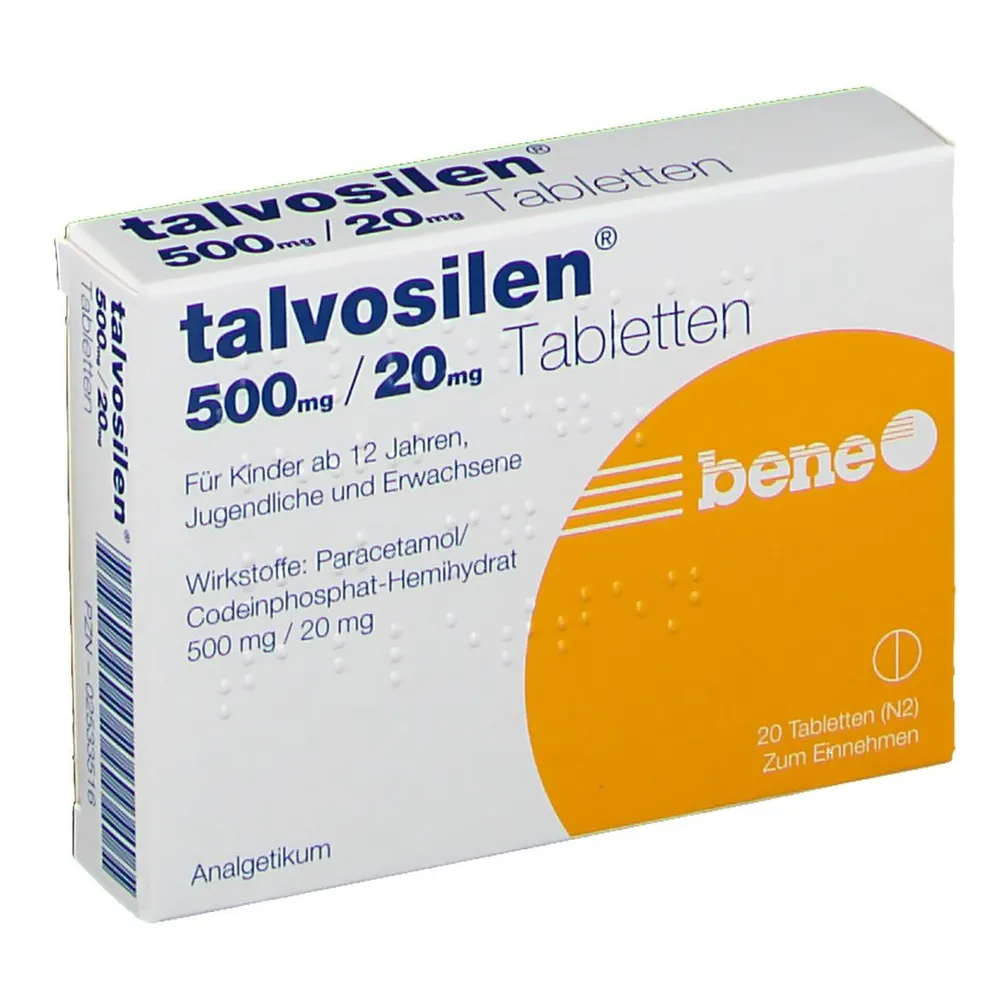
Table of Contents
Package leaflet: Information for the patient
TALVOSILEN
500 mg + 20 mg, tablets
Paracetamolum + Codeini phosphas hemihydricus
Please read the entire leaflet carefully before using this medicine, as it contains
important information for the patient.
- Keep this leaflet, so that you can read it again if necessary.
- If you have any questions, please consult your doctor or pharmacist.
- This medicine has been prescribed for a specific individual. Do not pass it on to others. This medicine may harm other people, even if their symptoms are identical.
- If any adverse reactions occur, including any possible adverse reactions not listed in this leaflet, inform your doctor or pharmacist. See section 4.
Contents of the leaflet:
- What Talvosilen is and what it is used for
- Important information before taking Talvosilen
- How to take Talvosilen
- Possible side effects
- How to store Talvosilen
- Contents of the package and other information
1. What Talvosilen is and what it is used for
Talvosilen is an analgesic medicine that can be used in children from 12 years of age, adolescents, and adults. This medicine contains paracetamol and codeine. Codeine belongs to a group of medicines called opioid analgesics, which relieve pain. It may be used alone or in combination with other analgesics such as paracetamol.
Talvosilen may be used in children aged 12 years and older for the short-term relief of moderate pain which is not relieved by other analgesics used alone, such as paracetamol or ibuprofen.
2. Important information before using Talvosilen
When not to use Talvosilen
- if the patient is allergic to paracetamol, codeine, or any of the other ingredients of this medicine (listed in section 6);
- if the patient has functional respiratory impairment (respiratory failure) or difficulty breathing (respiratory depression);
- in case of loss of consciousness;
- coma;
- in case of pneumonia;
- in patients experiencing an acute asthma attack;
- in patients with chronic cough, which may be, for example, a warning sign indicating the onset of bronchial asthma (particular attention should be paid to children);
- as delivery approaches;
- if premature labour has been diagnosed;
- in children under 12 years of age;
- for pain relief in children and adolescents (aged 0 to 18 years) following tonsillectomy due to obstructive sleep apnoea syndrome;
- if the patient knows they metabolise codeine to morphine very rapidly;
- if the patient is breastfeeding.
Warnings and precautions
Before starting treatment with Talvosilen, discuss this with your doctor or pharmacist.
Particular caution is required when using Talvosilen in the following cases:
- in patients dependent on opioids (including strong analgesics and sedatives);
- in patients with impaired consciousness;
- in patients with increased intracranial pressure;
- disorders of the respiratory centre and respiratory function;
- concomitant use of monoamine oxidase inhibitors (a group of medicines used in the treatment of depression);
- impaired lung ventilation due to chronic bronchitis or bronchial asthma;
- post-cholecystectomy state (after removal of the gallbladder);
- use of high doses in patients with low blood pressure due to fluid deficiency.
Talvosilen should be taken only in reduced doses or less frequently than indicated in the dosing instructions (dose reduction or prolonged intervals between doses) in the following cases:
- liver function disorders (e.g. due to chronic alcohol abuse or previous hepatitis);
- liver function disorders (hepatitis, Gilbert-Meulengracht syndrome);
- kidney function disorders (this also applies to dialysed patients);
- diseases that may be associated with reduced glutathione concentration (possibly requiring dose adjustment, e.g. in diabetes, HIV infection, Down's syndrome, tumours);
- glucose-6-phosphate dehydrogenase deficiency.
Codeine, one of the components of Talvosilen, is converted into morphine by liver enzymes. Morphine is the substance that relieves pain. Some individuals have a modified enzyme, which may affect them differently. In some patients, morphine is not produced or is produced in very small amounts, resulting in inadequate pain relief. Other individuals are more susceptible to severe adverse effects due to the production of very large amounts of morphine. If any of the following adverse effects occur, the patient should stop taking this medicine immediately and contact their doctor: slow or shallow breathing, disorientation, drowsiness, pinpoint pupils, visual disturbances, nausea or vomiting, constipation, loss of appetite.
Due to the risk of overdose, check whether other medicines currently being taken contain paracetamol and/or codeine.
Prolonged use of high-dose paracetamol may cause headaches that should not be treated with increased doses of the medicine.
Long-term use of analgesics, especially in combination with anti-inflammatory and antipyretic analgesics, may lead to permanent kidney damage and kidney failure (analgesic nephropathy).
Do not abruptly discontinue treatment if the medicine has been used long-term, due to the risk of withdrawal syndrome. Headaches, fatigue, muscle pain, nervousness, and autonomic symptoms may occur. Withdrawal symptoms usually resolve spontaneously within a few days. In such cases, do not restart analgesic treatment without consulting a doctor.
Because the ability to metabolise codeine contained in Talvosilen varies individually, symptoms of overdose may occur even when taking doses recommended by a doctor. If the patient observes symptoms such as visual disturbances, drowsiness, fatigue, constipation, or circulatory problems, they should consult their treating physician.
At the beginning of treatment, the doctor will assess the patient's individual response to Talvosilen.
Severe symptoms of acute hypersensitivity (e.g. anaphylactic shock) have been observed very rarely. In case of hypersensitivity reactions, discontinue the medicine and contact a doctor immediately.
In patients receiving higher doses and in particularly sensitive individuals, dose-related disturbances in visual fixation of objects (visual-motor coordination) and disturbances in visual acuity may occur. Additionally, respiratory function impairment (respiratory depression) and excessive sense of well-being (euphoria) may occur.
With prolonged use of this medicine, as with other medicines containing codeine, there is a risk of dependence.
Exercise caution when administering the medicine to individuals with a history of opioid dependence.
Discuss with your doctor, even if the above warnings refer to conditions occurring in the past.
Children and adolescents
Use in children and adolescents after surgery
Talvosilen should not be used for pain relief in children and adolescents after surgical removal of palatine or pharyngeal tonsils due to obstructive sleep apnoea syndrome.
Use in children with breathing disorders
The use of Talvosilen is not recommended in children with breathing disorders, as symptoms of morphine toxicity may worsen in these children.
Talvosilen with other medicines
Inform your doctor or pharmacist about all medicines currently taken, recently taken, or planned for use.
Concomitant use of Talvosilen and sedatives such as benzodiazepines or similar medicines increases the risk of drowsiness, breathing difficulties (respiratory depression), coma, and may be life-threatening. Therefore, concomitant use should only be considered when other treatment options are not possible. However, if your doctor prescribes Talvosilen together with sedatives, the dose and duration of concomitant treatment should be limited by the doctor. Inform your doctor about all sedative medicines you are taking and strictly follow the doctor's dosage recommendations. It may be helpful to inform friends or family members so they are aware of the above-mentioned symptoms. Contact your doctor if such symptoms occur.
Increased fatigue, drowsiness, and breathing disturbances may occur when Talvosilen is used concomitantly with the following agents: sedatives and hypnotics, psychotropic medicines (phenothiazine group, e.g. chlorpromazine, thioridazine, perphenazine), other medicines affecting the central nervous system, antiallergic medicines (antihistamines, e.g. promethazine, meclizine), antihypertensive medicines, analgesics, alcohol.
Concomitant use of medicines that increase hepatic metabolism, such as certain hypnotics and antiepileptic drugs (e.g. phenobarbital, phenytoin, carbamazepine), and rifampicin, may cause liver damage, even when recommended doses are used. This also applies to substances toxic to the liver and alcohol abuse.
Taking Talvosilen with food and/or a medicine delaying gastric emptying (e.g. propantheline) may delay the absorption of paracetamol and the onset of therapeutic effect.
Taking Talvosilen with medicines accelerating gastric emptying (e.g. metoclopramide) may enhance the absorption of paracetamol and the therapeutic effect.
Concomitant administration of Talvosilen with AZT (zidovudine) intensifies the toxic effect of zidovudine on bone marrow. Talvosilen should not be used with zidovudine unless recommended by a doctor.
When using medicines for treating elevated uric acid levels (e.g. probenecid) concomitantly with Talvosilen, the paracetamol dose should be reduced.
Cholestyramine (a medicine used to reduce elevated cholesterol levels) decreases the absorption of paracetamol.
During treatment with Talvosilen, alcohol consumption should be avoided, as it strongly affects motor coordination and cognitive processes.
In patients taking certain antidepressants (tricyclic antidepressants) such as imipramine, amitriptyline, or opipramol, respiratory centre depression caused by codeine may occur.
Concomitant use of antidepressants (MAO inhibitors) such as tranylcypromine may intensify effects on the central nervous system and other adverse effects to an unpredictable degree. Therefore, Talvosilen treatment may only be initiated at least two weeks after discontinuation of MAO inhibitor therapy.
Concomitant use with analgesics such as buprenorphine and pentazocine may reduce the effectiveness of the medicine.
Cimetidine and other medicines affecting hepatic metabolism may enhance the effect of Talvosilen. When cimetidine is administered with morphine, inhibition of morphine's metabolic breakdown leading to increased plasma concentration has been observed. Such a reaction cannot be excluded in the case of codeine.
If the patient is taking warfarin or other coumarins (to thin the blood), occasional doses of this medicine may be taken, but regular use should only be initiated after consulting a doctor.
Effect on laboratory test results
Paracetamol contained in Talvosilen may affect laboratory test results for uric acid and blood glucose levels.
Use of Talvosilen with food, drink, and alcohol
During treatment with Talvosilen, alcohol consumption should be avoided (see section 2.3).
Pregnancy and breastfeeding
During pregnancy, breastfeeding, or if pregnancy is suspected or planned, consult a doctor before using this medicine.
Pregnancy
Pregnant women may take Talvosilen only on the explicit recommendation of their doctor, as adverse effects affecting the development of the unborn child cannot be excluded.
In the period immediately before delivery and in cases of threatened premature labour, Talvosilen must not be taken, as codeine crosses the placenta and may suppress respiratory function in the newborn.
With prolonged use of codeine, fetal opioid dependence may develop. Cases of withdrawal symptoms in newborns have been reported following repeated use of codeine in the third trimester of pregnancy.
Breastfeeding
Talvosilen should not be taken during breastfeeding.
Paracetamol and codeine, as well as morphine, its metabolite, pass into breast milk.
Driving and operating machinery
Talvosilen may impair the ability to drive and operate machinery, even when taken as directed by a doctor.
Do not drive or operate machinery while taking this medicine.
This medicine contains less than 1 mmol of sodium (23 mg) per tablet; therefore, the medicine is considered "sodium-free".
3. How to use Talvosilen
Talvosilen should always be used as directed by the physician. In case of doubt, consult your doctor.
The medicine is taken orally.
Dosage:
Adults and adolescents over 12 years of age: orally, 1 to 2 tablets as a single dose; if needed, the dose may be repeated every 6 to 8 hours, no more than 4 times per day.
The paracetamol dose depends on the patient's body weight and age (usually the single dose is 10 to 15 mg per kg of body weight). The total daily dose must not exceed 60 mg/kg body weight.
Maximum daily dose:
- Paracetamol: 4000 mg
- Codeine: 160 mg, corresponding to 8 tablets
The appropriate intervals between doses depend on symptoms and the total maximum daily dose. These intervals must not be shorter than 6 hours.
Single dose
(appropriate dose of paracetamol and codeine phosphate hemihydrate)
Maximum daily dose
(24 hours)
(appropriate dose of paracetamol and codeine phosphate hemihydrate)
Body weight
(age)
1 or 2 tablets
(corresponding to 500 or 1000 mg paracetamol and 20 or 40 mg codeine phosphate hemihydrate)
from 43 kg to
8 tablets
(corresponding to max. 4000 mg paracetamol and max. 160 mg codeine phosphate hemihydrate)
(children over 12 years, adolescents and adults)
Under no circumstances should the maximum daily dose indicated in the table (for 24 hours) be exceeded.
Talvosilen must not be used in children under 12 years of age due to the risk of severe respiratory disorders.
Method of administration
The break line on the tablet is intended only to facilitate crushing for easier swallowing, not for dividing into equal doses.
Tablets should be taken whole, with sufficient fluid, between meals.
Taking the tablets after meals may delay their effect.
Do not take the tablets while lying down.
Duration of treatment
The duration of treatment is determined by the treating physician.
Talvosilen should not be taken for longer than 3 days. If pain persists after 3 days, consult a doctor.
Special caution is required in patients:
- with hepatic impairment and mild renal impairment. In patients with impaired liver or kidney function or with Gilbert-Meulengracht syndrome, the dose should be reduced or the intervals between doses extended.
- with severe renal impairment. In cases of severe renal impairment (GFR < 30 ml/min), intervals between doses should be at least 8 hours.
Children and adolescents under 12 years of age
Use of Talvosilen tablets is not recommended in children under 12 years of age or with body weight below 43 kg, as the dose is not appropriate for this patient group.
If the effect of Talvosilen is too strong or too weak, please consult your doctor.
Taking more than the recommended dose of Talvosilen
To avoid the risk of overdose, ensure that other medicines taken concurrently do not contain paracetamol and (or) codeine.
Paracetamol overdose may cause severe liver damage.
Symptoms of overdose include vomiting, nausea, pallor, and abdominal pain.
A characteristic feature of codeine overdose is severe respiratory depression. Symptoms largely resemble acute morphine poisoning, including extreme drowsiness progressing to loss of consciousness. Typically, miosis (pupil constriction), vomiting, headache, urinary retention, and constipation also occur. Hypoxia (cyanosis), cold skin, increased smooth muscle tone (with single codeine doses exceeding 60 mg), loss of reflexes, bradycardia, and hypotension may also occur. Seizures, especially in children, may occasionally occur.
In case of overdose with Talvosilen, seek immediate medical help. The doctor will decide on appropriate further management.
Missed dose of Talvosilen
Do not take a double dose to make up for a missed dose.
If a dose of Talvosilen is missed, it may be taken at any time, but at least a 6-hour interval must be maintained between this dose and the next.
Stopping Talvosilen treatment
When Talvosilen is used as directed, no special precautions are required.
However, abrupt discontinuation after long-term, high-dose use may lead to headache, fatigue, muscle pain, nervousness, and autonomic symptoms. Withdrawal symptoms usually resolve spontaneously within a few days. Do not start taking other analgesics without consulting your doctor.
If you have any further questions about the use of this medicine, consult your doctor.
4. Possible adverse reactions
Like all medicines, this medicine can cause adverse reactions, although not everybody will experience them.
If hypersensitivity reactions occur, such as facial swelling, difficulty breathing, profuse sweating, nausea, low blood pressure, or shock, treatment must be discontinued and immediate contact with a doctor is required.
The frequency of adverse reactions is defined as follows:
Very common: may affect more than 1 in 10 people:
- nausea
- vomiting
- constipation
- fatigue
- mild headache
Common: may affect up to 1 in 10 people:
- mild drowsiness
- low blood pressure and fainting (in patients receiving high doses)
Uncommon: may affect up to 1 in 100 people:
- dry mouth
- sleep disturbances
- itching
- flushing
- allergic rash
- urticaria
- shallow breathing
- tinnitus
Rare: may affect up to 1 in 1,000 people:
- increased hepatic aminotransferase activity (liver enzymes)
- severe allergic reactions (including Stevens-Johnson syndrome)
- decreased platelet and white blood cell count
Very rare: may affect up to 1 in 10,000 people:
- bronchospasm with breathing difficulties (analgesic-induced asthma)
- pulmonary fluid accumulation (pulmonary edema may occur with high doses, especially in patients with pre-existing lung dysfunction)
- decreased number or absence of granulocytes
- decreased number of cells in the entire haematopoietic system
- hypersensitivity reactions such as angioedema, dyspnoea, increased sweating, nausea, rapid drop in blood pressure leading to shock
Reporting of adverse reactions
If any adverse reactions occur, including those not listed in this leaflet, inform your doctor, pharmacist, or nurse.
Adverse reactions can be reported directly to the Department of Monitoring Adverse Drug Reactions, Office for Registration of Medicinal Products, Medical Devices and Biocidal Products
Al. Jerozolimskie 181C
PL-02-222 Warsaw
Tel.: + 48 22 49 21 301
Fax: + 48 22 49 21 309
e-mail: https://smz.ezdrowie.gov.pl
Adverse reactions can also be reported to the marketing authorization holder.
Reporting adverse reactions helps to provide more information on the safety of the medicine.
5. How to store Talvosilen
Keep the medicine out of the sight and reach of children.
Do not use this medicine after the expiry date stated on the packaging (blister) and on the
carton box. The expiry date refers to the last day of the stated month.
Storage conditions:
No special precautions for storage of the medicinal product.
Medicines should not be disposed of via wastewater or household waste. Ask your
pharmacist how to dispose of medicines no longer required. Such measures will help
protect the environment.
6. Contents of the pack and other information
What Talvosilen contains
The active substances in this medicine are: paracetamol and codeine phosphate hemihydrate.
Each tablet contains 500 mg of paracetamol and 20 mg of codeine phosphate hemihydrate.
Excipients:
corn starch, talc, stearic acid, colloidal anhydrous silica,
sodium carboxymethyl starch (type A), povidone.
What Talvosilen looks like and contents of the pack
Talvosilen is a white, round, biconvex, faceted tablet with a bevel on one side and the engraved mark "Talvosilen" on the other side.
Talvosilen is available in packs containing 20 tablets (2 blisters of 10 tablets each).
Marketing Authorisation Holder and Manufacturer:
bene-Arzneimittel GmbH
Herterichstraße 1
D-81479 Munich
Germany
Tel. +49 89/74987-0
e-mail: [email protected]
For further information about this medicine, please contact the local representative of the Marketing Authorisation Holder:
Poland
Miralex Sp. z o.o.
ul. Św. Szczepana 25
PL - 61-465 Poznań
Tel. +48 61 832 90 74
e-mail: [email protected]