Synosept intensive apteo med
Poland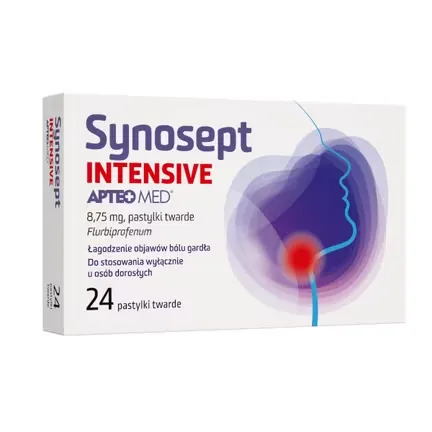
Table of Contents
Package leaflet: Information for the patient
Synosept INTENSIVE APTEO MED, 8.75 mg, hard tablets
Flurbiprofen
Please read all of this leaflet carefully before taking this medicine, because it contains
important information for you.
- Keep this leaflet, as you may need to read it again.
- If you have any further questions, please consult your doctor, pharmacist, or nurse.
- This medicine has been prescribed for you personally. Do not pass it on to others. It may harm someone else, even if their symptoms are the same as yours.
- If you experience any adverse reactions, including any not listed in this leaflet, inform your doctor, pharmacist, or nurse. See section 4.
- If there is no improvement after three days, or if you feel worse, you should contact your doctor.
Table of contents
- What Synosept is and what it is used for
- What you need to know before taking Synosept
- How to take Synosept
- Possible side effects
- How to store Synosept
- Contents of the pack and other information
1. What Synosept is and what it is used for
Synosept hard tablets contain flurbiprofen as the active substance. Flurbiprofen
belongs to a group of medicines called non-steroidal anti-inflammatory drugs (NSAIDs).
Synosept has analgesic and anti-inflammatory properties in the treatment of sore throat.
Synosept is indicated for the short-term relief of sore throat symptoms, such as throat pain and swelling, and difficulty in swallowing, in adults.
2. Important information before using Synosept
When not to use Synosept:
- If the patient is allergic to flurbiprofen or any of the other ingredients of this medicine (listed in section 6).
- If the patient has experienced asthma, unexpected wheezing or breathing difficulties, runny nose, facial swelling, or itchy skin rash (urticaria) after taking acetylsalicylic acid or any other medicine in the NSAID group.
- If the patient currently has or has previously had a peptic ulcer (two or more episodes of stomach or duodenal ulcer).
- If the patient has experienced gastrointestinal bleeding or perforation, severe colitis, or blood disorders after using another medicine from the NSAID group.
- If the patient is in the last trimester of pregnancy.
- If the patient currently has or has previously had severe heart, liver, or kidney failure.
Warnings and precautions
Before starting to use Synosept, consult a doctor:
- if the patient has or has ever had asthma or any allergy,
- if the patient is elderly (may be more susceptible to adverse effects),
- if the patient has a chronic autoimmune disease (including systemic lupus erythematosus or mixed connective tissue disease),
- if the patient has tonsillitis or suspects a bacterial throat infection (which may require antibiotic treatment),
- if the patient has heart, kidney, or liver disease,
- in patients who have previously suffered a stroke,
- in patients with high blood pressure,
- if the patient has previously had intestinal disorders (such as ulcerative colitis or Crohn's disease),
- if the patient suffers from medication-overuse headache,
- if the patient is in the first or second trimester of pregnancy,
- if the patient develops an infection – see section “Infections” below.
Infections
Non-steroidal anti-inflammatory drugs (NSAIDs) may mask symptoms of infection such as fever and pain. This may delay appropriate treatment of infections, potentially increasing the risk of complications. If the patient takes this medicine during an ongoing infection and symptoms persist or worsen, immediate consultation with a doctor or pharmacist is necessary.
While using Synosept:
- At the first signs of any hypersensitivity reaction (rash, skin peeling) or other allergic symptoms, discontinue use immediately and consult a doctor.
- Report any unusual abdominal symptoms (especially bleeding) to a doctor.
- If there is no improvement in the patient's condition or new symptoms appear, consult a doctor.
- Medicines such as flurbiprofen may slightly increase the risk of heart attack (myocardial infarction) or stroke. The risk is higher with higher doses or prolonged treatment. Do not exceed the recommended dose or duration of treatment (see section 3).
Children and adolescents
This medicine is not intended for use in children and adolescents under 18 years of age.
Synosept and other medicines
Inform the doctor about all medicines currently taken or recently used, including those available without prescription. In particular, before taking Synosept, inform the doctor or pharmacist if the patient is taking any of the following medicines:
- low-dose acetylsalicylic acid (up to 75 mg per day)
- medicines for high blood pressure or heart failure (antihypertensives, cardiac glycosides)
- medicines regulating fluid balance (diuretics, including potassium-sparing diuretics)
- blood-thinning medicines (anticoagulants, antiplatelet agents)
- medicines for gout (probenecid, sulfinpyrazone)
- other NSAIDs or corticosteroids – avoid concomitant use of Synosept with other NSAIDs (such as celecoxib, ibuprofen, diclofenac, acetylsalicylic acid in doses above 75 mg) or corticosteroids (such as prednisolone), as this may increase the risk of adverse effects, especially gastrointestinal ulcers and bleeding
- mifepristone (a medicine used to terminate pregnancy)
- quinolone antibiotics (such as ciprofloxacin)
- cyclosporine or tacrolimus (medicines used to suppress the immune system)
- phenytoin (a medicine used to treat epilepsy)
- methotrexate (a medicine used to treat autoimmune diseases or cancers)
- lithium or selective serotonin reuptake inhibitors (medicines for depression)
- oral antidiabetic medicines (medicines used to treat diabetes)
- zidovudine (a medicine used in HIV infection)
Synosept and alcohol
| Alcohol should be avoided | during treatment with this medicine | because it may increase the risk of gastrointestinal bleeding. |
| because it may increase the risk of gastrointestinal bleeding. | ||
Pregnancy, breastfeeding and fertility
If the patient is pregnant or breastfeeding, suspects she may be pregnant, or is planning to become pregnant, she should consult a doctor or pharmacist before using this medicine.
Pregnancy
Do not take Synopsept during the last three months of pregnancy.
Do not use Synosept during the first six months of pregnancy unless absolutely necessary and prescribed by a doctor. If treatment is required during this period, the lowest effective dose should be used for the shortest possible duration. Oral formulations (e.g. tablets) of flurbiprofen may cause adverse effects in the unborn child. It is unknown whether the same risk applies to Synopsept.
Breastfeeding
Flurbiprofen passes into breast milk in very small amounts and is unlikely to adversely affect the breastfed infant. However, due to the possibility of adverse effects in infants, the use of Synosept is not recommended in breastfeeding women.
Fertility
Flurbiprofen belongs to a group of medicines that may adversely affect female fertility. This effect is reversible upon discontinuation of the drug. It is unlikely that occasional use of Synosept will affect the chances of becoming pregnant. However, patients who have difficulties conceiving should inform their doctor before using this medicine.
Driving and operating machinery
It is unknown whether Synosept affects the ability to drive or operate machinery. However, dizziness and visual disturbances are possible adverse effects associated with NSAIDs. If such symptoms occur, patients should not drive or operate machinery.
Synosept contains isomalt (E 953) and maltitol (E 965)
If the patient has previously been diagnosed with intolerance to certain sugars, she should consult her doctor before taking this medicine.
Synosept contains carmine red (E 124) and sunset yellow (E 110)
This medicine may cause allergic reactions.
3. How to use Synosept
Synosept must always be used exactly as described in this patient leaflet, or as directed by a doctor or pharmacist. If in doubt, consult a doctor or pharmacist.
Synosept is intended for adults.
Recommended dose:
One hard lozenge every 3 to 6 hours as needed.
The lozenge should be sucked slowly. While sucking, move the lozenge around the mouth to avoid local irritation.
Do not use more than 5 hard lozenges per day.
Synosept is intended for short-term use only.
Use the lowest effective dose for the shortest duration necessary to relieve symptoms. If the patient has an infection, consult a doctor or pharmacist immediately if symptoms (such as fever and pain) persist or worsen (see section 2).
Treatment with Synosept should not last longer than 3 days.
If symptoms do not improve or new symptoms occur despite taking the medicine, consult a doctor or pharmacist. If irritation of the mouth occurs, discontinue treatment with flurbiprofen.
Taking more than the recommended dose of Synosept
If more Synosept has been taken than recommended, contact a doctor immediately or go to the nearest hospital.
| Signs | of overdose | may include: malaise or nausea, abdominal pain, or, less commonly, |
| diarrhea. Tinnitus, headache, and gastrointestinal bleeding are also possible. | ||
| gastrointestinal tract. | ||
If you have any further doubts regarding the use of this medicine, you should consult your doctor or pharmacist.
Missed dose of Synosept
Do not take a double dose to make up for a missed dose.
4. Possible adverse reactions
Like all medicines, this medicine can cause adverse reactions, although not everyone will experience them.
You should stop taking the medicine and contact your doctor immediately if any of the
following symptoms occur:
- symptoms of allergic reactions such as asthma, unexplained wheezing or shortness of breath, itching, nasal mucosal inflammation, skin rashes and others;
- swelling of the face, tongue or throat causing difficulty in breathing, rapid heartbeat and drop in blood pressure leading to shock (these may occur even after the first use of the medicine);
- severe skin reactions such as skin peeling, blister formation.
If any of the following symptoms or unlisted adverse reactions occur, consult your doctor or pharmacist.
Adverse reactions that may occur:
Common (may affect up to 1 in 10 people):
- dizziness, headache;
- throat irritation;
- mouth ulcers or mouth pain;
- sore throat;
- discomfort or unusual sensations in the mouth (such as warmth, burning, tingling, pricking, etc.);
- nausea and diarrhoea;
- skin pricking and itching.
Uncommon (may affect up to 1 in 100 people):
- drowsiness or difficulty sleeping;
- worsening of asthma, wheezing, breathing difficulties;
- mouth blisters, throat numbness;
- dryness in the mouth;
- burning sensation in the mouth, altered taste sensation, abdominal bloating;
- abdominal pain, flatulence, constipation, indigestion, vomiting;
- throat hypoaesthesia;
- fever, pain;
- skin rashes, skin itching.
Rare (may affect up to 1 in 1000 people):
- anaphylactic reaction.
Frequency not known (frequency cannot be estimated from available data):
- anaemia, thrombocytopenia (low platelet count in the blood, which may cause bruising and bleeding);
- oedema, high blood pressure, heart failure or heart attack;
- severe forms of skin reactions, such as blistering reactions, including Stevens-Johnson syndrome, Lyell's syndrome and toxic epidermal necrolysis;
- hepatitis.
Reporting of adverse reactions
If any adverse reactions occur, including any adverse reactions not listed in this leaflet, inform your doctor, pharmacist, or nurse. Adverse reactions can be reported directly to the Department of Monitoring Adverse Drug Reactions, Office for Registration of Medicinal Products, Medical Devices and Biocidal Products, Al. Jerozolimskie 181C, 02-222 Warsaw,
Tel.: +48 22 49 21 301
Fax: +48 22 49 21 309
Website: https://smz.ezdrowie.gov.pl
Adverse reactions can also be reported to the marketing authorisation holder.
Reporting adverse reactions helps to provide more information on the safety of the medicine.
5. How to store Synosept medicine
No special storage instructions are required for this medicine.
The medicine should be stored out of sight and reach of children.
Do not use this medicine after the expiry date stated on the carton and blister pack after "EXP". The expiry date refers to the last day of the stated month.
Medicines should not be disposed of via wastewater or household waste. Ask your pharmacist how to dispose of medicines no longer required. Such measures help protect the environment.
6. Contents of the pack and other information
What Synosept contains
- The active substance is flurbiprofen. Each hard tablet contains 8.75 mg of flurbiprofen.
- Other ingredients are: isomalt (E 953), maltitol liquid (E 965), cochineal red (E 124), orange yellow (E 110), potassium acesulfame, macrogol 300, potassium hydroxide, orange flavour (containing: limonene, decanal, citral, citronellol), levomenthol.
What Synosept looks like and contents of the pack
Synosept 8.75 mg, hard tablets are orange, round hard tablets with a diameter of 19 ± 1 mm.
The hard tablets are available in PVDC/PVC/Aluminium blisters containing 24 tablets, packed in a cardboard box.
Marketing Authorisation Holder
Synoptis Pharma Sp. z o.o.
Krakowiaków Street 65
02-255 Warsaw
Tel.: 22 321 62 40
Manufacturer
LOZY’S PHARMACEUTICALS, S.L.
Campus Empresarial no. 1
Lekaroz, 31795 Navarra
Spain